



















NASA’s Chandra Captures a Distant Quasar Growing at Record Speed
Sep 22, 2025
Soumyadeep Mukherjee
Soumyadeep Mukherjee is an award-winning astrophotographer from India. He has a doctorate degree in Linguistics. His work extends to the sub-genres of nightscape, deep sky, solar, lunar and optical phenomenon photography. He is also a photography educator and has conducted numerous workshops. His works have appeared in over 40 books & magazines including Astronomy, BBC Sky at Night, Sky & Telescope among others, and in various websites including National Geographic, NASA, Forbes. He was the first Indian to win “Astronomy Photographer of the Year” award in a major category.
Share:

Astronomy is often compared to photography on a grand scale. Instead of photography lenses, scientists use telescopes that capture light invisible to our eyes. Instead of landscapes or portraits, they record entire galaxies and black holes across billions of light-years. The latest example is a breathtaking find by NASA’s Chandra X-ray Observatory, which has revealed a quasar called RACS J0320-35.
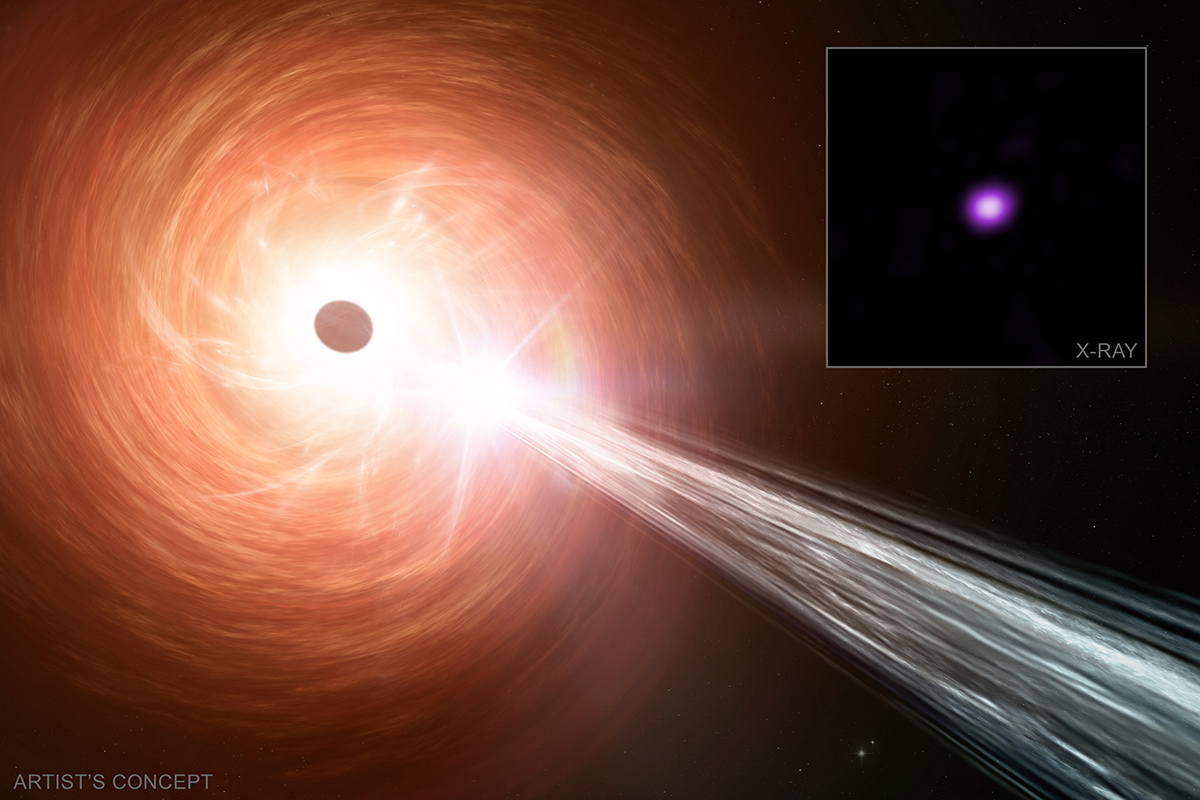
This quasar is remarkable for its distance, about 12.8 billion light-years, and also for the way it is growing. Chandra’s images show that the black hole powering the quasar is feeding at more than twice the expected limit, giving us a rare glimpse into how some of the earliest monsters in the universe came to be.
A cosmic photograph from 12.8 billion light-years away
When we talk about distance in astronomy, we are also talking about time. Light takes billions of years to travel, so the image of RACS J0320-35 that Chandra recorded shows the quasar as it was about 920 million years after the Big Bang. That makes it a true time capsule, one of the earliest portraits of a black hole caught in the act of rapid growth.
The quasar first appeared in a radio survey, a kind of sky-wide photo taken at long wavelengths. Once scientists knew where to look, they used Chandra to zoom in with X-ray vision. Just as a photographer switches from wide shots to close-ups to capture details, astronomers use different telescopes to reveal different layers of cosmic objects.
For RACS J0320-35, the X-ray image was the key. X-rays come from the hottest and most extreme regions around the black hole, where matter spirals in before crossing the point of no return. Chandra’s sensitive detectors captured that glow and helped measure the intensity of the feeding process.

Understanding the Eddington limit
To appreciate why this discovery is important, imagine photographing a candle in the wind. At some point, the flame pushes back against the air and flickers out. Black holes have a similar limit when they feed. The radiation from falling matter should, in theory, push back against more material trying to enter. That natural balance is called the Eddington limit.
But RACS J0320-35 breaks this rule. Chandra’s observations show it is accreting at about 2.4 times the Eddington limit. In photographic terms, it is like capturing a long-exposure image where the brightness keeps increasing far beyond what you expect. The result is a scene so bright and energetic that it challenges the settings you thought were fixed.
The quasar
Quasars are among the brightest objects in the universe. If you could somehow place RACS J0320-35 in our own galaxy, it would outshine every star in the night sky. Its light comes not from the black hole itself, which is invisible, but from the heated gas and dust swirling around it.
For astronomers, each quasar is like a cosmic beacon that can be photographed across the spectrum: radio, infrared, optical, ultraviolet, and X-ray. Each wavelength adds another layer of detail, just like combining color channels in advanced photography. In this case, the radio image showed the quasar’s position; the optical and infrared images gave its distance, and the X-ray image from Chandra revealed how much energy the black hole was releasing. Together, these frames built a complete portrait.
Capturing jets and cosmic motion
One of the most striking features of RACS J0320-35 is its jets. These are beams of charged particles shot out from the regions near the black hole at nearly the speed of light. In photographs taken at radio wavelengths, the jets appear as bright streaks extending from the quasar’s core.
For anyone who enjoys photographing natural light phenomena, like auroras, lightning, or even fireworks, the scale here is mind-blowing. These cosmic jets stretch across thousands of light-years and glow with energy far beyond anything on Earth. Yet they play a role in the story. By carrying energy away, the jets may actually allow the black hole to keep feeding at such a high rate without choking itself off.
Importance of the discovery
You don’t need to be an astrophysicist to appreciate the significance of this discovery. For anyone who enjoys astrophotography, the story of RACS J0320-35 is an example of the power of capturing light. Whether it is the faint glow of a nebula in your backyard telescope or the ancient X-rays caught by Chandra, the principle is the same: light carries information, and images reveal stories.
RACS J0320-35 is a quasar that defies limits. It feeds at a rate far above what theory once allowed. It shoots jets across cosmic distances. For photographers and sky watchers alike, this discovery highlights the ultimate goal of photography: to capture moments that matter. In this case, the “moment” is from a time when the first black holes were shaping galaxies. And the image is a record of light, preserved across the universe.
Clear skies!
See more from DIYPhotography.net on Google
Add DIYPhotography.net as a trusted source. This makes
our stories more likely to appear in your Google Search results.
 Add as a preferred source on Google

Soumyadeep Mukherjee
Soumyadeep Mukherjee is an award-winning astrophotographer from India. He has a doctorate degree in Linguistics. His work extends to the sub-genres of nightscape, deep sky, solar, lunar and optical phenomenon photography. He is also a photography educator and has conducted numerous workshops. His works have appeared in over 40 books & magazines including Astronomy, BBC Sky at Night, Sky & Telescope among others, and in various websites including National Geographic, NASA, Forbes. He was the first Indian to win “Astronomy Photographer of the Year” award in a major category.

Join the Discussion
DIYP Comment Policy
Be nice, be on-topic, no personal information or flames.