


























A Baby Planet under Fire: Chandra Photographs a Shrinking Exoplanet
Aug 24, 2025
Soumyadeep Mukherjee
Soumyadeep Mukherjee is an award-winning astrophotographer from India. He has a doctorate degree in Linguistics. His work extends to the sub-genres of nightscape, deep sky, solar, lunar and optical phenomenon photography. He is also a photography educator and has conducted numerous workshops. His works have appeared in over 40 books & magazines including Astronomy, BBC Sky at Night, Sky & Telescope among others, and in various websites including National Geographic, NASA, Forbes. He was the first Indian to win “Astronomy Photographer of the Year” award in a major category.
Share:
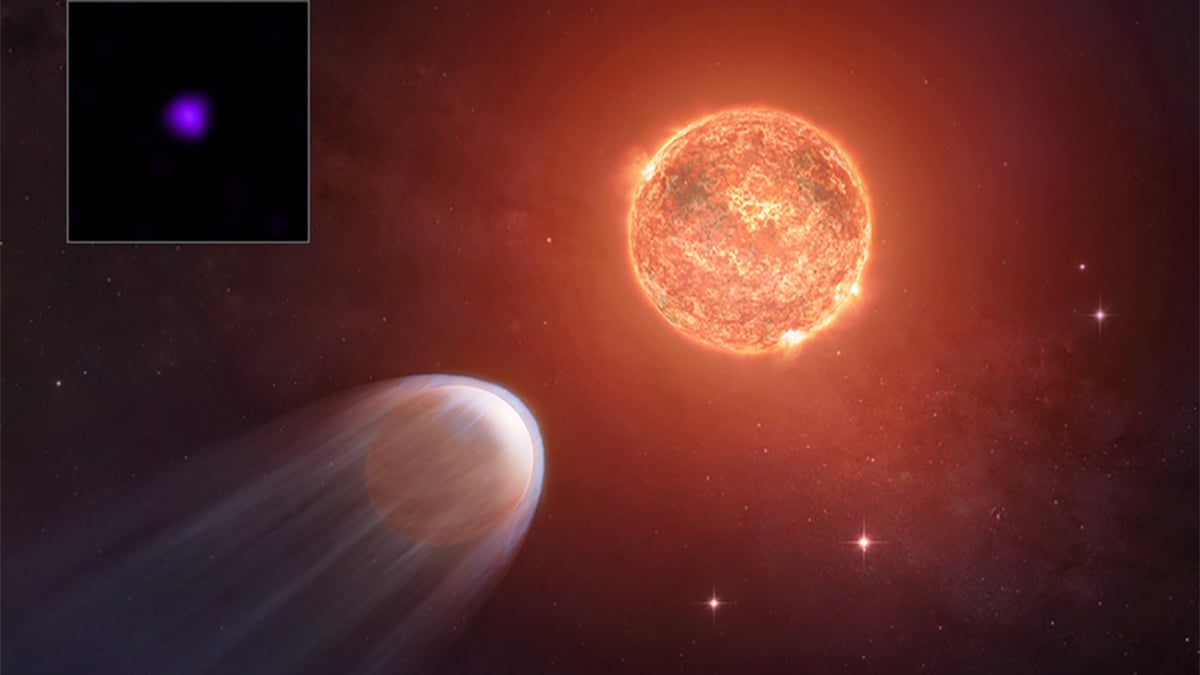
Astronomers have caught a planet in the act of growing smaller. The world is TOI 1227 b, a gas giant only about eight million years old. That makes it a true infant by cosmic standards. Researchers used NASA’s Chandra X-ray Observatory to measure intense radiation from its small red-dwarf star. Those X-rays are stripping the planet’s atmosphere at a striking pace. The team concludes the planet will not stay Jupiter-sized for long. Over time, it should contract into a far smaller, barren world.
TOI 1227 b and its star
TOI 1227 b circles a cool, faint red dwarf about 330 light-years from Earth, in the southern constellation Musca. The star has roughly a tenth of the Sun’s mass. In visible light, it looks modest, but in X-rays, it is fierce. The planet itself is puffed up to a size like Jupiter’s. Yet its mass is likely nearer to Neptune’s, which hints at a low-density, balloon-like atmosphere. The system is young enough that we are watching a planet in its early evolution, not a finished product. This youth also makes it one of the youngest transiting exoplanets ever measured.

Orbit and size
TOI 1227 b passes in front of its star from our point of view. That “transit” geometry lets scientists track its size and period precisely. Data in NASA’s exoplanet catalog show the planet completes one orbit in about 27.4 days. It travels at roughly 0.09 astronomical units from the star, far closer than Mercury is to our Sun. The catalog lists a mass estimate of approximately 0.209 Jupiter masses, although the true mass remains uncertain due to the young star’s activity, which muddies precise measurements. The planet’s discovery was first announced in 2022 after observations by NASA’s Transiting Exoplanet Survey Satellite (TESS) and follow-up work by the THYME collaboration.
What Chandra measured
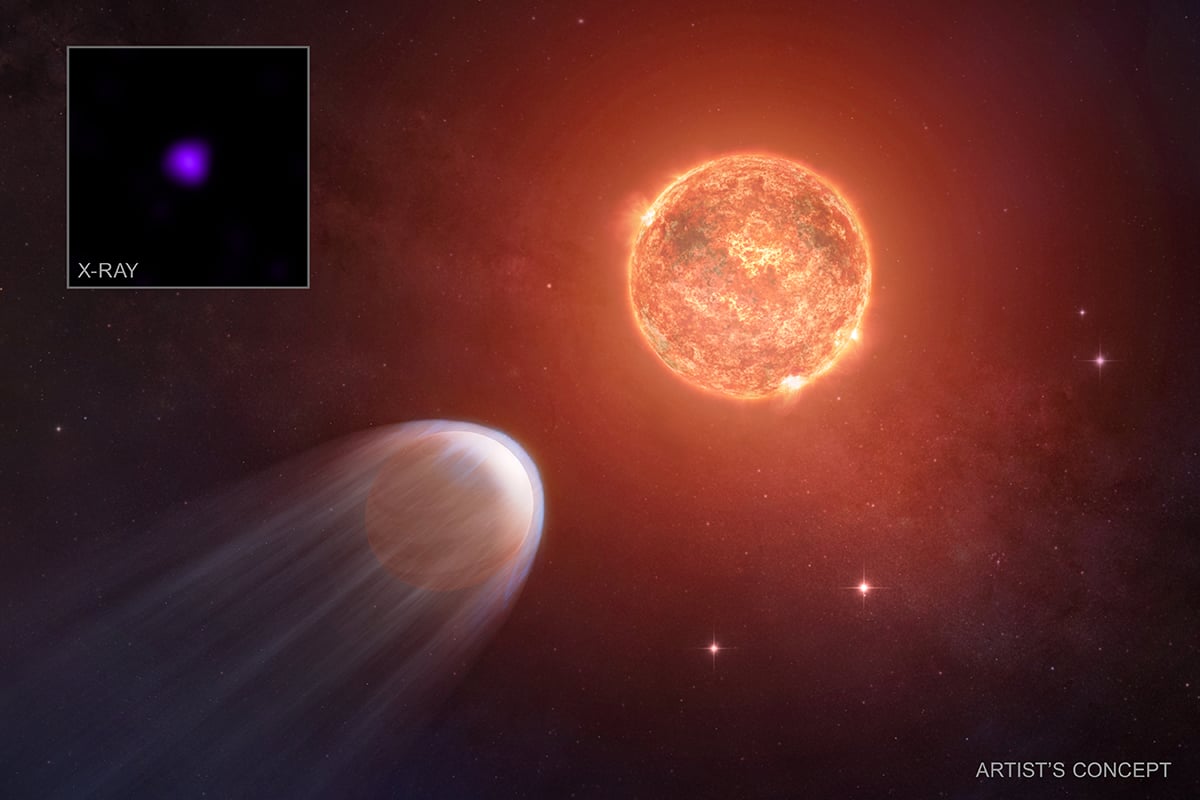
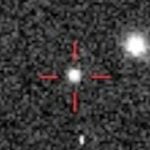
Chandra observed the star with its High Resolution Camera (HRC). The team measured the number of X-rays the star emits and the amount of that energy that impacts the nearby planet. Those data feed into models of atmospheric escape. The result is sobering for TOI 1227 b’s future. The planet is currently losing atmospheric gas at a rate comparable to the mass of Earth’s entire atmosphere every two centuries. Over a billion years, the cumulative loss could reach about two Earth masses. The new analysis revises the system’s age downward from earlier estimates of 11 million years to a best value near eight million years. That younger age explains why the planet appears so inflated.
How a planet shrinks under X-ray assault
High-energy radiation heats the upper atmosphere of a planet. Gas expands, becomes less bound by gravity, and begins to flow away into space. Astronomers call this “photoevaporation.” The process depends on both the energy input and the planet’s gravity. A young, low-mass, puffy planet is especially vulnerable. TOI 1227 b checks all those boxes. It is close to its active star. It is bathed in X-rays and likely ultraviolet light. And its gravity is modest for its size because much of its bulk is a swollen, hot envelope rather than dense rock or ice.
The Chandra team used standard atmospheric escape models to connect the observed X-ray flux to actual mass-loss rates. The conclusion is consistent across methods. The world is shedding gas fast enough to change its future. As the envelope escapes, the planet will cool and contract. Its radius will drop. The star’s pummeling will continue for hundreds of millions of years, because red dwarfs stay active for a long time. Taken together, the planet’s size and mass should drift toward the sub-Neptune or even super-Earth regime. In the most extreme scenario, only a rocky core could remain.
TOI 1227 b helps answer a nagging question in exoplanet science. Why are large, close-in gas giants rare around small stars, while small, rocky planets are common? One strong answer is that many close-in planets do not start small. They start puffy and hot, with thick gas envelopes. Young stars then remove those envelopes with X-rays and ultraviolet light. Over time, cores remain. Surveys with Kepler and TESS have mapped a “radius valley” that likely records this stripping process. TOI 1227 b shows that process in real time.
Clear skies!
See more from DIYPhotography.net on Google
Add DIYPhotography.net as a trusted source. This makes
our stories more likely to appear in your Google Search results.
 Add as a preferred source on Google

Soumyadeep Mukherjee
Soumyadeep Mukherjee is an award-winning astrophotographer from India. He has a doctorate degree in Linguistics. His work extends to the sub-genres of nightscape, deep sky, solar, lunar and optical phenomenon photography. He is also a photography educator and has conducted numerous workshops. His works have appeared in over 40 books & magazines including Astronomy, BBC Sky at Night, Sky & Telescope among others, and in various websites including National Geographic, NASA, Forbes. He was the first Indian to win “Astronomy Photographer of the Year” award in a major category.



Join the Discussion
DIYP Comment Policy
Be nice, be on-topic, no personal information or flames.