


























Festival in Space: Chandra’s Four Holiday Images Released
Jan 1, 2026
Soumyadeep Mukherjee
Soumyadeep Mukherjee is an award-winning astrophotographer from India. He has a doctorate degree in Linguistics. His work extends to the sub-genres of nightscape, deep sky, solar, lunar and optical phenomenon photography. He is also a photography educator and has conducted numerous workshops. His works have appeared in over 40 books & magazines including Astronomy, BBC Sky at Night, Sky & Telescope among others, and in various websites including National Geographic, NASA, Forbes. He was the first Indian to win “Astronomy Photographer of the Year” award in a major category.
Share:
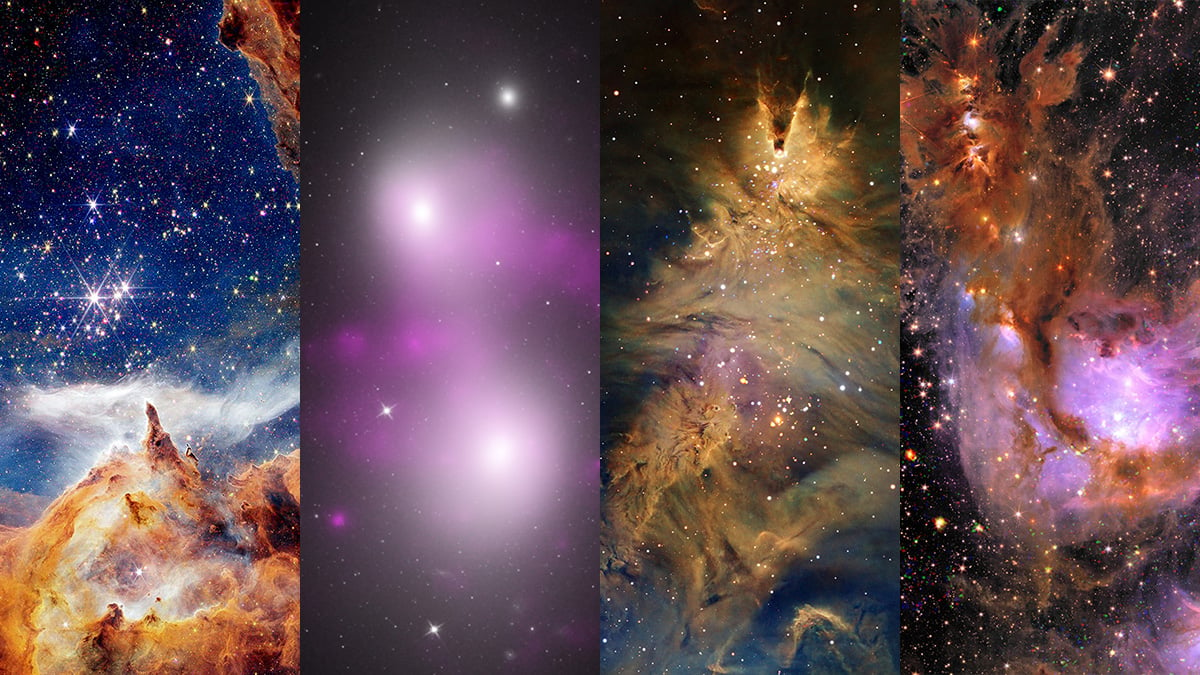
High-energy astrophysics rarely reaches the public in an intuitive visual form. X-ray astronomy deals with extreme temperatures, violent interactions, and invisible radiation. Yet every December, NASA’s Chandra X-ray Observatory demonstrates how rigorous science and clear visual communication can coexist. The 2025 Chandra Holiday Image Collection continues this tradition. It presents four astrophysical targets observed across multiple wavelengths and processed into scientifically accurate composite images.
These are data-driven representations created from years of observations. Chandra’s X-ray measurements trace hot plasma, shocks, and energetic stellar activity. Optical and infrared data from space-based observatories add structural and environmental context. Together, these datasets reveal how galaxies interact, how stars form, and how radiation shapes the interstellar medium.
This release focuses on four regions that carry seasonal nicknames. However, the naming remains secondary. The primary goal is to highlight core astrophysical processes. Each object in the collection represents a distinct regime of cosmic physics, from galaxy-scale interactions to localized star formation. When viewed together, they form a coherent narrative of how energy moves through the universe.
Framing a seasonal release through multi-wavelength science
NASA and the Chandra X-ray Center have long emphasized multi-wavelength astronomy. No single band of light can describe complex astrophysical systems. X-rays trace the hottest components. Optical light reveals stellar populations. Infrared data exposes dust-enshrouded regions. The 2025 holiday collection deliberately integrates all three.
Each image combines calibrated datasets from space telescopes operating at different wavelengths. Scientists align these datasets spatially and scale them physically. Color assignments reflect energy ranges rather than aesthetic preference. As a result, the final images preserve scientific meaning while remaining visually accessible.
This approach also reflects how professional astronomers study the universe. Researchers rarely analyze data from one observatory in isolation. Instead, they combine information to test physical models. The holiday release mirrors that workflow in a public-facing format.
The Snowman galaxies and the energetics of galaxy interactions
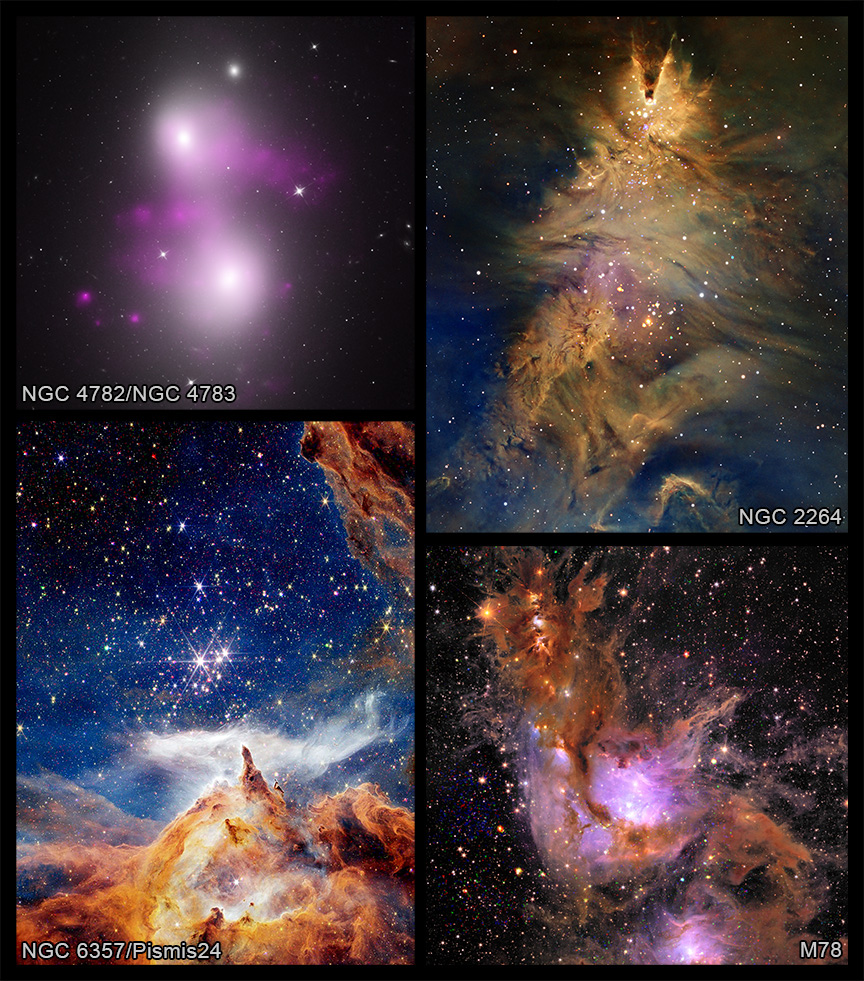
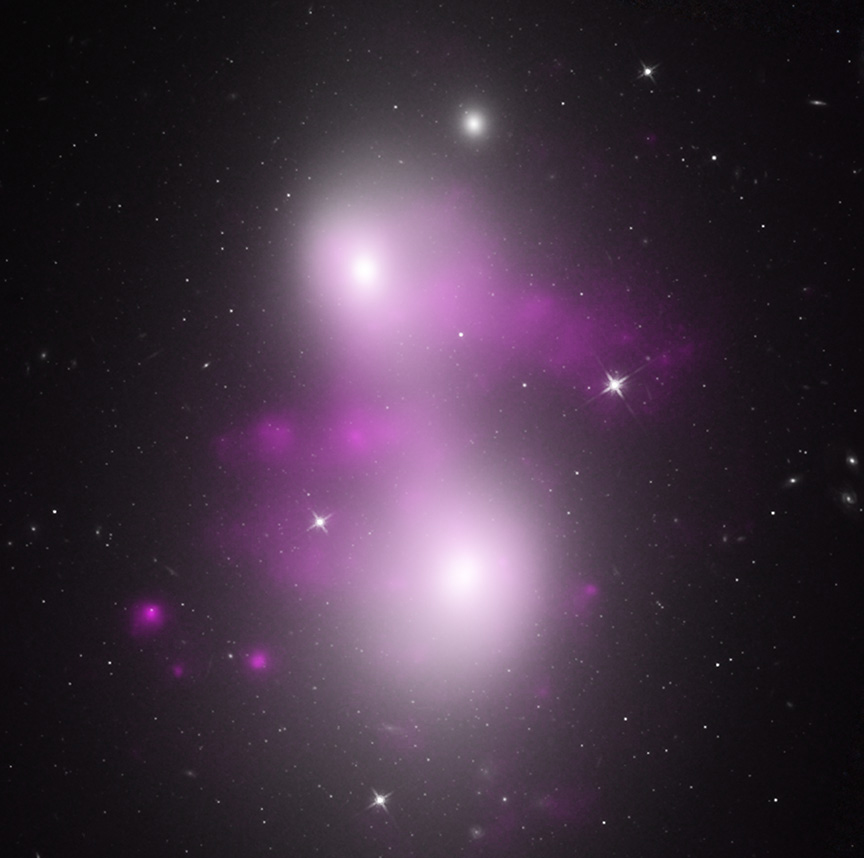
The first image features the interacting galaxies NGC 4782 and NGC 4783. Located roughly 210 million light-years away, this system offers a clear example of gravitational interaction between massive galaxies. In optical light, the galaxies appear as two luminous ellipses. Their apparent alignment creates a snowman-like silhouette.
However, the defining feature emerges in X-rays. Chandra reveals a stream of hot gas connecting the two galaxies. This gas reaches temperatures of several million degrees. Such temperatures indicate strong shocks and compression. These conditions arise when galaxies move through surrounding intragroup gas at high velocities.
The X-ray bridge traces the interaction history of the system. It shows where gas has been stripped, heated, and displaced. Optical data from the Hubble Space Telescope complements this view by mapping stellar distributions and dust lanes. Together, the datasets demonstrate how galaxy interactions redistribute both visible and invisible matter.
Astronomers study systems like NGC 4782 and NGC 4783 to understand how galaxies evolve. Mergers and close encounters drive star formation, fuel central black holes, and reshape galactic structure. The Snowman Galaxies provide a nearby laboratory for these processes.
NGC 2264 and the high-energy signatures of young stars
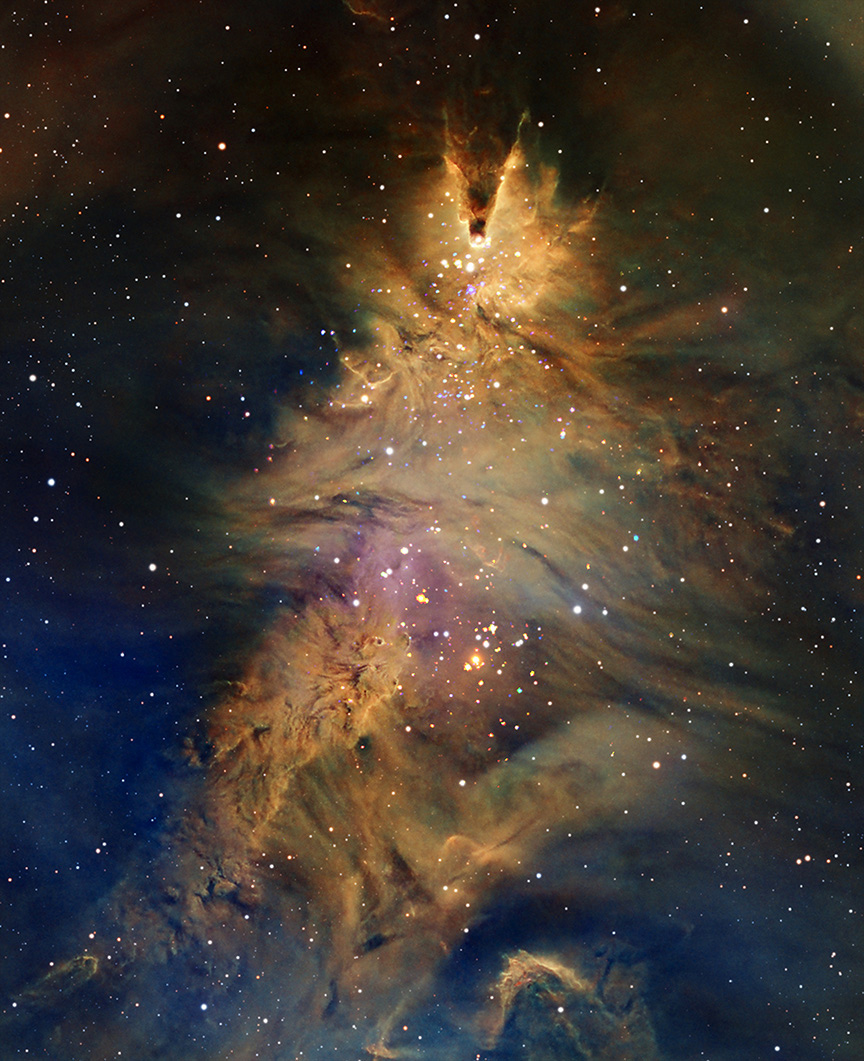
The upper portion of the collection features NGC 2264, commonly known as the Christmas Tree Nebula. This region lies about 2,500 light-years from Earth and represents an active site of star formation. Optical images show filamentary gas structures shaped by radiation and winds from young stars.
X-ray observations add a crucial dimension. Young stars emit strong X-rays due to magnetic activity and rapid rotation. Chandra detects hundreds of such sources across the NGC 2264 region. In the composite image, these sources appear as concentrated points of high-energy emission.
Additional X-ray data from ESA’s XMM-Newton observatory improve sensitivity to fainter sources. Infrared observations reveal protostars still embedded in dust. These stars remain invisible in optical light. The combined data, therefore, traces stellar evolution across multiple stages.
NGC 2264 allows researchers to study how clusters form and disperse. It also reveals how radiation from young stars influences the surrounding gas. This feedback determines whether additional stars can form. As a result, regions like this play a central role in understanding galactic star formation rates.
NGC 6357 and the impact of massive stellar feedback
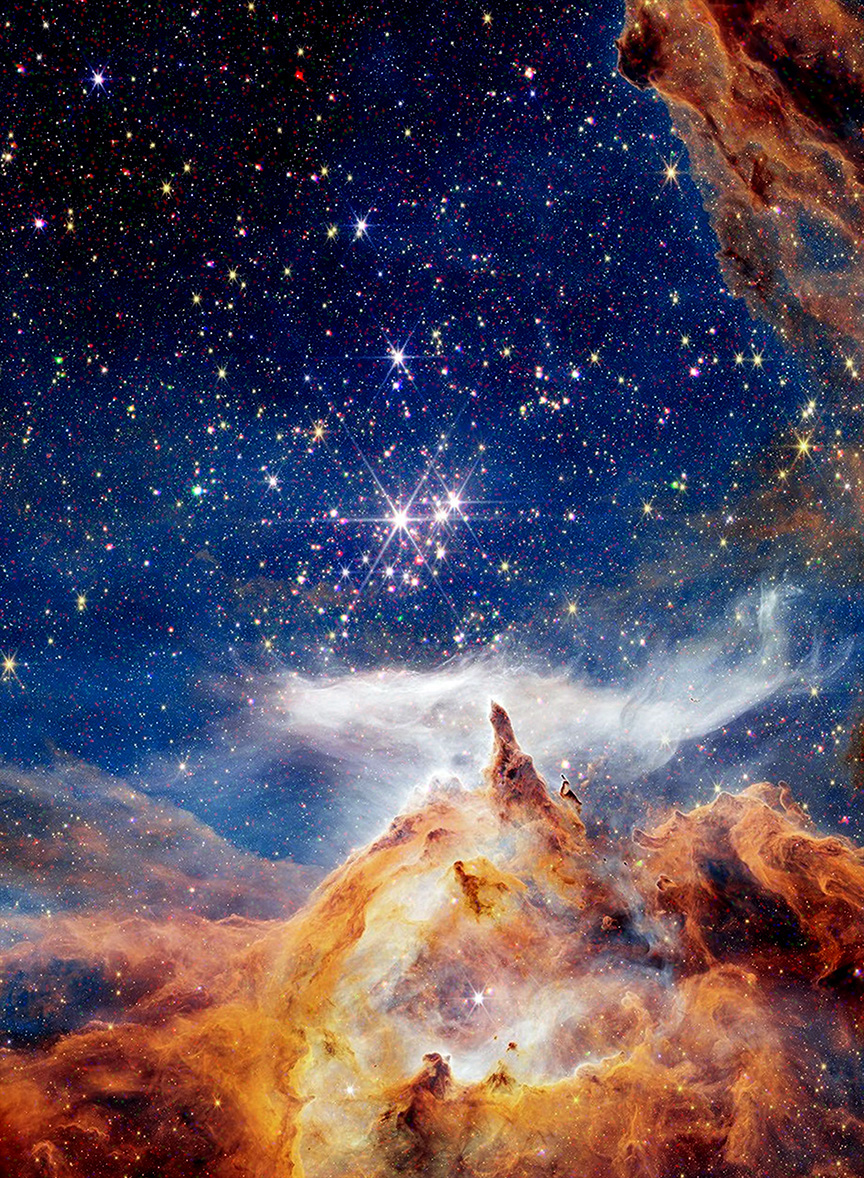
One of the most physically extreme regions in the collection is NGC 6357, which hosts the young cluster Pismis 24. Located approximately 5,500 light-years away, this nebula contains some of the most massive stars known in the Milky Way.
Infrared observations from the James Webb Space Telescope show dense dust structures carved into complex shapes. These shapes result from intense ultraviolet radiation emitted by massive stars. Stellar winds further erode the surrounding material. These processes operate continuously and reshape the nebula over short astronomical timescales.
Chandra’s X-ray data reveals the energetic core of this activity. It traces shock-heated plasma produced by colliding winds and stellar outflows. These X-ray sources mark regions where mechanical energy converts into heat. Such feedback influences whether gas clouds collapse or disperse.
NGC 6357 demonstrates how massive stars dominate their environments. Their influence extends far beyond their immediate surroundings. Understanding this feedback helps astronomers model star formation in both local and distant galaxies.
M78 and the subtle physics of dust and radiation
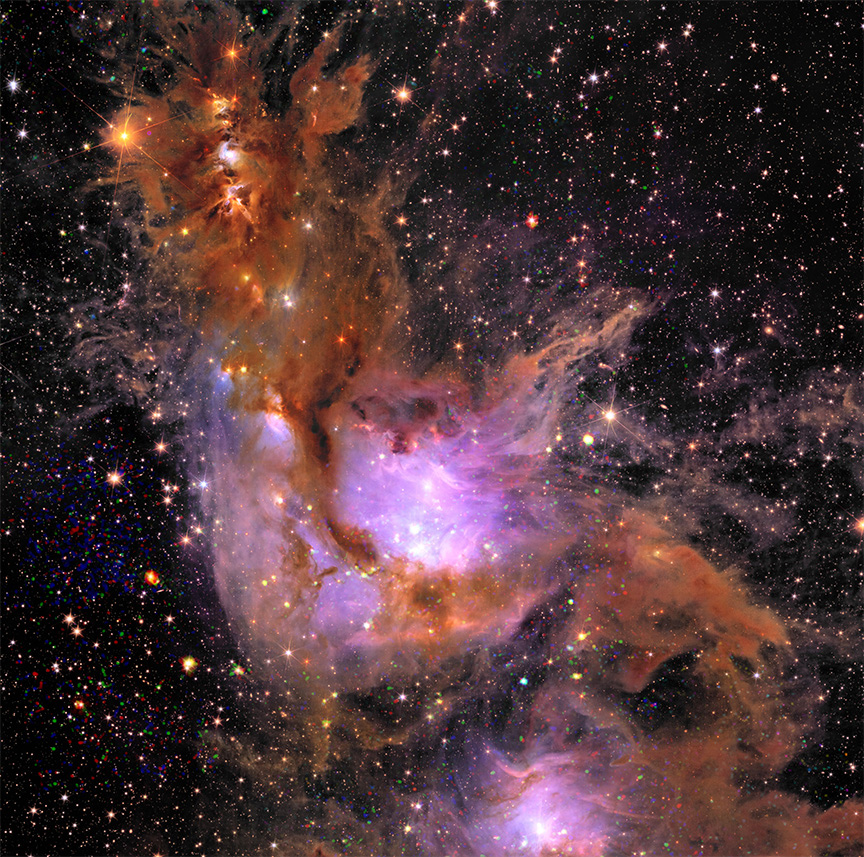
The final image focuses on M78, a reflection nebula located in the constellation Orion. At a distance of roughly 1,600 light-years, M78 serves as a nearby example of how dust interacts with starlight. Unlike emission nebulae, reflection nebulae shine by scattering light from nearby stars.
Optical and infrared data from ESA’s Euclid mission reveal fine dust structures and embedded stars. These observations show how dust grains preferentially scatter shorter wavelengths of light. This scattering gives M78 its characteristic appearance.
Chandra adds X-ray context by identifying young stellar objects within the nebula. These stars remain partially hidden behind dust. X-rays penetrate these regions more effectively than optical light. As a result, astronomers can locate and characterize embedded sources.
M78 helps refine models of interstellar dust. Dust plays a critical role in star formation and radiative transfer. Reflection nebulae, therefore, provide essential constraints on how light propagates through galaxies.
The role of Chandra in modern astronomy
Since its launch in 1999, the Chandra X-ray Observatory has transformed high-energy astrophysics. It has provided detailed views of black holes, supernova remnants, and galaxy clusters. Its angular resolution remains unmatched in X-ray astronomy. Even after decades in orbit, the observatory delivers high-quality data. It also demonstrates how archival observations gain new value when combined with modern missions like JWST and Euclid.
Although presented as a seasonal collection, the 2025 Chandra holiday images form a coherent scientific narrative. Each object illustrates a different scale of astrophysical energy transfer. Galaxies interact and heat the surrounding gas. Young stars inject energy into their birth clouds. Massive stars dominate nebular environments. Dust moderates the flow of radiation. Every feature corresponds to a measured physical quantity. At the same time, the careful presentation makes these processes accessible without oversimplification.
NASA’s Chandra holiday release, therefore, serves a dual purpose. It engages a broad audience. It also shows how professional astronomers interpret the universe. Through these images, the high-energy universe becomes both visible and understandable, without sacrificing scientific rigor.
Clear skies!
See more from DIYPhotography.net on Google
Add DIYPhotography.net as a trusted source. This makes
our stories more likely to appear in your Google Search results.
 Add as a preferred source on Google

Soumyadeep Mukherjee
Soumyadeep Mukherjee is an award-winning astrophotographer from India. He has a doctorate degree in Linguistics. His work extends to the sub-genres of nightscape, deep sky, solar, lunar and optical phenomenon photography. He is also a photography educator and has conducted numerous workshops. His works have appeared in over 40 books & magazines including Astronomy, BBC Sky at Night, Sky & Telescope among others, and in various websites including National Geographic, NASA, Forbes. He was the first Indian to win “Astronomy Photographer of the Year” award in a major category.
Related Posts
 Festival organisers blow millions on Instagram posts and marketing leaving no budget for the festival itself
 Apollo Mission Images Released, And They Are Out Of This World!
 Spring in Space: Chandra’s X-ray Views of Six Stellar Nurseries
 Unsplash has released over 2 million images in a new massive open source dataset
Join the Discussion
DIYP Comment Policy
Be nice, be on-topic, no personal information or flames.