




















ESA and NOAA Warn of a Severe Geomagnetic Storm: Aurora Alert
Nov 12, 2025
Soumyadeep Mukherjee
Soumyadeep Mukherjee is an award-winning astrophotographer from India. He has a doctorate degree in Linguistics. His work extends to the sub-genres of nightscape, deep sky, solar, lunar and optical phenomenon photography. He is also a photography educator and has conducted numerous workshops. His works have appeared in over 40 books & magazines including Astronomy, BBC Sky at Night, Sky & Telescope among others, and in various websites including National Geographic, NASA, Forbes. He was the first Indian to win “Astronomy Photographer of the Year” award in a major category.
Share:

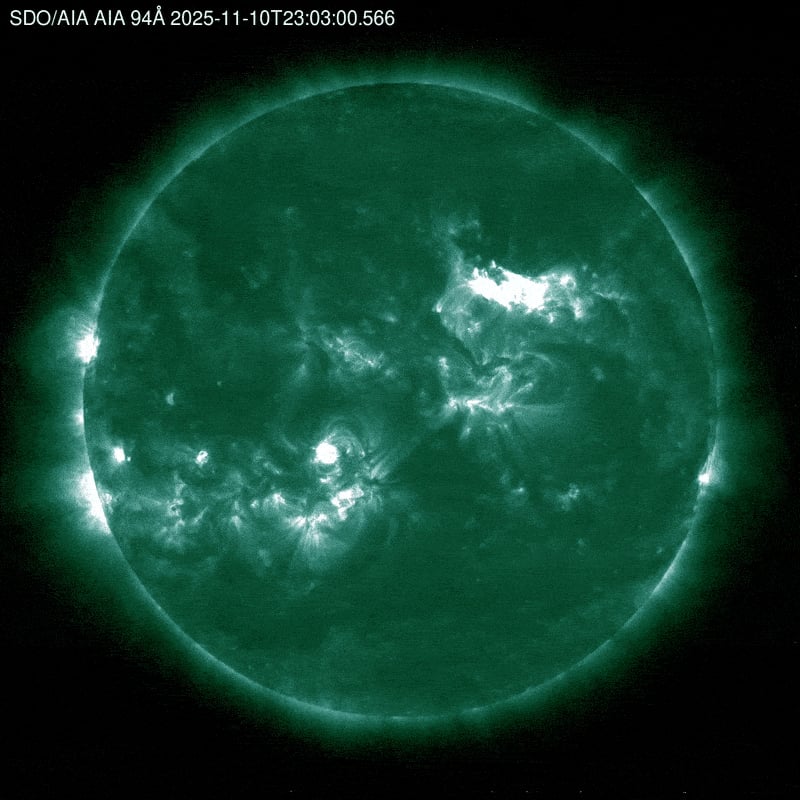
The Sun has unleashed a major space weather event. On November 11, 2025, an intense X5.1-class solar flare erupted, followed by a fast-moving coronal mass ejection (CME) racing toward Earth. The European Space Agency (ESA) and the U.S. National Oceanic and Atmospheric Administration (NOAA) are tracking this severe event that could disturb satellites, power grids, and navigation systems. This could also be producing strong auroras visible up to mid-latitudes.
A burst of solar fury
The flare originated from active region AR14274, which already produced two X-class flares earlier that week. Less than an hour after the X5.1 flare, ESA’s SOHO and NOAA’s GOES-19 satellites observed a CME moving at about 1,500 km/s. The CME was predicted to reach Earth by the evening of November 12 or early November 13, depending on its speed and trajectory.
ESA confirmed that earlier CMEs from the same region had already triggered a strong G4-level geomagnetic storm. The third and most powerful CME could merge with the previous two, amplifying the disturbance. Juha-Pekka Luntama, Head of ESA’s Space Weather Office, said that “severe space weather activity is expected to continue for the rest of the week.”
What happens when a CME hits Earth
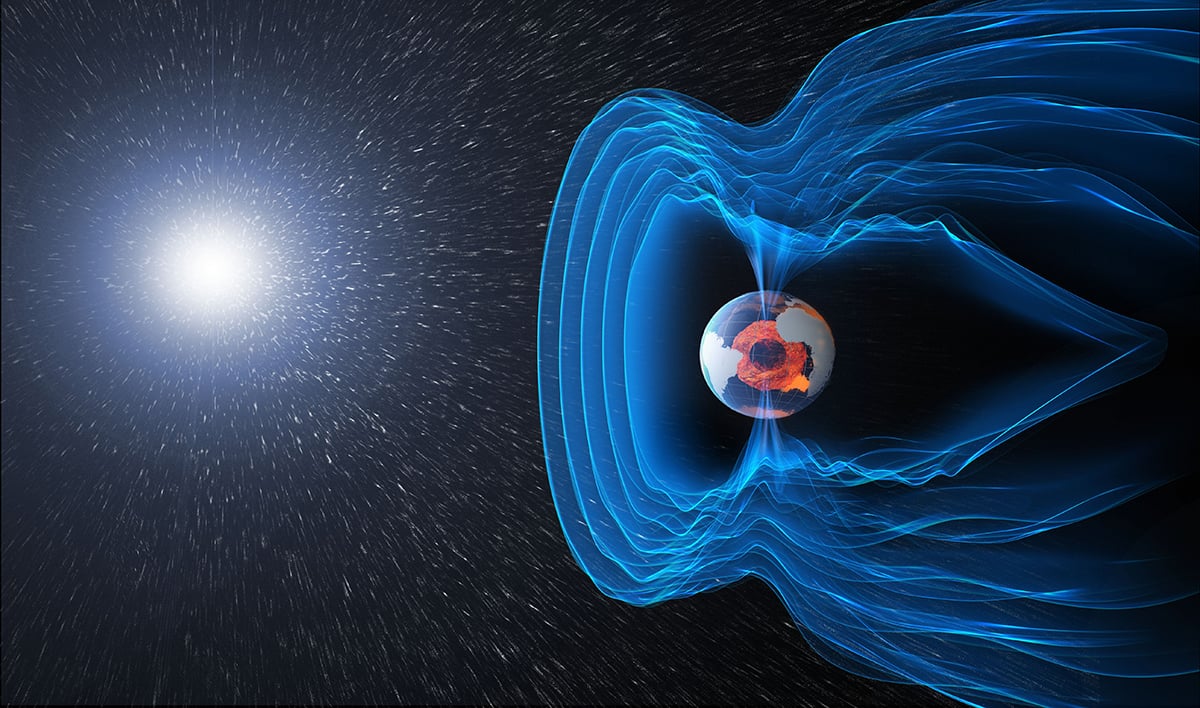
A CME carries billions of tons of magnetized plasma. When it collides with Earth’s magnetic field, it distorts and compresses the magnetosphere, creating a geomagnetic storm. This can cause power surges, disrupt satellite signals, and affect radio communications.
In severe cases, the upper atmosphere swells due to heating, increasing drag on low-orbit satellites. If not corrected, this drag can slowly lower satellite orbits. While this poses a challenge for spacecraft, it also helps clear space debris, which burns up as it re-enters the atmosphere.
A severe storm raises the odds of auroras being visible far from the poles. Photographers in mid-latitudes may see green and red glows. But aurora visibility depends on the CME’s magnetic orientation. If the magnetic field aligns southward, the storm will couple strongly with Earth’s field, and auroras will grow. If it aligns northward, auroras may remain weak. Watch local KP and aurora forecasts the night the CME is due. SpaceWeatherLive, NOAA, and ESA offer near-real-time maps and KP forecasts.
Impact on Earth and in space
ESA reports that the storm may temporarily affect radio communications and satellite navigation, particularly across the sunlit regions of Europe, Africa, and Asia. These disruptions are caused by charged particles interfering with radio waves and navigation signals, such as GPS.
Power grids at high latitudes can experience increased current flow through long transmission lines. Modern grids are designed with protection systems, but operators remain vigilant for voltage fluctuations or transformer stress. Airlines operating polar routes may also adjust flight paths to avoid high-radiation zones, as energetic particles can interfere with onboard electronics and pose health risks to crew at high altitudes.
Despite these challenges, ESA stresses that there is no direct biological risk to people on Earth. Our atmosphere and magnetic field provide strong protection against harmful solar radiation.
Understanding solar storms
Solar storms are part of the natural rhythm of our star. As the Sun has hit its peak in the 11-year solar cycle, powerful flares and CMEs have become more frequent. Predicting their exact timing remains difficult. Scientists can estimate when a region is likely to erupt, but they cannot yet pinpoint the precise moment or direction of a CME.
A solar storm begins with a flare, an intense flash of radiation that travels at the speed of light and reaches Earth in about eight minutes. This burst can disrupt high-frequency radio and navigation signals instantly. Then, high-energy particles arrive minutes to hours later, followed by the slower-moving CME, which takes between 18 hours and several days to arrive.
When a CME hits, charged particles cascade into Earth’s upper atmosphere, exciting atoms and producing auroras. These same particles can heat the atmosphere, interfere with electronics, and change atmospheric density.

The science behind monitoring
To forecast and study such events, ESA and NOAA use multiple spacecraft. ESA’s SOHO satellite and NOAA’s GOES-19 monitor solar activity, tracking eruptions and their direction. Instruments at the Lagrange Point 1 (L1), about 1.5 million kilometers from Earth, measure solar wind speed and density, giving a short warning, typically 20 minutes, before a CME arrives. To improve warning times, ESA is developing two missions: Vigil and Shield.
Vigil, scheduled for launch in 2031, will orbit the Sun from the Lagrange Point 5 (L5) position, about 60 degrees behind Earth. From this sideways view, it will detect solar eruptions days before they face Earth. Shield, a proposed mission farther away than L1, could extend warning times to two and a half hours. These projects aim to give satellite operators and power companies more time to prepare for strong storms.
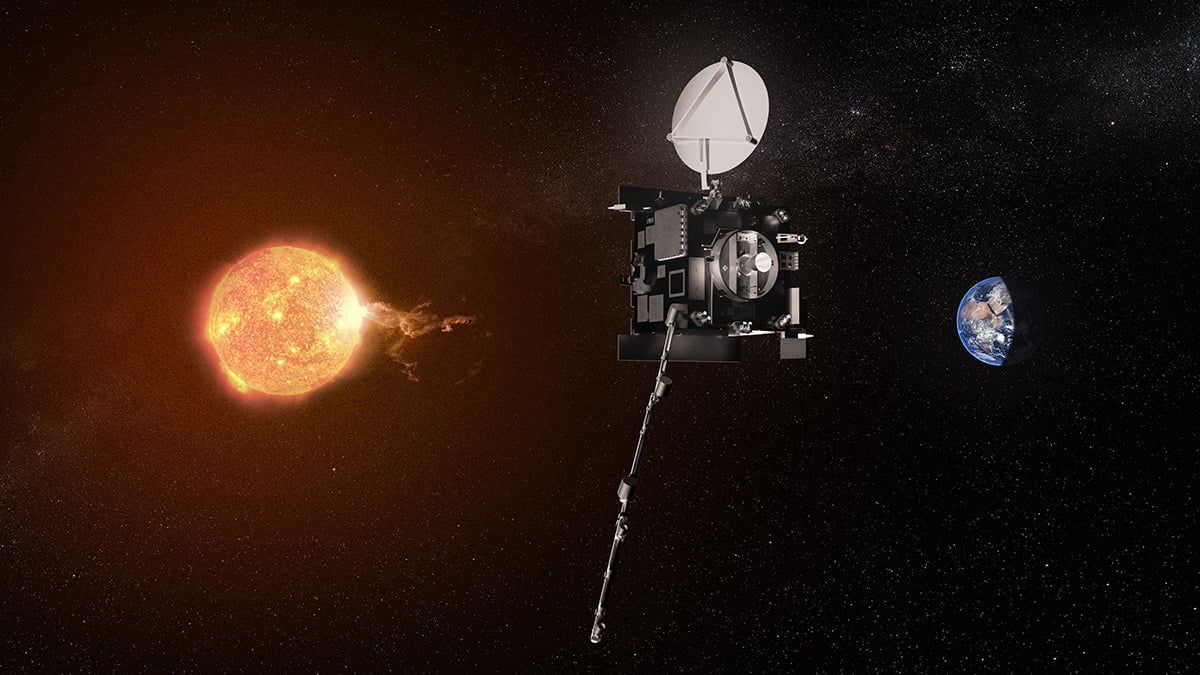
The agency’s long-term goal is to make space weather monitoring as reliable as meteorology on Earth. Missions like Vigil will help bridge the current gap between observation and prediction. Until then, agencies depend on near-Earth spacecraft, ground-based magnetometers, and solar telescopes to monitor changes in real time.
Clear skies!
See more from DIYPhotography.net on Google
Add DIYPhotography.net as a trusted source. This makes
our stories more likely to appear in your Google Search results.
 Add as a preferred source on Google

Soumyadeep Mukherjee
Soumyadeep Mukherjee is an award-winning astrophotographer from India. He has a doctorate degree in Linguistics. His work extends to the sub-genres of nightscape, deep sky, solar, lunar and optical phenomenon photography. He is also a photography educator and has conducted numerous workshops. His works have appeared in over 40 books & magazines including Astronomy, BBC Sky at Night, Sky & Telescope among others, and in various websites including National Geographic, NASA, Forbes. He was the first Indian to win “Astronomy Photographer of the Year” award in a major category.
Related Posts
 This Epic Storm Timelapse Will Make You Want To Get Close And Personal with A Storm
 Canada-based model suffers severe burns during fire photo shoot gone bad
 Portraits Of Severe Face Injuries Made With Cake, Candy & Ice Cream
 How to quickly use Photoshop to correct severe distortion for perfect panoramics
Join the Discussion
DIYP Comment Policy
Be nice, be on-topic, no personal information or flames.