

























Solar Orbiter Reveals the Sun’s Polar Magnetic Field in Motion for the First Time
Nov 11, 2025
Soumyadeep Mukherjee
Soumyadeep Mukherjee is an award-winning astrophotographer from India. He has a doctorate degree in Linguistics. His work extends to the sub-genres of nightscape, deep sky, solar, lunar and optical phenomenon photography. He is also a photography educator and has conducted numerous workshops. His works have appeared in over 40 books & magazines including Astronomy, BBC Sky at Night, Sky & Telescope among others, and in various websites including National Geographic, NASA, Forbes. He was the first Indian to win “Astronomy Photographer of the Year” award in a major category.
Share:
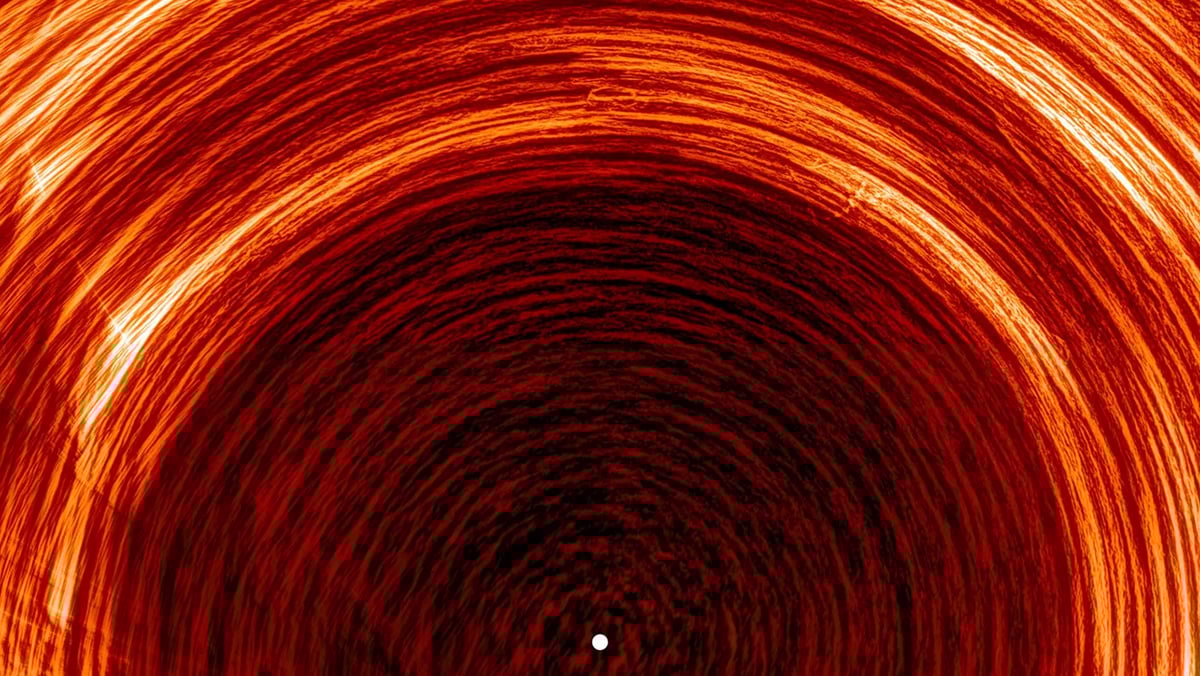
For the first time, scientists have watched the magnetic field near the Sun’s poles in motion. Using data from ESA’s Solar Orbiter, a team from the Max Planck Institute for Solar System Research (MPS) has captured this remarkable sight. Their work offers a new look at how magnetic fields drift toward the solar poles, a key part of understanding how the Sun’s magnetic cycle works. This discovery is a major step in uncovering the forces that drive solar activity.
A long-awaited look at the Sun’s poles
The Sun’s poles have always been a mystery. From Earth, we can only see its equatorial regions because our orbit lies in the same flat plane as the other planets. But the poles hold vital clues about how the Sun’s magnetism changes over time.
In March 2025, Solar Orbiter reached a tilted orbit, about 17 degrees above the plane of the planets. From there, it captured the first detailed magnetic and ultraviolet images of the Sun’s South Pole. The data came from two onboard instruments: the Polarimetric and Helioseismic Imager (PHI) and the Extreme Ultraviolet Imager (EUI).
PHI, which measures the Sun’s magnetic fields, took its images on March 21. Around the same time, EUI recorded ultraviolet images between March 16 and 24. When researchers compared the data, they saw something new. Magnetic structures were drifting toward the pole, showing that plasma flows were carrying magnetic fields northward at speeds of 10 to 20 meters per second.

Watching the magnetic conveyor belt in action
The Sun’s magnetic field comes from the motion of plasma inside it. These flows generate what scientists call the solar dynamo. Over an 11-year cycle, the Sun’s magnetic field flips, north becomes south, and south becomes north. This reversal drives solar activity such as sunspots, flares, and eruptions.
A major question in solar physics is how magnetic fields move across the Sun. The “magnetic conveyor belt” model suggests that magnetic fields travel from the equator toward the poles near the surface and then sink deeper inside before returning to the equator. However, no one had directly seen this near the poles. The view from Earth is too steep to get clear measurements. Solar Orbiter, flying outside the ecliptic plane, has changed that.
The new images reveal that magnetic fields at the poles are moving faster than expected. Earlier models predicted a slowdown near high latitudes, but Solar Orbiter’s data tell a different story. The poleward drift appears nearly as fast as at lower latitudes. This challenges older models of the Sun’s internal magnetic flow.
Supergranules and magnetic flows
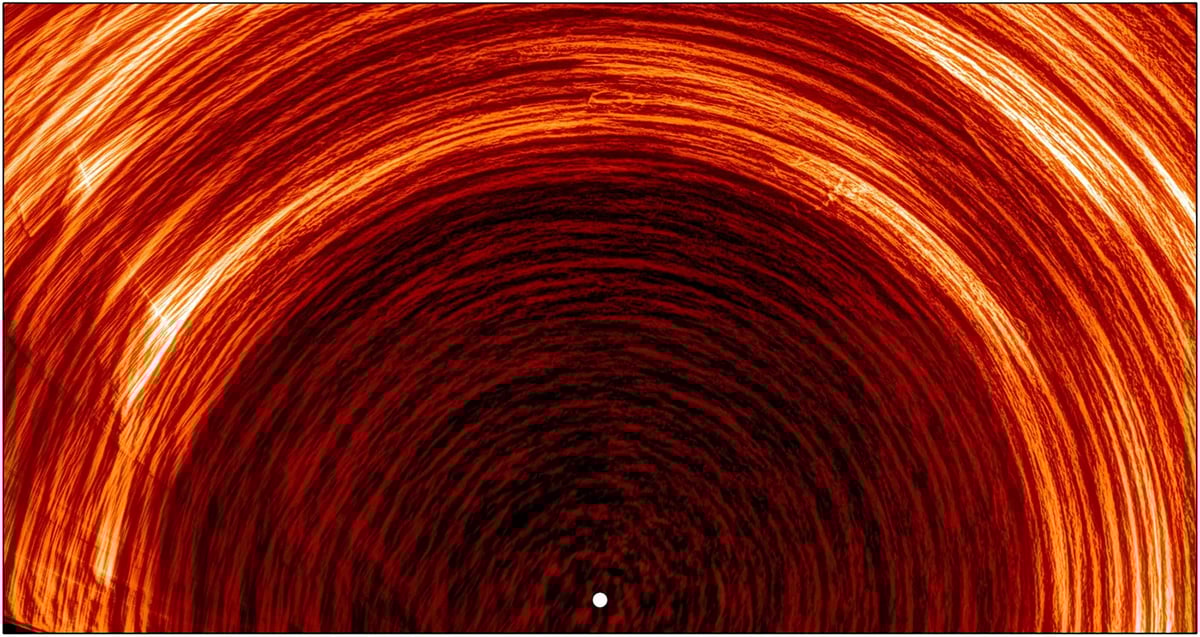
The images also show giant convection patterns, known as supergranules, near the poles. These are enormous cells of rising and sinking plasma, each about 30,000 kilometers wide, two or three times Earth’s size. Hot gas rises in the middle and cools as it sinks at the edges, creating a boiling pattern on the Sun’s surface.
Magnetic fields collect at the edges of these supergranules. Their motion carries magnetic flux across the solar surface. By tracking these small magnetic features in PHI’s data, scientists detected the poleward migration that reveals the magnetic flow.
The motion is uneven. Some regions show faster movement, while others stay steady. The speed, around 10 to 20 meters per second, is higher than previous models predicted. It suggests that the high-latitude magnetic transport is more dynamic and complex than once thought.

Filling the missing piece of the Solar Dynamo
The Sun’s poles are key to understanding its magnetic cycle. The way magnetic fields behave there determines how each new solar cycle begins. The polar magnetic field acts like a seed for the next cycle. Until now, scientists could only guess what happens near the poles. They had to rely on indirect data or simulated models. Solar Orbiter has changed that. It gives direct measurements that can finally be tested against theory.
According to Dr. Lakshmi Pradeep Chitta of MPS, who led the study, these observations fill a major gap. The faster poleward motion could mean the Sun’s conveyor belt works differently at high latitudes than scientists believed. If true, this could alter how we understand the length and strength of the solar cycle. But scientists will need long-term data to confirm whether this fast motion is constant or temporary.

This discovery could reshape our understanding of how the Sun works. The finding that magnetic fields move quickly at the poles challenges the old view of a slower conveyor belt. Better data on these flows will improve predictions of solar activity, information crucial for satellites, astronauts, and power grids on Earth.
Clear skies!
See more from DIYPhotography.net on Google
Add DIYPhotography.net as a trusted source. This makes
our stories more likely to appear in your Google Search results.
 Add as a preferred source on Google

Soumyadeep Mukherjee
Soumyadeep Mukherjee is an award-winning astrophotographer from India. He has a doctorate degree in Linguistics. His work extends to the sub-genres of nightscape, deep sky, solar, lunar and optical phenomenon photography. He is also a photography educator and has conducted numerous workshops. His works have appeared in over 40 books & magazines including Astronomy, BBC Sky at Night, Sky & Telescope among others, and in various websites including National Geographic, NASA, Forbes. He was the first Indian to win “Astronomy Photographer of the Year” award in a major category.

Join the Discussion
DIYP Comment Policy
Be nice, be on-topic, no personal information or flames.