



























NASA’s SPHEREx Maps Interstellar Glaciers Across the Milky Way
Apr 18, 2026
Soumyadeep Mukherjee
Soumyadeep Mukherjee is an award-winning astrophotographer from India. He has a doctorate degree in Linguistics. His work extends to the sub-genres of nightscape, deep sky, solar, lunar and optical phenomenon photography. He is also a photography educator and has conducted numerous workshops. His works have appeared in over 40 books & magazines including Astronomy, BBC Sky at Night, Sky & Telescope among others, and in various websites including National Geographic, NASA, Forbes. He was the first Indian to win “Astronomy Photographer of the Year” award in a major category.
Share:
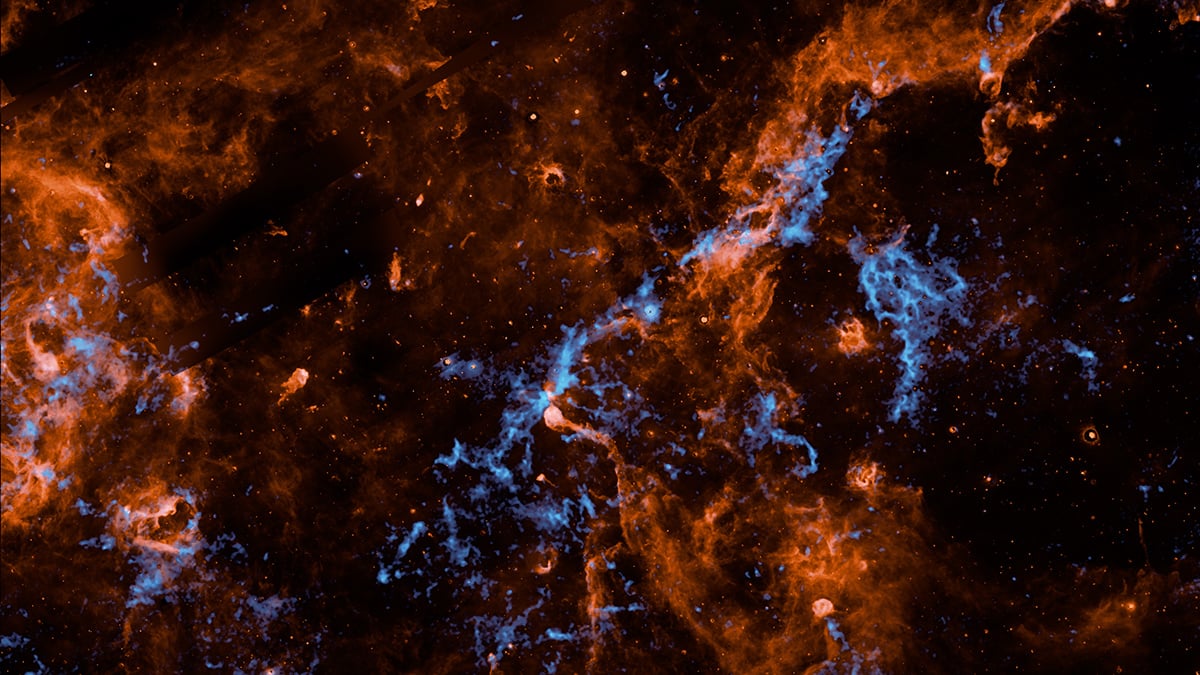
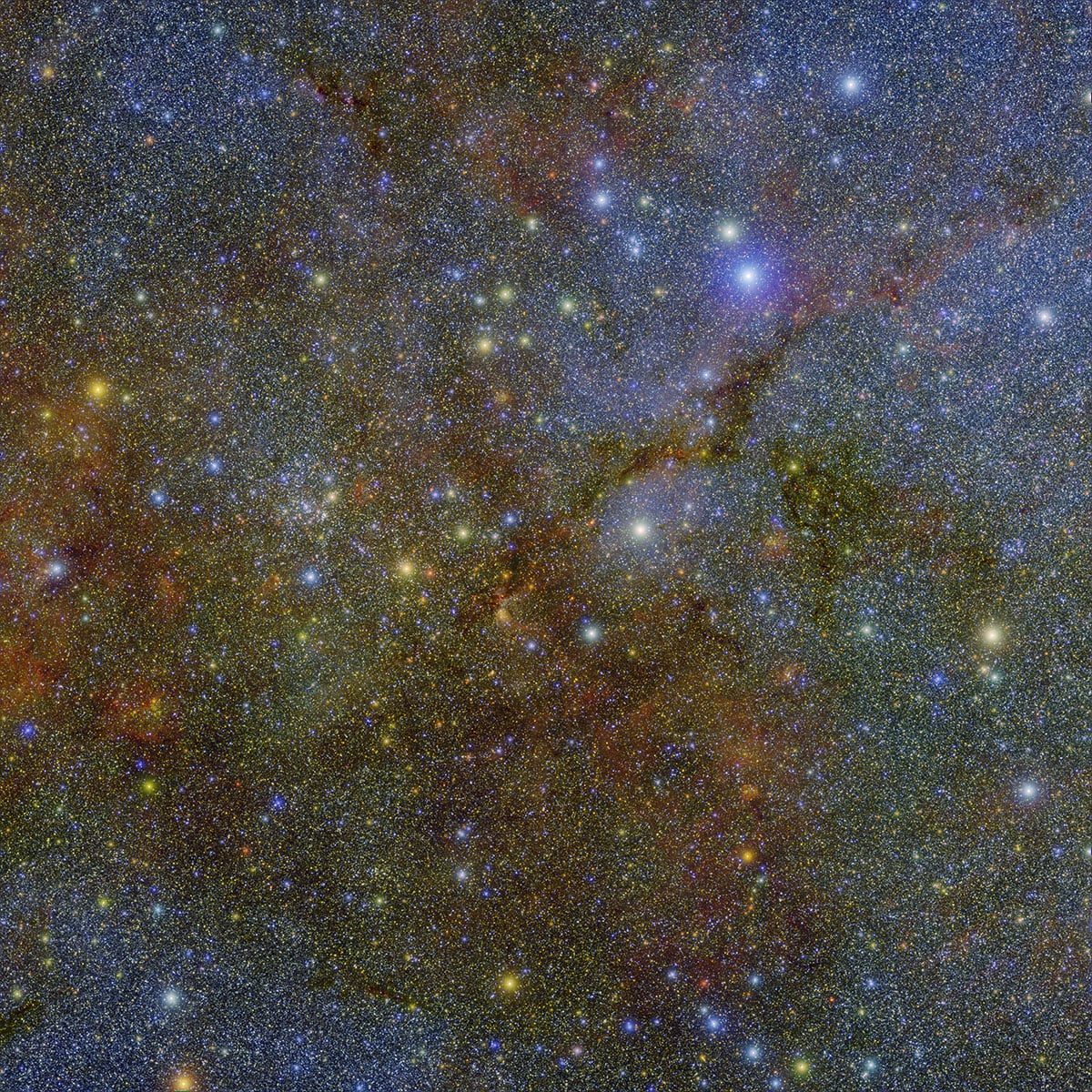
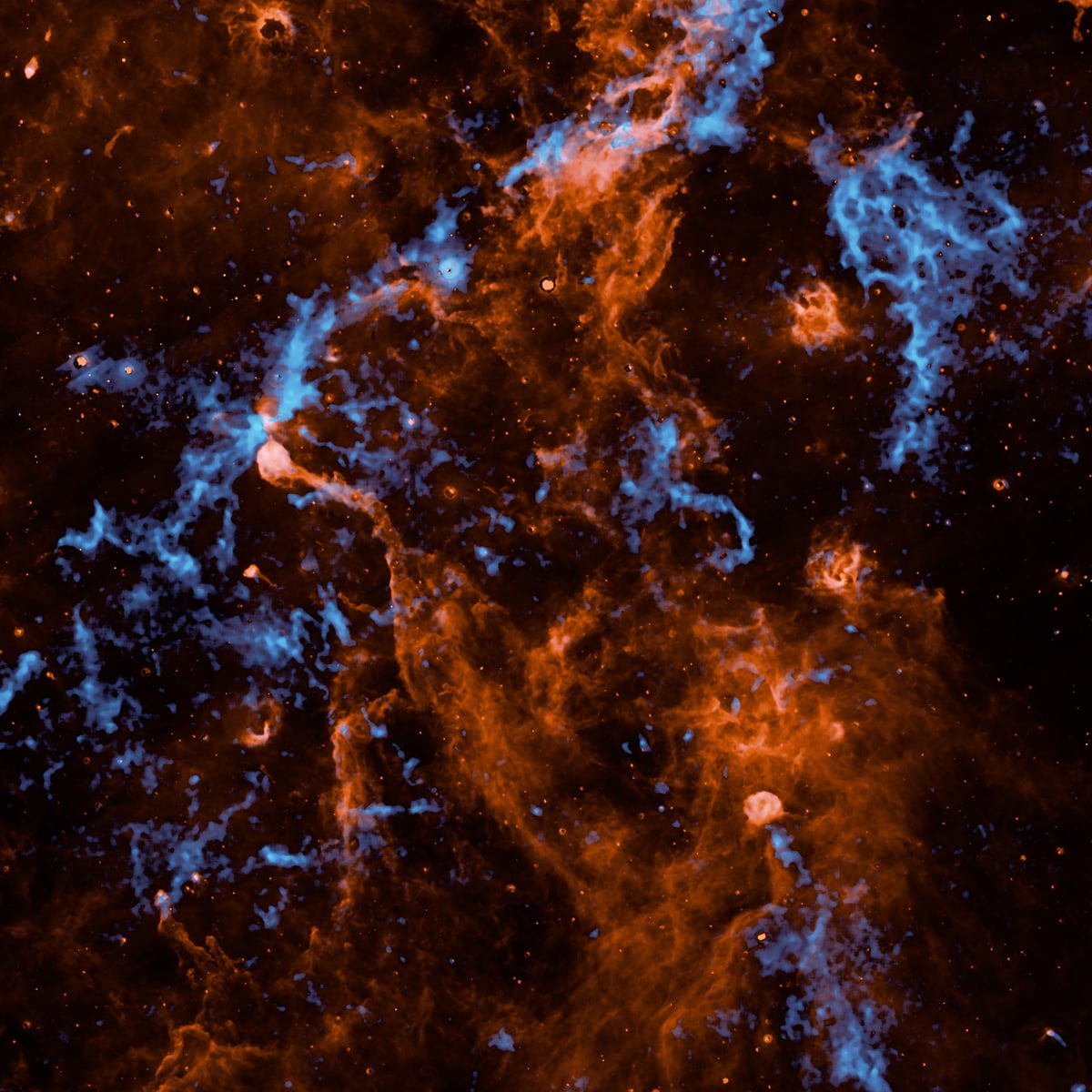
Astronomers have long suspected that the water inside planets begins its journey long before those planets exist. A new set of observations from NASA’s SPHEREx observatory now provides the strongest large-scale evidence yet for that idea. The mission has mapped vast reservoirs of frozen material inside the Milky Way. Scientists describe them as interstellar glaciers. These structures stretch across hundreds of light-years and contain water ice attached to microscopic dust grains inside star-forming clouds.
The results come from early observations of the Cygnus X region. This area ranks among the most active stellar nurseries in our galaxy. The new maps show that water ice follows the same dark dust lanes that astronomers already see in optical images of the Milky Way. These results help connect interstellar chemistry with the formation of stars and planets.
A mission to map the chemical structure of the sky
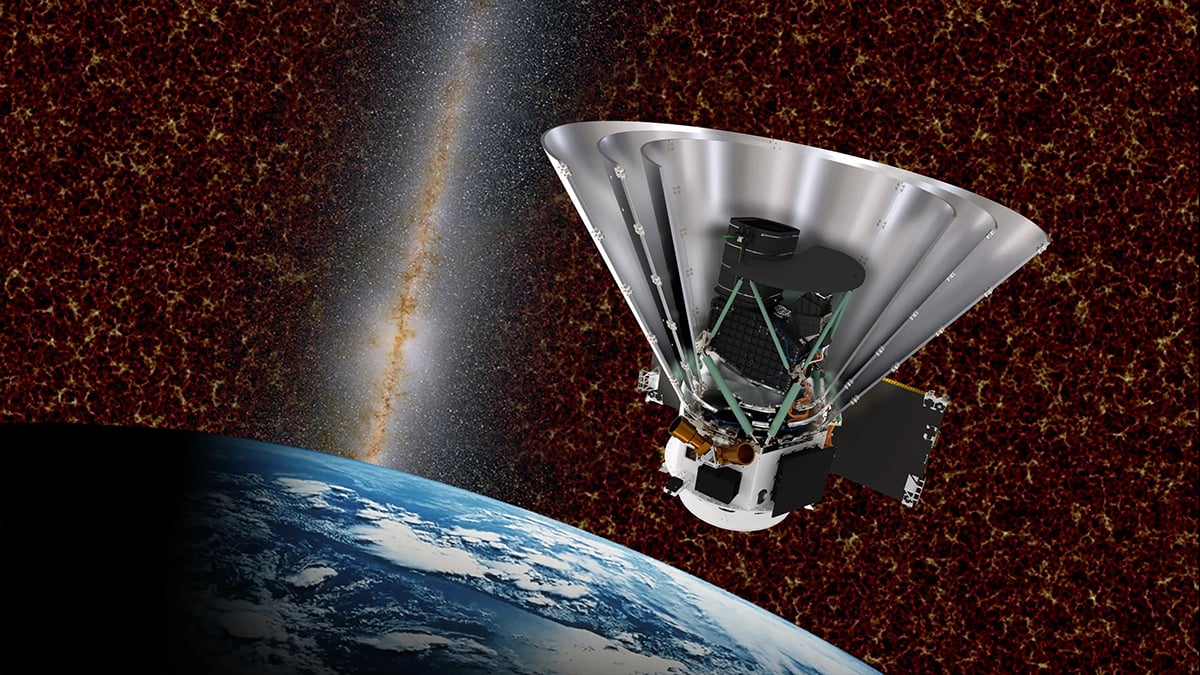
SPHEREx was launched in March 2025 with the goal of conducting the first all-sky spectral survey in near-infrared wavelengths at moderate resolution. The telescope observes the sky in 102 spectral bands. As a result, it can identify the signatures of important molecular species across very large regions of the galaxy.
Earlier infrared observatories studied interstellar ice primarily along narrow sightlines toward background stars. Those observations provided valuable chemical detections, but they did not reveal how ice distributes itself across entire cloud complexes. SPHEREx addresses that limitation by mapping the spectral fingerprints of frozen molecules across the sky in a uniform way.
This allows astronomers to examine how water ice, carbon dioxide ice, and carbon monoxide ice trace dense regions inside molecular clouds. At the same time, it enables comparisons between different star-forming environments across the Milky Way. Consequently, researchers can now investigate how local radiation fields, cloud density, and stellar feedback influence the survival of frozen material before planet formation begins.
Water ice reservoirs inside the Cygnus X molecular complex
The Cygnus X region contains one of the richest concentrations of molecular gas in the Milky Way. Massive stars form there in large numbers, and their radiation strongly influences the surrounding clouds. For decades, astronomers have studied this region as a laboratory for understanding star formation in clustered environments.
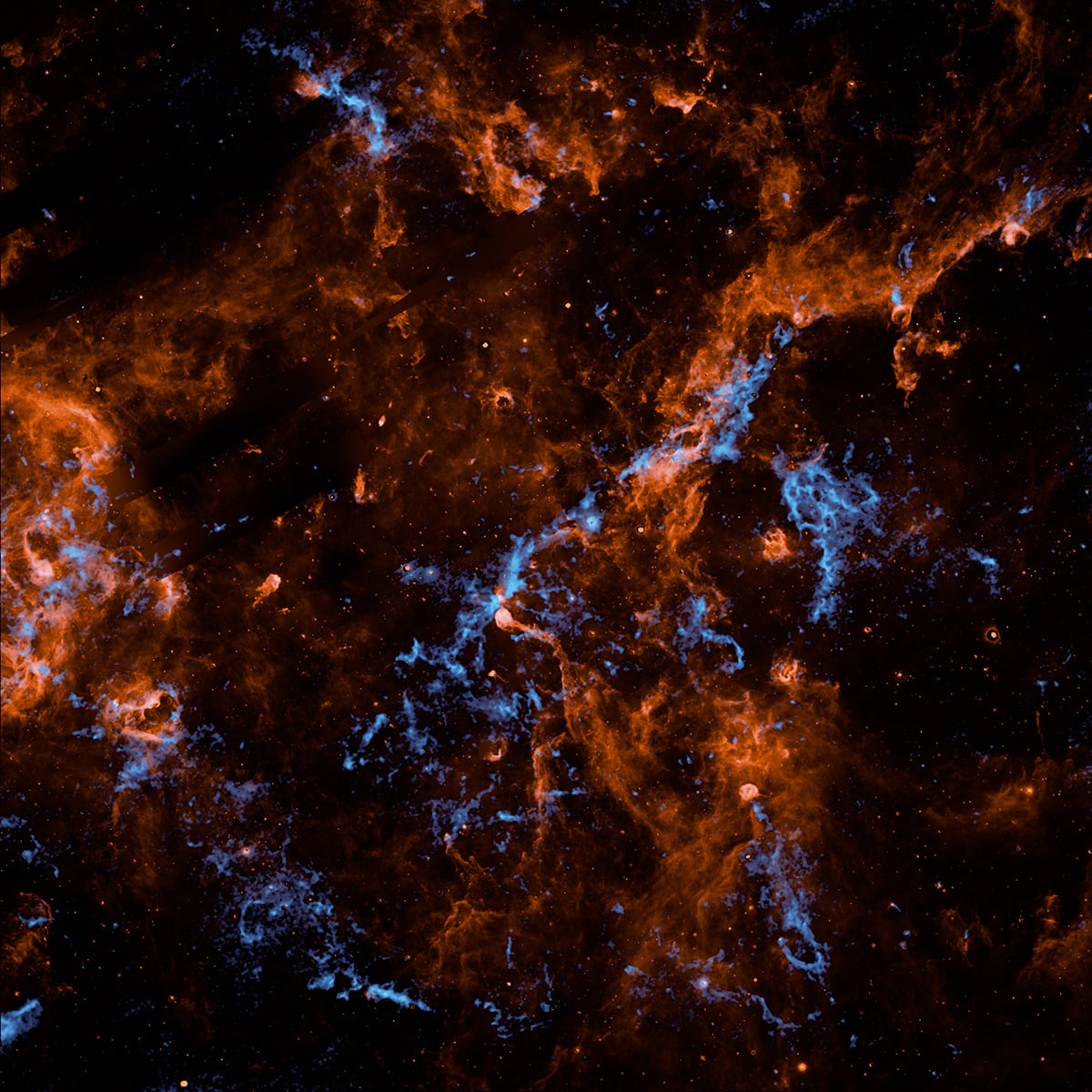
SPHEREx observations now reveal that water ice extends across structures more than 600 light-years wide within this complex. These reservoirs follow the same dark dust filaments that appear in optical and infrared surveys of the Milky Way. This alignment provides strong evidence that interstellar ice forms on dust grain surfaces inside dense cloud interiors.
Earlier studies detected water ice along individual sightlines passing through these clouds. However, those measurements could not describe the full spatial structure of the frozen material. SPHEREx now shows that the ice occupies extended regions rather than isolated pockets. This finding confirms that large molecular clouds store significant quantities of frozen water long before star formation proceeds to later stages.
Interstellar glaciers: Large-scale molecular reservoirs
Astronomers often describe these extended ice-rich regions as interstellar glaciers. The term reflects their enormous spatial scale rather than their physical appearance. Unlike terrestrial glaciers, these structures consist of microscopic dust grains coated with thin layers of frozen molecules.
Nevertheless, when these coated grains spread across hundreds of light-years, they form massive reservoirs of molecular material. Water ice dominates these coatings, although carbon dioxide and carbon monoxide also contribute significantly to the composition of the grain mantles.
These icy mantles play a central role in interstellar chemistry. Dust grains provide surfaces where atoms combine to form molecules that cannot form efficiently in the gas phase alone. Over time, these reactions produce complex molecular inventories that later become part of planetary systems.
A new framework for studying molecular clouds across the Milky Way
SPHEREx introduces a different observational strategy compared with earlier infrared space telescopes. Instead of focusing on selected targets, the mission surveys the entire sky using a uniform spectral method. This approach allows astronomers to compare molecular cloud chemistry across a wide range of galactic environments.
Researchers can now investigate how radiation from nearby massive stars modifies the composition of molecular clouds. They can also study regions where star formation proceeds more quietly and where frozen molecules remain protected for longer periods. These comparisons help clarify how environmental conditions influence the early stages of stellar evolution.
In addition, the mission collects spectral information for more than 100 million stars within the Milky Way and hundreds of millions of galaxies beyond it. These data support studies of galaxy formation as well as investigations of cosmic structure on large scales.
Clear skies!
See more from DIYPhotography.net on Google
Add DIYPhotography.net as a trusted source. This makes
our stories more likely to appear in your Google Search results.
 Add as a preferred source on Google

Soumyadeep Mukherjee
Soumyadeep Mukherjee is an award-winning astrophotographer from India. He has a doctorate degree in Linguistics. His work extends to the sub-genres of nightscape, deep sky, solar, lunar and optical phenomenon photography. He is also a photography educator and has conducted numerous workshops. His works have appeared in over 40 books & magazines including Astronomy, BBC Sky at Night, Sky & Telescope among others, and in various websites including National Geographic, NASA, Forbes. He was the first Indian to win “Astronomy Photographer of the Year” award in a major category.




Join the Discussion
DIYP Comment Policy
Be nice, be on-topic, no personal information or flames.