

























NASA’s Chandra Maps 3,300 X-ray Sources at Milky Way’s Core
Mar 13, 2026
Soumyadeep Mukherjee
Soumyadeep Mukherjee is an award-winning astrophotographer from India. He has a doctorate degree in Linguistics. His work extends to the sub-genres of nightscape, deep sky, solar, lunar and optical phenomenon photography. He is also a photography educator and has conducted numerous workshops. His works have appeared in over 40 books & magazines including Astronomy, BBC Sky at Night, Sky & Telescope among others, and in various websites including National Geographic, NASA, Forbes. He was the first Indian to win “Astronomy Photographer of the Year” award in a major category.
Share:
High-energy astrophysics relies on long observational records and carefully calibrated datasets. Over the past two decades, NASA’s Chandra X-ray Observatory has built one of the most detailed archives of cosmic X-ray emission ever collected. Since its launch in 1999, the telescope has repeatedly observed thousands of targets across the sky. These observations capture radiation produced by some of the most extreme physical environments in the universe.
Astronomers have now assembled this vast archive into a unified dataset known as the Chandra Source Catalog. The catalog brings together detections from thousands of observations and presents them through a consistent analysis framework. As a result, it allows scientists to study the X-ray universe in a systematic and statistically reliable way. The most recent release of the catalog contains more than 400,000 unique X-ray sources. In total, researchers identified over 1.3 million individual detections from observations spanning more than two decades. These measurements include positions, brightness values, spectral information, and time variability for each source.
Building a uniform catalog from two decades of observations
The Chandra Source Catalog represents a major effort to organize and standardize the telescope’s extensive archive. Chandra has recorded thousands of observations under different observing conditions. These data include exposures of galaxies, star clusters, supernova remnants, and distant active galactic nuclei.
However, observations collected over many years can be difficult to compare directly. Different analysis methods can introduce subtle differences in measurements. To address this challenge, scientists created a dedicated processing pipeline that analyzes every observation using the same procedures.
The pipeline scans each dataset and identifies sources based on the distribution of detected X-ray photons. Once the software locates a source, it calculates several key properties. These include the source position, the intensity of X-ray emission, and the distribution of photon energies. The system also tracks how the brightness changes during an observation.
Each detected object then enters the catalog with a standardized set of measurements. This uniform approach ensures that astronomers can compare sources across different observations without introducing systematic bias.
The current release, known as CSC 2.1, contains 407,806 unique X-ray sources detected in more than 15,000 Chandra observations. The catalog includes observations made with the Advanced CCD Imaging Spectrometer (ACIS) and the High Resolution Camera (HRC). Both instruments provide high sensitivity and precise imaging capabilities.
A deep X-ray view of the Galactic Center
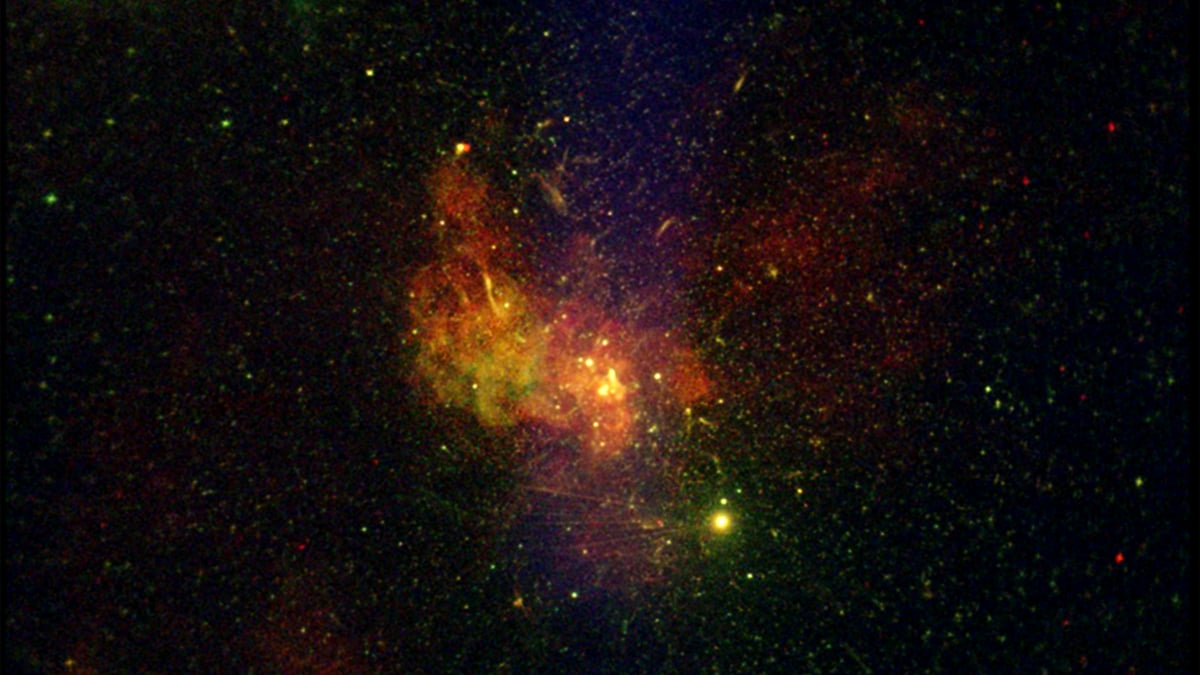
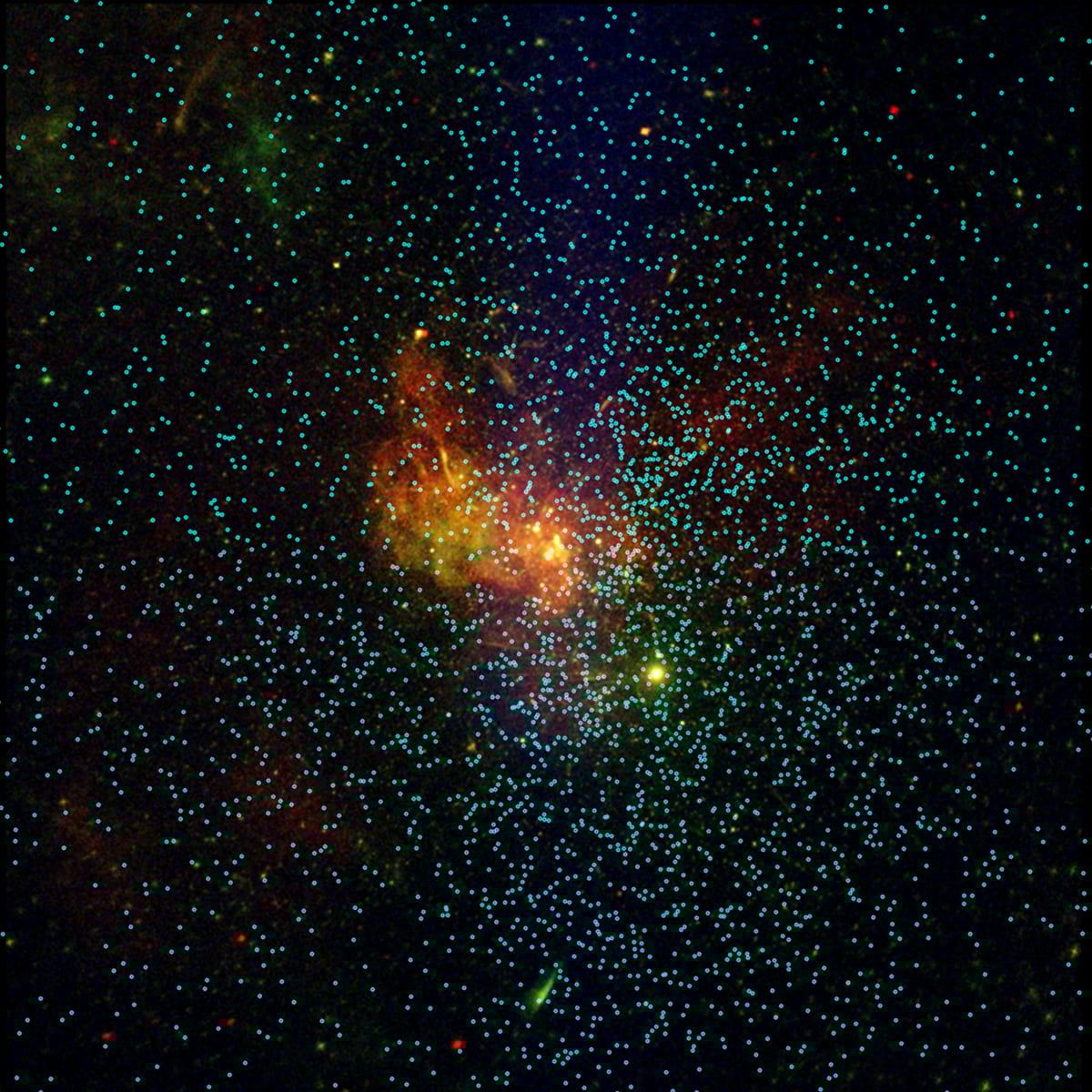
To highlight the richness of the catalog, astronomers created a deep X-ray mosaic of the Milky Way’s central region. This area surrounds Sagittarius A*, the supermassive black hole located at the center of our galaxy. Although the field spans only about 60 light-years, it contains a remarkable concentration of energetic objects.
The image combines 86 separate Chandra observations of the Galactic Center. When researchers merged these exposures, the total observing time exceeded three million seconds, which corresponds to roughly 35 days of accumulated observation. Such long integration dramatically increases the sensitivity of the final image.
Consequently, astronomers detected more than 3,300 X-ray sources within this relatively small region of space. Many of these objects are extremely faint and would remain invisible in shorter exposures.
The Galactic Center has long attracted attention because it hosts dense stellar populations and energetic phenomena. Star formation occurred frequently in this region throughout the galaxy’s history. As a result, many massive stars evolved rapidly and ended their lives as neutron stars or black holes.
These compact remnants often interact with nearby stars or interstellar gas. Such interactions generate high-energy radiation that Chandra can detect with remarkable clarity. Therefore, the deep mosaic offers a detailed census of energetic sources near the Milky Way’s central black hole.
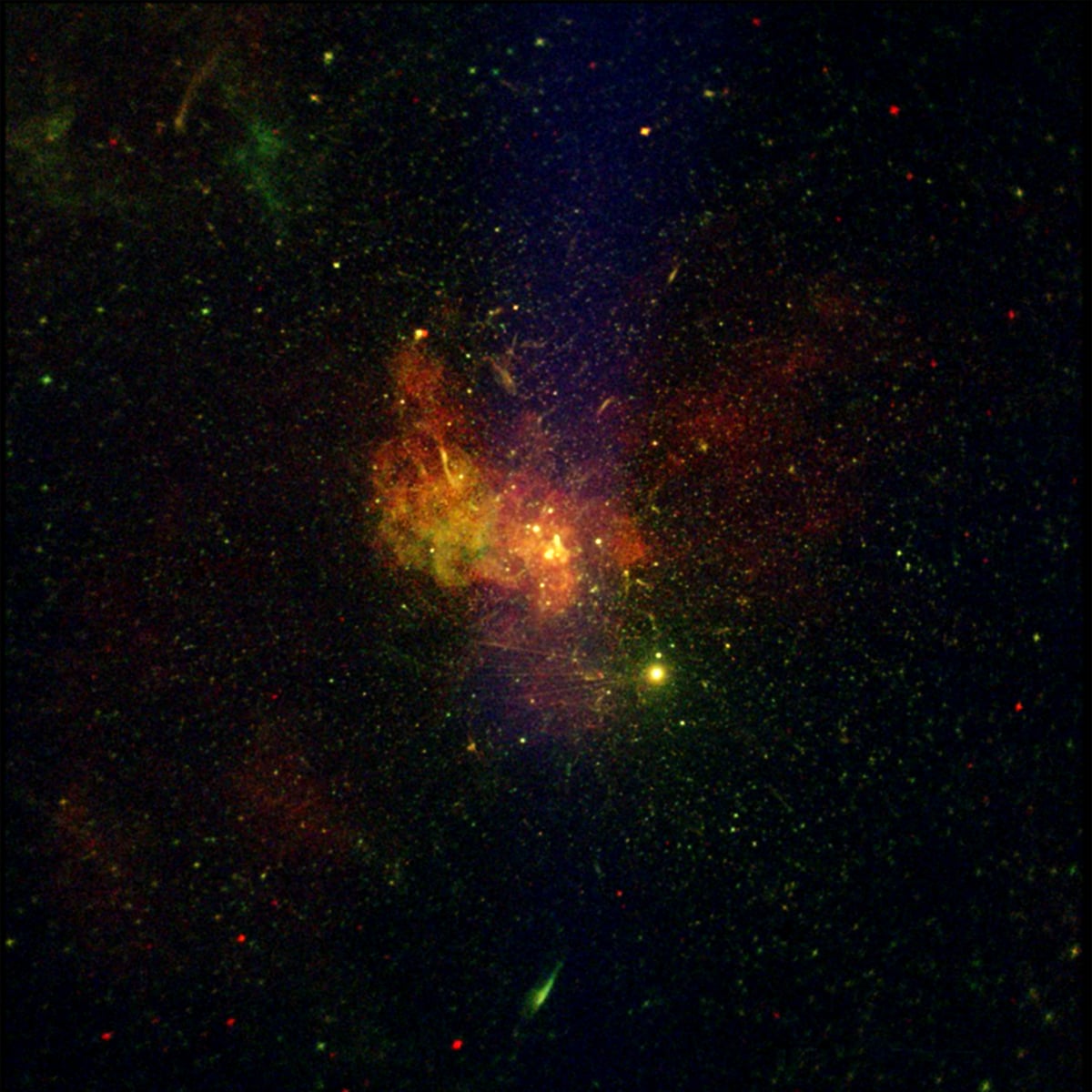
A complex environment around Sagittarius A*
The thousands of sources visible in the Galactic Center mosaic represent several different astrophysical systems. Each class of object produces X-rays through a distinct physical process.
One prominent category includes X-ray binary systems. In these systems, a neutron star or black hole orbits a companion star. Gas from the companion gradually flows toward the compact object and forms an accretion disk. As the gas spirals inward, gravitational energy converts into heat. The disk reaches temperatures of millions of degrees and emits strong X-ray radiation.
Another population consists of pulsars, which are rapidly rotating neutron stars. Their intense magnetic fields accelerate charged particles to extremely high energies. These particles generate beams of radiation that sweep across space as the star rotates. When the beam crosses Earth, telescopes detect periodic pulses of emission.
The region also contains several supernova remnants. These expanding shells formed when massive stars exploded at the end of their lives. Shock waves propagate through the surrounding gas and heat it to extremely high temperatures. The hot plasma radiates strongly in X-ray wavelengths, revealing the structure of the explosion.
The Continuing Legacy of the Chandra Observatory
The Chandra X-ray Observatory remains one of the most powerful tools for studying high-energy astrophysical phenomena. Its sharp imaging capability allows astronomers to resolve fine structures in crowded regions of the sky. Few other X-ray observatories can match this level of spatial resolution.
Equally important is the mission’s long operational history. Over more than two decades, Chandra has repeatedly observed many key regions of the sky. This extended timeline allows scientists to track how energetic objects evolve over long periods.
The Chandra Source Catalog captures this legacy in a single, carefully organized dataset. By combining thousands of observations into a unified framework, the catalog transforms the telescope’s archive into a powerful scientific resource.
The deep mosaic of the Galactic Center illustrates what such a dataset can reveal. Within a region only sixty light-years across, thousands of X-ray sources emerge once the observations are combined. Each source marks an energetic system operating under extreme physical conditions.
Clear skies!
See more from DIYPhotography.net on Google
Add DIYPhotography.net as a trusted source. This makes
our stories more likely to appear in your Google Search results.
 Add as a preferred source on Google

Soumyadeep Mukherjee
Soumyadeep Mukherjee is an award-winning astrophotographer from India. He has a doctorate degree in Linguistics. His work extends to the sub-genres of nightscape, deep sky, solar, lunar and optical phenomenon photography. He is also a photography educator and has conducted numerous workshops. His works have appeared in over 40 books & magazines including Astronomy, BBC Sky at Night, Sky & Telescope among others, and in various websites including National Geographic, NASA, Forbes. He was the first Indian to win “Astronomy Photographer of the Year” award in a major category.


Join the Discussion
DIYP Comment Policy
Be nice, be on-topic, no personal information or flames.