























NASA’s Chandra Reveals a Hidden Neutron Star Merger
Mar 10, 2026
Soumyadeep Mukherjee
Soumyadeep Mukherjee is an award-winning astrophotographer from India. He has a doctorate degree in Linguistics. His work extends to the sub-genres of nightscape, deep sky, solar, lunar and optical phenomenon photography. He is also a photography educator and has conducted numerous workshops. His works have appeared in over 40 books & magazines including Astronomy, BBC Sky at Night, Sky & Telescope among others, and in various websites including National Geographic, NASA, Forbes. He was the first Indian to win “Astronomy Photographer of the Year” award in a major category.
Share:
Short gamma-ray bursts represent some of the most energetic transient events in the universe. Astronomers generally associate them with the merger of two neutron stars in a compact binary system. These explosions release intense gamma radiation for a fraction of a second and then produce afterglows that can be detected at X-ray, optical, and radio wavelengths. Over the past two decades, observations from space observatories have allowed researchers to study the physical origin of these bursts in increasing detail. However, the environments where these events occur still raise important questions.
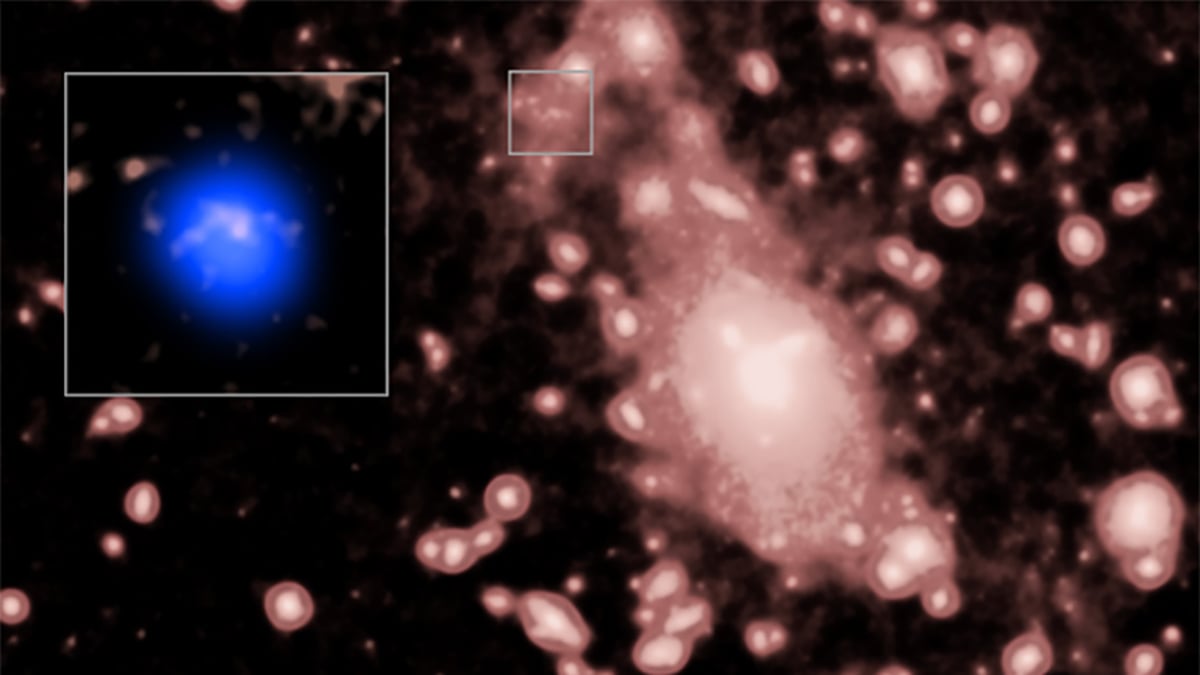
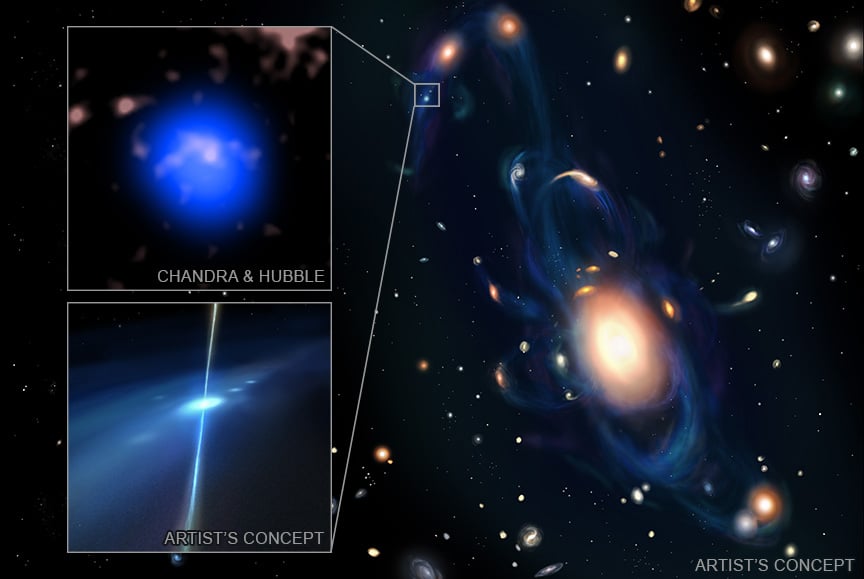
A recent observation involving NASA’s Chandra X-ray Observatory has revealed a particularly unusual example. The event, known as GRB 230906A, appears to originate from a faint galaxy embedded within a vast tidal stream of stars and gas. This stream formed during an earlier collision between larger galaxies. The discovery places a neutron star merger inside the debris of interacting galaxies, a setting rarely associated with such explosions.
Detection of a short gamma-ray burst
The sequence of observations began on September 6, 2023. On that day, NASA’s Fermi Gamma-ray Space Telescope detected a sudden burst of high-energy radiation from a distant region of the sky. The event lasted less than two seconds, which immediately placed it in the category of short gamma-ray bursts.
Short gamma-ray bursts are brief but extremely powerful. They occur when compact objects release enormous amounts of energy within a short time interval. In most cases, astronomers interpret these bursts as the result of neutron star mergers.
Neutron stars form when massive stars explode as supernovae. The core of the star collapses into an object with extraordinary density. A neutron star typically contains more mass than the Sun but compresses it into a sphere only about twenty kilometers across. When two neutron stars exist in a binary system, gravitational radiation gradually shrinks their orbit. Eventually, the stars merge in a violent collision.
The burst detected by Fermi displayed the typical properties of this class of events. After the initial detection, astronomers alerted the global observing network, allowing follow-up observations to begin promptly. Several space telescopes soon turned their attention toward the region where the burst occurred.

X-Ray observations locate the afterglow
Although gamma-ray instruments can detect bursts easily, they often provide only rough positional information. Astronomers rely on observations at other wavelengths to determine the exact location of the source.
NASA’s Neil Gehrels Swift Observatory conducted early follow-up observations and identified emission consistent with an afterglow. However, the precise location remained uncertain. At this stage, researchers requested observations with the Chandra X-ray Observatory.
Chandra possesses exceptional angular resolution in the X-ray band. This capability allows it to isolate faint X-ray sources in crowded regions of the sky. When Chandra observed the region associated with GRB 230906A, it detected a weak but distinct X-ray afterglow.
More importantly, the observatory determined the position of the source with high precision. This accurate location allowed astronomers to examine the same region using optical and infrared instruments.
Subsequent observations with the Hubble Space Telescope revealed a faint galaxy at the position identified by Chandra. The host galaxy appeared much smaller and dimmer than those normally associated with short gamma-ray bursts. At first glance, the environment looked unusual. A closer inspection revealed the reason.

A galaxy embedded in tidal debris
The faint host galaxy lies inside a large stream of stellar and gaseous material. Astronomers refer to such structures as tidal streams or tidal tails. These features form when galaxies pass close to one another, and gravitational forces pull material away from them.
During a galactic encounter, stars and gas clouds respond to the changing gravitational field. As a result, matter can stretch outward and form elongated structures extending far beyond the galaxies themselves. Over time, these structures may grow to enormous sizes.
Observations indicate that the tidal stream associated with GRB 230906A extends roughly six hundred thousand light-years across. This scale exceeds the diameter of the Milky Way several times. The structure represents the remnants of a major interaction between galaxies that occurred in the distant past.
Within this tidal debris, gas clouds continued to evolve. Gravity caused some of the gas to collapse, which triggered new episodes of star formation. In certain regions, the material condensed enough to form small galaxies. Astronomers refer to these systems as tidal dwarf galaxies because they originate from material stripped during galactic encounters.
The host galaxy of GRB 230906A appears to be one of these objects. Its location inside the tidal stream explains why the gamma-ray burst appears far from the center of any large galaxy.
Formation of the neutron star binary
The neutron star merger responsible for GRB 230906A represents the final step in a much longer sequence of astrophysical processes. The earlier collision between galaxies likely triggered widespread star formation in the tidal debris. As gas clouds collapsed, they produced new generations of stars, including some massive ones.
Massive stars evolve quickly compared with lower-mass stars. After exhausting their nuclear fuel, they explode as supernovae. The explosion expels the outer layers of the star into space while the core collapses into a neutron star.
In some systems, two massive stars form together as a binary pair. When both stars eventually explode, the system may contain two neutron stars bound by gravity. Such binaries gradually lose orbital energy through gravitational radiation. As a result, the stars spiral closer together over time.
Astronomers estimate that the neutron star pair associated with GRB 230906A may have formed hundreds of millions of years ago. Observational analysis suggests that the progenitor stars likely formed during a period of star formation triggered by the earlier galaxy interaction.
After their formation, the neutron stars continued to orbit each other while slowly losing energy. Eventually, the orbit became unstable, and the stars merged. The collision produced the intense gamma-ray burst observed in 2023.
Clear skies!
See more from DIYPhotography.net on Google
Add DIYPhotography.net as a trusted source. This makes
our stories more likely to appear in your Google Search results.
 Add as a preferred source on Google

Soumyadeep Mukherjee
Soumyadeep Mukherjee is an award-winning astrophotographer from India. He has a doctorate degree in Linguistics. His work extends to the sub-genres of nightscape, deep sky, solar, lunar and optical phenomenon photography. He is also a photography educator and has conducted numerous workshops. His works have appeared in over 40 books & magazines including Astronomy, BBC Sky at Night, Sky & Telescope among others, and in various websites including National Geographic, NASA, Forbes. He was the first Indian to win “Astronomy Photographer of the Year” award in a major category.


Join the Discussion
DIYP Comment Policy
Be nice, be on-topic, no personal information or flames.