





















ESO’s GRAVITY+ Unveils Hidden Binary Star in the Tarantula Nebula
Nov 10, 2025
Soumyadeep Mukherjee
Soumyadeep Mukherjee is an award-winning astrophotographer from India. He has a doctorate degree in Linguistics. His work extends to the sub-genres of nightscape, deep sky, solar, lunar and optical phenomenon photography. He is also a photography educator and has conducted numerous workshops. His works have appeared in over 40 books & magazines including Astronomy, BBC Sky at Night, Sky & Telescope among others, and in various websites including National Geographic, NASA, Forbes. He was the first Indian to win “Astronomy Photographer of the Year” award in a major category.
Share:
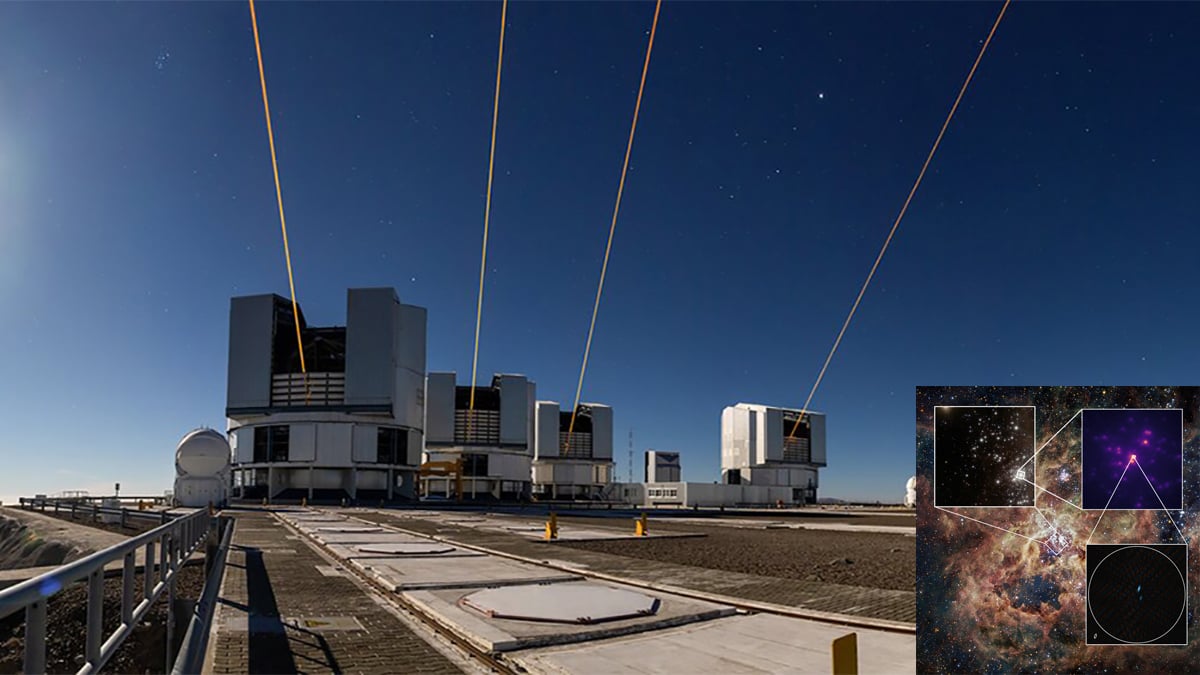
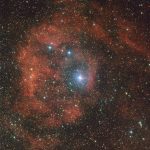
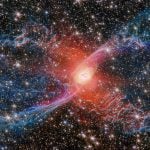
The Tarantula Nebula has revealed a secret that was hiding in plain sight. A star once thought to be a single, gigantic object has now been exposed as a close binary pair. This discovery comes from the European Southern Observatory’s Very Large Telescope Interferometer (VLTI) using its newly upgraded GRAVITY+ instrument. It’s the first major image from GRAVITY+ since the upgrade, and marks a new era for observing the Universe in sharper detail than ever before.
A big discovery in a famous nebula
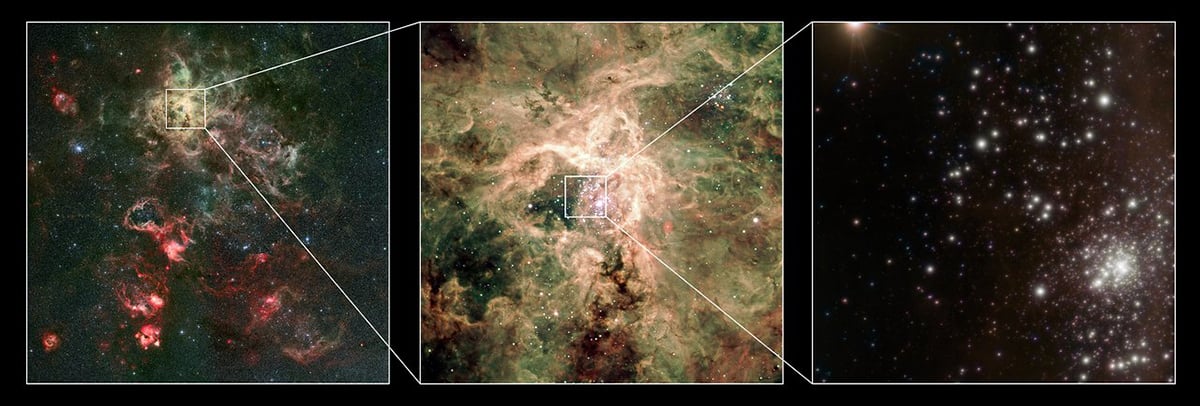
The Tarantula Nebula, located in the Large Magellanic Cloud, is one of the brightest and most active star-forming regions near the Milky Way. Astronomers have studied it for decades, fascinated by its massive stars and powerful stellar winds.
At its center lies a cluster of hot, luminous stars that have shaped the surrounding gas and dust. One of these bright objects was believed to be a single, extremely massive star, possibly one of the heaviest ever found.
But GRAVITY+ has now shown that this object isn’t alone. It’s actually two stars locked in a close orbit around each other. The new image reveals the binary with stunning clarity, proving that what we thought was one monster star is, in fact, two.

The GRAVITY+
This discovery is a direct demonstration of the new GRAVITY+, the upgraded interferometric system at ESO’s Paranal Observatory in Chile. The original GRAVITY instrument already made headlines when it tracked stars orbiting the supermassive black hole at the center of our galaxy. Now, GRAVITY+ takes that precision to the next level.
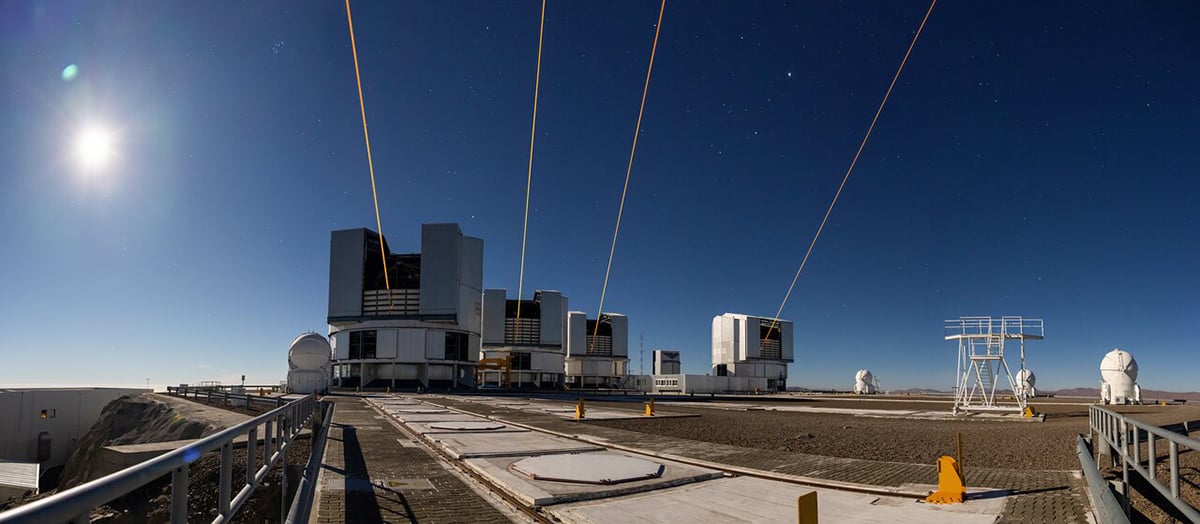
The new system combines the light from ESO’s four 8.2-meter Unit Telescopes. It also uses four laser guide stars, one for each telescope, to correct the blurring effects of Earth’s atmosphere. That combination gives astronomers a virtual telescope with an effective resolution sharp enough to see details equivalent to spotting a coin on the Moon. In this test observation, GRAVITY+ achieved something no single telescope could: it resolved two stars separated by only a few thousandths of an arcsecond.
How it works
Interferometry is a simple concept with complex engineering. Instead of using a single large mirror, astronomers combine the light collected by multiple telescopes. When their signals are added together with perfect timing, they produce interference patterns that can be used to reconstruct images with incredibly fine detail. GRAVITY+ operates in the infrared part of the spectrum, specifically around 2 microns in wavelength. At those wavelengths, the instrument is sensitive to dust-enshrouded regions like the Tarantula Nebula, where many young stars form.
The recent upgrade added adaptive optics systems to each Unit Telescope and installed laser guide stars to help measure how the atmosphere distorts incoming light. With those distortions corrected in real time, GRAVITY+ can now observe fainter and more crowded regions than ever before.
For the Tarantula Nebula test, the team used all four lasers. Each created a glowing point high in the upper atmosphere that acted as an artificial star. These reference points allowed the adaptive optics to make precise corrections. Once the system locked onto its target, it combined the light from all four telescopes. The resulting image revealed two distinct stars instead of one.

The discovery
Astronomers once thought this bright object was a single star with a mass possibly exceeding 150 times that of the Sun. That would make it one of the heaviest stars known. But if the light actually comes from two separate stars, each one is smaller and less massive than believed.
That has big consequences. It means we may have been overestimating the upper limit of stellar masses in the Tarantula Nebula. It also means that binary systems may be far more common among the most massive stars than we thought.
Binaries also play a key role in how stars live and die. When two massive stars orbit closely, they can exchange material, spin each other up, and even merge. These interactions affect the stars’ evolution and can lead to spectacular end stages, including supernovae, neutron stars, or black hole pairs that later merge and emit gravitational waves.

A test that exceeded expectations
The observation was part of GRAVITY+’s commissioning phase, meant to test its new laser guide star adaptive optics system. Engineers wanted to see if the lasers and optics could stabilize the four telescope beams well enough to combine them successfully. The results confirm that GRAVITY+ can now achieve its designed resolution and sensitivity. It also shows that the VLTI can observe fainter and more complex targets, even in crowded regions like the Tarantula Nebula.
Unraveling how these massive systems, like the Tarantula Nebula, evolve is one of modern astronomy’s biggest challenges. GRAVITY+ gives researchers a new way to peer inside these dense environments. By resolving individual stars that used to blur together, scientists can now measure their orbits, masses, and temperatures with far greater accuracy.
Clear skies!
See more from DIYPhotography.net on Google
Add DIYPhotography.net as a trusted source. This makes
our stories more likely to appear in your Google Search results.
 Add as a preferred source on Google

Soumyadeep Mukherjee
Soumyadeep Mukherjee is an award-winning astrophotographer from India. He has a doctorate degree in Linguistics. His work extends to the sub-genres of nightscape, deep sky, solar, lunar and optical phenomenon photography. He is also a photography educator and has conducted numerous workshops. His works have appeared in over 40 books & magazines including Astronomy, BBC Sky at Night, Sky & Telescope among others, and in various websites including National Geographic, NASA, Forbes. He was the first Indian to win “Astronomy Photographer of the Year” award in a major category.
Join the Discussion
DIYP Comment Policy
Be nice, be on-topic, no personal information or flames.