























JWST Photographs Apep’s Spiraling Dust Engine and Hidden Third Star
Nov 23, 2025
Soumyadeep Mukherjee
Soumyadeep Mukherjee is an award-winning astrophotographer from India. He has a doctorate degree in Linguistics. His work extends to the sub-genres of nightscape, deep sky, solar, lunar and optical phenomenon photography. He is also a photography educator and has conducted numerous workshops. His works have appeared in over 40 books & magazines including Astronomy, BBC Sky at Night, Sky & Telescope among others, and in various websites including National Geographic, NASA, Forbes. He was the first Indian to win “Astronomy Photographer of the Year” award in a major category.
Share:
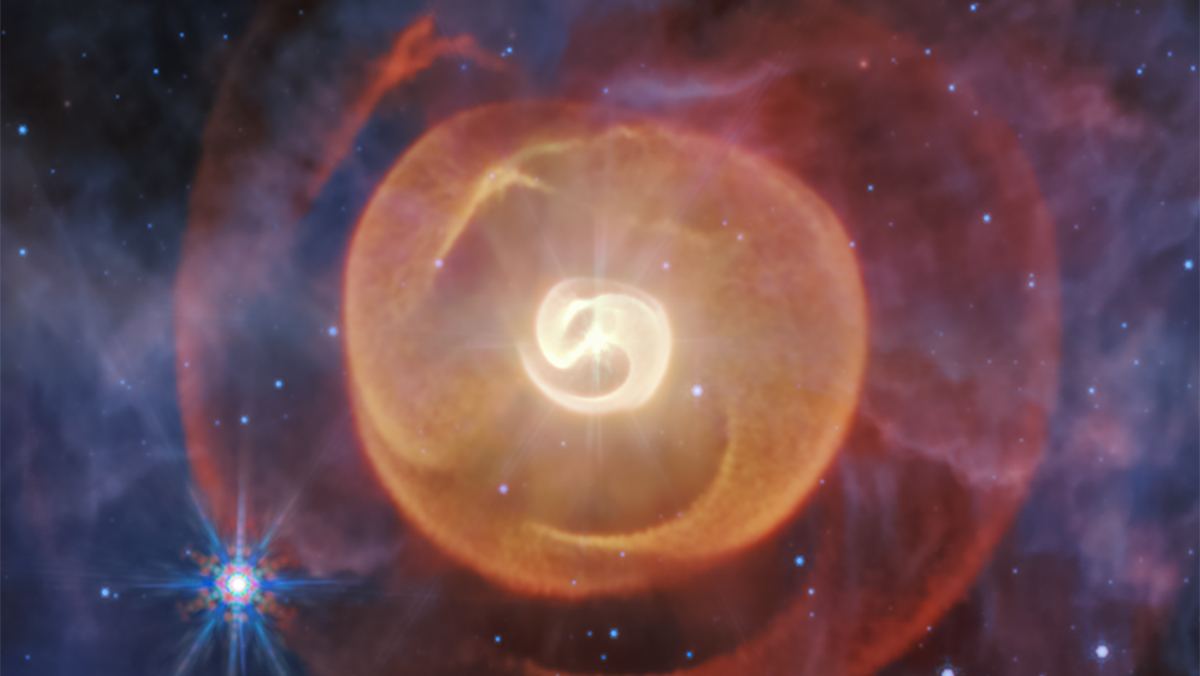
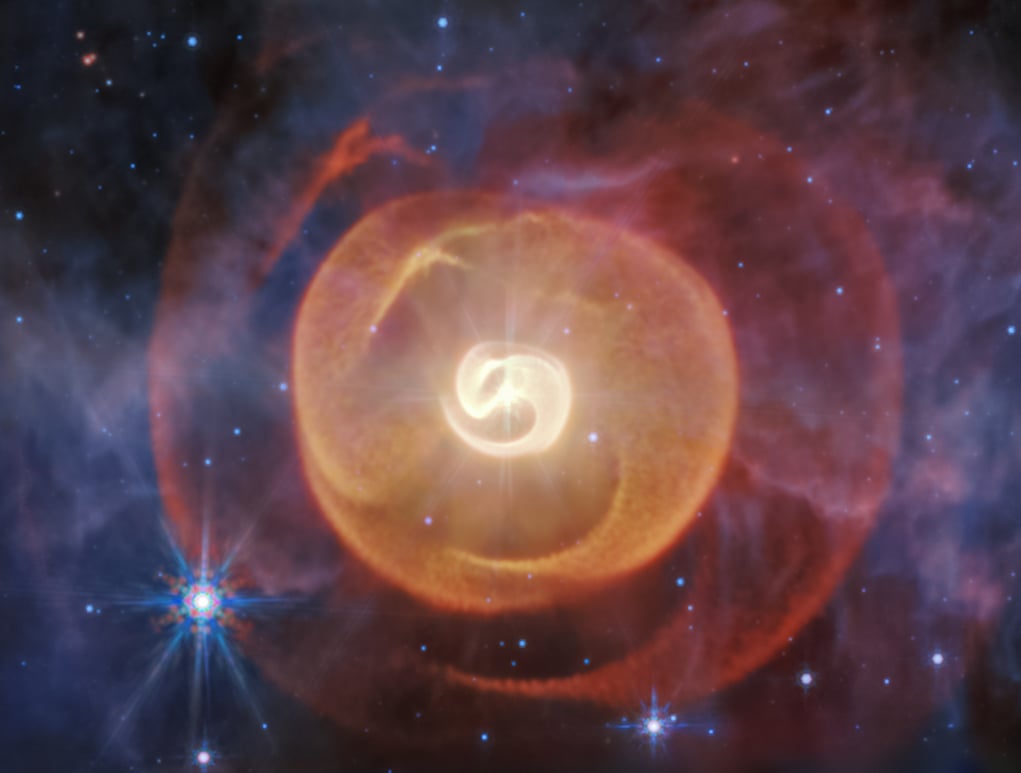
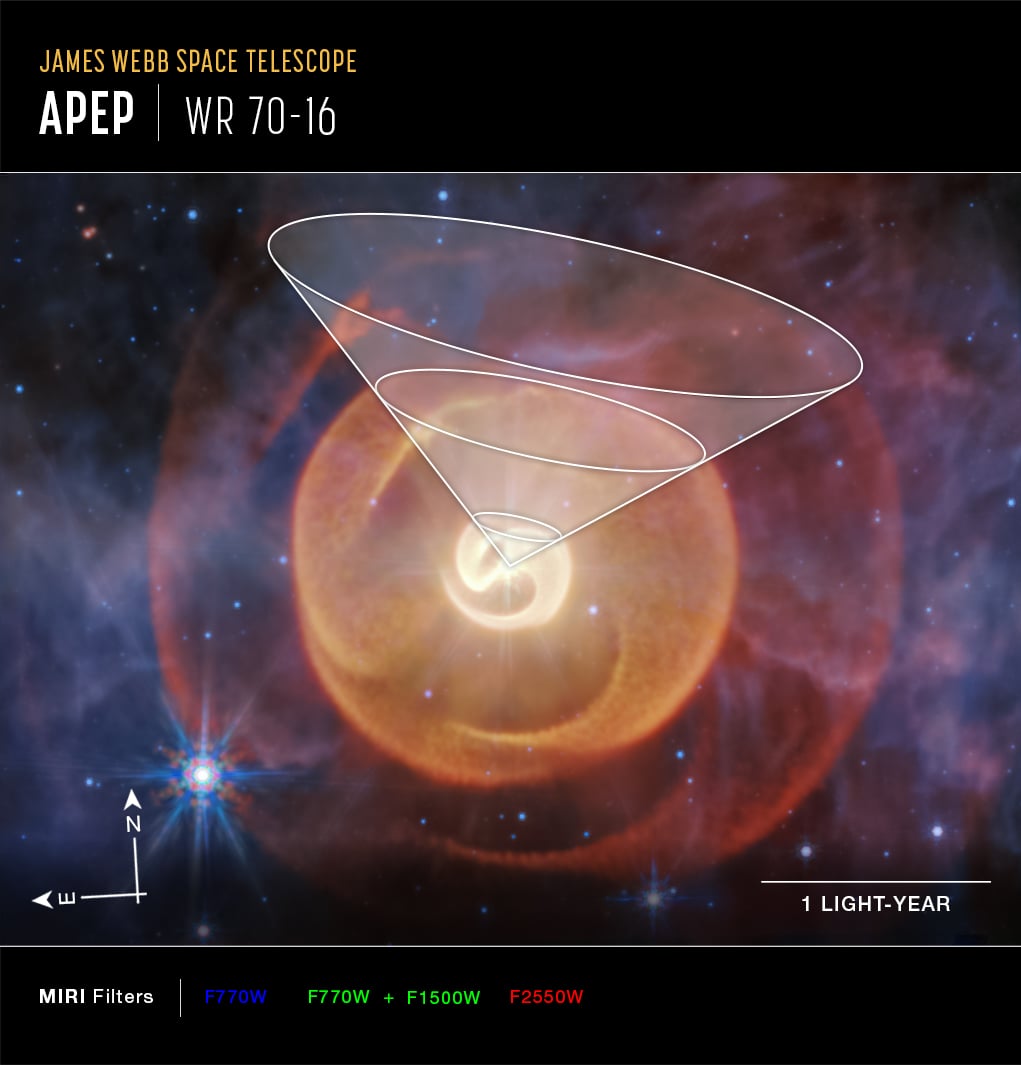
The James Webb Space Telescope has produced a new and sharper look at one of the most unusual stellar systems in our region of the Milky Way. The target is Apep, a complex Wolf-Rayet system that sits almost 8,000 light-years away. JWST’s Mid-Infrared Instrument, or MIRI, has revealed four clean and coiled dust shells wrapped around the system. These shells form a wide spiral that spans nearly four light-years across. This single image resets what astronomers believed about how these massive stars behave, how they lose mass, and how their winds shape the surrounding dust.
This new view goes far beyond earlier observations. Before JWST, researchers had identified only one dusty coil. Now they see four. Each shell records an earlier stage in the system’s history. Each shell carries clues about the winds, the orbit, and the timing of dust formation. With a clearer structure in hand, astronomers can now trace how the stars shed material over centuries. They can also track how each layer expands and how the system evolves as a whole. JWST’s mid-infrared sensitivity made this possible. Other telescopes could not see these faint outer coils with such detail.
A sharper and wider portrait
The new image covers a region that spans about 1.9 arcminutes on the sky. At Apep’s distance, that equals roughly four light-years across. That scale is surprisingly large for material produced by two or three stars in the center. The system ejects carbon dust in periodic waves, and these waves move outward over time to fill this wide region. The image shows a clean spiral that does not break apart until the shells grow older and cooler. It is one of the most orderly dust patterns seen from any Wolf-Rayet system so far.
Most of the brightness comes from mid-infrared emission. Carbon dust glows well in these wavelengths, so MIRI captures it with clarity. The shells appear smooth and consistent in thickness. That consistency suggests a stable formation process. It also suggests that the stars in the center follow a repeatable rhythm in their orbit. This rhythm creates each coil as the stars move around each other.
The engine behind the pattern
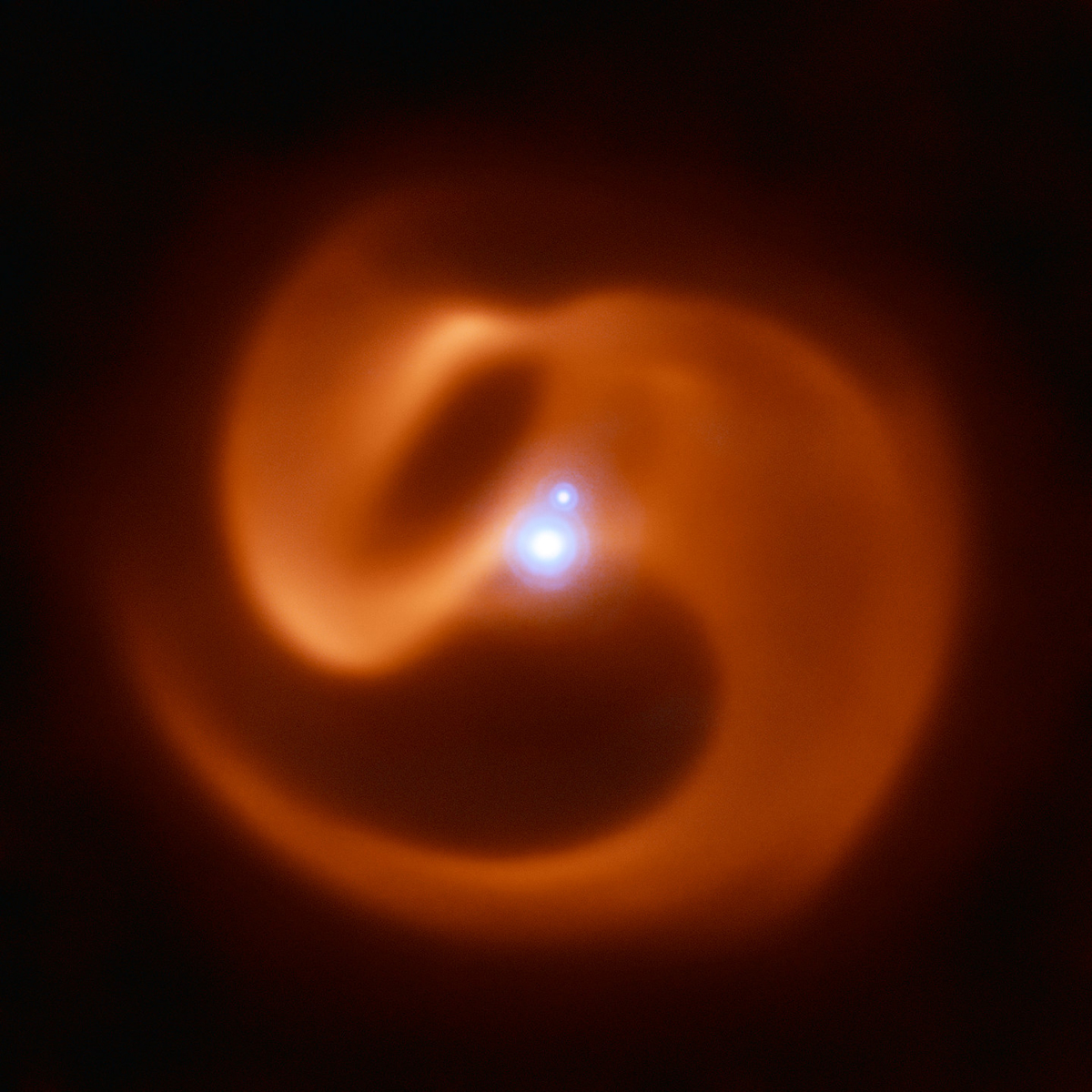
At the heart of Apep sit two Wolf-Rayet stars. These are massive and evolved stars that have already lost much of their outer layers. They blow out strong and steady winds. These winds collide in the space between them. The collision compresses gas and allows dust to form when the material cools. When the stars orbit, the dust stream turns like a sprinkler and creates the spiral we now see.
JWST’s data also confirm a third star. This star orbits at a wider distance from the central pair. Earlier images hinted at its influence, but the new data reveal clear signs. The third star carves cavities and dents into the expanding dust shells. These cavities match the path of an orbiting object with enough mass to disturb the dust but not enough to erase the spiral altogether. The pattern stays intact because the third star does not get too close. Its effect looks like a slow and steady scraping of the surface of each shell. These features make it clear that this third star is gravitationally tied to the system.
This insight matters because it changes how astronomers model the system. A pair of stars can produce a spiral. But a third star adds new forces, including tugs and changes in wind interactions. These forces leave signatures in the dust. JWST’s view makes those signatures visible for the first time.
A timeline written in dust
One of the most useful results from JWST’s data is the timeline hidden in the shells. Researchers estimate that the inner binary has an orbital period of roughly 190 years. Each dust coil marks a point in that orbit. By counting and measuring them, astronomers can trace back almost 700 years of activity. That gives them more than three full orbital cycles to study. Few massive star systems offer such a long and clear record.
The spacing between the shells tells researchers how fast the dust moves. The shape of the spiral shows the orbital motion of the central pair. The thickness of the shells indicates how stable the dust production has been. These factors reveal the rhythm of the winds and the strength of the outflows. JWST’s data allow scientists to check older measurements of wind speed and update them when needed. They can now match the movement of dust with the movement of gas and resolve earlier mismatches reported in other studies.
Dust like this forms only when certain conditions line up. Wolf-Rayet stars produce carbon in their inner layers. They bring this carbon to the surface as their outer layers peel away. Their winds carry that carbon into space. When two Wolf-Rayet winds collide, they can compress the material enough to create dust. The dust then cools and flows outward. JWST’s mid-infrared image shows how effective this system is at producing dust and pushing it outward over centuries.
How the outer star reshapes the picture
The outer star’s effect on the shells is one of the most striking results. Each cavity in the image corresponds to the same relative position on each shell. This means the cavities do not form at random. They come from the same object passing through or near each expanding layer. That object must be the third star.
This carving gives astronomers a new way to model the outer orbit. The shape of the cavities shows the path and speed of the star. The size of the cavities shows how strong its wind is. Earlier models lacked this information because they did not have such clear cavities to study. JWST fills that gap.
The presence of the third star also solves older puzzles. Past measurements reported differences between how fast the gas travels and how fast the dust expands. Those differences created confusion. With the new shells visible, researchers can see how the outer star disturbs the dust. They can now place each measurement in the correct context. That makes the system easier to interpret.
The new dataset gives astronomers a framework for many future studies. Astronomers will track the shells to see how fast they change. They will observe the center again to check for new dust formation and will refine orbital models for both the inner pair and the outer companion. They will also use the system to test how dust grains grow and how they survive in such strong radiation fields.
Clear skies!
See more from DIYPhotography.net on Google
Add DIYPhotography.net as a trusted source. This makes
our stories more likely to appear in your Google Search results.
 Add as a preferred source on Google

Soumyadeep Mukherjee
Soumyadeep Mukherjee is an award-winning astrophotographer from India. He has a doctorate degree in Linguistics. His work extends to the sub-genres of nightscape, deep sky, solar, lunar and optical phenomenon photography. He is also a photography educator and has conducted numerous workshops. His works have appeared in over 40 books & magazines including Astronomy, BBC Sky at Night, Sky & Telescope among others, and in various websites including National Geographic, NASA, Forbes. He was the first Indian to win “Astronomy Photographer of the Year” award in a major category.

Join the Discussion
DIYP Comment Policy
Be nice, be on-topic, no personal information or flames.