

























NASA’s IXPE Photographs Black Hole Jets in Perseus Cluster
Mar 12, 2026
Soumyadeep Mukherjee
Soumyadeep Mukherjee is an award-winning astrophotographer from India. He has a doctorate degree in Linguistics. His work extends to the sub-genres of nightscape, deep sky, solar, lunar and optical phenomenon photography. He is also a photography educator and has conducted numerous workshops. His works have appeared in over 40 books & magazines including Astronomy, BBC Sky at Night, Sky & Telescope among others, and in various websites including National Geographic, NASA, Forbes. He was the first Indian to win “Astronomy Photographer of the Year” award in a major category.
Share:

Relativistic jets from supermassive black holes rank among the most energetic phenomena in the universe. These narrow streams of plasma emerge from the vicinity of an accreting black hole and propagate far beyond their host galaxy. Observations across the electromagnetic spectrum show that these jets radiate strongly at radio, optical, and X-ray wavelengths. However, despite decades of study, the physical mechanism responsible for producing the X-ray emission has remained uncertain.
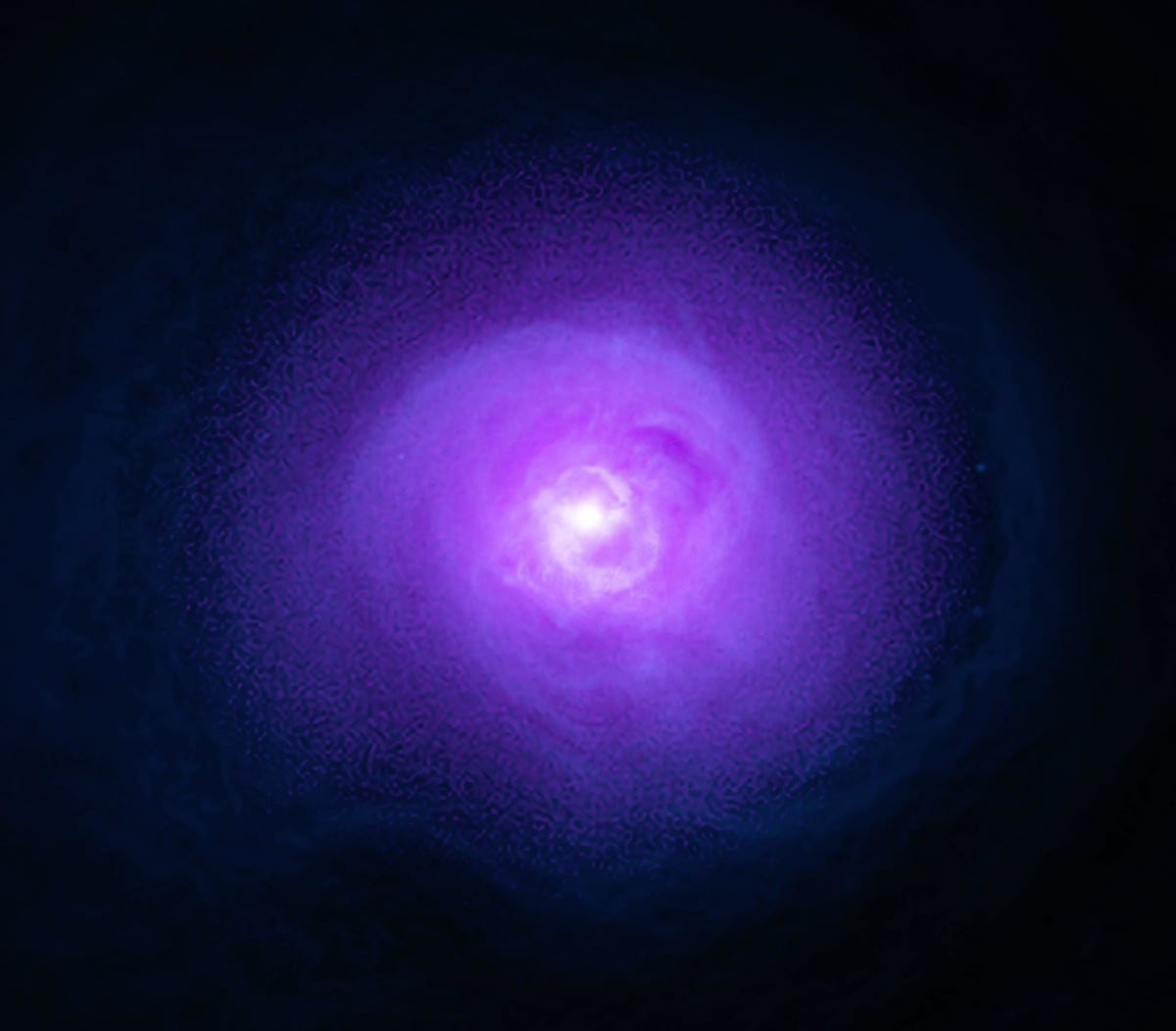
Recent observations by NASA’s Imaging X-ray Polarimetry Explorer (IXPE) have now clarified the situation. The spacecraft completed the longest observation in its mission while studying the Perseus galaxy cluster. During this campaign, IXPE measured the polarization of X-ray emission associated with a powerful jet from the central galaxy. The results strongly support inverse Compton scattering as the primary mechanism responsible for the X-ray radiation.
The Perseus Cluster as an observational target
The Perseus Cluster offers an excellent opportunity to study the interaction between a supermassive black hole and its surrounding environment. This galaxy cluster lies roughly 240 million light-years from Earth and remains one of the brightest extended sources in the X-ray sky. Clusters of galaxies contain vast reservoirs of hot gas that fill the space between galaxies. The gas reaches temperatures of tens of millions of degrees and emits intense X-ray radiation.
At the center of the Perseus Cluster lies the massive galaxy NGC 1275. Its central black hole drives a powerful active galactic nucleus that produces relativistic jets. These jets push into the surrounding cluster gas, creating large cavities that are clearly visible in X-ray images. The energy released by the jets influences the thermal structure of the entire cluster core.
Because the system is bright and well studied, astronomers often use it as a natural laboratory for exploring jet physics. The central radio source, commonly known as 3C 84, emits radiation across a wide range of wavelengths. Observatories have monitored the source for many years, which provides valuable context for new observations.
IXPE targeted the Perseus Cluster during an extended observing campaign. The spacecraft accumulated more than 600 hours of exposure over roughly two months. This record-length observation allowed researchers to collect enough photons to measure the subtle polarization signature of the X-ray emission.

X-ray polarimetry opens a new diagnostic tool
Traditional X-ray telescopes measure the intensity and energy distribution of incoming photons. These measurements reveal important properties of astrophysical sources, including temperature and chemical composition. Nevertheless, they provide limited information about the orientation of electromagnetic waves.
Polarization measurements add dimension to the analysis. Polarization describes the direction in which the electric field of a light wave oscillates. Different radiation processes generate distinct polarization patterns. Consequently, measuring polarization allows astronomers to determine how the radiation formed.
X-ray polarimetry remained technically challenging for many years. Detecting polarization requires highly sensitive detectors capable of recording the direction of electron tracks created when X-ray photons interact with matter. Only recently has the necessary instrumentation become available.
NASA launched the Imaging X-ray Polarimetry Explorer in December 2021 to exploit this capability. The spacecraft carries three identical telescopes designed specifically to measure polarization in the X-ray band. Each telescope focuses incoming photons onto detectors that determine both the energy and polarization of the radiation.
This approach enables scientists to examine the geometry and physical processes within extreme environments such as black hole jets and neutron star magnetospheres. The Perseus Cluster observation provided an ideal opportunity to apply this method to a long-standing astrophysical problem.

Evidence from the longest IXPE observation
The extended IXPE observation of the Perseus Cluster provided the data necessary to test these models. Scientists carefully analyzed the polarization of X-ray photons associated with the jet emerging from the central black hole. The IXPE mission observed the Perseus Cluster in X-rays for more than 600 hours over 60 days between January and March.
The results revealed a polarization level significantly lower than expected for synchrotron radiation. If synchrotron emission dominated the X-ray production, the detectors should have measured a stronger polarization signal aligned with the magnetic field structure of the jet.
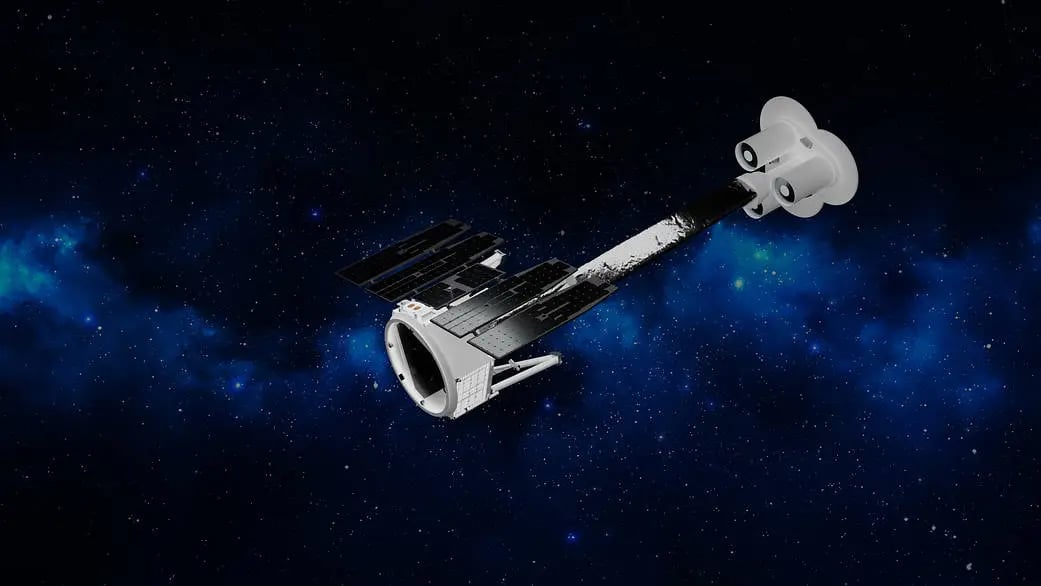
Instead, the observed polarization remained weak. This finding strongly supports the interpretation that inverse Compton scattering generates the X-ray emission. In this scenario, energetic electrons within the jet collide with lower-energy photons and boost them into the X-ray range.
Researchers combined IXPE measurements with data from several other space observatories. Observations from Chandra, NuSTAR, and the Neil Gehrels Swift Observatory provided complementary information about the spectral properties and variability of the source. Together, these data sets produced a coherent picture of the radiation processes operating in the jet.
The combined analysis suggests that synchrotron photons generated within the jet likely serve as the seed photons for the scattering process. Relativistic electrons then scatter these photons to higher energies, producing the observed X-ray emission.
Clear skies!
See more from DIYPhotography.net on Google
Add DIYPhotography.net as a trusted source. This makes
our stories more likely to appear in your Google Search results.
 Add as a preferred source on Google

Soumyadeep Mukherjee
Soumyadeep Mukherjee is an award-winning astrophotographer from India. He has a doctorate degree in Linguistics. His work extends to the sub-genres of nightscape, deep sky, solar, lunar and optical phenomenon photography. He is also a photography educator and has conducted numerous workshops. His works have appeared in over 40 books & magazines including Astronomy, BBC Sky at Night, Sky & Telescope among others, and in various websites including National Geographic, NASA, Forbes. He was the first Indian to win “Astronomy Photographer of the Year” award in a major category.




Join the Discussion
DIYP Comment Policy
Be nice, be on-topic, no personal information or flames.