



















Awakening of a Sleeping Giant: VLA and VLBA Photographs a Supermassive Black Hole
Aug 13, 2025
Soumyadeep Mukherjee
Soumyadeep Mukherjee is an award-winning astrophotographer from India. He has a doctorate degree in Linguistics. His work extends to the sub-genres of nightscape, deep sky, solar, lunar and optical phenomenon photography. He is also a photography educator and has conducted numerous workshops. His works have appeared in over 40 books & magazines including Astronomy, BBC Sky at Night, Sky & Telescope among others, and in various websites including National Geographic, NASA, Forbes. He was the first Indian to win “Astronomy Photographer of the Year” award in a major category.
Share:
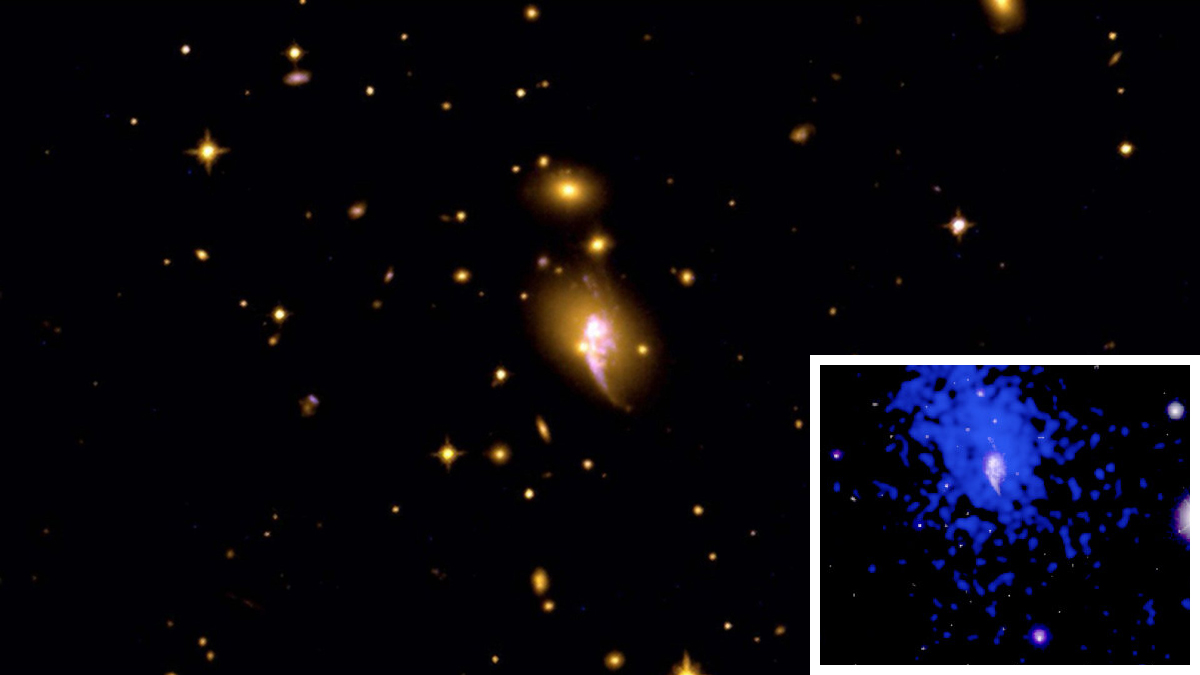
When astronomers turned their instruments toward CHiPS 1911+4455, they didn’t expect to witness a cosmic awakening. Yet that is precisely what they saw: a supermassive black hole stirring from a long slumber, firing its first jets and unleashing its power at the heart of a galaxy cluster. This rare, early-stage ignition unfolds some six billion light-years from Earth, and it offers a front-row seat to the birth of active galactic feedback.
A snap in cosmic time
Black holes are famously silent, until they feed. When cold gas spirals inward, it heats up and radiates. In dramatic cases, jets of plasma launch at near-light speed. Most black hole studies catch them midspeech, already shaping their surroundings with vast bubbles and sweeping waves. But this discovery offers something different. Observations show a black hole that turned on only about a thousand years ago, an instant in cosmic terms. At that infancy, its jets measure just thirty parsecs (roughly a hundred light-years), tiny when compared to the hundreds of thousands of light-years of older radio galaxies. The radio spectrum, rising sharply and then falling, marks this galaxy as a newborn in action.
Telescopes that made the sight possible
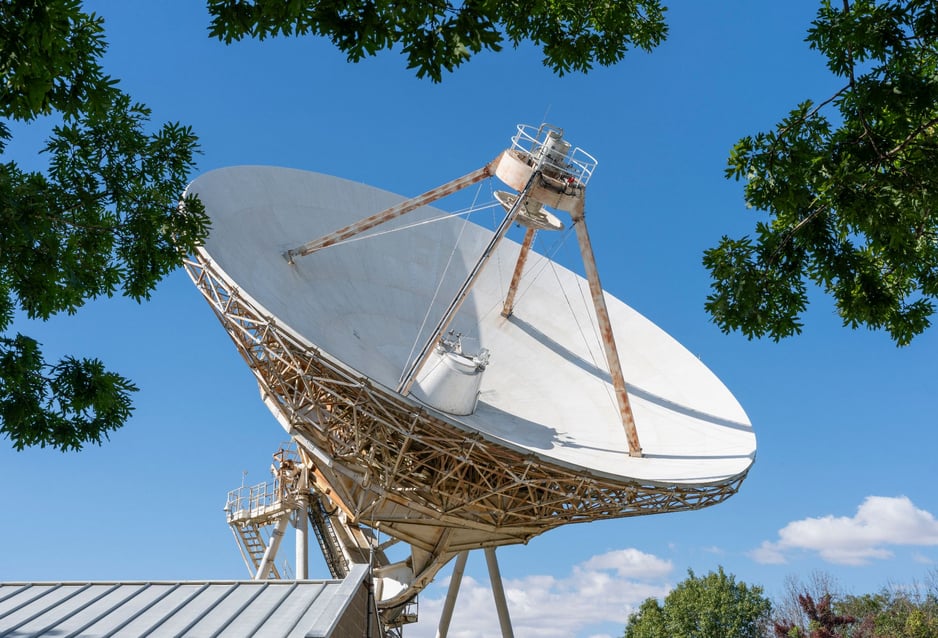
Precision matters when capturing such a fleeting moment. The team combined two of the National Science Foundation’s radio workhorses: the Very Long Baseline Array (VLBA) and the Karl G. Jansky Very Large Array (VLA). The VLA, with its 27 dishes spread across New Mexico, yields high sensitivity and a wide-field view, catching fainter, sprawling radio features. The VLBA, spanning up to 8,600 kilometers, gives milliarcsecond resolution, perfect for zooming in on the tiny jets emerging near the black hole. Together, these arrays captured the newborn jets and traced the broader context of star formation around them.
A galaxy cluster primed to ignite
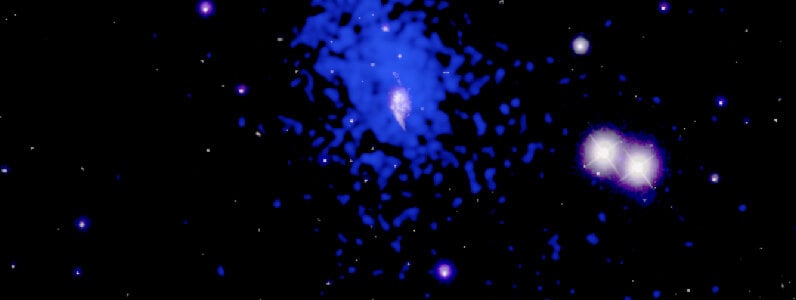
What triggered the black hole to wake? The answer lies in the cluster’s cooling gas. CHiPS 1911+4455 exhibits low entropy in its core, signaling rapid cooling and imminent gas collapse. That cooling gas likely fed both the black hole and a furious burst of star formation. The brightest cluster galaxy there births stars at a rate between 140 and 190 Suns per year, astonishing for such a massive, central galaxy. This extreme starburst heralds a deluge of cold material raining toward the center. The radio images even reveal wispy “whiskers” of emission from massive stars and supernovae, mapping where gas fuels both stars and the black hole alike.
The recent spark
A cluster does not awaken in isolation. CHiPS 1911+4455 bears the sign of a recent merger; its X-ray morphology looks twisted and disturbed. Such events can stir the intracluster medium, compress hot gas, and hasten cooling, a prime condition for black-hole feeding. The imagery threading cold gas, stars, and the infant jet supports a scenario where a cosmic collision helped trigger this dramatic ignition. Amid the swirl of cluster dynamics, gas cooled rapidly, fueled intense star formation, and then ignited the dormant black hole. Now the central engine has flicked on, just as the surroundings remain receptive.
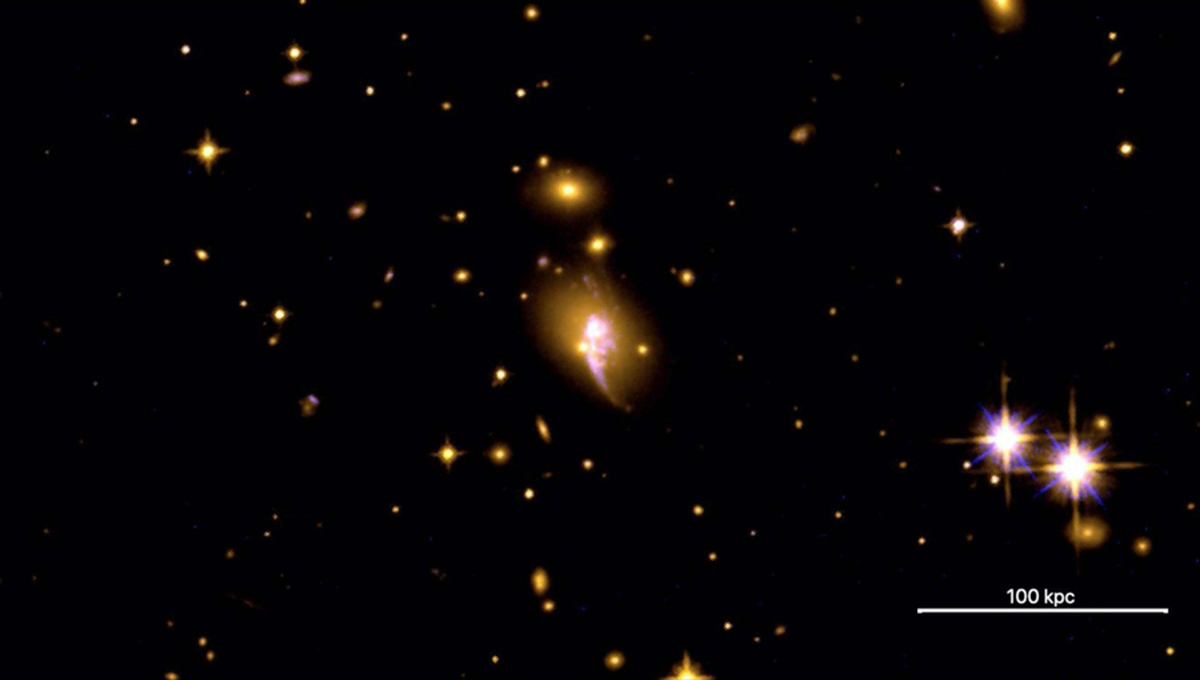
The survey “Clusters Hiding in Plain Sight” (CHiPS) targets clusters disguised as bright point sources in older X-ray maps. CHiPS 1911+4455 appeared odd in legacy data. Follow-up revealed its hidden cluster nature. Similar finds may reveal more pre-feedback black holes, building a sample we can watch as they awaken. Upcoming upgrades to VLA and VLBA will further sharpen our vision. Enhanced sensitivity, bandwidth, and digital backend systems will accelerate the discovery of new awakening black holes and refine our timeline of radio galaxy infancy.
Clear skies!
See more from DIYPhotography.net on Google
Add DIYPhotography.net as a trusted source. This makes
our stories more likely to appear in your Google Search results.
 Add as a preferred source on Google

Soumyadeep Mukherjee
Soumyadeep Mukherjee is an award-winning astrophotographer from India. He has a doctorate degree in Linguistics. His work extends to the sub-genres of nightscape, deep sky, solar, lunar and optical phenomenon photography. He is also a photography educator and has conducted numerous workshops. His works have appeared in over 40 books & magazines including Astronomy, BBC Sky at Night, Sky & Telescope among others, and in various websites including National Geographic, NASA, Forbes. He was the first Indian to win “Astronomy Photographer of the Year” award in a major category.


Join the Discussion
DIYP Comment Policy
Be nice, be on-topic, no personal information or flames.
One response to “Awakening of a Sleeping Giant: VLA and VLBA Photographs a Supermassive Black Hole”
What part of “do-it-yourself” don’t you understand?