
























EHT Photographs a Flip around the Supermassive Black Hole at M87 Galaxy
Oct 6, 2025
Soumyadeep Mukherjee
Soumyadeep Mukherjee is an award-winning astrophotographer from India. He has a doctorate degree in Linguistics. His work extends to the sub-genres of nightscape, deep sky, solar, lunar and optical phenomenon photography. He is also a photography educator and has conducted numerous workshops. His works have appeared in over 40 books & magazines including Astronomy, BBC Sky at Night, Sky & Telescope among others, and in various websites including National Geographic, NASA, Forbes. He was the first Indian to win “Astronomy Photographer of the Year” award in a major category.
Share:

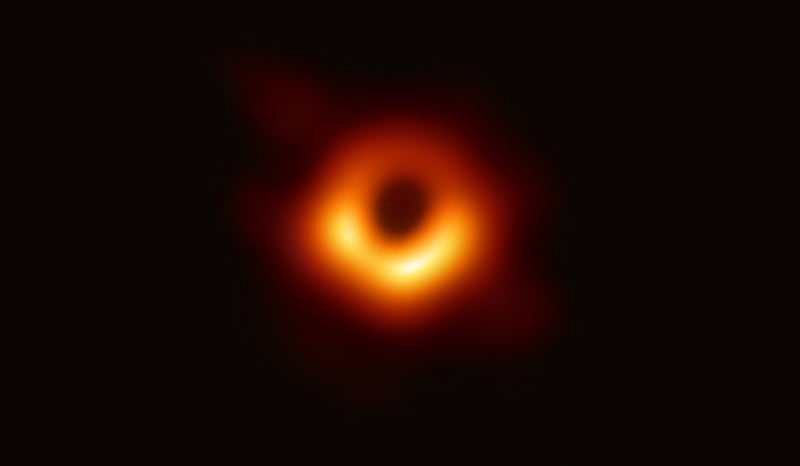
When the Event Horizon Telescope (EHT) unveiled the first-ever image of a black hole in 2019, it instantly became an iconic symbol. That glowing orange ring surrounding a dark shadow, the supermassive black hole at the center of galaxy Messier 87, offered humanity its first direct look at one of nature’s most extreme objects.
Initially, M87* appeared calm and unchanging. But new observations have shattered that illusion. Between 2017 and 2021, the light around this black hole changed its polarization, a property that reveals the direction of magnetic fields. Even more surprisingly, those fields appear to have flipped direction entirely.
This finding, revealed by the EHT collaboration in 2025, suggests that the region surrounding M87* is far more dynamic than anyone expected. The flip hints at a turbulent magnetic environment where powerful fields twist, reconnect, and reorganize around the event horizon.
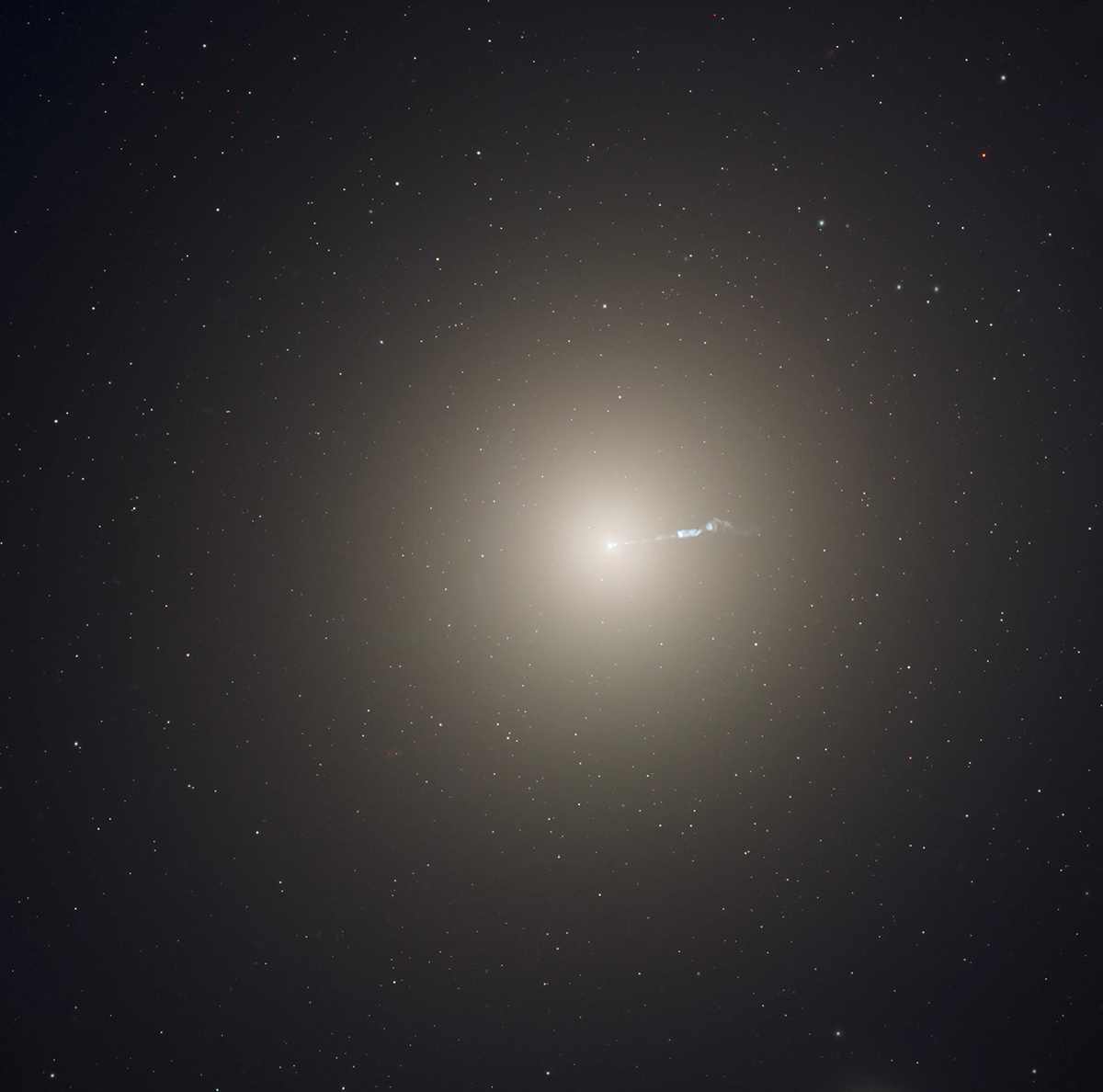
The giant in the Virgo cluster
M87 lies about 55 million light-years away in the Virgo Cluster. It’s a massive elliptical galaxy, home to a black hole weighing around 6.5 billion solar masses. At this scale, its event horizon, the point of no return, is roughly the size of our entire solar system.
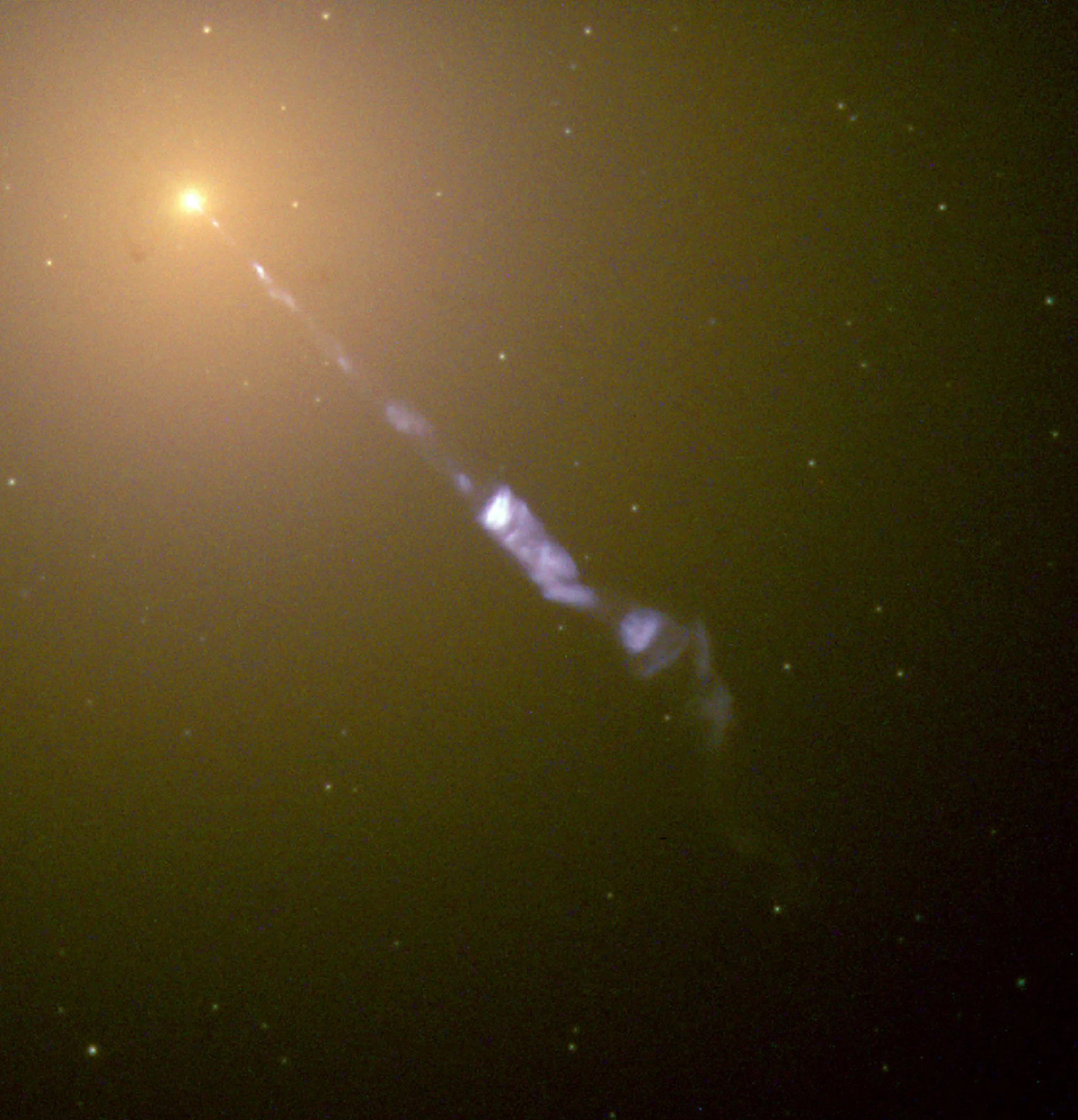
What makes M87* even more fascinating is its jet, a narrow beam of charged particles extending thousands of light-years into space. The black hole’s rotation powers this jet and the magnetic fields anchored in its accretion disk. Understanding how those fields behave is key to understanding how jets form and evolve.
The EHT began observing M87* in 2017, linking radio telescopes around the world to act as one giant Earth-sized observatory. The first image, published in 2019, confirmed Einstein’s theory of general relativity with stunning precision. But as the EHT continued its long-term monitoring, the story became more complex.
A magnetic flip caught in the act
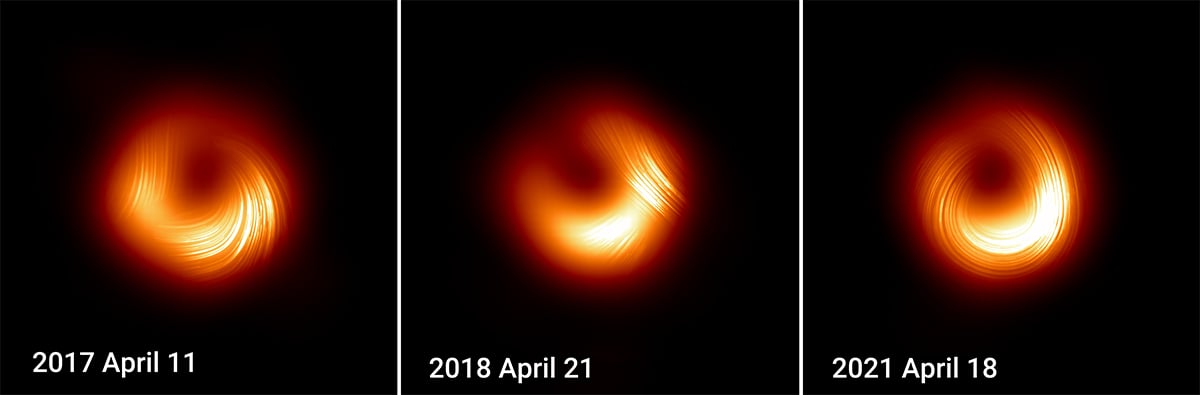
The team compared data from three observing campaigns: 2017, 2018, and 2021. The size and structure of the ring stayed remarkably stable, around 43.9 micro-arcseconds in diameter. But the polarization patterns told a new story.
In 2017, the EHT found that the polarized light around M87* traced magnetic field lines curling clockwise. By 2021, the orientation had reversed, forming a counterclockwise pattern. Even more, the degree of polarization dropped, from roughly 15 percent to about 5 percent.
Polarization traces how light waves oscillate, and in synchrotron emission, produced when electrons spiral along magnetic fields, it directly maps field directions. The observed flip means the magnetic structure near the event horizon changed dramatically. The reversal affected the entire inner region, suggesting a global reorganization of magnetic fields. That’s a sign that M87*’s magnetized plasma is unstable, constantly interacting and reconnecting as matter swirls inward.
How the images were captured
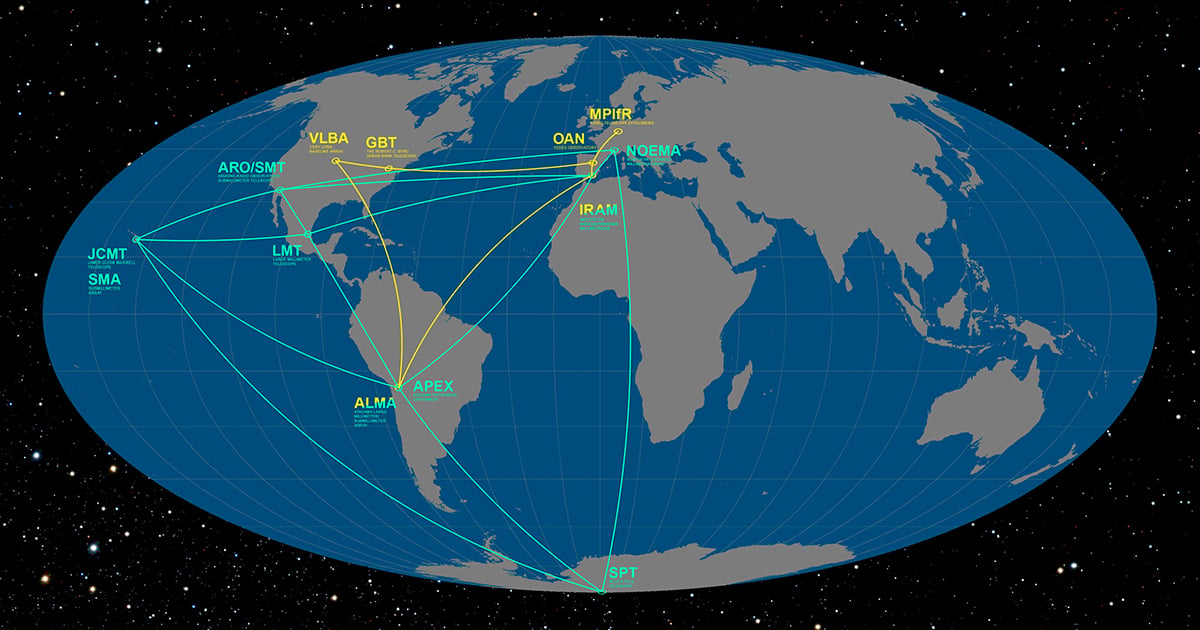
The Event Horizon Telescope isn’t a single instrument. It’s a network of radio observatories stretching from the South Pole to Spain, from Chile to Hawaii. Together, they use a method called Very Long Baseline Interferometry (VLBI).
Each station observes the black hole simultaneously at a frequency of 230 GHz (a wavelength of 1.3 millimeters). Atomic clocks keep their timing synchronized to within billionths of a second. When the signals are later combined, they create an effective telescope with the resolution equivalent to an Earth-sized mirror.
The 2021 observing run added several new telescopes, including NOEMA in France and Kitt Peak in the U.S., which filled crucial gaps in the array. This increased the sensitivity and improved the clarity of polarization measurements. The Atacama Large Millimeter/submillimeter Array (ALMA) in Chile continued to serve as the most sensitive element, contributing the bulk of the signal strength.
From terabytes to a clear image
Once the data are collected, the real work begins. Each telescope’s recordings are shipped to correlation centers in the U.S. and Germany, where the raw signals are aligned in time and frequency. Calibration comes next, correcting for atmospheric interference, instrumental delays, and tiny differences between telescopes.
The EHT collaboration then uses a combination of imaging algorithms to reconstruct the final picture. These include CLEAN, Maximum Entropy, and Regularized Maximum Likelihood (RML) methods. Each team works independently to ensure that the resulting structures are real and not artifacts of a single algorithm. Polarization imaging is even more demanding. Scientists must separate the horizontal and vertical components of the radio waves and determine how their orientation changes across the image. From this, they map the direction of the magnetic field lines.
A crucial correction involves Faraday rotation, a twisting of polarization caused by ionized gas between Earth and the black hole. To isolate the intrinsic pattern around M87*, researchers model and subtract these intervening effects. The process can take years, but it ensures every polarization vector in the image reflects real physics near the event horizon.
Understanding the flip: A living portrait of a black hole
The EHT’s findings point to rapid and large-scale magnetic changes near M87*. But what could cause such a reversal? One explanation involves a process called magnetic reconnection, where tangled magnetic field lines break and reconnect, releasing energy. This can reverse the field’s direction locally and alter the flow of plasma. Another possibility is a change in the accretion flow, where the disk alternates between magnetically dominated and plasma-dominated states.
Many researchers think M87* may be in a magnetically arrested disk (MAD) state. In this model, the magnetic field becomes so strong it temporarily halts the inward flow of gas. When pressure builds up, the system reorganizes, sometimes flipping the overall field. This could happen on timescales of a few years, consistent with what the EHT observed.
Interestingly, while the magnetic environment changed, the black hole’s size and shadow remained constant. That stability supports general relativity’s predictions: gravity’s structure is steady, even when the surrounding plasma is turbulent.
The upcoming Next Generation EHT (ngEHT) will add more telescopes, improve data rates, and use multiple observing frequencies. This will sharpen the resolution and reveal how polarization evolves on shorter timescales, perhaps even capturing a full cycle of magnetic reversal.
Clear skies!
See more from DIYPhotography.net on Google
Add DIYPhotography.net as a trusted source. This makes
our stories more likely to appear in your Google Search results.
 Add as a preferred source on Google

Soumyadeep Mukherjee
Soumyadeep Mukherjee is an award-winning astrophotographer from India. He has a doctorate degree in Linguistics. His work extends to the sub-genres of nightscape, deep sky, solar, lunar and optical phenomenon photography. He is also a photography educator and has conducted numerous workshops. His works have appeared in over 40 books & magazines including Astronomy, BBC Sky at Night, Sky & Telescope among others, and in various websites including National Geographic, NASA, Forbes. He was the first Indian to win “Astronomy Photographer of the Year” award in a major category.



Join the Discussion
DIYP Comment Policy
Be nice, be on-topic, no personal information or flames.