

















JWST Photographs an Oversized Black Hole in a Tiny Infant Galaxy
Nov 21, 2025
Soumyadeep Mukherjee
Soumyadeep Mukherjee is an award-winning astrophotographer from India. He has a doctorate degree in Linguistics. His work extends to the sub-genres of nightscape, deep sky, solar, lunar and optical phenomenon photography. He is also a photography educator and has conducted numerous workshops. His works have appeared in over 40 books & magazines including Astronomy, BBC Sky at Night, Sky & Telescope among others, and in various websites including National Geographic, NASA, Forbes. He was the first Indian to win “Astronomy Photographer of the Year” award in a major category.
Share:
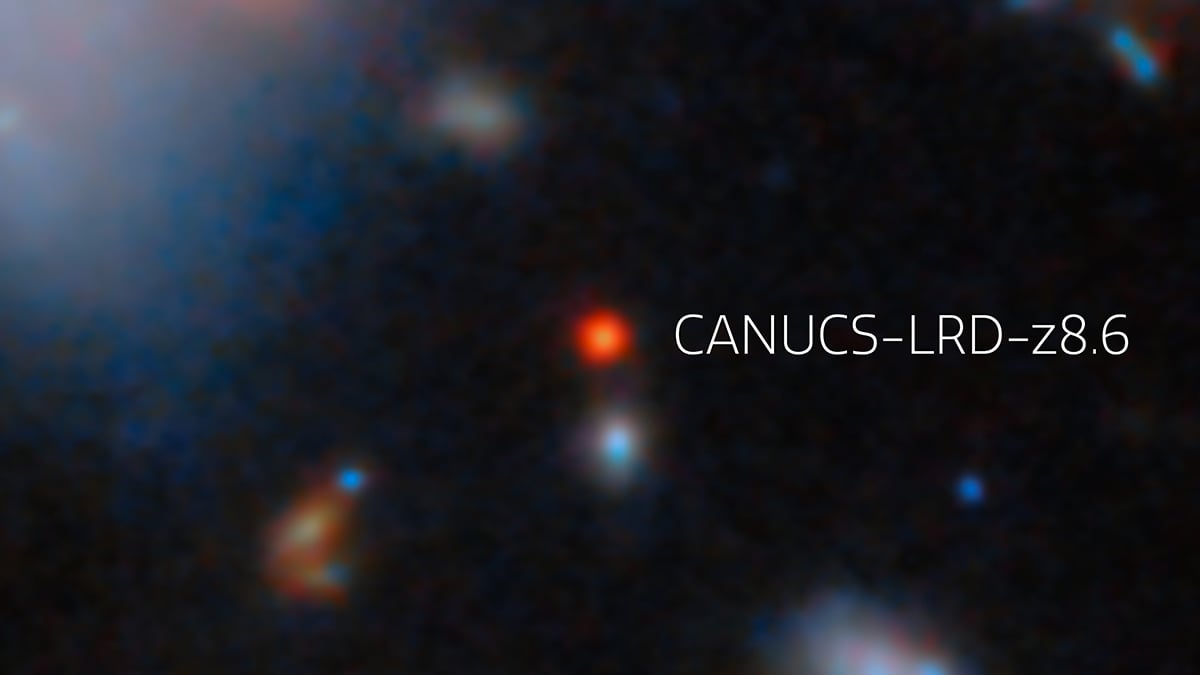
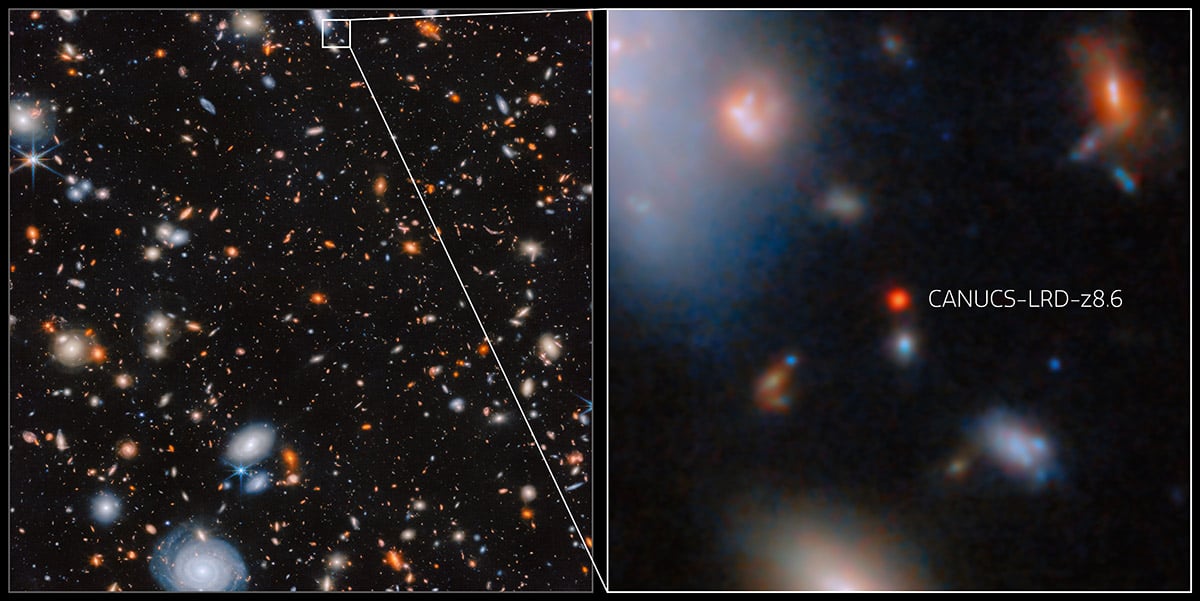
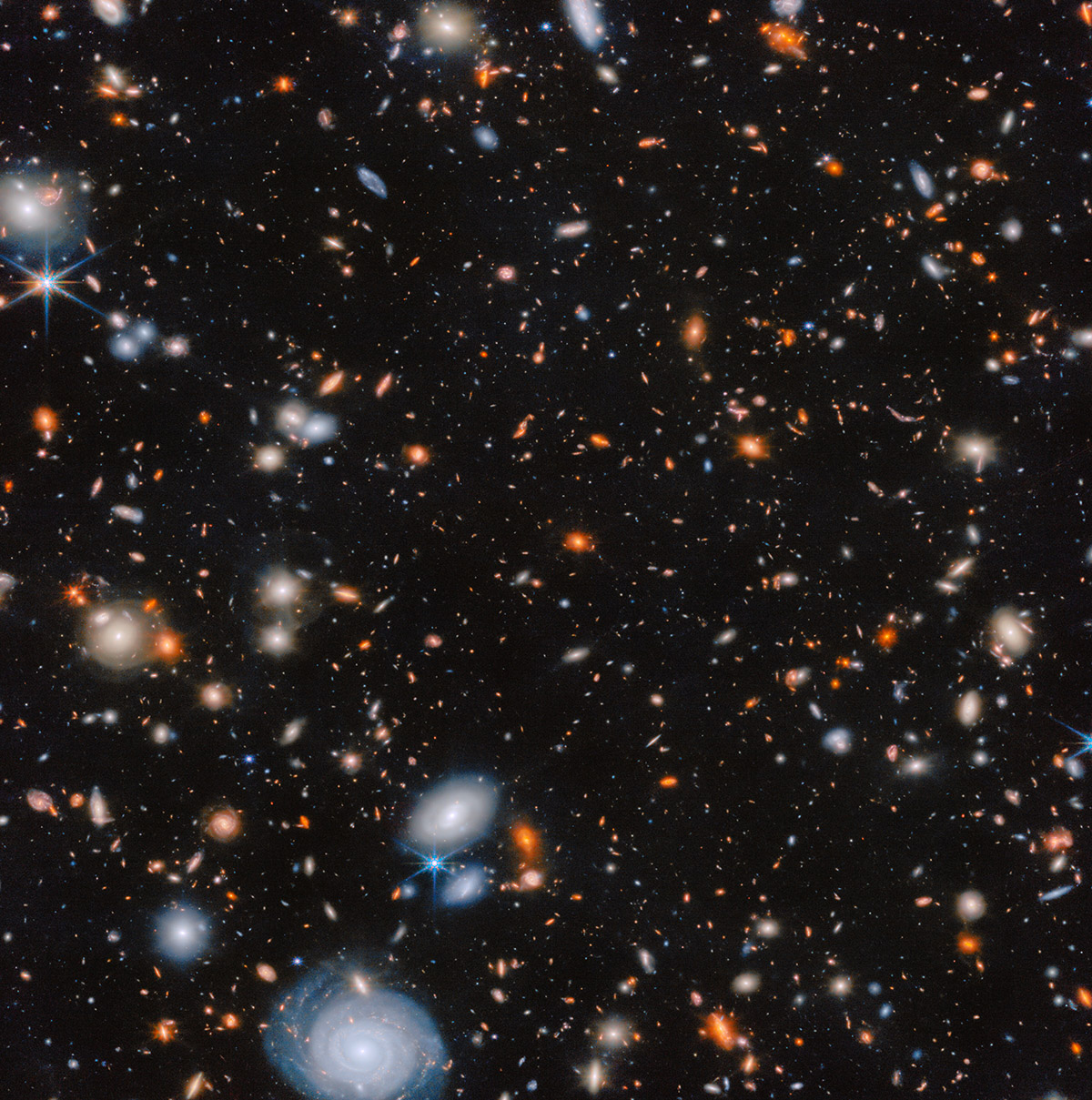
When astronomers looked at a deep field image from the James Webb Space Telescope (JWST), they spotted a faint, crimson speck tucked among the brighter galaxies of the cluster MACS J1149.5+2223. It seemed unremarkable. But that unassuming dot, named CANUCS-LRD-z8.6, harbors a cosmic heavyweight: a rapidly feeding supermassive black hole, seen when the universe was only about 570 million years old. This discovery, announced by ESA and the CANUCS team in November 2025, challenges our understanding of how black holes and galaxies first formed together.
A tiny galaxy hiding a monster
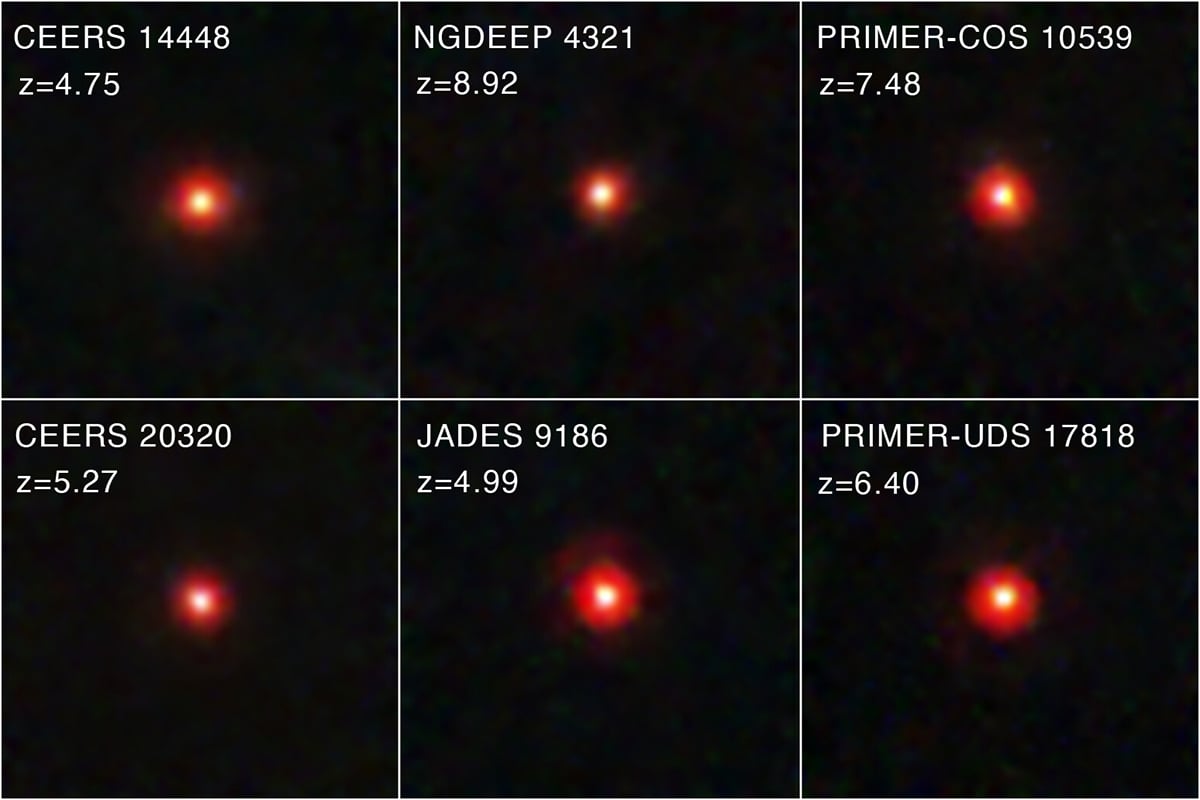
CANUCS-LRD-z8.6 belongs to a population of faint, red, distant galaxies that JWST has started to reveal, the so-called Little Red Dots (LRDs). These galaxies are small, compact, and surprisingly red in colour, thanks to how their light is stretched into the infrared.
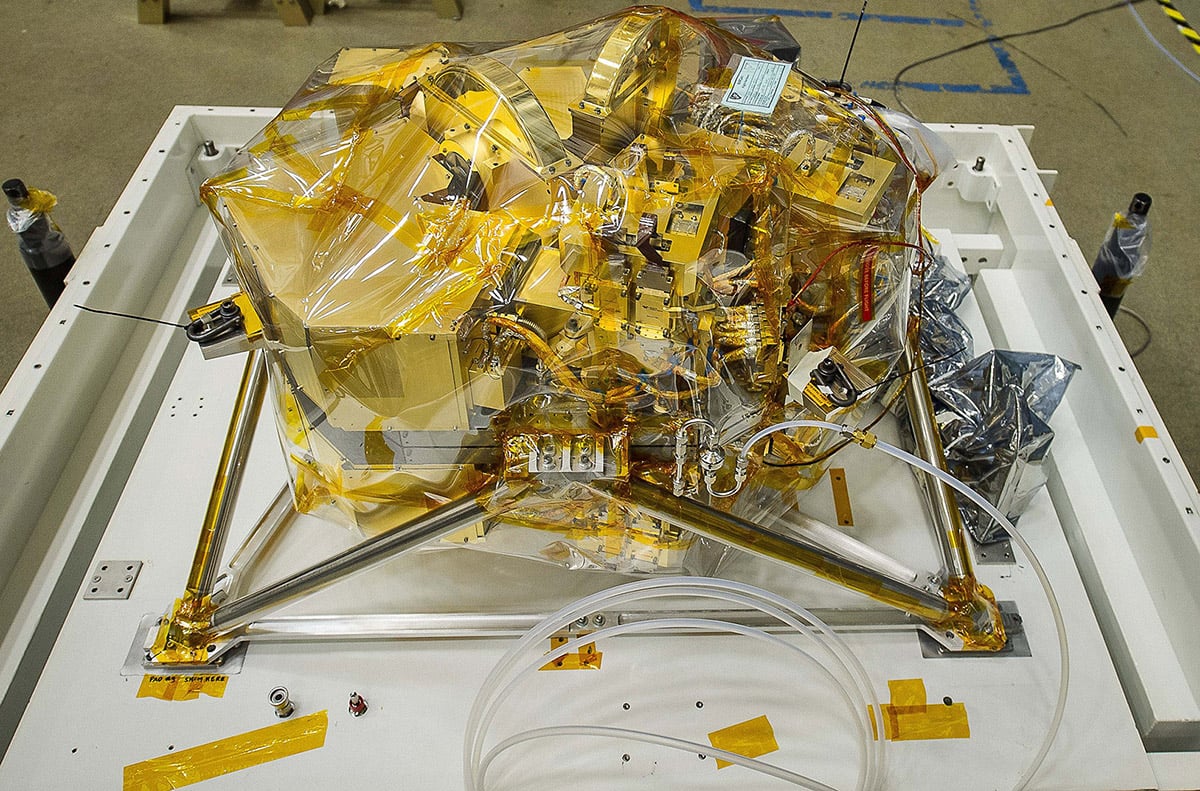
Although LRDs are hard to study in detail, JWST’s powerful Near-Infrared Spectrograph (NIRSpec) made it possible. The team examined the light from CANUCS-LRD-z8.6 and observed clear signs of highly energetic gas. They detected broad emission lines, such as Hβ, and highly ionized lines like C IV and N IV. These features are telltale signs of an active galactic nucleus (AGN), in other words, a black hole that’s gulping down gas.
From the spectral data, the researchers estimated the black hole’s mass to be around 10⁸ solar masses (about a hundred million times the mass of the Sun). That’s huge for such an early, tiny galaxy.
The findings from the galaxy
In the nearby universe, astronomers have observed a fairly consistent link: more massive galaxies host bigger black holes. But CANUCS-LRD-z8.6 upends that trend. Its black hole seems disproportionately large compared to the galaxy’s own stellar mass.
On top of that, the galaxy is chemically very ancient. Its metallicity, the abundance of heavy elements, is extremely low (less than 10 percent of what we find in more evolved galaxies today). That suggests this is not a grown-up galaxy. It’s young, still building up its stars, yet already hosting a ravenous black hole.
This mismatch forces theorists to rethink how supermassive black holes first form. It seems possible that black holes diverged from their host galaxies very early. They may have grown fast, even before their galaxies did. One way to explain this is via massive seed black holes, maybe they formed from the direct collapse of dense gas clouds, rather than evolving from smaller stellar remnants. Alternatively, the black hole might have grown by accreting gas at rates well above the normal (Eddington) limit.
How JWST photographed it
The NIRCam instrument captured a deep, high-contrast image of the MACS J1149.5+2223 cluster, revealing CANUCS-LRD-z8.6 as a faint red dot. Then NIRSpec came in, providing detailed spectra with enough sensitivity to pick up delicate emission lines from a tiny, distant object.
The galaxy was found in a “parallel field” strategy by the CANUCS survey (JWST observing program #1208, PI: C. J. Willott). This means they didn’t just observe the bright core of the cluster; they also looked at neighboring regions, where lensed background galaxies show up more cleanly. Without JWST’s infrared sensitivity and its long exposures, the galaxy’s spectrum would have been far too faint to analyze.
Ripples in our models of the cosmic dawn
This finding has real implications for how the first structures in the universe were built up. If black holes in early galaxies like CANUCS-LRD-z8.6 grew faster than their stars, they might have played a much more active role in shaping their environment. As black holes feed, they pump out energy into their surroundings. This “feedback” can heat or drive away gas, starving the galaxy of fuel for new stars. In the early universe, such feedback could have strongly influenced how, where, and when stars formed.
Moreover, CANUCS-LRD-z8.6 could be a forerunner of the bright quasars we see later. Those quasars are powered by supermassive black holes shining brilliantly. Perhaps LRDs like this one evolved into or seeded those quasars. From a theoretical standpoint, the observation demands more detailed simulations. Models must allow for seed black holes that are either very heavy from the start or that accrete in unusually efficient ways. It’s a new piece in the puzzle of how the earliest black holes came to be.
As further observations come in, from ALMA, more JWST time, and new simulations, we will likely learn more about how the first black holes formed and how they drove change in their cosmic neighborhoods.
Clear skies!
See more from DIYPhotography.net on Google
Add DIYPhotography.net as a trusted source. This makes
our stories more likely to appear in your Google Search results.
 Add as a preferred source on Google

Soumyadeep Mukherjee
Soumyadeep Mukherjee is an award-winning astrophotographer from India. He has a doctorate degree in Linguistics. His work extends to the sub-genres of nightscape, deep sky, solar, lunar and optical phenomenon photography. He is also a photography educator and has conducted numerous workshops. His works have appeared in over 40 books & magazines including Astronomy, BBC Sky at Night, Sky & Telescope among others, and in various websites including National Geographic, NASA, Forbes. He was the first Indian to win “Astronomy Photographer of the Year” award in a major category.



Join the Discussion
DIYP Comment Policy
Be nice, be on-topic, no personal information or flames.