





















JWST Spots a Rare Beast: A Possible Direct-Collapse Black Hole
Jul 16, 2025
Soumyadeep Mukherjee
Soumyadeep Mukherjee is an award-winning astrophotographer from India. He has a doctorate degree in Linguistics. His work extends to the sub-genres of nightscape, deep sky, solar, lunar and optical phenomenon photography. He is also a photography educator and has conducted numerous workshops. His works have appeared in over 40 books & magazines including Astronomy, BBC Sky at Night, Sky & Telescope among others, and in various websites including National Geographic, NASA, Forbes. He was the first Indian to win “Astronomy Photographer of the Year” award in a major category.
Share:

The James Webb Space Telescope (JWST) has stunned astronomers yet again. This time, it may have caught something never seen before. Scientists believe JWST has found a direct-collapse black hole, a mysterious object long theorized but never directly observed. If confirmed, it could explain one of the biggest cosmic mysteries: how supermassive black holes formed so early in the Universe.
Direct-Collapse Black Hole
A direct-collapse black hole (DCBH) forms straight from a cloud of gas. No star needs to die first. That’s different from typical black holes, which form when massive stars collapse at the end of their life. Those are called “light seeds.” DCBHs, on the other hand, are “heavy seeds.” They start much bigger, between 10,000 and 1 million times the mass of the Sun. That’s a huge shortcut to building the billion-solar-mass black holes seen in the early Universe. But until now, no one had solid proof of their existence.
The JWST discovery
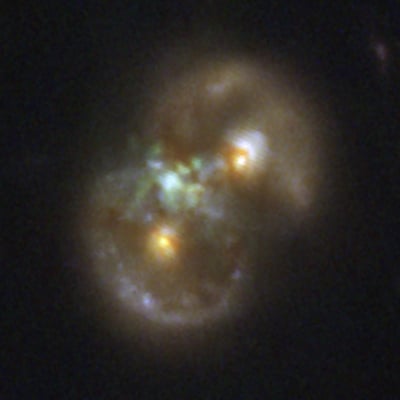
On July 15, 2025, NASA released a blog post detailing this extraordinary find. They nicknamed it the “Infinity Galaxy.” It’s a pair of galaxies caught in a cosmic collision. But that’s not the strange part. Lying between the two galaxy cores is a huge, glowing cloud. It’s about 40,000 light-years across. Inside it sits a growing black hole. This object is around a million times the mass of the Sun. It’s also surrounded by gas and dust. And it’s actively pulling material inward, a process called accretion. Astronomers think this could be a direct-collapse black hole forming right now.
Why is this object so unique?
Most black holes live at the center of galaxies. That’s where the most gas, dust, and stars collect. But this object isn’t in the center of a galaxy. It sits between two merging galaxies. That’s highly unusual. Also, the black hole is embedded inside a giant, glowing cloud. Its light comes from the heat and energy released as gas falls in. That cloud has some strange features. It lacks signs of older stars. Instead, it looks like a primordial gas reservoir. That’s exactly what scientists expect for direct-collapse black hole formation.
Is it confirmed?
Not yet. This discovery is still a strong candidate. Scientists need more data to be sure. They want to rule out other possibilities, like:
- Could it be a dense star cluster?
- Could it be a hidden galactic nucleus?
- Could it be a rare type of quasar?
Future observations will help. JWST’s NIRSpec spectrometer will look for chemical fingerprints. If the object lacks heavy elements (like carbon and oxygen), it may be primordial gas. That would support the direct-collapse theory. Also, other telescopes like Chandra (X-ray) and ALMA (radio) will join in. They’ll study the black hole’s surroundings and energy output. Together, this multi-wavelength approach will test the DCBH theory like never before.
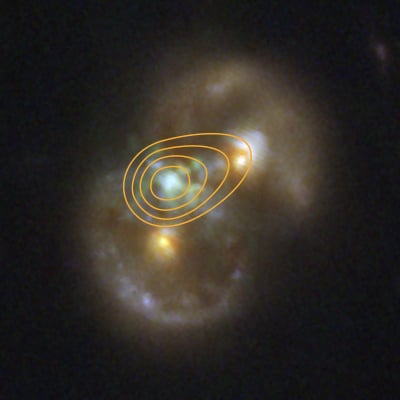
This could be one of JWST’s most important discoveries yet. If it holds up, it will rewrite what we know about black holes. It could also explain how the Universe built its largest structures so quickly. We may soon uncover many more ancient black hole seeds. Some may even date back to the cosmic dawn.
Clear skies!
See more from DIYPhotography.net on Google
Add DIYPhotography.net as a trusted source. This makes
our stories more likely to appear in your Google Search results.
 Add as a preferred source on Google

Soumyadeep Mukherjee
Soumyadeep Mukherjee is an award-winning astrophotographer from India. He has a doctorate degree in Linguistics. His work extends to the sub-genres of nightscape, deep sky, solar, lunar and optical phenomenon photography. He is also a photography educator and has conducted numerous workshops. His works have appeared in over 40 books & magazines including Astronomy, BBC Sky at Night, Sky & Telescope among others, and in various websites including National Geographic, NASA, Forbes. He was the first Indian to win “Astronomy Photographer of the Year” award in a major category.



Join the Discussion
DIYP Comment Policy
Be nice, be on-topic, no personal information or flames.