
























Hubble Photographs a Time Capsule: Globular Cluster NGC 1786
Jul 14, 2025
Soumyadeep Mukherjee
Soumyadeep Mukherjee is an award-winning astrophotographer from India. He has a doctorate degree in Linguistics. His work extends to the sub-genres of nightscape, deep sky, solar, lunar and optical phenomenon photography. He is also a photography educator and has conducted numerous workshops. His works have appeared in over 40 books & magazines including Astronomy, BBC Sky at Night, Sky & Telescope among others, and in various websites including National Geographic, NASA, Forbes. He was the first Indian to win “Astronomy Photographer of the Year” award in a major category.
Share:
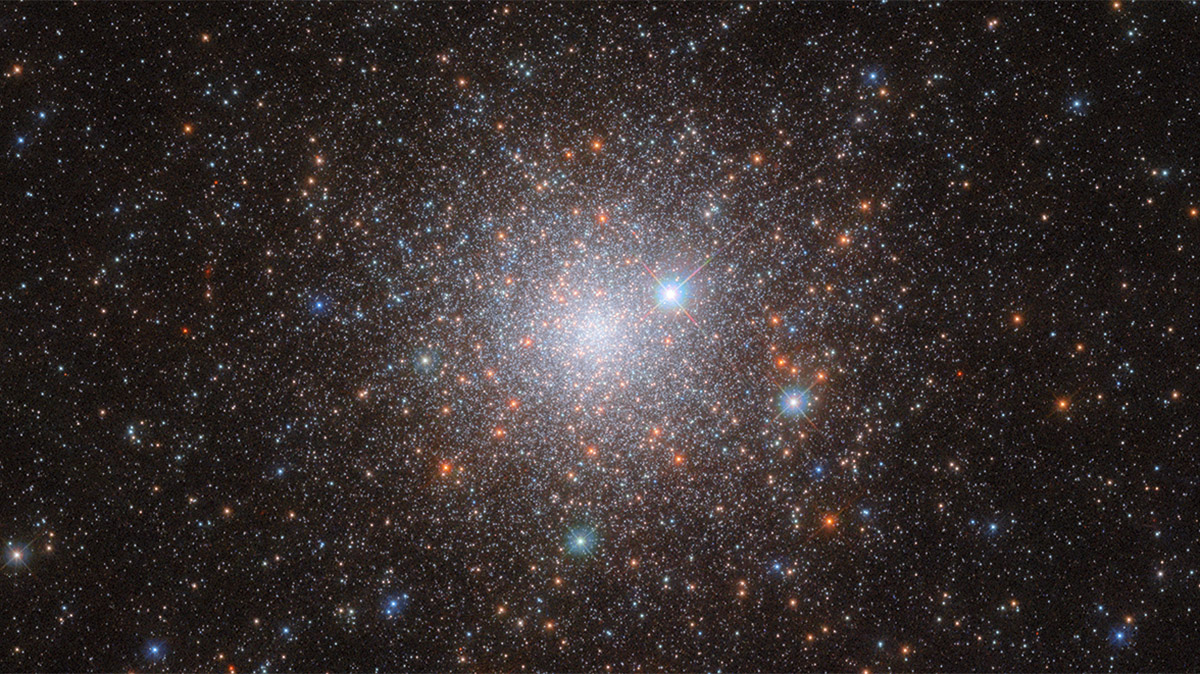
ESA/Hubble has released a dazzling new image of the globular cluster NGC 1786 in incredible detail. This image became their “Picture of the Week.” Captured by the Hubble Space Telescope, it highlights both the beauty and science behind these ancient stellar systems. NGC 1786 lies in the Large Magellanic Cloud (LMC), a satellite galaxy of our Milky Way.
About NGC 1786
NGC 1786 is a globular cluster. Globular clusters are dense collections of old stars. They orbit galaxies like satellites. They often contain hundreds of thousands, or even millions, of stars. These stars are packed tightly into a spherical shape. NGC 1786 sits inside the Large Magellanic Cloud, which is about 160,000 light-years away from Earth. The LMC is a small galaxy that orbits the Milky Way. Despite its distance, the LMC is visible to the naked eye from the Southern Hemisphere. NGC 1786 is also one of the brightest and most massive clusters in the LMC. Its stars are incredibly old, with some exceeding 10 billion years in age. This makes it a perfect target for studying the early universe.
Hubble’s view of NGC 1786
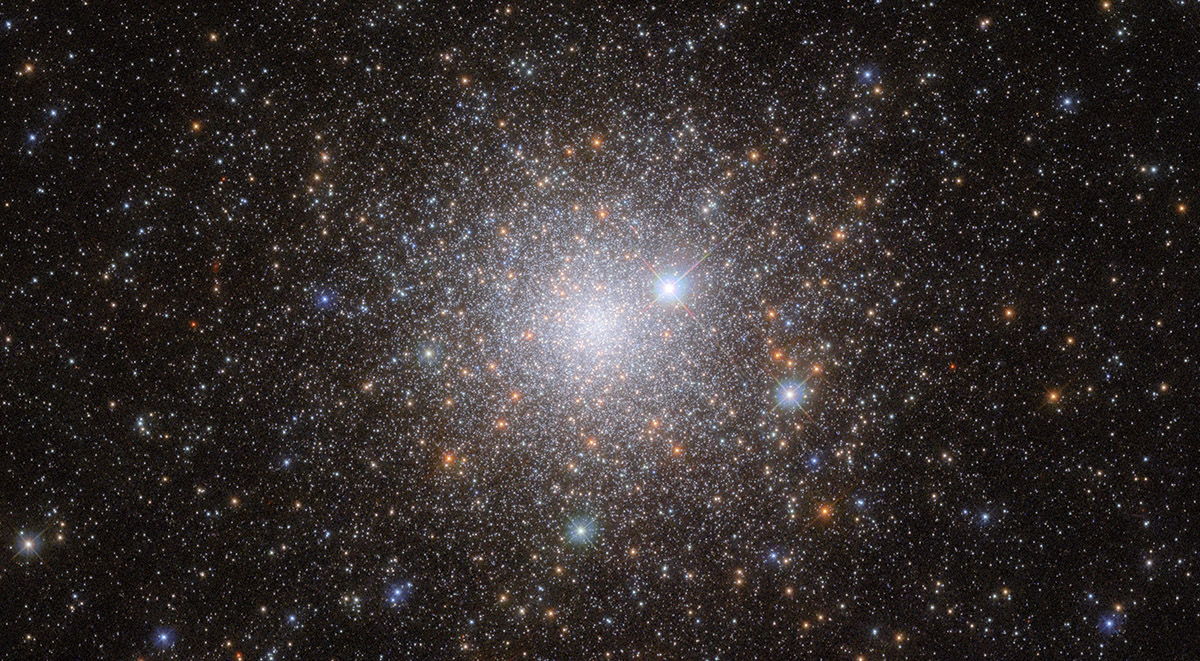
The image taken by Hubble is breathtaking. At the center, you see a concentration of stars. The brightness is intense due to the sheer number of stars crowded in a small space. The outer regions gradually thin out, creating a soft, glowing halo. Most stars in the cluster appear pale blue or white. These are older stars, typically with low metal content. A few red and orange stars also dot the scene. These might be red giants or stars in later stages of life. Three bright stars stand out. They have prominent diffraction spikes, a result of the telescope’s optics. These stars are actually in the foreground and lie much closer to us. This image was taken with Hubble’s Advanced Camera for Surveys and Wide Field Camera 3. Together, they offer excellent resolution and sensitivity. They allow astronomers to study even the faintest stars in the cluster.
Importance of globular clusters
Globular clusters are cosmic fossils. They preserve information from the early days of the universe. By studying them, astronomers can learn about star formation, chemical evolution, and galactic history. For a long time, scientists believed globular clusters contained only one generation of stars. That idea has changed. New evidence shows that many clusters, including NGC 1786, have multiple stellar populations. This means stars of different ages and compositions exist together. Understanding why and how these populations form is a major question in astronomy. The answers could reveal how galaxies like ours grew over time.
Studying stellar populations
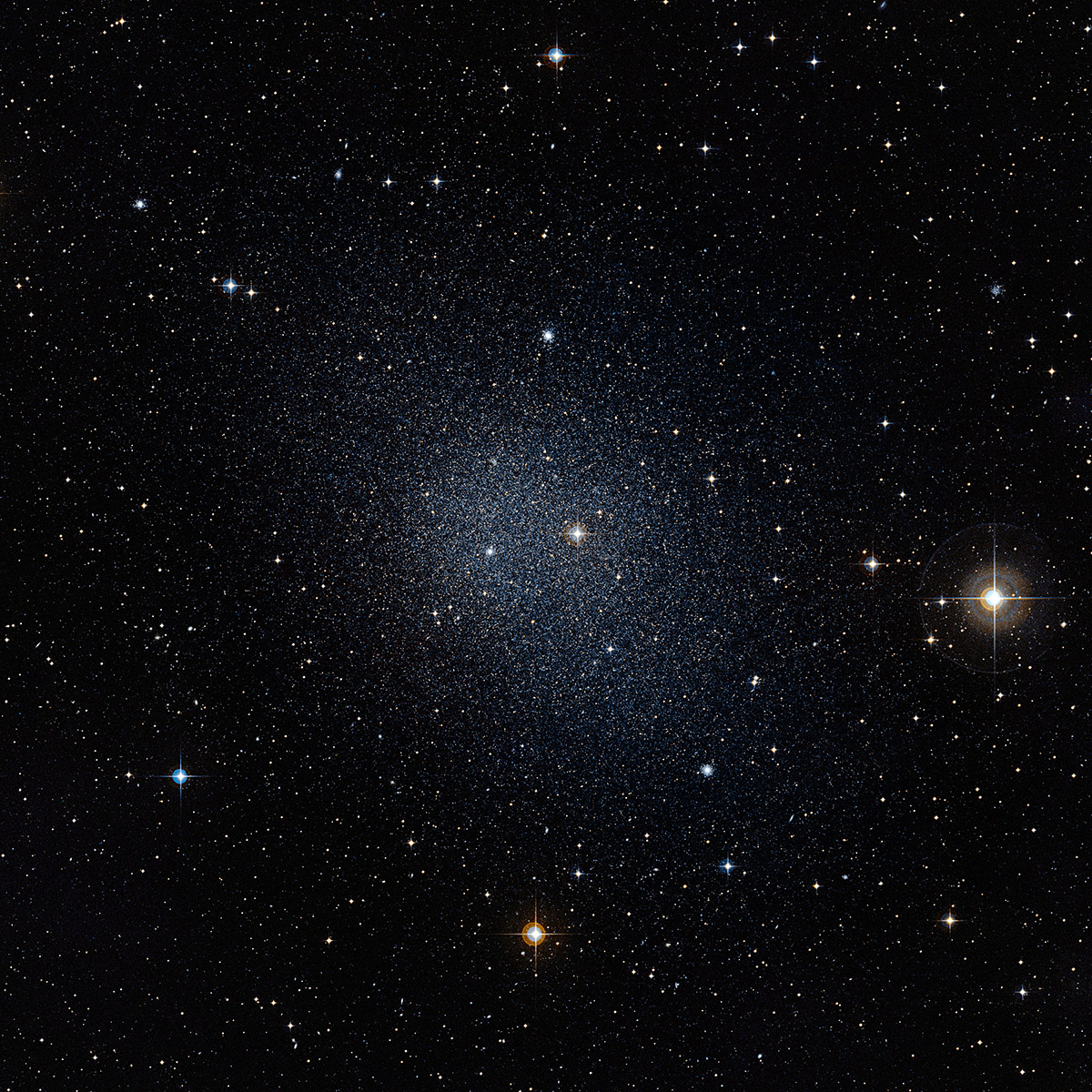
ESA and NASA scientists are using Hubble to study clusters like NGC 1786 in great detail. They want to understand the history of star formation in these systems. The project includes clusters from the LMC, the Small Magellanic Cloud (SMC), and the Fornax Dwarf Galaxy. These dwarf galaxies offer a variety of environments for star formation. Comparing clusters from each galaxy helps researchers see patterns. For example, they look at how many different stellar populations are present. They study the chemical composition of each group. They also analyze how the stars move within the cluster. In NGC 1786, multiple populations have been identified. These stars have different amounts of helium and other elements. This tells scientists that the cluster had more than one period of star formation.
Through Hubble’s lens, we see not just light, but time itself. Each star is a relic from an ancient past. Together, they whisper secrets of how galaxies like ours came to be. Thanks to this incredible image, NGC 1786 will now inspire both scientists and stargazers alike.
Clear skies!
See more from DIYPhotography.net on Google
Add DIYPhotography.net as a trusted source. This makes
our stories more likely to appear in your Google Search results.
 Add as a preferred source on Google

Soumyadeep Mukherjee
Soumyadeep Mukherjee is an award-winning astrophotographer from India. He has a doctorate degree in Linguistics. His work extends to the sub-genres of nightscape, deep sky, solar, lunar and optical phenomenon photography. He is also a photography educator and has conducted numerous workshops. His works have appeared in over 40 books & magazines including Astronomy, BBC Sky at Night, Sky & Telescope among others, and in various websites including National Geographic, NASA, Forbes. He was the first Indian to win “Astronomy Photographer of the Year” award in a major category.

Join the Discussion
DIYP Comment Policy
Be nice, be on-topic, no personal information or flames.