
























Hubble Photographs a Lost Gem in the Milky Way
Jul 10, 2025
Soumyadeep Mukherjee
Soumyadeep Mukherjee is an award-winning astrophotographer from India. He has a doctorate degree in Linguistics. His work extends to the sub-genres of nightscape, deep sky, solar, lunar and optical phenomenon photography. He is also a photography educator and has conducted numerous workshops. His works have appeared in over 40 books & magazines including Astronomy, BBC Sky at Night, Sky & Telescope among others, and in various websites including National Geographic, NASA, Forbes. He was the first Indian to win “Astronomy Photographer of the Year” award in a major category.
Share:
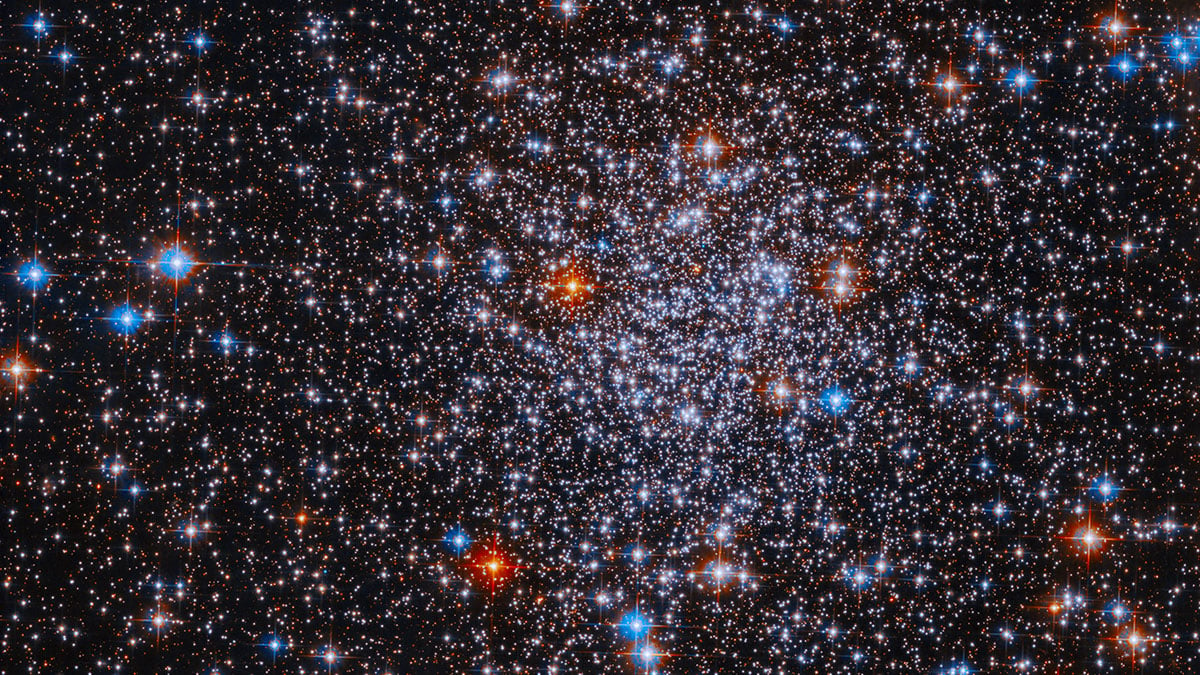
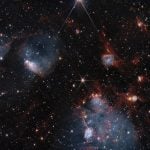
For decades, a star cluster quietly hid in the crowded regions of the Milky Way. Its stars glimmered faintly behind thick curtains of dust and gas. Astronomers knew of its existence but couldn’t study it well. Now, thanks to the Hubble Space Telescope, that missing cluster finally gets its moment in the spotlight. NASA has released a new image of this elusive object. It is officially named ESO 591-12, but also known as Palomar 8. It lies in the dense region of our galaxy’s inner halo. The image shows a glittering mix of red and blue stars. It’s a fresh and vivid portrait of one of the least-studied globular clusters in our galaxy.
Globular clusters
Globular clusters are large, spherical groups of stars. They can contain hundreds of thousands or even millions of stars. These stars are tightly packed and gravitationally bound. Most globular clusters are very old, more than 10 billion years old. That makes them cosmic fossils. These clusters formed in the early days of the universe. Studying them helps astronomers learn how galaxies like the Milky Way were built. They reveal the conditions of the young universe. Globular clusters orbit in a galaxy’s halo, bulge, or disk. Our Milky Way has over 150 known clusters. But not all of them are well understood. Some, like ESO 591-12, have remained hidden. Dust and crowding made it hard to observe them in detail, until now.
The missing globular clusters survey
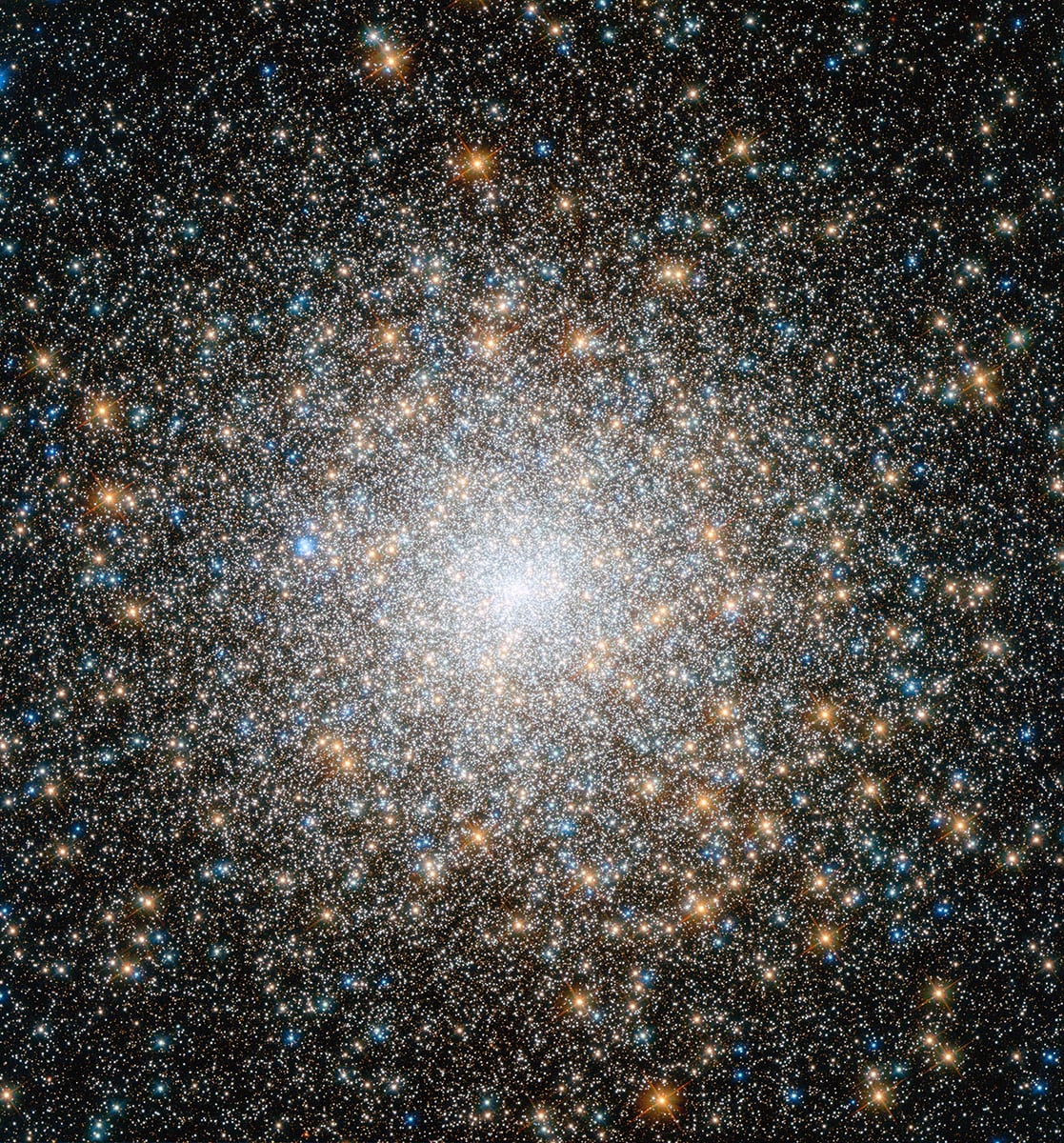
ESO 591-12 was imaged as part of Hubble’s Missing Globular Clusters Survey. This new campaign aims to photograph 34 Milky Way globular clusters. These are clusters that had never been fully imaged by Hubble before. Why were they missing? In many cases, their location made them difficult to observe. They were buried in the thick bulge of the galaxy or lost in star-crowded skies. But these clusters are important. Each one adds a piece to the puzzle of our galaxy’s history. The survey fills the final gap in Hubble’s imaging of the Milky Way’s globular cluster population. It gives astronomers high-resolution views of each cluster’s stars. These sharp images allow them to measure stellar ages, brightness, colors, and distances with high precision.
A New Look at ESO 591-12
The image of ESO 591-12 reveals a spectacular stellar crowd. Thousands of stars sparkle in different colors. The bright blue stars are hotter. The reddish stars are cooler. Some are red giants, older stars that have expanded. Others are main-sequence stars still burning hydrogen in their cores. Hubble’s image was taken using its Advanced Camera for Surveys and Wide Field Camera 3. These cameras can observe in both visible and ultraviolet light. The ultraviolet light is especially useful. It reveals hotter and younger stars that don’t show up well in regular light. The combination of filters gives astronomers a full picture of the cluster’s stellar population. They can analyze star types, colors, and even subtle changes in brightness. That helps them build a precise timeline for the cluster’s formation.

Filling in the galactic story
The Hubble survey will create a complete set of images for all known Milky Way globular clusters. This full dataset allows scientists to compare clusters across different environments. They can study how cluster properties change with location. Clusters in the bulge might be older and more metal-rich. Some clusters show evidence of multiple generations of stars. That was a surprise. Astronomers used to think all stars in a globular cluster formed at once. But now we know clusters can be more complex. Some show signs of second or even third waves of star formation. These discoveries are rewriting textbooks.
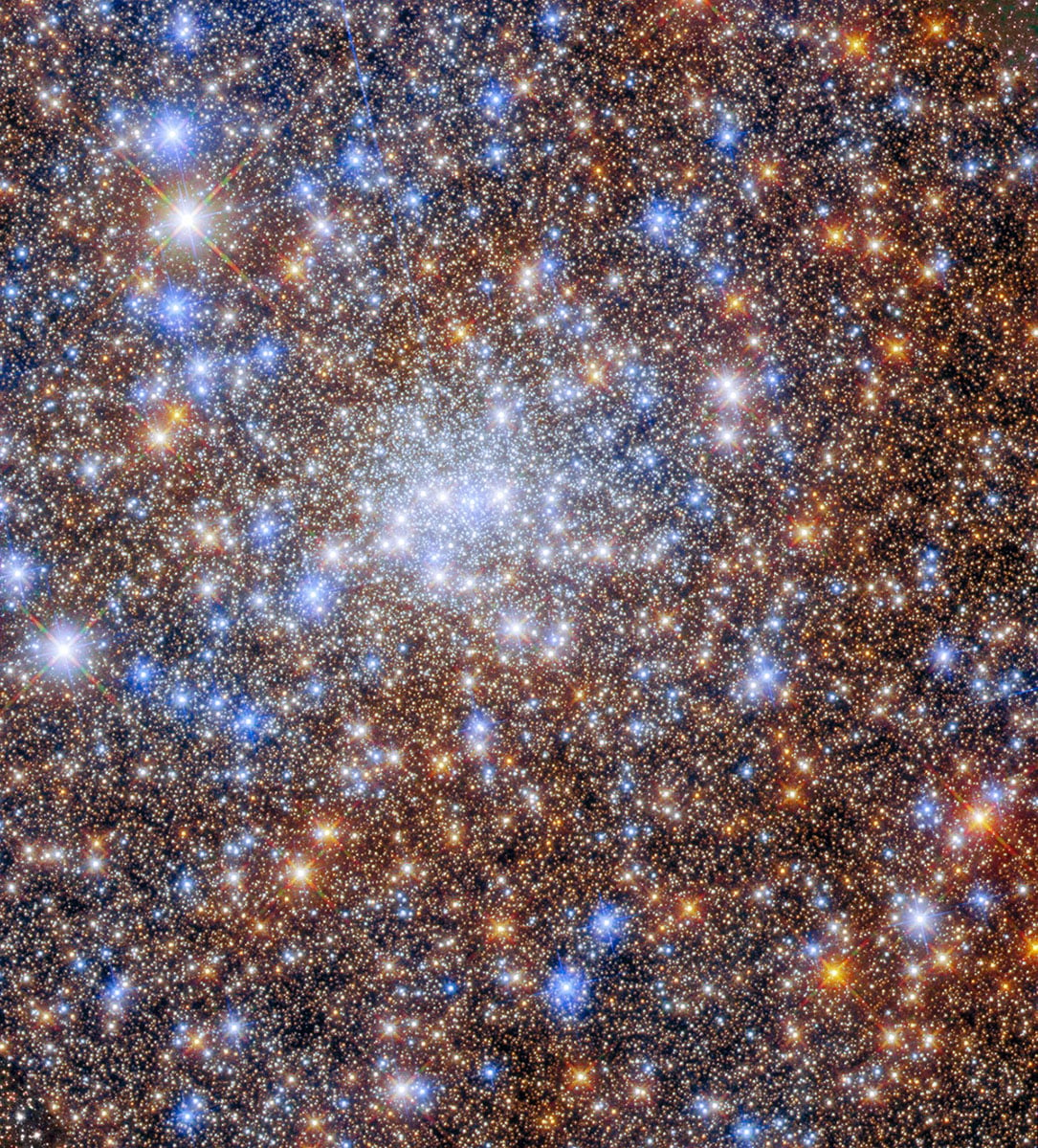
ESO 591-12 finally shines in full glory, thanks to Hubble. Once overlooked and hidden, it now takes its place among the stars. The Missing Globular Clusters Survey ensures that no cluster is left behind. With each new image, we step closer to understanding the true story of our Milky Way.
Clear skies!
See more from DIYPhotography.net on Google
Add DIYPhotography.net as a trusted source. This makes
our stories more likely to appear in your Google Search results.
 Add as a preferred source on Google

Soumyadeep Mukherjee
Soumyadeep Mukherjee is an award-winning astrophotographer from India. He has a doctorate degree in Linguistics. His work extends to the sub-genres of nightscape, deep sky, solar, lunar and optical phenomenon photography. He is also a photography educator and has conducted numerous workshops. His works have appeared in over 40 books & magazines including Astronomy, BBC Sky at Night, Sky & Telescope among others, and in various websites including National Geographic, NASA, Forbes. He was the first Indian to win “Astronomy Photographer of the Year” award in a major category.


Join the Discussion
DIYP Comment Policy
Be nice, be on-topic, no personal information or flames.