



















WarpAstron Launches WD-20E: 30kg Payload in a 5.7kg Mount
Oct 18, 2026
Soumyadeep Mukherjee
Soumyadeep Mukherjee is an award-winning astrophotographer from India. He has a doctorate degree in Linguistics. His work extends to the sub-genres of nightscape, deep sky, solar, lunar and optical phenomenon photography. He is also a photography educator and has conducted numerous workshops. His works have appeared in over 40 books & magazines including Astronomy, BBC Sky at Night, Sky & Telescope among others, and in various websites including National Geographic, NASA, Forbes. He was the first Indian to win “Astronomy Photographer of the Year” award in a major category.
Share:
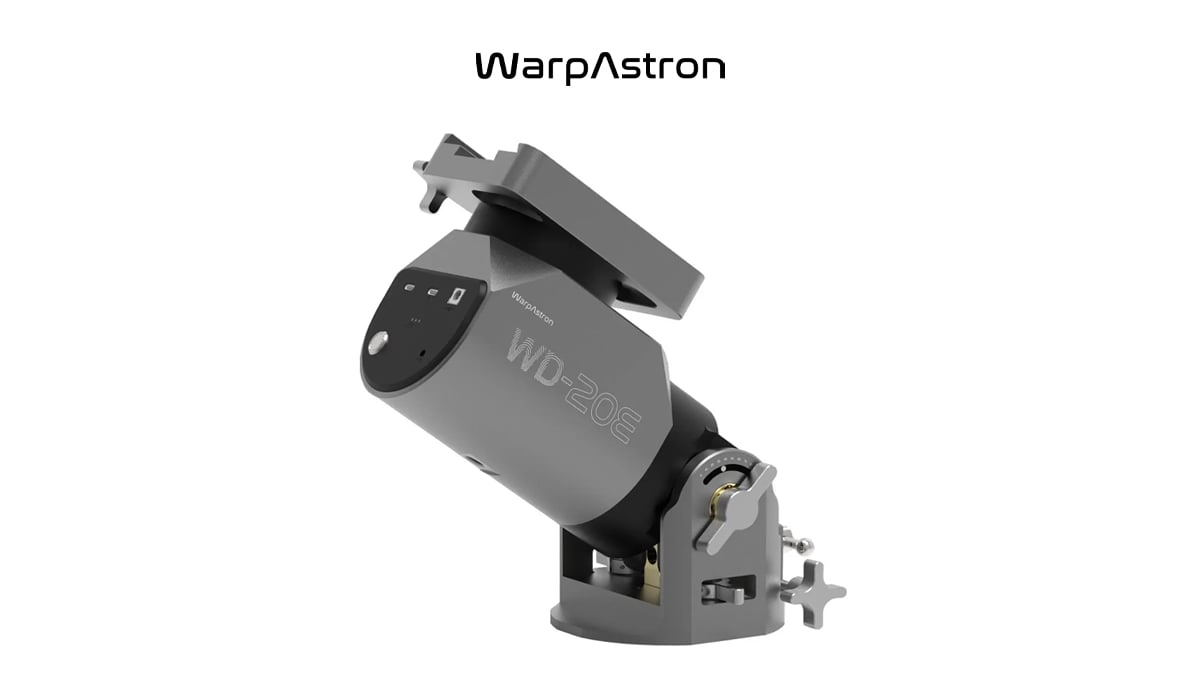
WarpAstron has added a new model to its WARPDRIVE EC Series of telescope mounts. The WD-20E weighs 5.7kg, yet supports telescopes and accessories weighing up to 30kg when users add counterweights. The mount features brushless servo motors, strain-wave reducers, and an absolute encoder on its right ascension (RA) axis. A new touchscreen hand controller completes the package.
The WD-20E also brings updated control options, including GPS, Wi-Fi, and Bluetooth through its Advanced Hand Controller. Users can operate it in equatorial or alt-azimuth mode and connect it to compatible astronomy software. Let’s take a look at what the new mount offers.
A compact mount for heavier telescopes
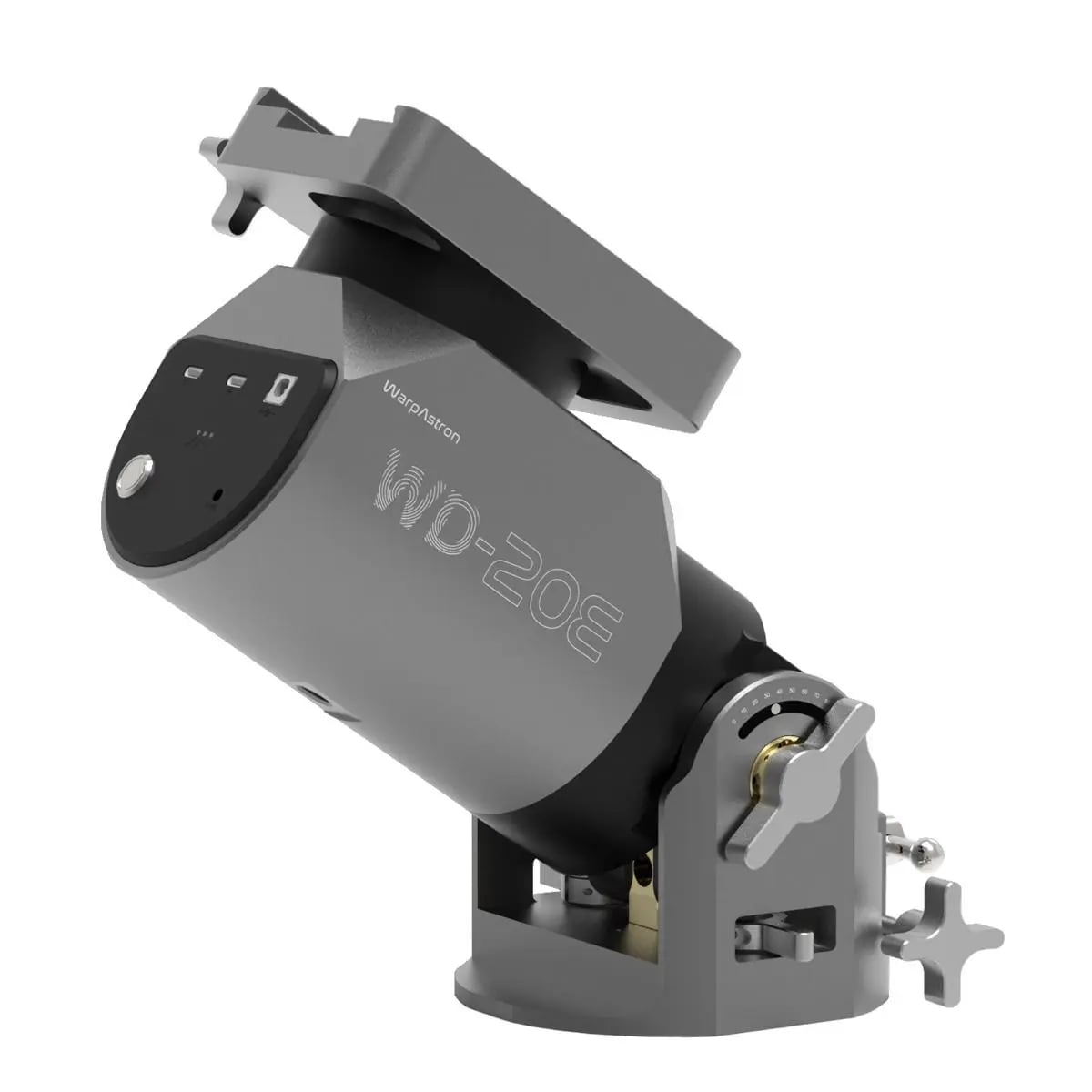
WarpAstron lists the WD-20E’s mount head at 5.7kg. The mount has a payload capacity of 22kg without counterweights and 30kg with counterweights. It also specifies a recommended payload torque of 50Nm and a maximum of 60Nm.
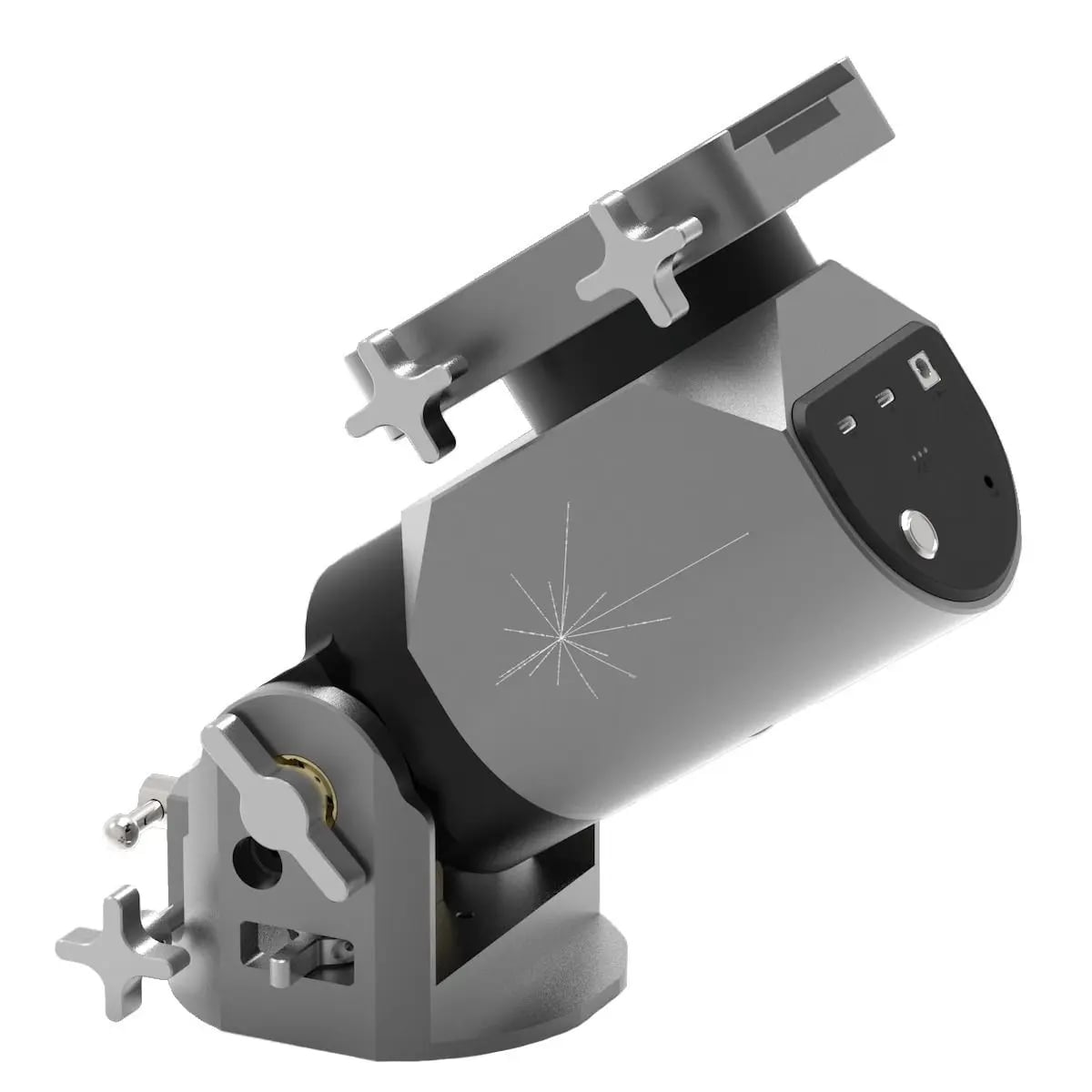
The WD-20E uses a size-20 strain-wave reducer on its RA axis and a size-17 reducer on its declination (DEC) axis. Its saddle accepts Vixen and Losmandy dovetails, two common standards among telescope owners. The mount also offers latitude adjustment from 0 to 90 degrees and azimuth adjustment of ±8 degrees. These controls help users align the RA axis with the celestial pole for equatorial tracking.
The mount has an operating temperature range of −25°C to +45°C. That range covers many observing conditions, though users should check the limits of their cameras, computers, and power supplies before working in extreme temperatures.
Servo motors and an encoder
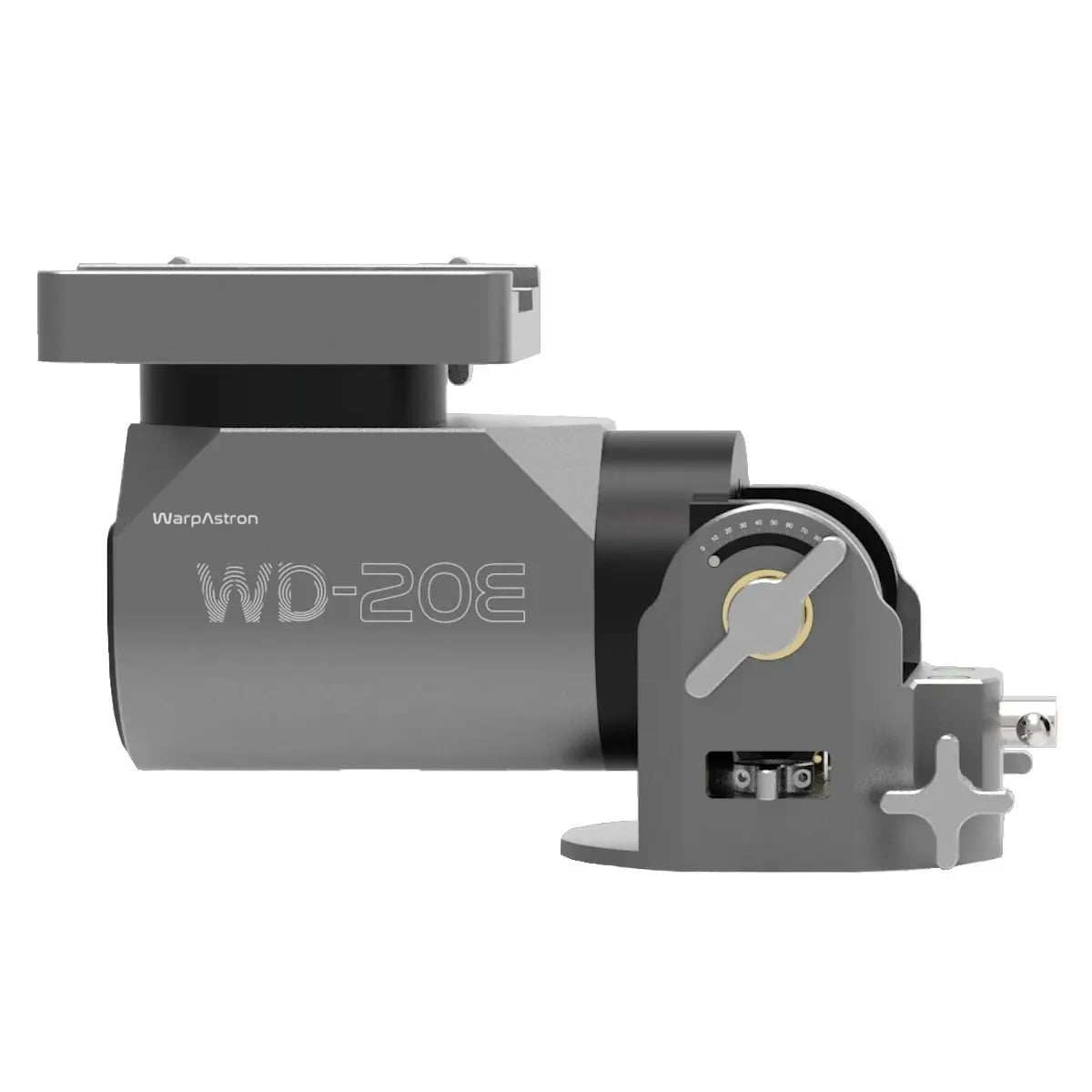
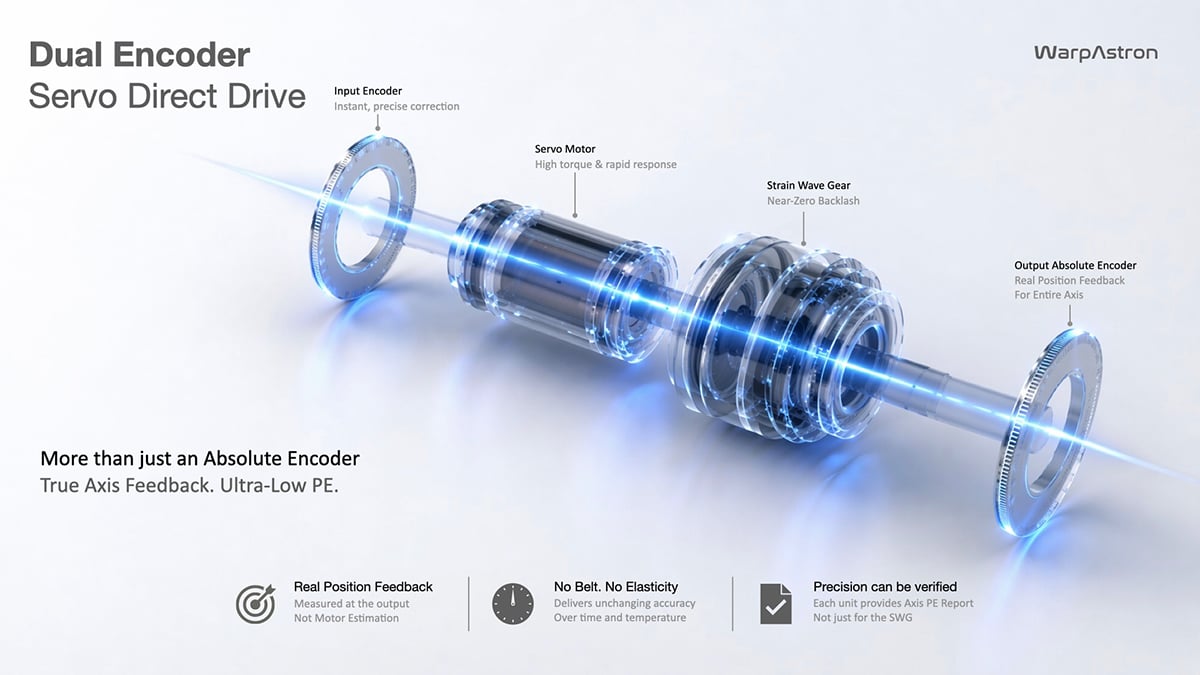
The WD-20E uses brushless DC servo motors to drive its strain-wave reducers. WarpAstron calls this arrangement Servo Direct Drive. The design avoids additional belt or planetary transmission stages between the motors and reducers.
The WD-20E carries an absolute encoder on its RA output axis. This is the axis that moves the telescope as it tracks an object across the sky. The encoder measures the axis’s position, giving the control system feedback about the telescope’s actual movement instead of relying solely on motor rotation.
That feedback helps the mount detect and correct tracking deviations. WarpAstron specifies an encoder-corrected periodic error of ±3 arcseconds. Periodic error describes recurring deviations in a mount’s tracking, often caused by imperfections in its drive mechanism.
A new hand controller
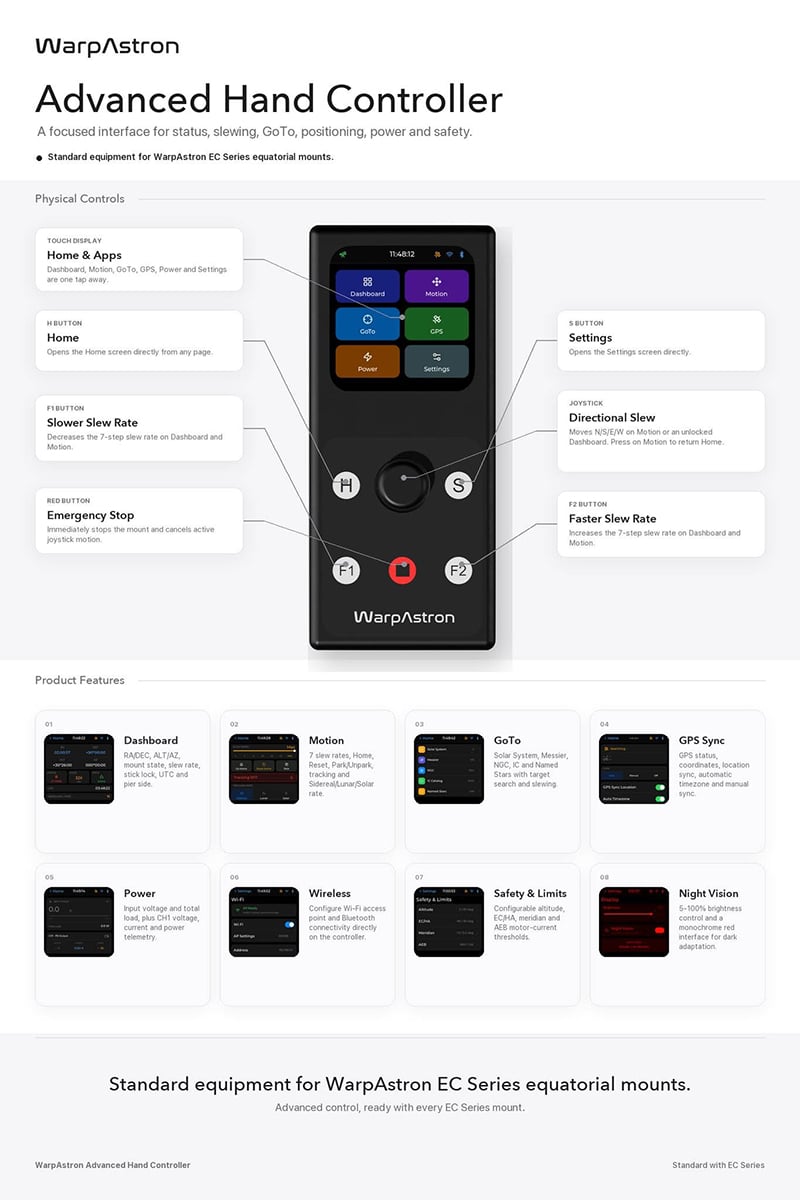
WarpAstron supplies the WD-20E with its 2026 Advanced Hand Controller. The unit features a 2-inch color OLED touchscreen and a Hall-effect joystick. It also includes GPS, Wi-Fi, and Bluetooth.
The controller gives users access to mount movement, GoTo commands, tracking and parking. Its catalogue interface helps them select celestial targets, while its menus provide access to configuration settings. GPS can assist with setting the observing location and time, reducing the need for manual entry.
The joystick offers a physical control for moving the telescope during setup. The touchscreen handles target selection and other operating functions. This combination gives users an alternative to controllers that rely mainly on directional buttons and small displays.
Computer control also remains as an option. The WD-20E supports ASCOM, INDI, LX200, and INDIGO-compatible systems. These protocols allow users to connect the mount to astronomy software and incorporate it into an imaging workflow.
Other features of WD-20E
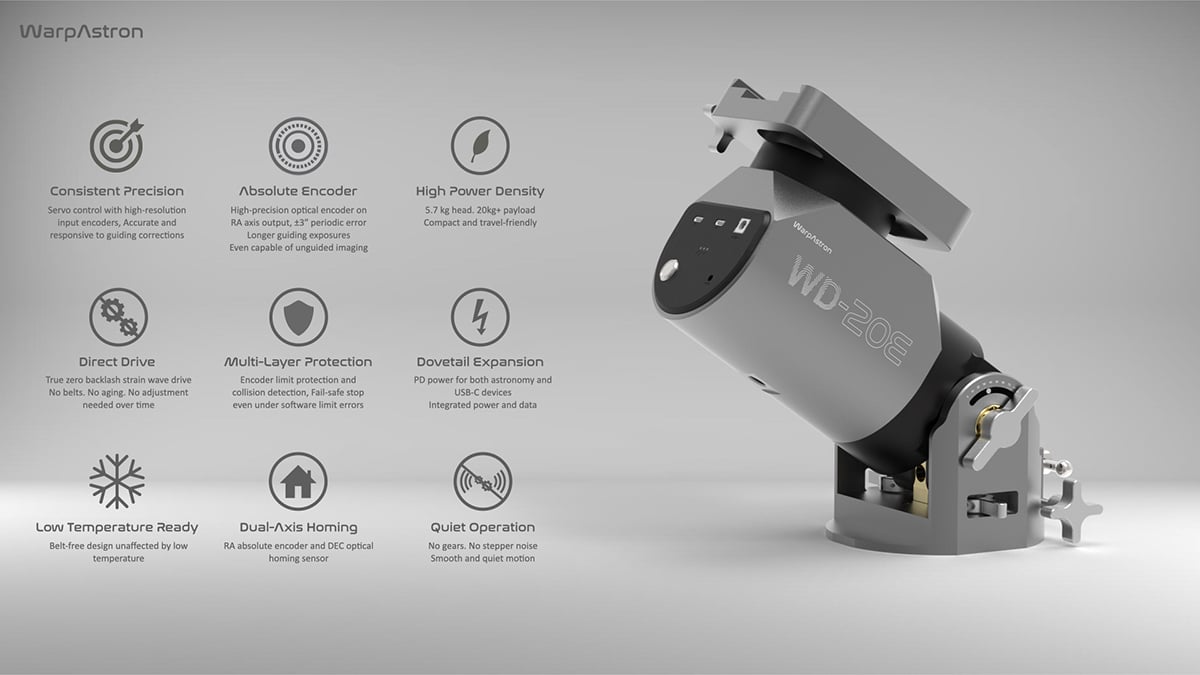
The mount offers Auto Emergency Brake functionality. WarpAstron says this feature responds to abnormal motor loading and helps limit certain movement-related risks. Users must still balance their equipment properly and check that the telescope can move freely.
The WD-20E accepts a DC input between 12V and 25V. WarpAstron specifies a 5A supply and a 5.5 × 2.5mm connector. Buyers should check the voltage, current capacity, polarity, and connector before connecting an external power source.
The mount’s standard slew speed is 5 degrees per second, with a maximum of 10 degrees per second. Slewing moves the telescope between targets, while tracking follows an object during observation or imaging. These functions use different movement rates.
Price and availability
The WD-20E mount is priced at $3,499. The mount will be available for ordering from mid-October 2026, according to an authorized dealer.
The listed package includes the mount head, Advanced Hand Controller, connection cables, a tracking accuracy report, an aluminum transport case, and a hex key.
Clear skies!
See more from DIYPhotography.net on Google
Add DIYPhotography.net as a trusted source. This makes
our stories more likely to appear in your Google Search results.
 Add as a preferred source on Google

Soumyadeep Mukherjee
Soumyadeep Mukherjee is an award-winning astrophotographer from India. He has a doctorate degree in Linguistics. His work extends to the sub-genres of nightscape, deep sky, solar, lunar and optical phenomenon photography. He is also a photography educator and has conducted numerous workshops. His works have appeared in over 40 books & magazines including Astronomy, BBC Sky at Night, Sky & Telescope among others, and in various websites including National Geographic, NASA, Forbes. He was the first Indian to win “Astronomy Photographer of the Year” award in a major category.
Related Posts
 Gitzo’s new Ball Head Series 4 can handle a payload of up to 30kg
 DJI’s new Matrice 300 RTK drone offers a ridiculous 55-minutes of flight time and 2.7kg payload
 WarpAstron WD15E Harmonic Drive Mount: A New Servo-Driven Platform
 This guy hacked his DJI Mini 2’s LEDs to add remote control payload delivery
Join the Discussion
DIYP Comment Policy
Be nice, be on-topic, no personal information or flames.