




















Psyche Mission Captures a Crescent Red Planet During Mars Flyby
May 19, 2026
Soumyadeep Mukherjee
Soumyadeep Mukherjee is an award-winning astrophotographer from India. He has a doctorate degree in Linguistics. His work extends to the sub-genres of nightscape, deep sky, solar, lunar and optical phenomenon photography. He is also a photography educator and has conducted numerous workshops. His works have appeared in over 40 books & magazines including Astronomy, BBC Sky at Night, Sky & Telescope among others, and in various websites including National Geographic, NASA, Forbes. He was the first Indian to win “Astronomy Photographer of the Year” award in a major category.
Share:
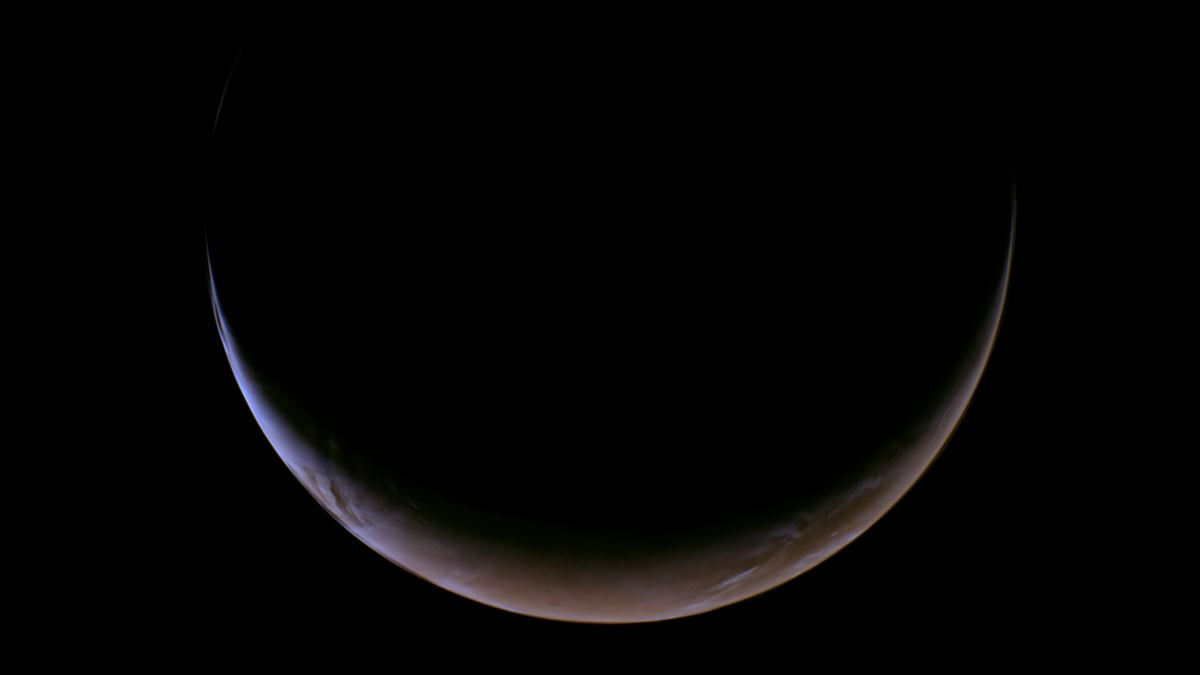
NASA’s Psyche spacecraft has completed one of the most demanding operations of its deep-space mission. On May 15, 2026, the probe executed a precisely planned gravity assist maneuver at Mars, allowing the spacecraft to alter its trajectory and gain additional velocity for its journey toward asteroid 16 Psyche. During closest approach, the spacecraft passed within about 4,609 kilometers of the Martian surface while traveling at interplanetary speeds.
Asteroid Psyche has attracted attention for decades because researchers believe it may contain exceptionally high concentrations of metal. Some planetary scientists think the asteroid could represent the exposed core of a partially destroyed protoplanet that formed during the earliest stages of solar system evolution. If that interpretation proves correct, the mission may provide the first direct observations of material similar to the metallic interiors hidden deep inside rocky planets like Earth.
Mars Gravity Assist: Psyche Mission
The Psyche mission employs a strategy that utilizes planetary gravity to redirect spacecraft across the solar system. Although the spacecraft launched successfully in October 2023, the initial trajectory alone could not efficiently deliver the probe to the asteroid belt. NASA therefore incorporated a Mars flyby into the mission profile.
The gravity assist changed both the spacecraft’s speed and orbital inclination. That adjustment placed Psyche onto the proper transfer path toward asteroid 16 Psyche, which orbits the Sun between Mars and Jupiter. Without the flyby, the spacecraft would have required much larger propulsion maneuvers and substantially more fuel. Instead, Mars supplied the needed energy through gravitational interaction alone.
NASA has relied on gravity assists for many historic missions. Voyager used planetary flybys to explore the outer planets. Cassini depended on several gravity assists before reaching Saturn. Likewise, New Horizons gained additional speed from Jupiter before continuing toward Pluto. Psyche now joins that long history of missions that transformed planetary gravity into a navigation tool for deep-space exploration.
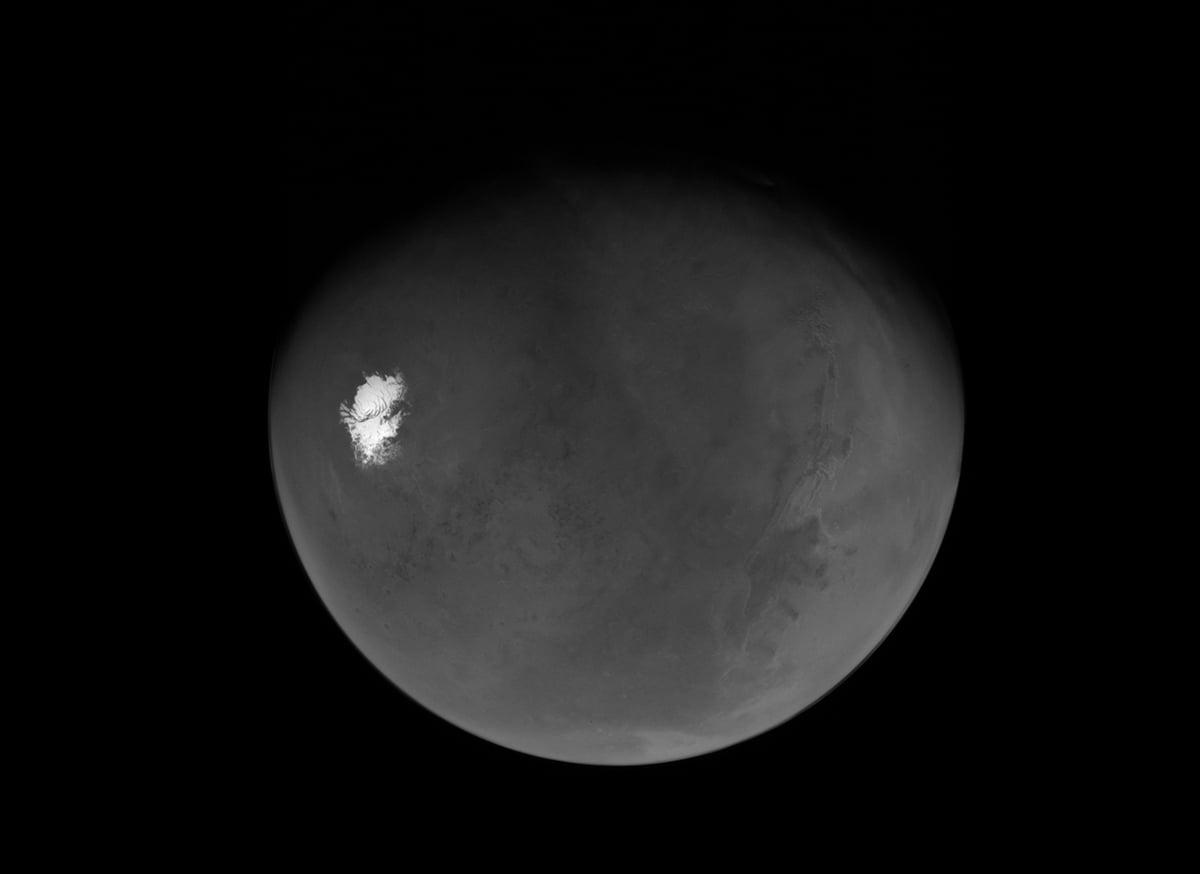
A long ion-propelled cruise
Unlike conventional spacecraft that depend mainly on chemical propulsion, Psyche travels through space using solar-electric propulsion. The spacecraft carries four Hall-effect thrusters powered by large cross-shaped solar arrays. These thrusters ionize and accelerate xenon gas to generate continuous low-thrust propulsion over long periods.
The acceleration produced by ion propulsion remains extremely small compared with chemical rockets. However, the engines can operate for months at a time. Over long durations, the spacecraft gradually builds enormous velocity changes while consuming relatively little propellant. That efficiency makes solar-electric propulsion especially valuable for deep-space missions that must travel vast distances.
The spacecraft itself weighs about 2,800 kilograms and spans nearly 25 meters across when its solar arrays are fully extended. Because the mission operates far from the Sun, NASA equipped the spacecraft with exceptionally large solar panels capable of generating enough electrical power even in the asteroid belt. At those distances, sunlight becomes much weaker than near Earth. Nevertheless, the arrays can still support continuous thruster operation and scientific observations.
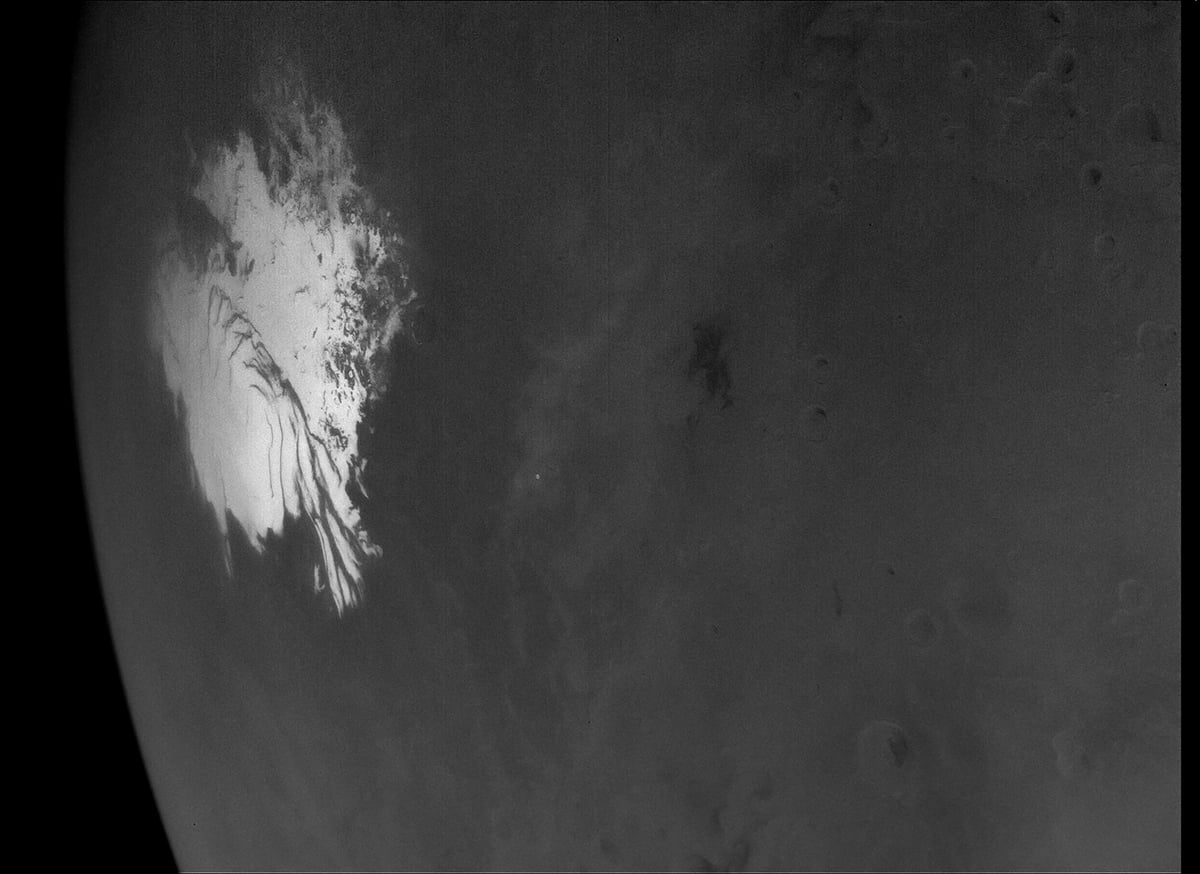
A crescent Mars during the flyby
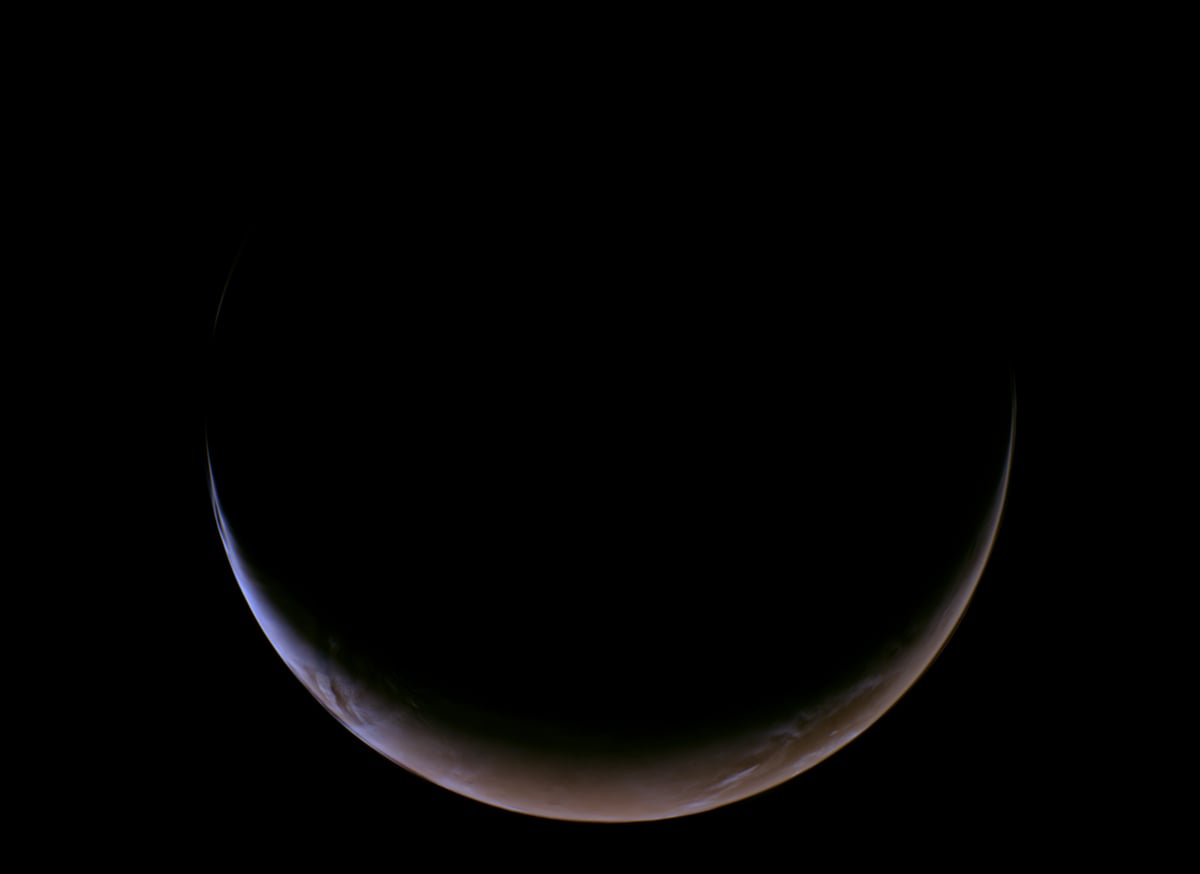
The geometry of the flyby produced unusual views of Mars that differed from typical planetary images. Most Mars photographs released by orbiters show a brightly illuminated disk. Psyche, however, approached the planet from a high phase angle, meaning sunlight illuminated only a narrow portion of the visible hemisphere. And as a result, Mars appeared as a thin crescent suspended against the darkness.
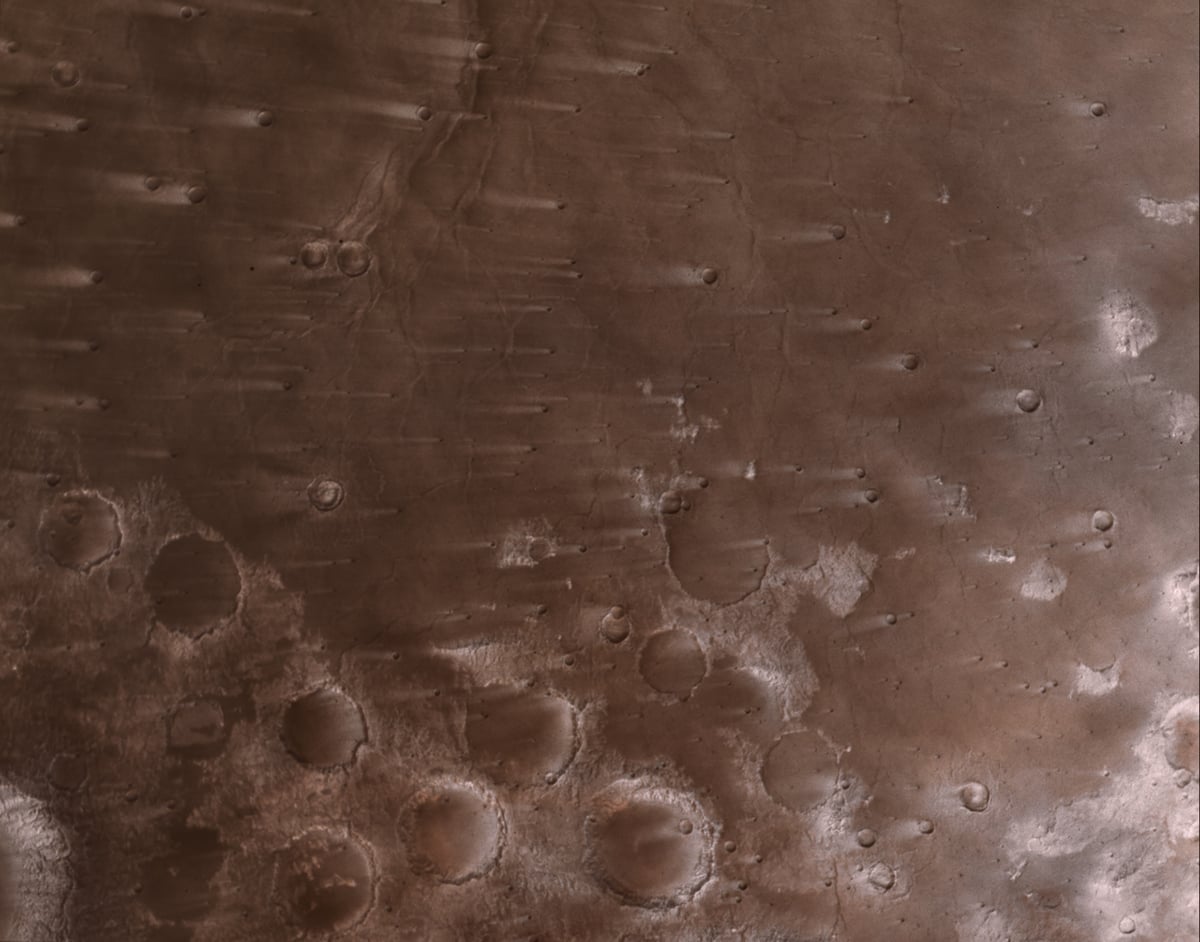
The spacecraft’s multispectral imager captured several sequences during approach and departure. Some images revealed a bright atmospheric arc extending beyond the planet’s edge. Scientists attributed this effect to sunlight scattering through suspended dust particles in the Martian atmosphere. Mars frequently contains fine airborne dust that rises high above the surface, particularly during active atmospheric conditions.
The spacecraft also captured views of surface terrain along the crescent boundary. Some frames revealed dark volcanic regions and rugged terrain in the southern hemisphere. Although Mars was not the mission’s primary science target, the observations offered an important opportunity to test the spacecraft’s imaging capabilities under realistic operational conditions.
Asteroid Psyche may preserve the history of planet formation
Although astronomers discovered asteroid Psyche in 1852, many basic questions about the object remain unanswered. Radar observations suggest the asteroid contains unusually high metal content compared with most known asteroids. This characteristic immediately separated Psyche from ordinary rocky bodies found throughout the asteroid belt.
For many years, scientists proposed that Psyche might represent the exposed metallic core of a protoplanet destroyed during the chaotic early history of the solar system. During planetary formation, large bodies heated internally and separated into layers. Heavy metals sank toward the center while lighter rocky materials formed outer crusts and mantles.
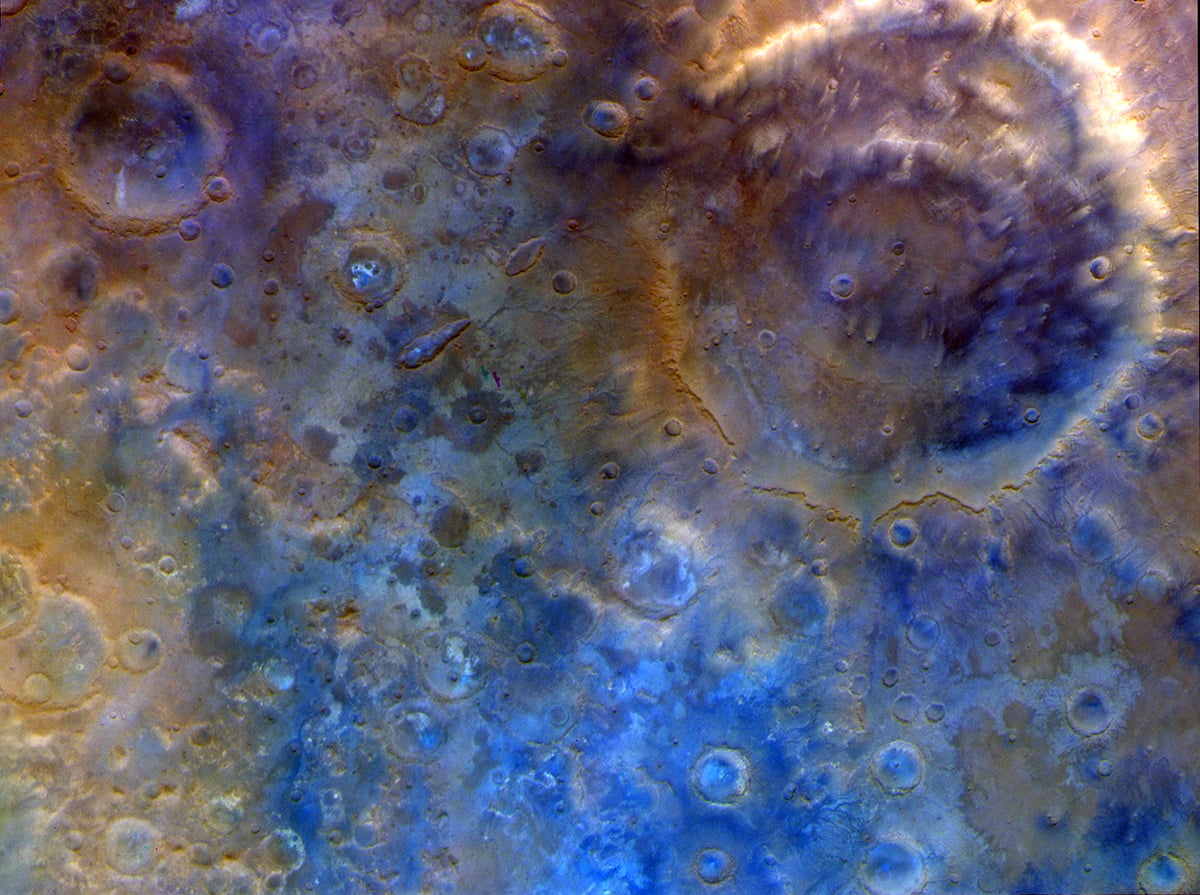
However, recent infrared data revealed evidence of silicate minerals and possible hydrated materials on parts of the asteroid’s surface. Those findings suggest Psyche may not consist entirely of metal. The asteroid could contain a complex mixture of metallic and rocky components shaped by repeated impacts over billions of years.
Once Psyche arrives in orbit around the asteroid in 2029, the spacecraft will spend about 26 months studying the object from multiple orbital altitudes. During that period, scientists will construct gravity maps, analyze surface composition, search for magnetic signatures, and investigate geological structures across the asteroid.
Clear skies!
See more from DIYPhotography.net on Google
Add DIYPhotography.net as a trusted source. This makes
our stories more likely to appear in your Google Search results.
 Add as a preferred source on Google

Soumyadeep Mukherjee
Soumyadeep Mukherjee is an award-winning astrophotographer from India. He has a doctorate degree in Linguistics. His work extends to the sub-genres of nightscape, deep sky, solar, lunar and optical phenomenon photography. He is also a photography educator and has conducted numerous workshops. His works have appeared in over 40 books & magazines including Astronomy, BBC Sky at Night, Sky & Telescope among others, and in various websites including National Geographic, NASA, Forbes. He was the first Indian to win “Astronomy Photographer of the Year” award in a major category.


Join the Discussion
DIYP Comment Policy
Be nice, be on-topic, no personal information or flames.