

















Hera captures two Asteroid Portraits: Otero and Kellyday
Aug 14, 2025
Soumyadeep Mukherjee
Soumyadeep Mukherjee is an award-winning astrophotographer from India. He has a doctorate degree in Linguistics. His work extends to the sub-genres of nightscape, deep sky, solar, lunar and optical phenomenon photography. He is also a photography educator and has conducted numerous workshops. His works have appeared in over 40 books & magazines including Astronomy, BBC Sky at Night, Sky & Telescope among others, and in various websites including National Geographic, NASA, Forbes. He was the first Indian to win “Astronomy Photographer of the Year” award in a major category.
Share:
The European Space Agency’s Hera mission is steadily building momentum on its journey to the Didymos–Dimorphos asteroid system. Recently, the spacecraft photographed two other asteroids during its cruise, (1126) Otero and (18805) Kellyday. These were not just casual snapshots taken in passing. They were carefully planned operations that tested Hera’s camera systems and operational readiness in deep space, and they offered a glimpse of the precision needed when the spacecraft arrives at its primary destination in late 2026.
The Hera mission and its camera
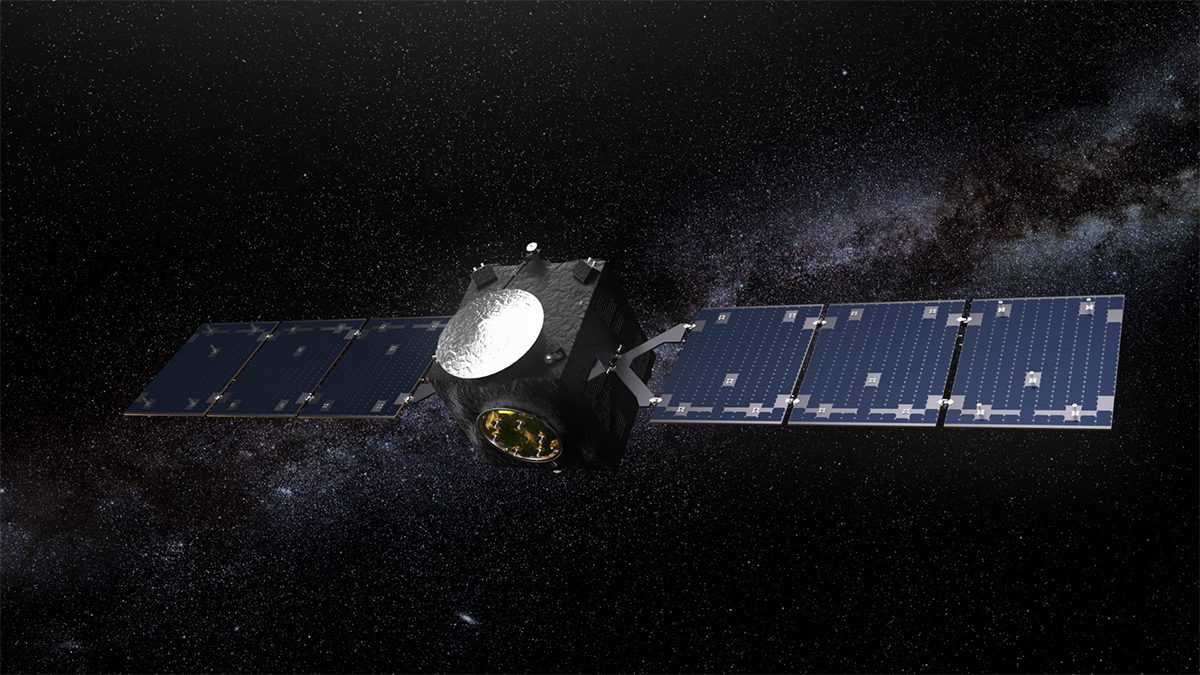
Launched on 7 October 2024, Hera is designed to perform a detailed survey of the Didymos binary asteroid system, where NASA’s DART spacecraft impacted the smaller moon, Dimorphos, in 2022. After a successful Mars flyby in March 2025, Hera is now en route to its target, using the cruise phase not only to travel but also to rehearse mission-critical operations. Central to these tests is the Asteroid Framing Camera (AFC), a pair of identical, redundant imaging units developed by Jena-Optronik in Germany. Each unit features a 1020×1020 pixel monochrome sensor housed behind protective baffles to reduce stray light. The cameras are designed for both navigation and science, tracking asteroids during approach, mapping their surfaces once in proximity, and supporting the deployment of companion spacecraft. These are robust instruments, built not for aesthetic space imagery, but for consistent, reliable performance under demanding conditions, exactly what a planetary defence mission requires.
First target: Asteroid Otero
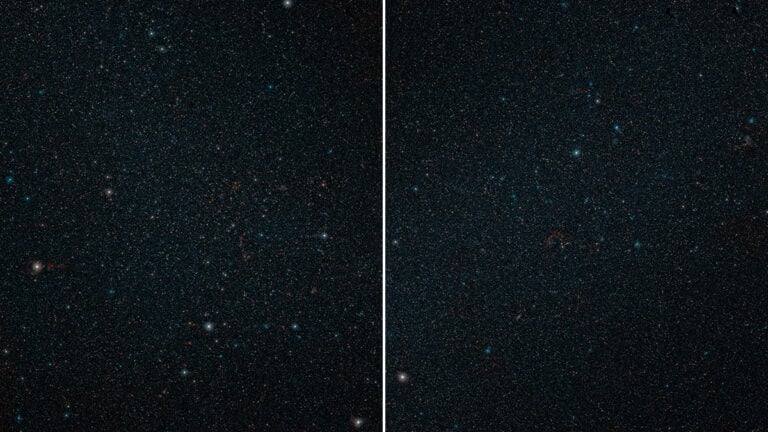
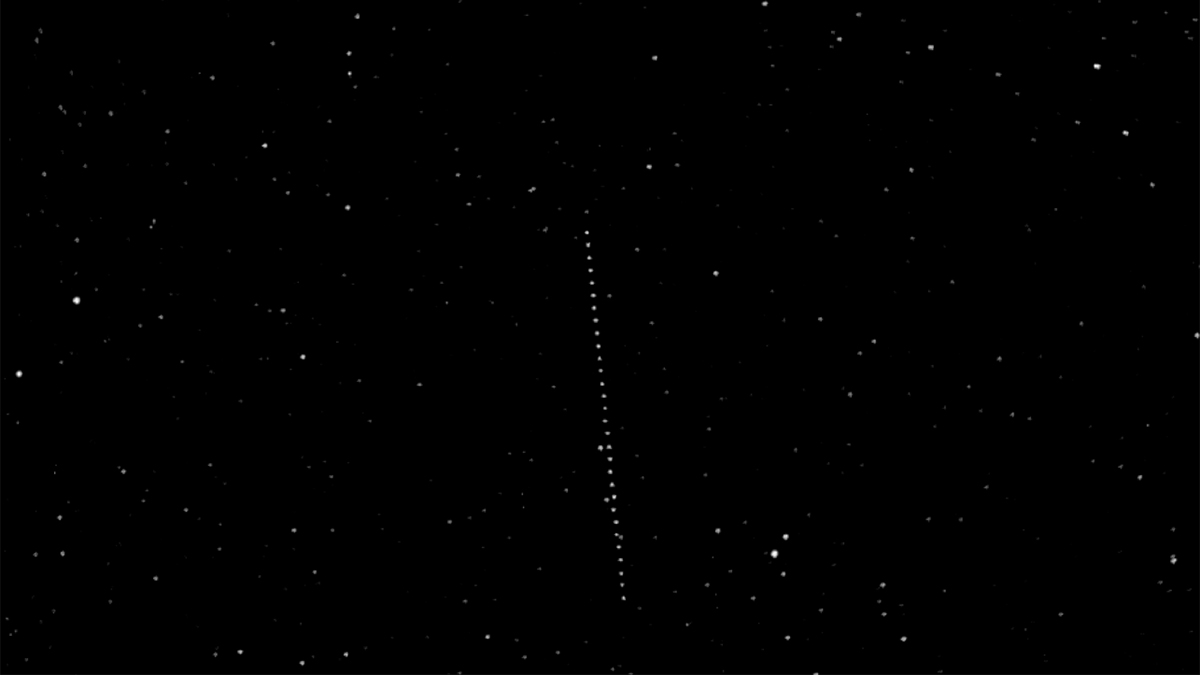
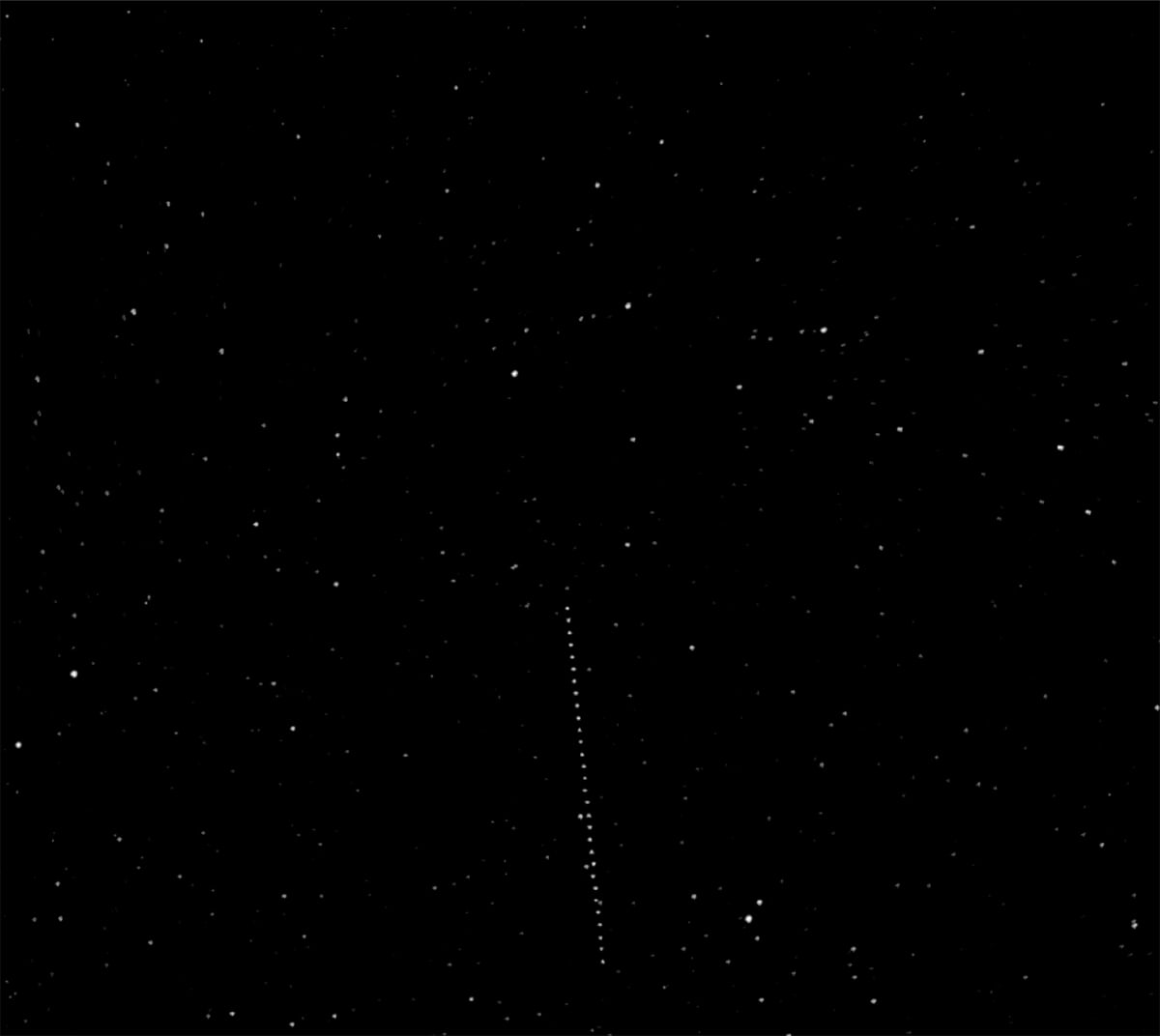
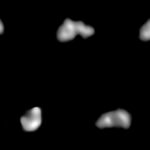
On 11 May 2025, Hera’s team turned the AFC toward (1126) Otero, a rare A-type asteroid located in the main belt. At the time of observation, Hera was about 2.8 million kilometres away from its target. In the raw frames, Otero appeared only as a faint moving point against a fixed background of stars. To track it, the spacecraft captured one image every six minutes over three hours. Engineers then aligned the starfield in all frames, allowing Otero’s subtle motion to stand out in a stacked composite image. The choice of Otero was deliberate; its brightness, well-known orbit, and favourable geometry made it an ideal first rehearsal. Planning was completed within a couple of weeks, which also demonstrated how quickly the mission team could prepare for an observation, a valuable skill for future operations that may require rapid response.
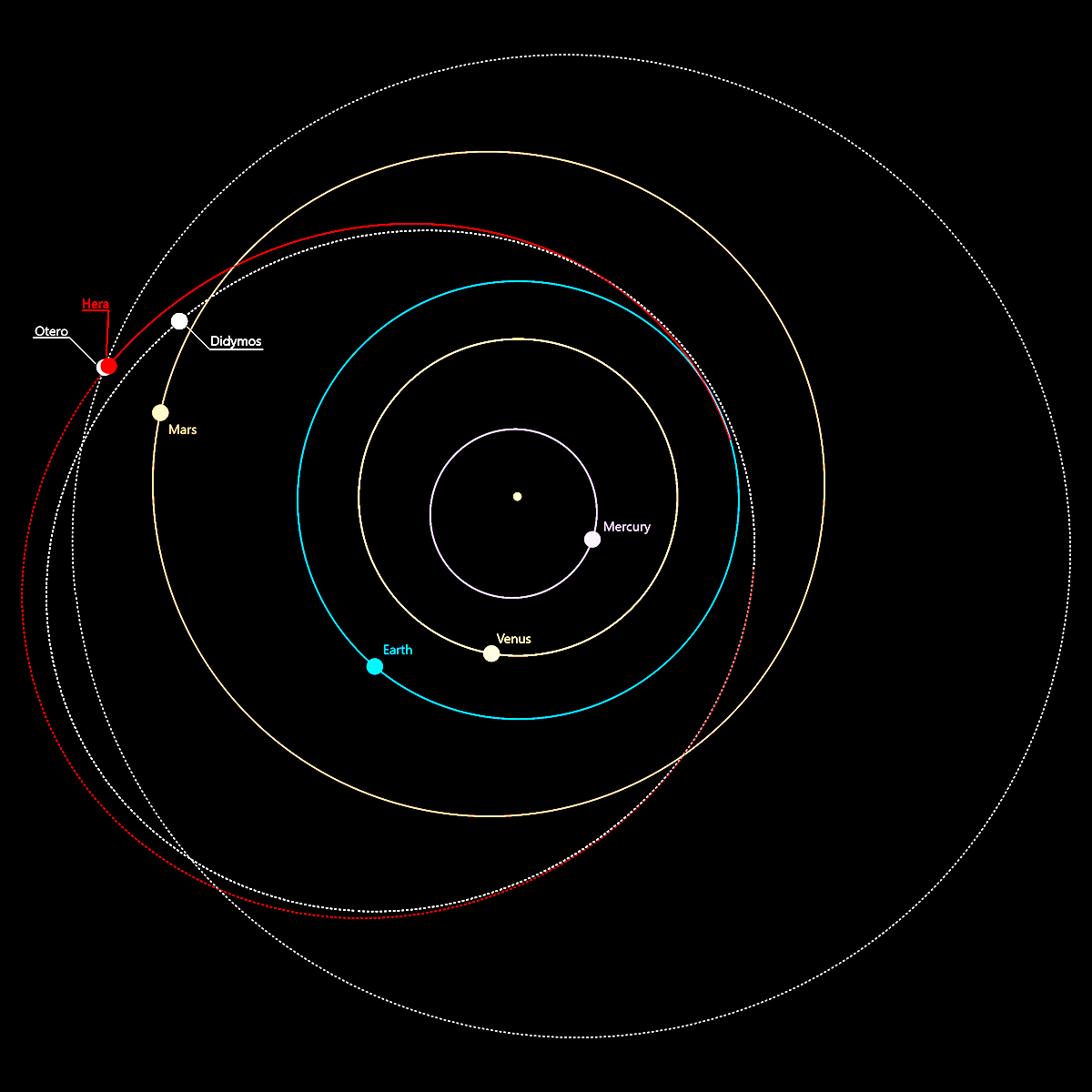
ESA also released a visual showing the positions of Hera, Otero, and the inner planets at the time of the observation. This helped illustrate the geometry of the encounter, making the scale and distance involved easier to grasp. While the result was a simple streak of light among stars, the exercise proved the spacecraft could find, track, and capture a small moving target in the vastness of space, exactly the task it will face with Didymos.
Pushing the limits with Kellyday
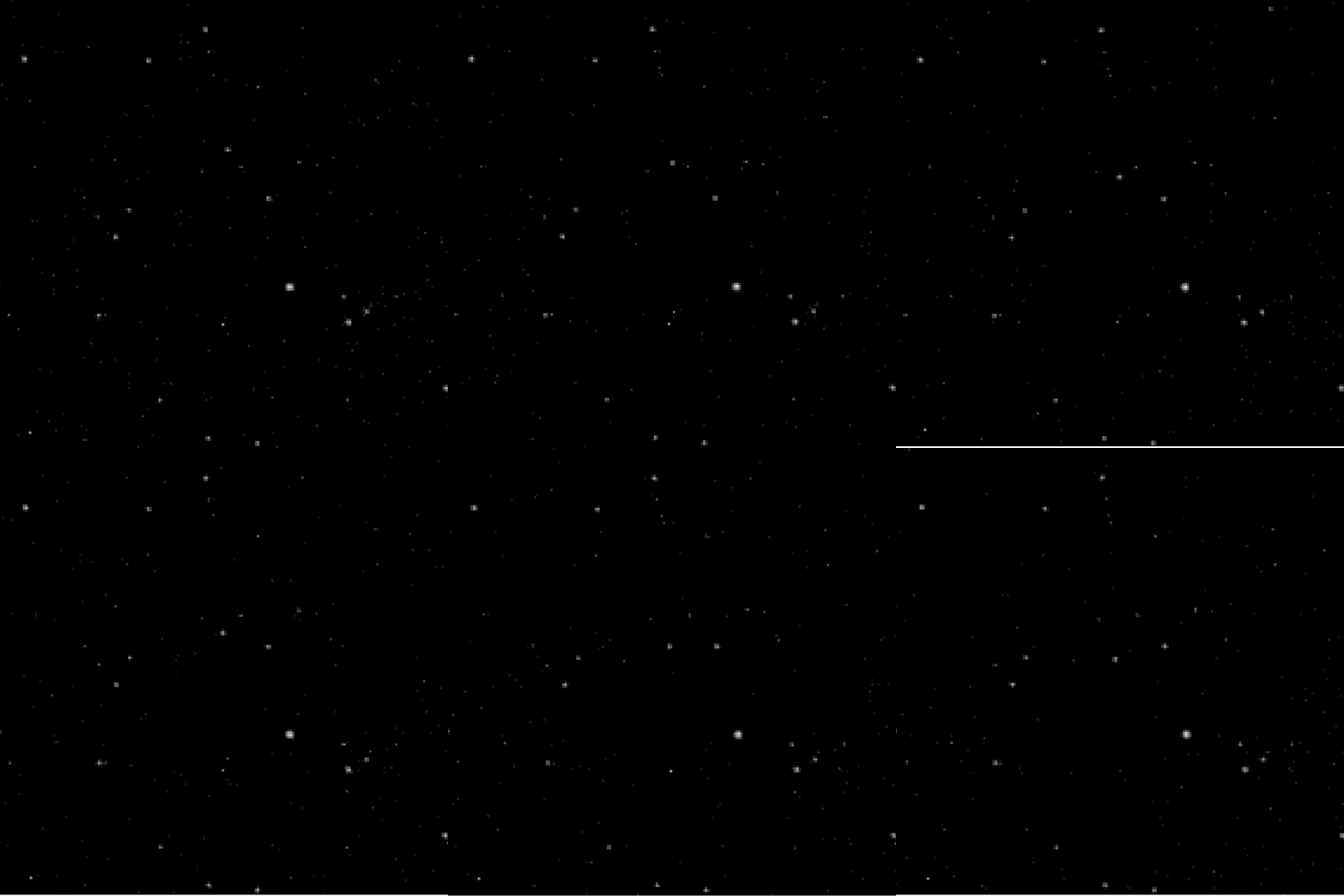
Two months later, on 19 July 2025, the mission team aimed for a far more difficult challenge: imaging asteroid (18805) Kellyday. Unlike Otero, Kellyday was faint, about 40 times dimmer, and much farther away, roughly six million kilometres from Hera. The same technique was used: a sequence of images was taken, the starfield was aligned, and the asteroid’s faint trace was enhanced through processing. Here, the challenge was at the very edge of the AFC’s detection capability. In each individual frame, Kellyday was almost indistinguishable from noise, so the accuracy of image alignment and stacking was critical. Yet the result was successful; the asteroid was detected enough to confirm the spacecraft’s ability to find even the faintest targets in deep space.
What the images reveal
The Otero composite demonstrates the value of stacking techniques in astronomy. By combining multiple exposures, the signal from the asteroid is amplified while noise is reduced, making its motion visible against the background stars. For Kellyday, the images reveal a different skill, detecting an object at the very limit of sensitivity. This required near-perfect alignment, stable pointing, and a processing pipeline fine-tuned for faint signals. Both cases also allowed engineers to refine their knowledge of the AFC’s field of view, exposure behaviour, and pointing stability. These technical details are essential for the precise navigation Hera will require during close-proximity operations at Didymos. The dual-camera setup ensures that even if one unit fails, imaging operations can continue uninterrupted, a redundancy that significantly reduces mission risk.
Hera will continue its journey through 2026, performing further deep-space manoeuvres before arriving at the Didymos system late in the year. Once there, it will spend months in close proximity, mapping the asteroids in detail, measuring Dimorphos’s mass, studying the crater left by DART, and characterising the system’s orbits and physical properties. Two CubeSats deployed from Hera will add to the scientific return. The ultimate goal is to provide the most complete dataset ever gathered on an asteroid deflection test, strengthening our ability to protect Earth from hazardous objects.
Clear skies!
See more from DIYPhotography.net on Google
Add DIYPhotography.net as a trusted source. This makes
our stories more likely to appear in your Google Search results.
 Add as a preferred source on Google

Soumyadeep Mukherjee
Soumyadeep Mukherjee is an award-winning astrophotographer from India. He has a doctorate degree in Linguistics. His work extends to the sub-genres of nightscape, deep sky, solar, lunar and optical phenomenon photography. He is also a photography educator and has conducted numerous workshops. His works have appeared in over 40 books & magazines including Astronomy, BBC Sky at Night, Sky & Telescope among others, and in various websites including National Geographic, NASA, Forbes. He was the first Indian to win “Astronomy Photographer of the Year” award in a major category.



Join the Discussion
DIYP Comment Policy
Be nice, be on-topic, no personal information or flames.
One response to “Hera captures two Asteroid Portraits: Otero and Kellyday”
And how is this DIY photography?