





















NASA’s Nancy Grace Roman Space Telescope is Ready for Launch
Apr 22, 2026
Soumyadeep Mukherjee
Soumyadeep Mukherjee is an award-winning astrophotographer from India. He has a doctorate degree in Linguistics. His work extends to the sub-genres of nightscape, deep sky, solar, lunar and optical phenomenon photography. He is also a photography educator and has conducted numerous workshops. His works have appeared in over 40 books & magazines including Astronomy, BBC Sky at Night, Sky & Telescope among others, and in various websites including National Geographic, NASA, Forbes. He was the first Indian to win “Astronomy Photographer of the Year” award in a major category.
Share:
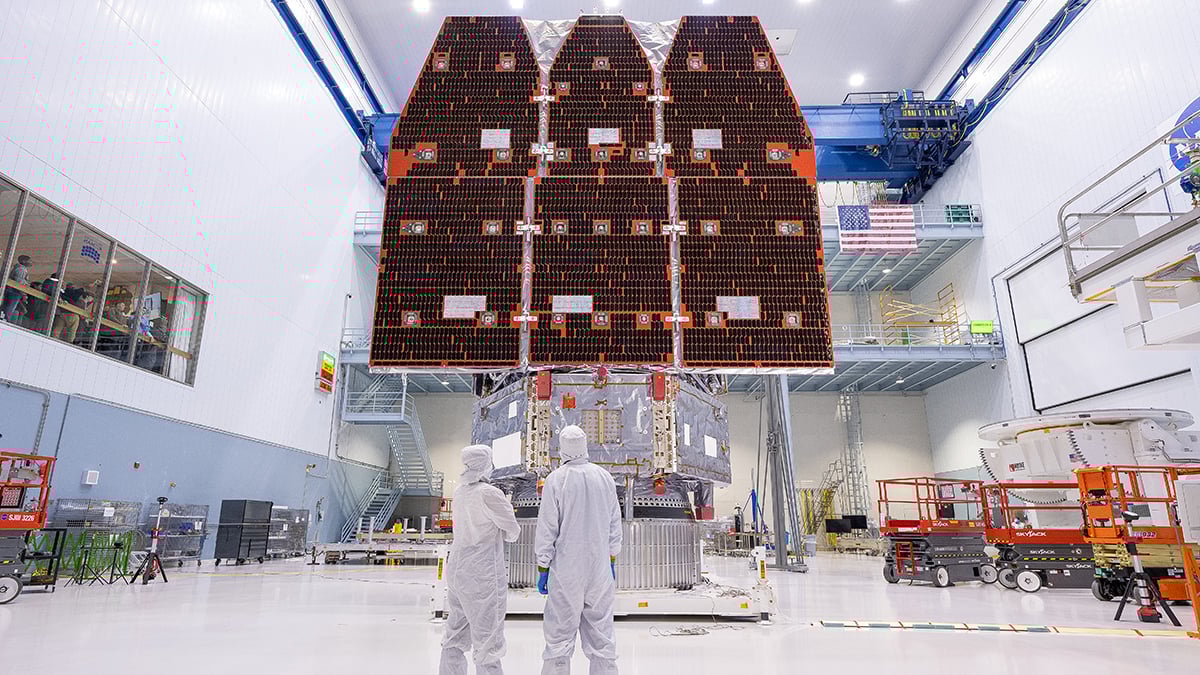
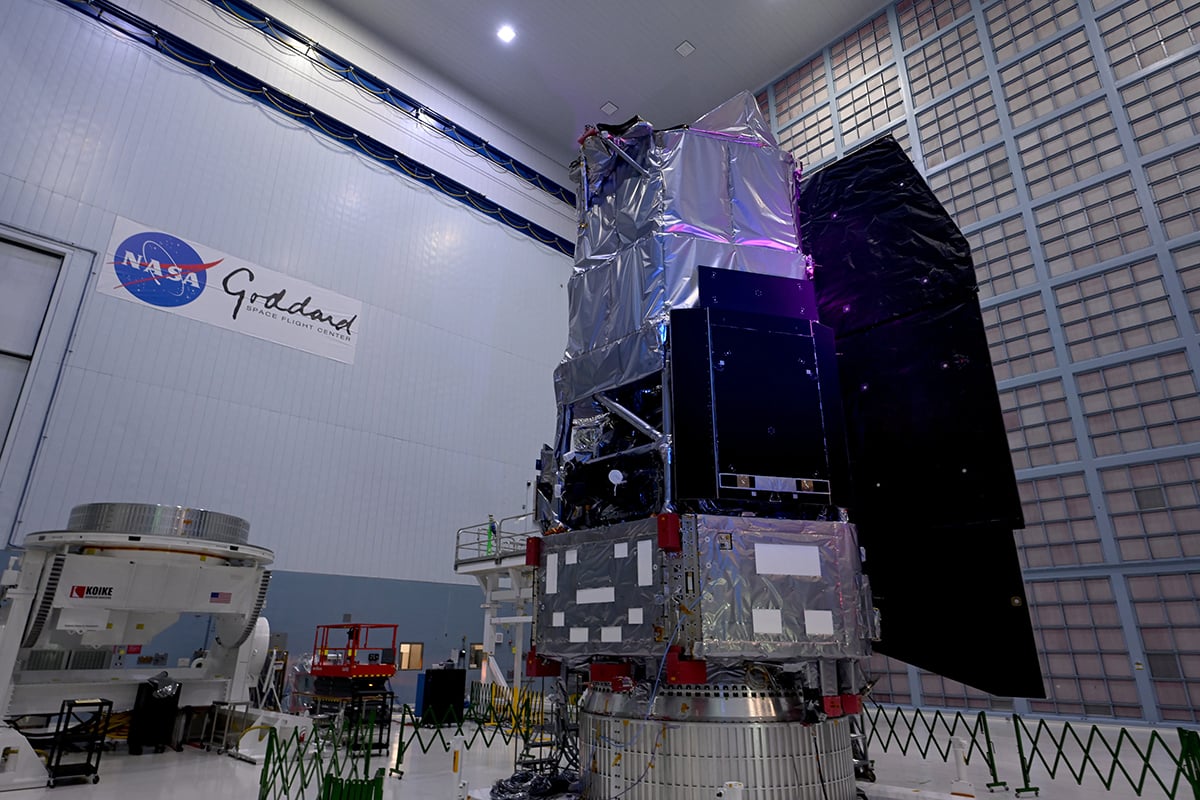
NASA has completed the integration of the Nancy Grace Roman Space Telescope, marking a critical transition from assembly to observatory-level environmental testing. Engineers combined the telescope optics, instrument module, spacecraft bus, and deployable sunshield into a single flight configuration at Goddard Space Flight Center. With this milestone achieved, the mission has entered the final phase before launch preparation and delivery to the launch site.
The observatory will investigate the expansion history of the universe, map dark matter across cosmic structures, and conduct a large statistical census of exoplanets toward the Galactic bulge. At the same time, its coronagraph instrument will validate high-contrast imaging technologies needed for future direct imaging missions. NASA now targets early September 2026 for the launch of the telescope.
A wide-field observatory
Roman occupies a distinct role among modern space telescopes. While the Hubble Space Telescope excels at high-resolution imaging of selected targets and the James Webb Space Telescope probes the early universe with deep infrared sensitivity, Roman focuses on large-area mapping with high angular resolution. This survey-driven approach enables astronomers to study cosmic structure across vast spatial scales.
The observatory carries a 2.4-meter primary mirror that matches Hubble’s aperture. However, Roman’s imaging performance differs crucially. Its Wide Field Instrument captures a region roughly one hundred times larger than Hubble’s primary camera in a single exposure. As a result, astronomers can now observe extended sky regions without sacrificing image quality.
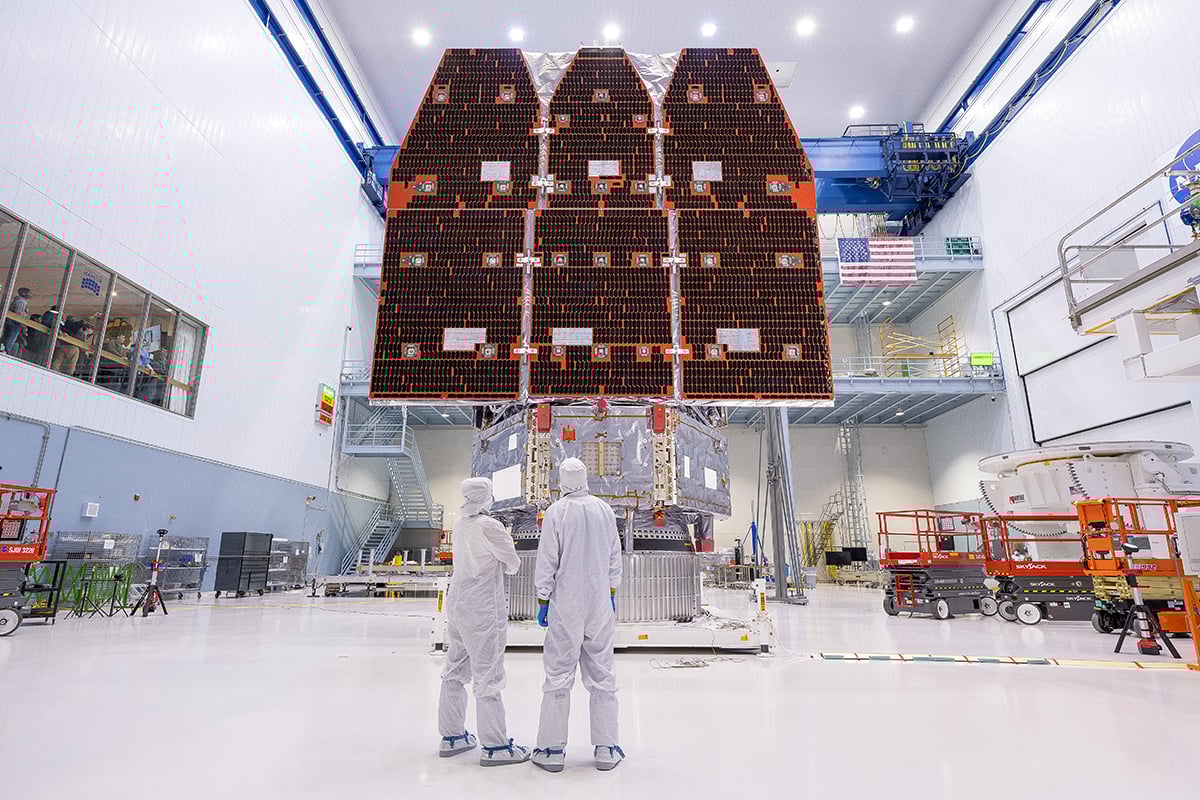
Roman operates primarily at visible and near-infrared wavelengths. These wavelengths trace galaxy populations across a wide range of cosmic distances. They also allow the telescope to measure faint stellar populations and dusty structures within nearby galaxies. Due to this combination, Roman will support both cosmological surveys and investigations of Galactic structure within the same mission framework.
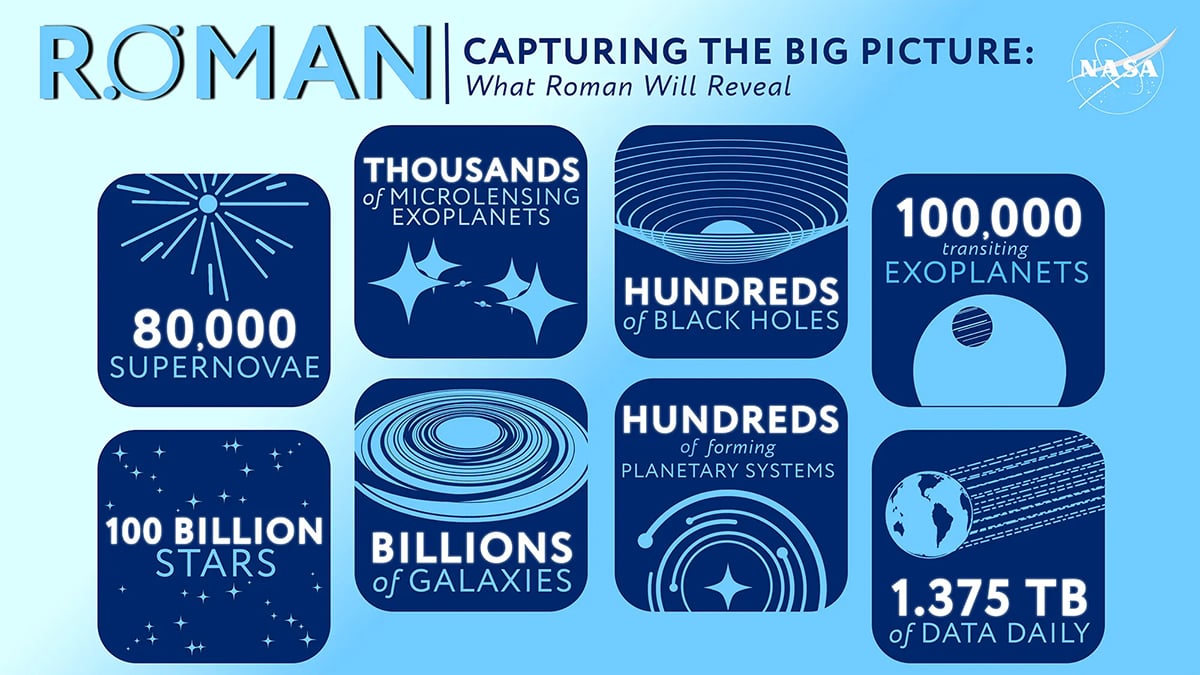
Over the course of its primary mission, Roman is expected to observe light from nearly a billion galaxies. Such a dataset will transform statistical studies of galaxy evolution and large-scale structure.
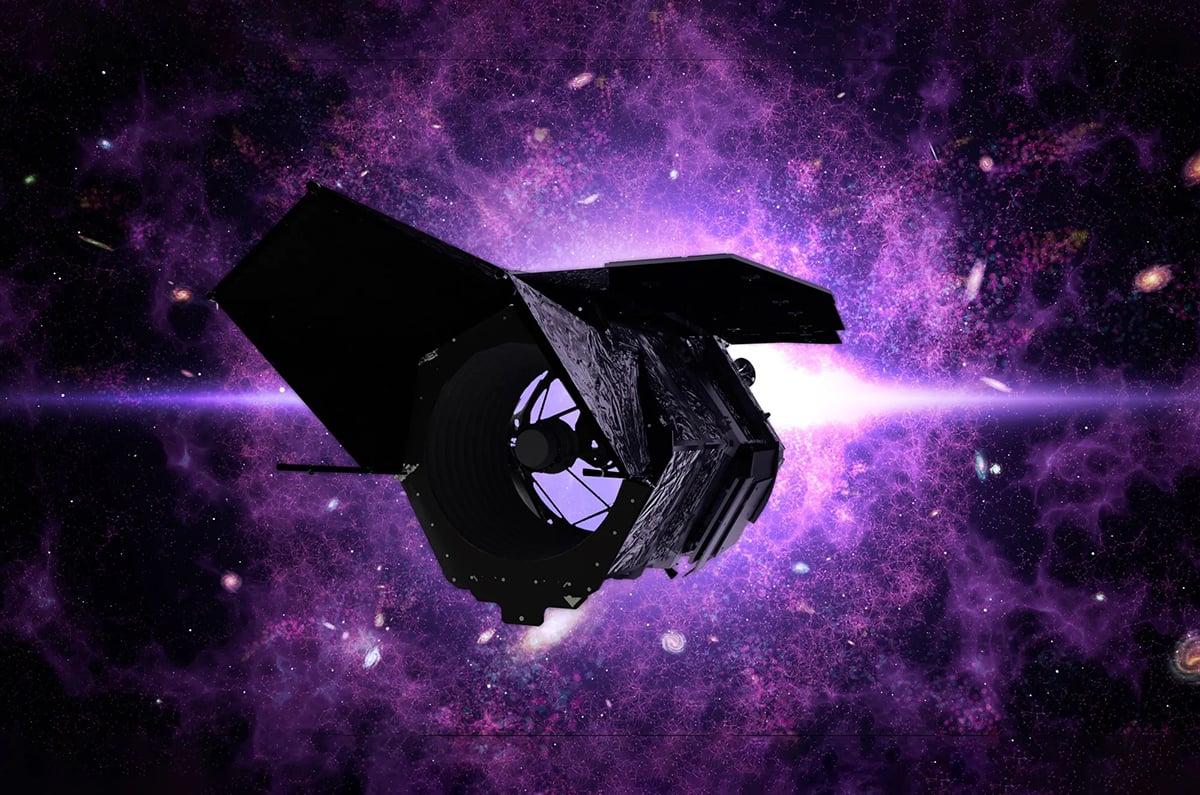
The Wide Field Instrument (WFI)
Roman’s Wide Field Instrument forms the scientific backbone of the observatory. This camera contains a large mosaic of infrared detectors that deliver both high sensitivity and wide angular coverage. These characteristics will allow astronomers to perform large surveys with unprecedented efficiency from space.
Researchers will use this instrument to image galaxy populations across cosmological distances. These observations will help measure galaxy shapes. Shape measurements are essential for weak gravitational lensing studies, which trace the distribution of dark matter throughout the universe.
In addition, the Wide Field Instrument will observe dense stellar environments near the center of the Milky Way. These regions remain difficult to study from the ground because of dust absorption and atmospheric distortion. Roman’s space-based platform removes these limitations and enables long-term monitoring of crowded stellar fields.
A coronagraph for direct planet imaging
Roman’s second instrument, the Coronagraph Instrument, addresses a different scientific challenge. Detecting faint planets near bright stars requires extreme suppression of scattered starlight. Roman’s coronagraph achieves this suppression using a combination of masks, deformable mirrors, and wavefront control systems.
This instrument will show high-contrast imaging performance that has never been achieved before in space. Engineers will use the results to refine technologies planned for future missions that aim to detect Earth-like planets around nearby stars.
During its operational phase, the coronagraph will also observe giant exoplanets orbiting nearby stellar systems. It will measure the reflected light from these planets and analyze surrounding debris disks. These observations provide insight into how planetary systems evolve after formation.
Measuring the expansion history of the universe
One of Roman’s primary scientific goals involves the study of cosmic acceleration. Observations during the late twentieth century revealed that the universe expands at an increasing rate. This discovery introduced the concept of dark energy, which now dominates the energy content of the universe.
Roman will investigate this phenomenon using several complementary observational methods. First, the telescope will measure weak gravitational lensing across large galaxy samples. These measurements reveal how matter clusters under the influence of gravity over time.
Second, Roman will analyze the spatial distribution of galaxies across wide cosmological volumes. Patterns within this distribution preserve signatures of early cosmic conditions and later expansion history.
Third, the observatory will monitor distant supernova explosions that serve as precise distance indicators. By combining these measurements, astronomers will reconstruct the expansion history of the universe with improved accuracy.
Operating at the Sun–Earth L2 location
After launch, Roman will travel to the Sun–Earth L2 region, located about 1.5 million kilometers from Earth. This location provides stable thermal conditions and continuous access to large areas of the sky.
Operating at L2 allows Roman to maintain a constant orientation relative to the Sun and Earth. This stability improves detector performance and supports uninterrupted long-duration observations. It also enables efficient communication with ground stations throughout the mission.
Roman’s primary mission will last five years, although engineers expect the observatory to continue operating longer if systems remain healthy. During this period, the telescope will collect a large archive of survey data that will support research across many areas of astrophysics.
Clear skies!
See more from DIYPhotography.net on Google
Add DIYPhotography.net as a trusted source. This makes
our stories more likely to appear in your Google Search results.
 Add as a preferred source on Google

Soumyadeep Mukherjee
Soumyadeep Mukherjee is an award-winning astrophotographer from India. He has a doctorate degree in Linguistics. His work extends to the sub-genres of nightscape, deep sky, solar, lunar and optical phenomenon photography. He is also a photography educator and has conducted numerous workshops. His works have appeared in over 40 books & magazines including Astronomy, BBC Sky at Night, Sky & Telescope among others, and in various websites including National Geographic, NASA, Forbes. He was the first Indian to win “Astronomy Photographer of the Year” award in a major category.

Join the Discussion
DIYP Comment Policy
Be nice, be on-topic, no personal information or flames.