























Euclid Unveils an Einstein Ring: A Glimpse into the Dark Universe
Oct 10, 2025
Soumyadeep Mukherjee
Soumyadeep Mukherjee is an award-winning astrophotographer from India. He has a doctorate degree in Linguistics. His work extends to the sub-genres of nightscape, deep sky, solar, lunar and optical phenomenon photography. He is also a photography educator and has conducted numerous workshops. His works have appeared in over 40 books & magazines including Astronomy, BBC Sky at Night, Sky & Telescope among others, and in various websites including National Geographic, NASA, Forbes. He was the first Indian to win “Astronomy Photographer of the Year” award in a major category.
Share:

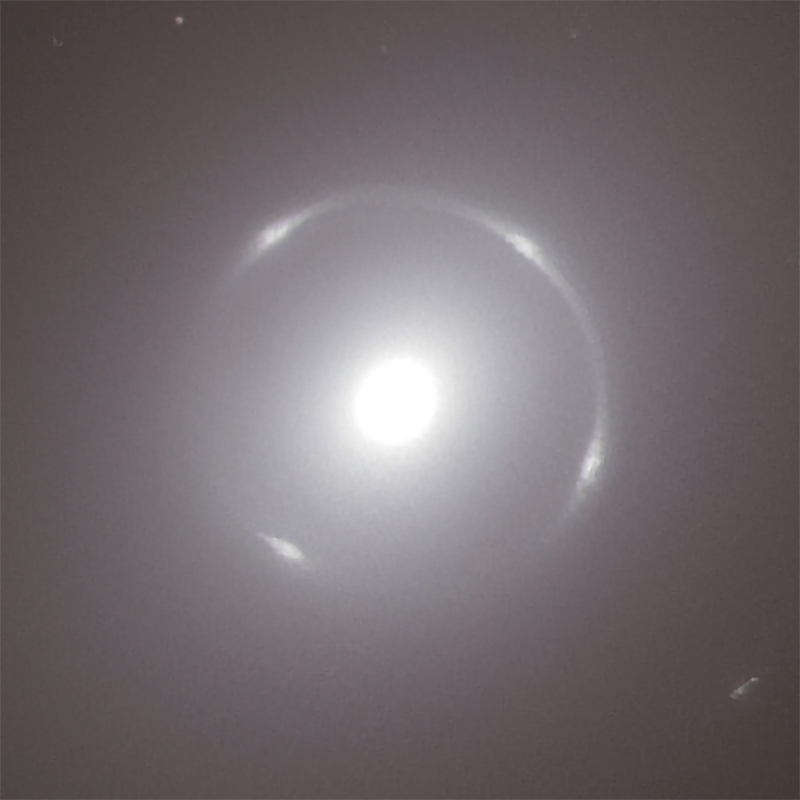
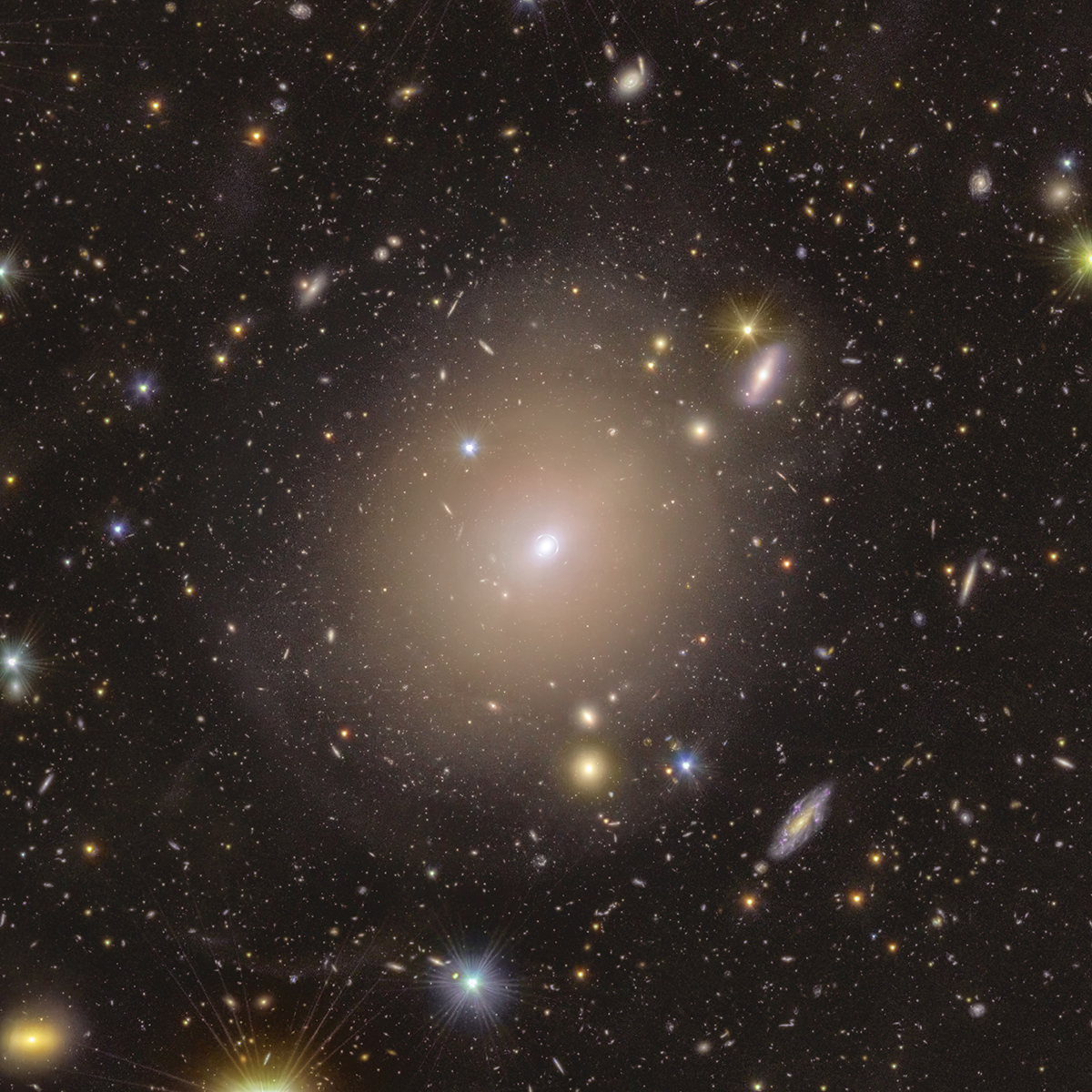
When the European Space Agency launched the Euclid telescope in July 2023, its goal was ambitious: to map the dark universe with unmatched precision. Barely months into its mission, Euclid has already delivered one of the most striking images of modern astronomy: a near-perfect Einstein ring encircling the galaxy NGC 6505.
A hidden wonder revealed
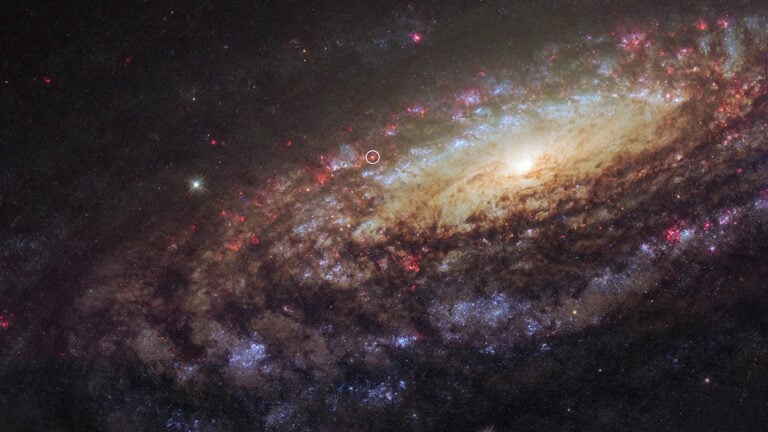
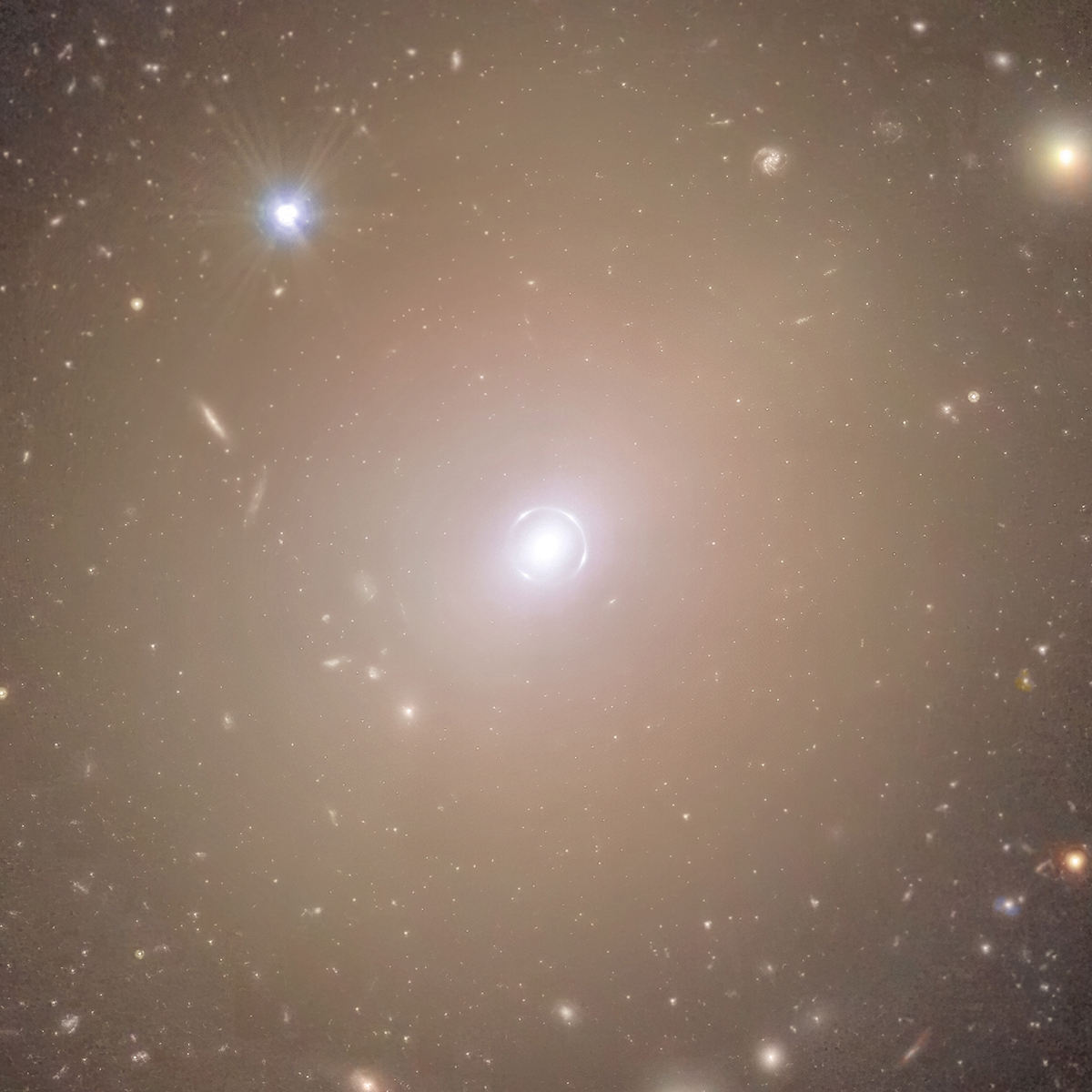
The galaxy NGC 6505 lies around 590 million light-years away in the constellation Hercules. It’s an old elliptical system, known to astronomers since 1884. But no one suspected it was hiding something extraordinary. Euclid’s instruments, the Visible Imager (VIS) and the Near-Infrared Spectrometer and Photometer (NISP), detected an unusual circular structure surrounding NGC 6505.
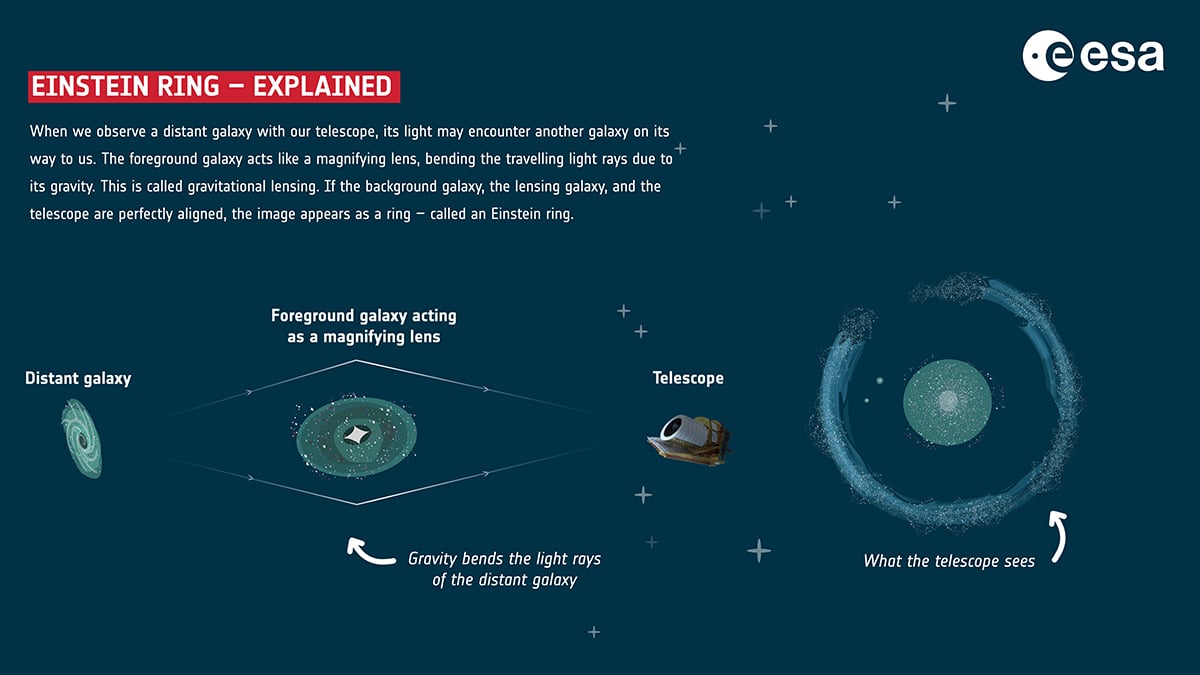
The light forming that ring did not come from NGC 6505 at all. It originated from a much more distant galaxy, roughly 4.4 billion light-years away. The light from that background galaxy had been gravitationally lensed by NGC 6505 on its way to us, curved so precisely that it formed a complete circle around the foreground galaxy.
That circle is what physicists call an Einstein ring, predicted by Albert Einstein’s theory of general relativity over a century ago. It forms only when three celestial objects: the background source, the lensing galaxy, and the observer, align almost perfectly. The chance of such alignment is extremely small, which makes every discovered Einstein ring a rare and valuable find.
The science behind the ring
When light passes near a massive object like a galaxy, gravity bends its path. If the alignment is close enough, the bending splits and stretches the background light into arcs or rings. The size and shape of those arcs reveal the total mass of the lensing object, including both visible matter (like stars and gas) and invisible dark matter.
By studying how the background galaxy’s light curves around NGC 6505, scientists can “weigh” the galaxy with remarkable accuracy. The Euclid team’s analysis found that about 11 percent of the mass within the Einstein ring is made up of dark matter.
That’s a crucial measurement because it helps astronomers understand how mass is distributed within galaxies. In the central regions, stars dominate. But further out, dark matter becomes increasingly significant. By comparing lensing results like this with stellar models and velocity data, Euclid helps refine our understanding of how galaxies form, evolve, and hold themselves together.
Euclid’s eyes: Instruments and optics
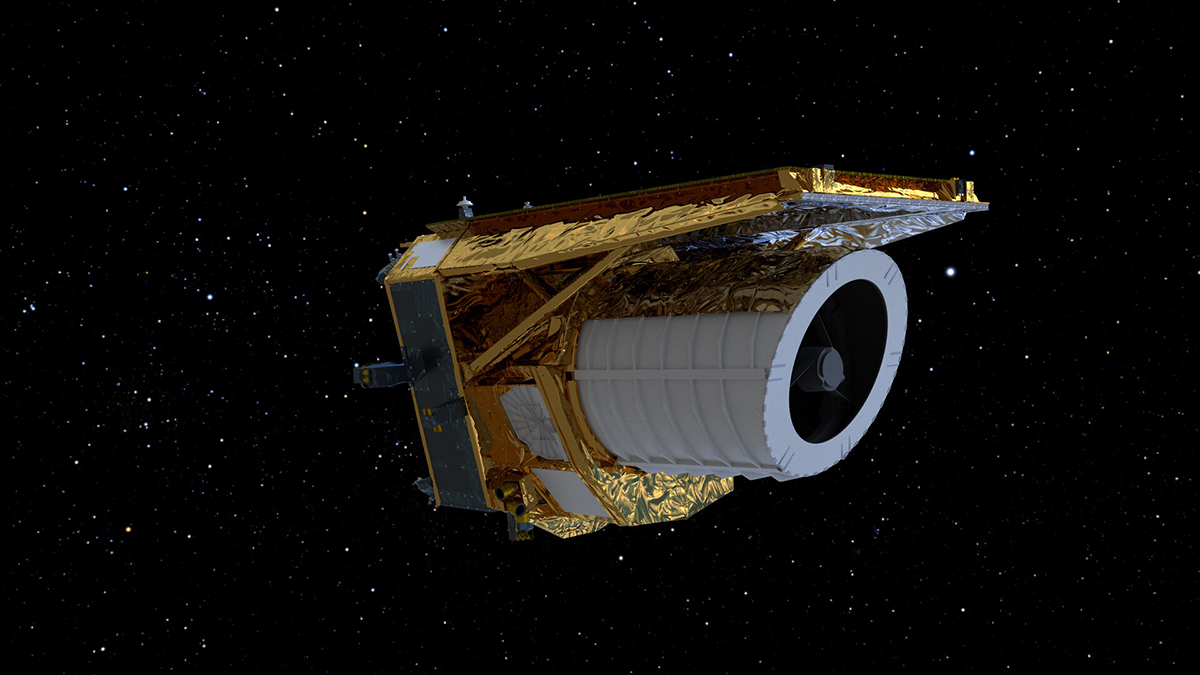
Euclid is a 1.2-metre Korsch telescope built for wide-field, high-quality imaging. It feeds two main instruments: VIS, a large visible imager, and NISP, a near-infrared photometer and slitless spectrograph. VIS uses a 36-CCD focal plane sampled at about 0.1 arcsecond per pixel. NISP’s infrared detectors sample at about 0.3 arcseconds per pixel and provide photometry and slitless spectroscopy. The telescope’s optics and dichroic splitter send the correct wavelengths to each instrument. These design choices let Euclid combine sharp resolution with wide survey speed.
During its calibration phase, Euclid took several long exposures of NGC 6505. The resulting images revealed the faint, perfectly circular glow of the Einstein ring around it. Further analysis confirmed the background source’s redshift, the degree to which its light had been stretched by cosmic expansion, at z ≈ 0.406, compared to z ≈ 0.042 for NGC 6505.
Importance of this discovery
Euclid’s main mission is not to hunt for individual lenses, but to study the universe’s large-scale structure through weak gravitational lensing. It aims to find out the subtle distortion of millions of distant galaxies by intervening dark matter. However, the detection of a strong lens like this one carries special significance.
First, it confirms that Euclid’s instruments are performing exactly as planned. The telescope’s optics and detectors are sharp enough to identify small-scale features that depend on perfect image quality.
Second, it provides a test case for how Euclid’s data will be processed during its six-year mission. The ring around NGC 6505 was detected during the early phase of observation, using the same calibration tools and reduction pipeline that will process billions of galaxy images.
Third, each Einstein ring adds to a growing catalogue of strong gravitational lenses that scientists can use to study cosmic evolution. The geometry of the lens tells us not only about the galaxy doing the lensing but also about the expansion of the universe itself.
A new view of the known
It’s striking that NGC 6505, a galaxy catalogued for more than a century, still held a surprise like this. Euclid’s ability to look deeper, cleaner, and across multiple wavelengths means it can uncover hidden details even in familiar regions of the sky.
Einstein rings are spectacular to look at, but their value goes beyond aesthetics. Each one serves as a laboratory for physics on the largest scales. By tracing how light curves around a galaxy, astronomers can measure gravity itself and where invisible mass lurks.
Clear skies!
See more from DIYPhotography.net on Google
Add DIYPhotography.net as a trusted source. This makes
our stories more likely to appear in your Google Search results.
 Add as a preferred source on Google

Soumyadeep Mukherjee
Soumyadeep Mukherjee is an award-winning astrophotographer from India. He has a doctorate degree in Linguistics. His work extends to the sub-genres of nightscape, deep sky, solar, lunar and optical phenomenon photography. He is also a photography educator and has conducted numerous workshops. His works have appeared in over 40 books & magazines including Astronomy, BBC Sky at Night, Sky & Telescope among others, and in various websites including National Geographic, NASA, Forbes. He was the first Indian to win “Astronomy Photographer of the Year” award in a major category.

Join the Discussion
DIYP Comment Policy
Be nice, be on-topic, no personal information or flames.