
























Counting Craters: Mars Express Reveals Mars’s Ancient Landscape
Mar 13, 2026
Soumyadeep Mukherjee
Soumyadeep Mukherjee is an award-winning astrophotographer from India. He has a doctorate degree in Linguistics. His work extends to the sub-genres of nightscape, deep sky, solar, lunar and optical phenomenon photography. He is also a photography educator and has conducted numerous workshops. His works have appeared in over 40 books & magazines including Astronomy, BBC Sky at Night, Sky & Telescope among others, and in various websites including National Geographic, NASA, Forbes. He was the first Indian to win “Astronomy Photographer of the Year” award in a major category.
Share:
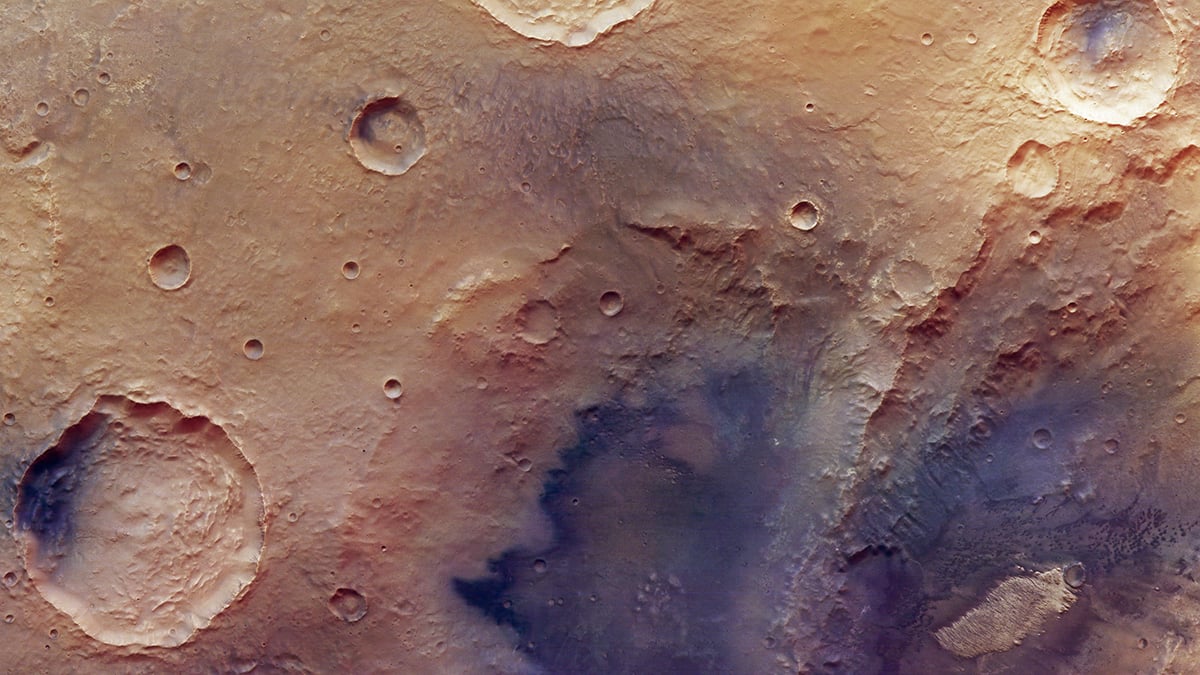
Mars offers a particularly valuable record of impact history. Large areas of the planet still preserve ancient terrain formed during the earliest stages of Solar System evolution. One of the best examples can be found in the region known as Arabia Terra. This landscape contains a dense population of impact structures that formed during the first billion years of Martian history.
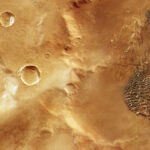
A recent image released by the European Space Agency highlights this ancient terrain. The observation comes from the Mars Express mission, which has been orbiting Mars since 2003. The image reveals a heavily cratered landscape centred around Trouvelot Crater, a large impact structure located within Arabia Terra. These features provide an excellent case study for understanding how scientists interpret cratered planetary surfaces.
Mars Express and high-resolution mapping of the martian surface
The image originates from the High-Resolution Stereo Camera carried by the Mars Express spacecraft. This instrument plays a central role in mapping the planet’s surface. It records images from multiple viewing angles and colour channels during each orbital pass.
These observations allow scientists to construct detailed three-dimensional models of Martian terrain. Elevation data derived from the images reveal subtle structures such as ridges, terraces, and shallow depressions. Such information is essential when studying impact craters and erosion patterns.
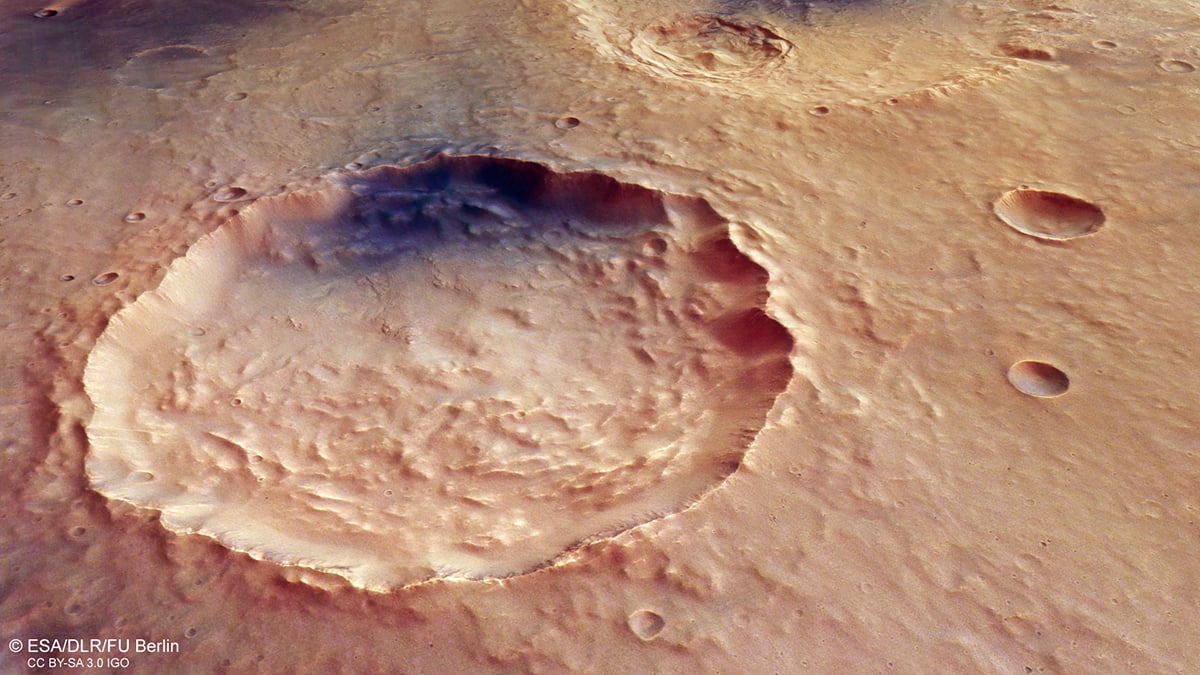
Mars Express captured the data for this particular observation during orbit 26,233 on October 12, 2024. Scientists later processed the raw data to produce colour and topographic views of the region. Although the observation itself occurred earlier, the processed image provides a clear and informative look at a geologically important area.
The camera’s ability to combine high spatial resolution with topographic mapping makes it well suited for studying cratered landscapes. It allows researchers to identify overlapping impact structures, degraded rims, and internal features that reveal how a crater formed and evolved. In this case, the camera recorded a broad section of Arabia Terra, a region that preserves one of the most complete records of early Martian bombardment.

Arabia Terra: A preserved landscape from early Mars
Arabia Terra lies near the transition between the Martian northern lowlands and the southern highlands. The terrain stretches across a wide band of the planet’s northern hemisphere and displays one of the highest crater densities on Mars.
Scientists estimate that much of this region formed more than 3.7 billion years ago. During that time, the Solar System experienced a high rate of asteroid and comet impacts. Many planetary surfaces formed during this era and accumulated large numbers of craters.
Arabia Terra preserved these structures exceptionally well. Unlike younger volcanic plains on Mars, this region did not experience extensive lava flows that could erase older features. As a result, the surface retained a large population of ancient craters.
The Mars Express image illustrates this. Circular depressions of many sizes cover the terrain. Some craters appear relatively well preserved, with clear rims and central structures. Others look heavily eroded and partially filled with sediment. These differences allow scientists to reconstruct the sequence of impacts that shaped the region. Larger and more degraded craters generally formed earlier. Smaller and sharper structures often represent later impacts.

Trouvelot crater and the structure of a large impact basin
The most prominent feature in the image is Trouvelot Crater, a large complex impact structure roughly 130 kilometres across. The crater occupies a significant portion of the lower area of the scene and dominates the surrounding landscape.
Large impacts produce complex craters rather than simple bowl-shaped depressions. After the initial collision excavates the cavity, the surrounding rock collapses inward under gravity. This movement forms stepped terraces along the inner walls and sometimes creates a central peak or uplift.
Several of these structural features remain visible inside Trouvelot Crater. Terraced slopes line sections of the interior walls, indicating large-scale collapse shortly after the impact event. However, the outer rim appears irregular and worn, suggesting that erosion has altered the crater over a long period.
Additional evidence for its age appears in the form of smaller craters scattered across the basin floor and along its rim. These younger impacts formed after the main crater already existed. Their presence shows that the region continued to experience bombardment long after the original event.
Trouvelot Crater also overlaps another degraded crater nearby. This relationship provides a useful chronological marker. Because Trouvelot cuts into the older structure, scientists know that the neighbouring crater formed earlier.

Volcanic materials and wind-driven dunes
The interior of Trouvelot Crater contains several dark patches that contrast strongly with the surrounding reddish surface. These deposits cover parts of the crater floor and extend along sections of the inner walls.
Researchers believe this material contains minerals rich in iron and magnesium. Minerals such as pyroxene and olivine commonly occur in volcanic rocks. Their presence suggests that the dark deposits may originate from deeper layers of the Martian crust or from volcanic materials exposed by impacts.
Large impacts often excavate material from below the surface and spread it across the surrounding terrain. Later processes then redistribute these deposits across the crater floor.
Wind has played a major role in shaping the deposits seen inside Trouvelot Crater. The dark sand forms crescent-shaped dunes that appear clearly in the image. These structures belong to a type known as barchan dunes.
Barchan dunes form when winds blow steadily from a dominant direction. The wind pushes sand forward while the edges move more slowly, producing a curved shape with pointed tips that extend downwind.
Such dunes appear in deserts on Earth as well. Their presence on Mars demonstrates that wind continues to reshape the surface despite the planet’s thin atmosphere. Over time, these winds transport dust and sand, gradually altering the appearance of the landscape.

Clear skies!
See more from DIYPhotography.net on Google
Add DIYPhotography.net as a trusted source. This makes
our stories more likely to appear in your Google Search results.
 Add as a preferred source on Google

Soumyadeep Mukherjee
Soumyadeep Mukherjee is an award-winning astrophotographer from India. He has a doctorate degree in Linguistics. His work extends to the sub-genres of nightscape, deep sky, solar, lunar and optical phenomenon photography. He is also a photography educator and has conducted numerous workshops. His works have appeared in over 40 books & magazines including Astronomy, BBC Sky at Night, Sky & Telescope among others, and in various websites including National Geographic, NASA, Forbes. He was the first Indian to win “Astronomy Photographer of the Year” award in a major category.

Join the Discussion
DIYP Comment Policy
Be nice, be on-topic, no personal information or flames.