























JWST Reveals Spiral Galaxy NGC 5134 in Unprecedented Detail
Feb 23, 2026
Soumyadeep Mukherjee
Soumyadeep Mukherjee is an award-winning astrophotographer from India. He has a doctorate degree in Linguistics. His work extends to the sub-genres of nightscape, deep sky, solar, lunar and optical phenomenon photography. He is also a photography educator and has conducted numerous workshops. His works have appeared in over 40 books & magazines including Astronomy, BBC Sky at Night, Sky & Telescope among others, and in various websites including National Geographic, NASA, Forbes. He was the first Indian to win “Astronomy Photographer of the Year” award in a major category.
Share:
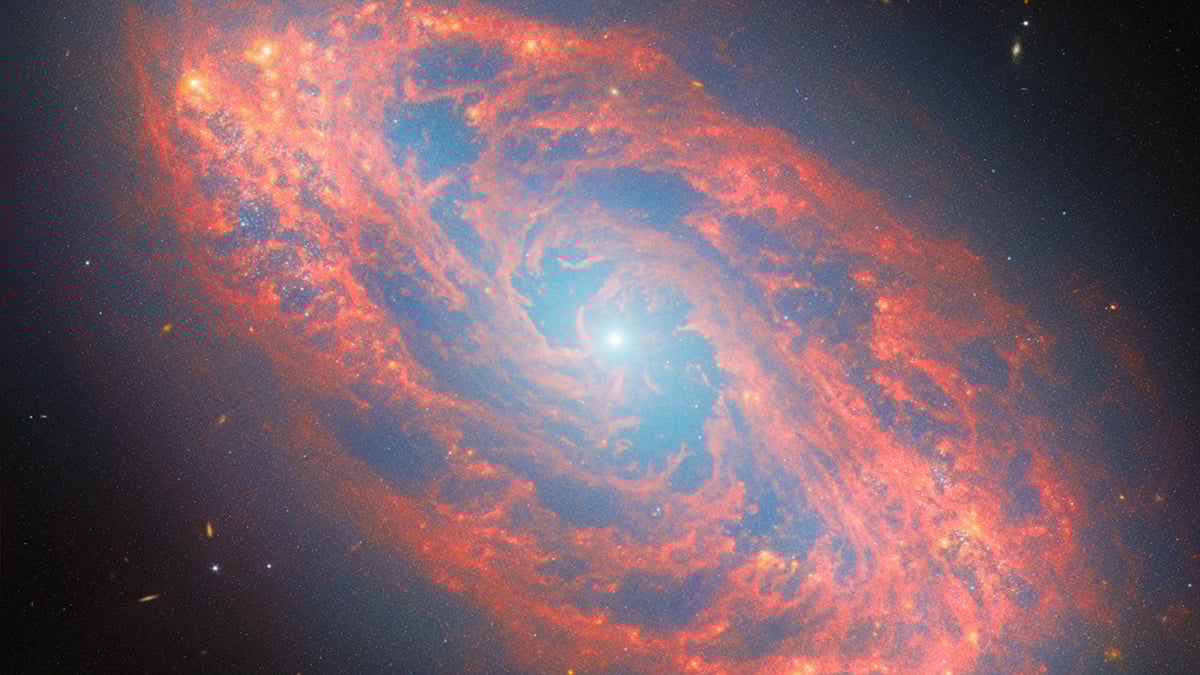
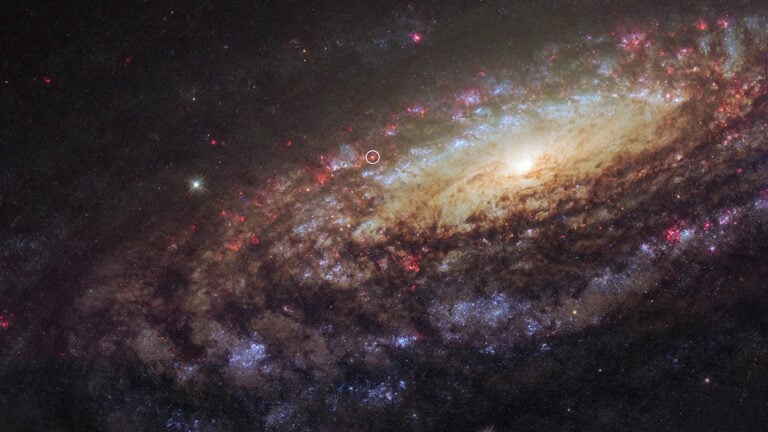
Infrared imaging now drives much of modern galaxy research. By probing wavelengths that penetrate dust, astronomers can trace both embedded star formation and the structure of the interstellar medium. In February 2026, the European Space Agency released a new dataset from the James Webb Space Telescope focused on the spiral galaxy NGC 5134. The observation forms part of a broader JWST program targeting nearby star-forming galaxies. It aims to measure how stars and dust interact across galactic disks.
NGC 5134 lies roughly 65 million light-years away in the constellation Virgo. At this distance, JWST resolves structural features across the galaxy’s spiral arms. The new image combines near-infrared and mid-infrared data, allowing astronomers to examine stellar populations and dust emission in the same frame. As a result, the galaxy becomes a detailed laboratory for studying star formation physics.
Resolving structure across the disk
Because NGC 5134 is relatively nearby, JWST achieves high spatial resolution across its disk. The spiral arms appear tightly wound, with numerous bright knots embedded along their length. These knots mark regions of active star formation. Surrounding them, filamentary dust structures trace the underlying gas distribution.
Importantly, this level of detail allows quantitative analysis. Astronomers can measure the size and luminosity of individual star-forming complexes. They can also examine how these regions cluster along the arms. Such measurements help test models of spiral density waves and gas compression.
In optical images, many of these regions appear partially obscured. Dust absorbs visible light and hides embedded young stars. However, JWST’s infrared capability reveals what optical telescopes cannot. As infrared light penetrates dusty clouds more effectively, previously hidden structures become visible.
Furthermore, the galaxy’s central region shows a mix of older stars and dust emission. This contrast between the nucleus and the spiral arms provides insight into how star formation varies across galactic environments. By comparing different zones within the same galaxy, researchers can explore how local conditions influence stellar birth.

Combining NIRCam and MIRI observations
The scientific strength of the image lies in its multi-instrument approach. JWST’s NIRCam instrument records near-infrared light. It traces stellar populations and highlights both young clusters and evolved stars. In the NGC 5134 image, NIRCam defines the stellar backbone of the galaxy.
Meanwhile, the Mid-Infrared Instrument, or MIRI, captures emission from warm dust and complex organic molecules. Dust grains absorb energetic radiation from young stars and re-emit that energy at longer wavelengths. Consequently, MIRI maps regions where star formation actively heats the surrounding medium.
When astronomers combine these datasets, they obtain a layered view of the galaxy. Stellar concentrations align with glowing dust structures. In several regions, dust outlines cavities carved by stellar winds and radiation. This spatial relationship reveals how newly formed stars influence their birth clouds.
Moreover, mid-infrared emission often traces polycyclic aromatic hydrocarbons. These molecules fluoresce under ultraviolet radiation from massive stars. By mapping their distribution, researchers can identify interfaces between ionized regions and cooler molecular gas. Such boundaries mark active feedback zones.
This coordinated use of NIRCam and MIRI therefore transforms a visual image into a physical map. It links radiation, dust heating, and stellar distribution in a single coherent dataset.

Tracing the stellar lifecycle
Galaxies continuously recycle matter, and NGC 5134 illustrates that process. Star formation begins within cold molecular clouds. Gravity drives the collapse of dense clumps, which then ignite nuclear fusion. Young stars emerge deeply embedded in gas and dust.
Soon after formation, massive stars emit strong ultraviolet radiation. Their stellar winds inject energy into the surrounding medium. These processes heat dust, generate infrared emission, and sculpt nearby clouds. Over time, feedback reshapes the local interstellar structure.
Eventually, the most massive stars end their lives as supernovae. These explosions disperse heavy elements into the galaxy. Lower-mass stars follow a gentler path, shedding outer layers during late evolutionary stages. In both cases, material returns to the interstellar medium.
As this enriched gas cools, it can collapse again and form new stars. Thus, the cycle continues. JWST’s image of NGC 5134 captures several stages of this sequence within one system. Bright star-forming knots indicate recent stellar birth. Surrounding dust filaments reflect ongoing heating and disruption.
By examining how these features distribute across the disk, astronomers can estimate star formation efficiency. They can also assess how feedback regulates further collapse. These measurements help refine theoretical models of galactic evolution.
The role of infrared astronomy
Infrared observations play a central role in these analyses. Dust strongly absorbs visible light, which limits optical studies of active star-forming regions. Infrared wavelengths, however, penetrate dust more effectively. As a result, JWST can probe deeper into embedded environments.
In NGC 5134, infrared imaging exposes the internal structure of spiral arms. Dust lanes appear as luminous filaments rather than dark silhouettes. Embedded star clusters become visible, even when thick clouds surround them. This capability leads to more complete star formation inventories.
Mid-infrared data add further diagnostic power. Emission features reveal information about dust grain properties and molecular composition. Temperature variations across the disk become measurable. These parameters influence how gas cools and fragments, which in turn affects the rate of star formation.
Linking Nearby Galaxies to the Early Universe
Although NGC 5134 lies in the nearby universe, its study has broader implications. JWST routinely observes galaxies at high redshift, where the universe was much younger. However, those distant galaxies appear small and faint. Even JWST cannot resolve its fine internal structure.
To interpret distant observations, astronomers rely on nearby benchmarks. Galaxies like NGC 5134 serve as calibration standards. Researchers can measure relationships between dust emission, stellar luminosity, and star formation rate in detail. They can then apply those relationships to unresolved distant systems.
The JWST program, which includes NGC 5134, surveys dozens of nearby star-forming galaxies. Together, they form a statistical sample. Scientists will compare properties across the sample and identify common patterns. Over time, this work will improve the interpretation of early galaxy formation.
NGC 5134 acts as a bridge between local and distant cosmic environments. Its detailed structure informs models that extend across billions of light-years.

Clear skies!
See more from DIYPhotography.net on Google
Add DIYPhotography.net as a trusted source. This makes
our stories more likely to appear in your Google Search results.
 Add as a preferred source on Google

Soumyadeep Mukherjee
Soumyadeep Mukherjee is an award-winning astrophotographer from India. He has a doctorate degree in Linguistics. His work extends to the sub-genres of nightscape, deep sky, solar, lunar and optical phenomenon photography. He is also a photography educator and has conducted numerous workshops. His works have appeared in over 40 books & magazines including Astronomy, BBC Sky at Night, Sky & Telescope among others, and in various websites including National Geographic, NASA, Forbes. He was the first Indian to win “Astronomy Photographer of the Year” award in a major category.


Join the Discussion
DIYP Comment Policy
Be nice, be on-topic, no personal information or flames.