


















Inside a Lenticular Galaxy: Hubble Captures NGC 7722 in Unprecedented Detail
Jan 31, 2026
Soumyadeep Mukherjee
Soumyadeep Mukherjee is an award-winning astrophotographer from India. He has a doctorate degree in Linguistics. His work extends to the sub-genres of nightscape, deep sky, solar, lunar and optical phenomenon photography. He is also a photography educator and has conducted numerous workshops. His works have appeared in over 40 books & magazines including Astronomy, BBC Sky at Night, Sky & Telescope among others, and in various websites including National Geographic, NASA, Forbes. He was the first Indian to win “Astronomy Photographer of the Year” award in a major category.
Share:

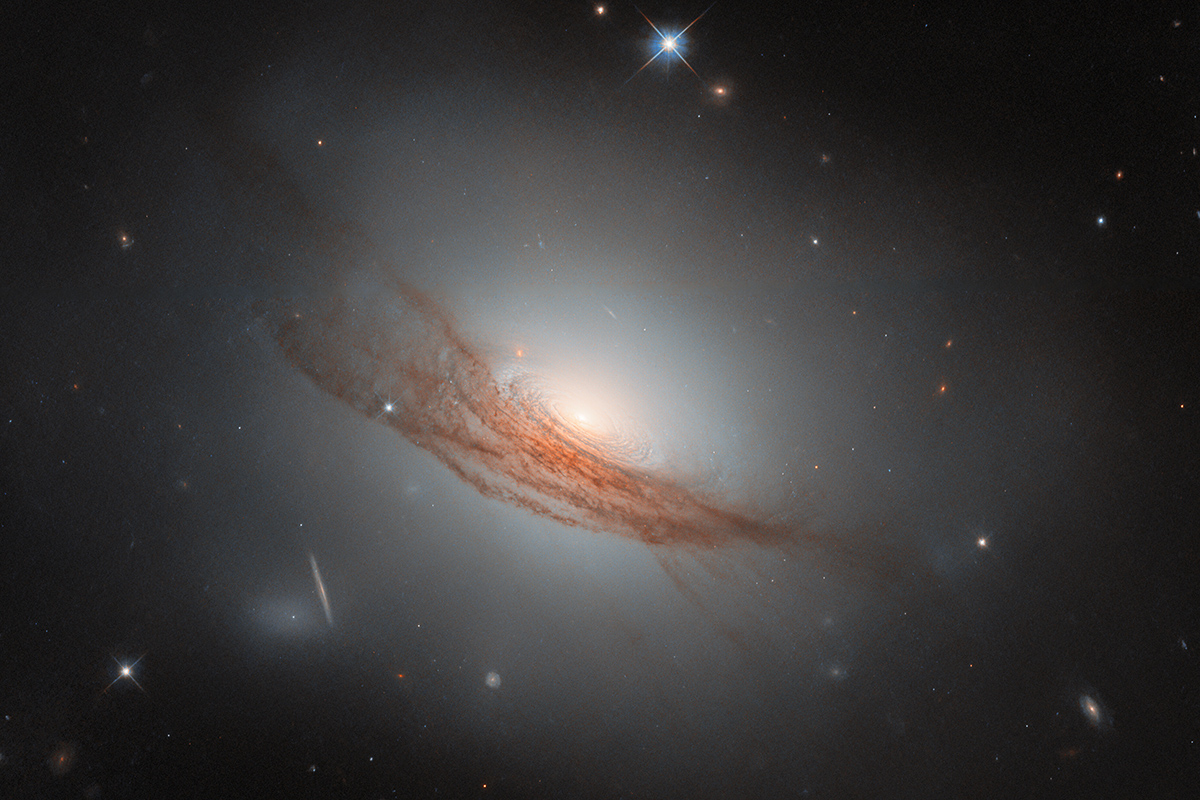
Galaxies evolve through complex physical processes. Gravity reshapes them. Interactions disturb them. Gas and dust regulate their star formation. Over cosmic time, these mechanisms transform simple systems into the diverse galaxy population we observe today. In January 2026, the NASA/ESA Hubble Space Telescope delivered a new benchmark observation of this process. Using its Wide Field Camera 3, Hubble captured its sharpest image yet of NGC 7722, a lenticular galaxy located about 187 million light-years away in the constellation Pegasus.
This observation resolves faint dust structures, subtle stellar halos, and concentric rings that reveal the galaxy’s dynamical past. NGC 7722 occupies a critical position in galaxy classification. It belongs to the lenticular class systems that bridge spiral and elliptical galaxies. These objects hold vital clues about how galaxies transition between active star-forming discs and quiescent spheroids. The new Hubble data expose long, dark dust lanes winding across NGC 7722’s outer regions. These features point toward past gravitational encounters and possible merger activity. At the same time, the galaxy’s smooth bulge and extended halo suggest an evolved stellar population.
A lenticular galaxy caught between two worlds
Astronomers classify galaxies into broad families. Spiral galaxies display well-defined arms and ongoing star formation. Elliptical galaxies appear smooth and rounded, with little cold gas and mostly old stars. Lenticular galaxies sit between these extremes. NGC 7722 exemplifies this intermediate state.
It shows a bright central bulge similar to that of ellipticals. It also exhibits a flattened disc, a hallmark of spirals. However, it lacks prominent spiral arms. Instead, Hubble reveals a system dominated by rings, diffuse light, and layered dust. This hybrid structure raises an important question. How did NGC 7722 reach this form?
Many researchers suspect that lenticular galaxies begin life as spirals. Over time, they lose their gas through gravitational encounters, mergers, or environmental effects. As gas disappears, star formation declines. Spiral arms fade. What remains is a disc galaxy with little internal structure. Alternatively, some lenticulars may form through mergers between smaller galaxies. Such events redistribute stars and angular momentum. They also disturb gas and dust, often leaving behind shells, rings, and warped features.
NGC 7722 shows evidence for both pathways. Its smooth stellar halo suggests long-term dynamical settling. Meanwhile, its prominent dust lanes indicate more recent disruption.
Acknowledgement: Mehmet Yüksek
Dark dust lanes as tracers of past interactions
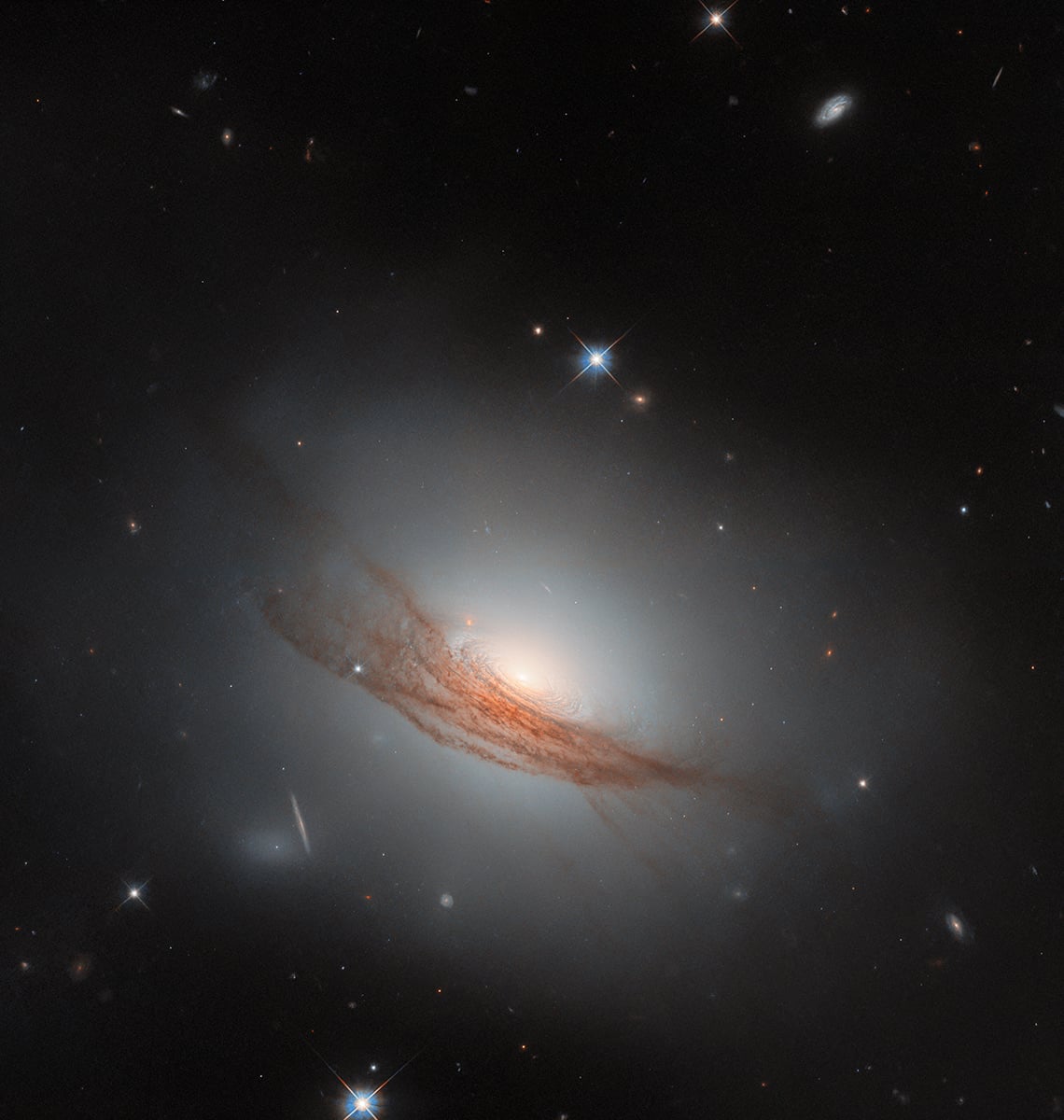
The most striking feature in Hubble’s image is the network of dark dust lanes that wrap around the galaxy. These lanes consist of microscopic solid particles mixed with cold gas. Dust absorbs and scatters visible light. As a result, it appears as dark filaments against brighter stellar backgrounds. In NGC 7722, these filaments extend far beyond the central bulge and trace curved paths through the outer disc and halo.
Such structures rarely form in isolation. Instead, they usually arise when gravitational forces disturb a galaxy. Close encounters with companions can pull dust inward or fling it outward. Minor mergers can inject fresh material into a galaxy’s outskirts. Over time, differential rotation stretches this material into elongated streams.
The geometry of NGC 7722’s dust strongly suggests an external origin. The lanes do not align neatly with the stellar disc. Rather, they appear tilted and offset, as if introduced from outside and later shaped by the galaxy’s rotation. These features, therefore, act as fossil records. They preserve the imprint of interactions that occurred hundreds of millions of years ago. By mapping their distribution, astronomers can reconstruct parts of the galaxy’s dynamical history.
Dust also influences future evolution. It cools the surrounding gas and promotes star formation under the right conditions. Yet in NGC 7722, star formation appears subdued. This implies that much of the available gas has already dispersed or heated, consistent with a system transitioning toward quiescence.
Hubble’s Wide Field Camera 3 reveals hidden structure
Hubble captured this image using Wide Field Camera 3, an instrument designed to observe across optical and near-infrared wavelengths. This capability allows astronomers to penetrate dusty regions while preserving fine spatial detail. In the case of NGC 7722, it reveals faint rings, diffuse halos, and subtle brightness gradients that earlier observations could not resolve.
The resulting image represents the sharpest view ever obtained of this galaxy. Fine dust filaments now stand out clearly. The central bulge shows smooth luminosity profiles. The surrounding halo fades gradually into intergalactic space. Together, these elements provide a complete structural portrait.
Importantly, the observation formed part of a program targeting galaxies that recently hosted Type Ia supernovae. NGC 7722 produced such an event in 2020, known as SN 2020SSF. Hubble observed the galaxy roughly two years later, after the supernova faded. With the explosion no longer dominating the field, Hubble could isolate the galaxy’s intrinsic features. Researchers can now study the environment around the former supernova site and examine how dust and stars distribute across the system.
NGC 7722 and lenticular galaxy evolution
Lenticular galaxies remain one of the least understood major galaxy classes. They appear common in galaxy clusters and dense environments. Yet they also exist in relative isolation. Their mixed properties complicate simple evolutionary models. NGC 7722 offers an instructive example. Its smooth bulge indicates an older stellar population. Its faint halo suggests long-term gravitational relaxation. However, its dust lanes point toward a more recent disturbance. This combination supports a multi-stage evolution.
First, the galaxy likely formed as a disc system with active star formation. Later, gravitational encounters altered its structure and redistributed its interstellar material. Gas depletion then reduced star formation, leaving behind the lenticular morphology we observe today. The dust now visible represents residual material from these interactions. Over time, this dust will either form new stars or disperse into intergalactic space. Either outcome will push the galaxy further toward quiescence.
By studying galaxies like NGC 7722, astronomers can trace how spirals fade into lenticulars and how mergers accelerate this transition. Each detailed observation adds another piece to this long-standing puzzle.
At a distance of 187 million light-years, this system reveals long dust lanes, concentric rings, and a smooth stellar halo. Together, these features trace a complex evolutionary path marked by interaction and gradual transformation. Through the Wide Field Camera 3, Hubble reveals structures that connect past mergers to present morphology.
Clear skies!
See more from DIYPhotography.net on Google
Add DIYPhotography.net as a trusted source. This makes
our stories more likely to appear in your Google Search results.
 Add as a preferred source on Google

Soumyadeep Mukherjee
Soumyadeep Mukherjee is an award-winning astrophotographer from India. He has a doctorate degree in Linguistics. His work extends to the sub-genres of nightscape, deep sky, solar, lunar and optical phenomenon photography. He is also a photography educator and has conducted numerous workshops. His works have appeared in over 40 books & magazines including Astronomy, BBC Sky at Night, Sky & Telescope among others, and in various websites including National Geographic, NASA, Forbes. He was the first Indian to win “Astronomy Photographer of the Year” award in a major category.

Join the Discussion
DIYP Comment Policy
Be nice, be on-topic, no personal information or flames.