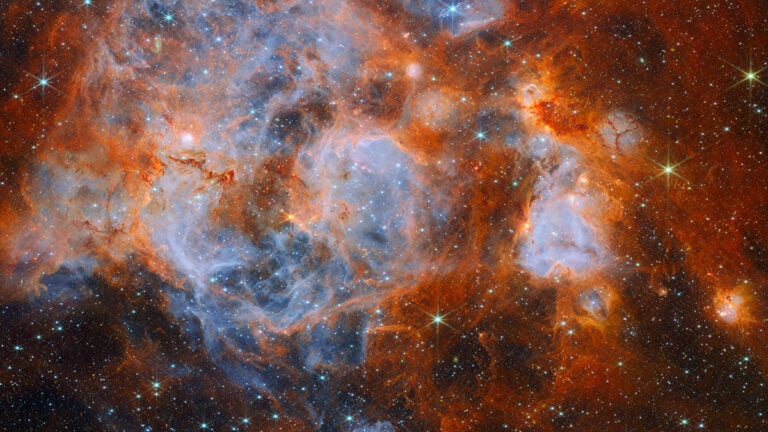




















JWST Photographs Sextans A: A Rudimentary Galaxy with PAHs
Jan 7, 2026
Soumyadeep Mukherjee
Soumyadeep Mukherjee is an award-winning astrophotographer from India. He has a doctorate degree in Linguistics. His work extends to the sub-genres of nightscape, deep sky, solar, lunar and optical phenomenon photography. He is also a photography educator and has conducted numerous workshops. His works have appeared in over 40 books & magazines including Astronomy, BBC Sky at Night, Sky & Telescope among others, and in various websites including National Geographic, NASA, Forbes. He was the first Indian to win “Astronomy Photographer of the Year” award in a major category.
Share:
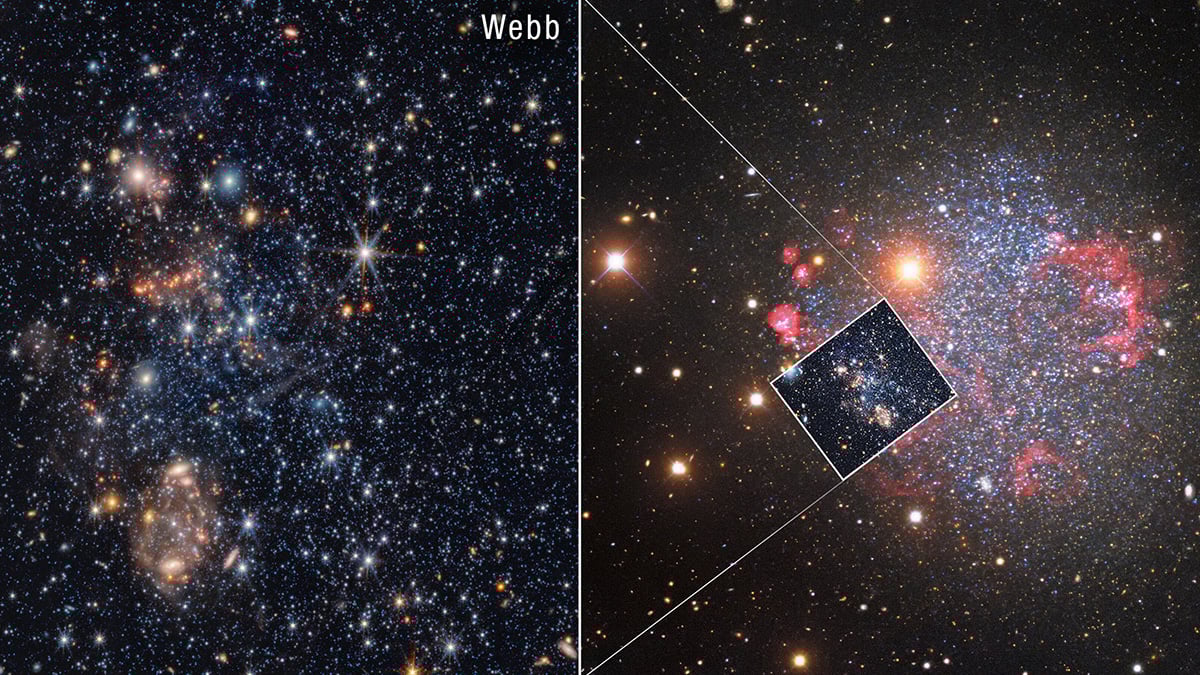
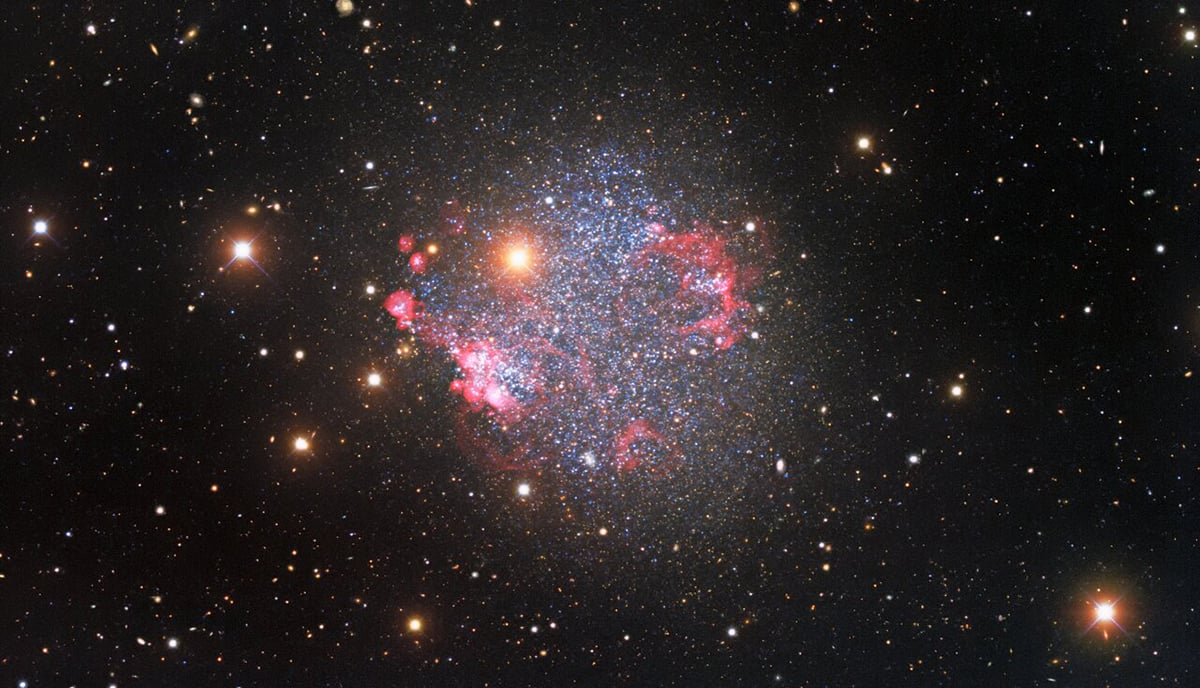
Low-metallicity dwarf galaxies serve as natural laboratories for studying conditions similar to the early universe. Their simple chemical makeup mirrors an era before repeated stellar generations enriched space with heavy elements. Sextans A belongs to this rare class. It is a nearby irregular dwarf galaxy located roughly four million light-years away. Astronomers have studied it for decades because of its extreme metal deficiency and ongoing star formation. However, recent observations from the James Webb Space Telescope have pushed Sextans A into a new scientific spotlight. JWST has detected complex organic molecules and unexpected dust species in this galaxy. These findings directly challenge long-standing assumptions about how chemistry evolves in early galactic environments.
The observations come from JWST’s combined near- and mid-infrared imaging and spectroscopy. They reveal faint molecular signatures that earlier telescopes could not resolve. As a result, Sextans A now stands as the most metal-poor galaxy known to host detectable polycyclic aromatic hydrocarbons. This result carries strong implications for our understanding of dust formation, molecular survival, and early galactic evolution.
Sextans A as an analog of early galaxies
Sextans A is small by galactic standards. It spans only a few thousand light-years and contains far fewer stars than the Milky Way. Yet its scientific value lies in its chemical simplicity rather than its size. The galaxy contains only a few percent of the heavy elements found in the Sun. Astronomers describe such environments as metal-poor because they lack elements forged in earlier stellar generations.
Because of this scarcity, Sextans A resembles galaxies that existed when the universe was young. During that era, stars had only begun enriching interstellar space with carbon, oxygen, and silicon. For this reason, astronomers expected limited dust and weak molecular chemistry in galaxies like Sextans A. Previous infrared surveys appeared to support that idea. They showed little evidence for complex molecules across the galaxy.
JWST’s superior sensitivity and spatial resolution allow scientists to probe the interstellar medium at much smaller physical scales. As a result, structures that once blended into background noise now emerge as distinct chemical regions.
JWST’s instruments and infrared detection
The new view of Sextans A relies on two key JWST instruments. NIRCam observes near-infrared light and traces stars and warm dust. MIRI operates at longer wavelengths, detecting cooler dust and molecular emission features. Together, these instruments provide a layered view of galactic structure and chemistry.
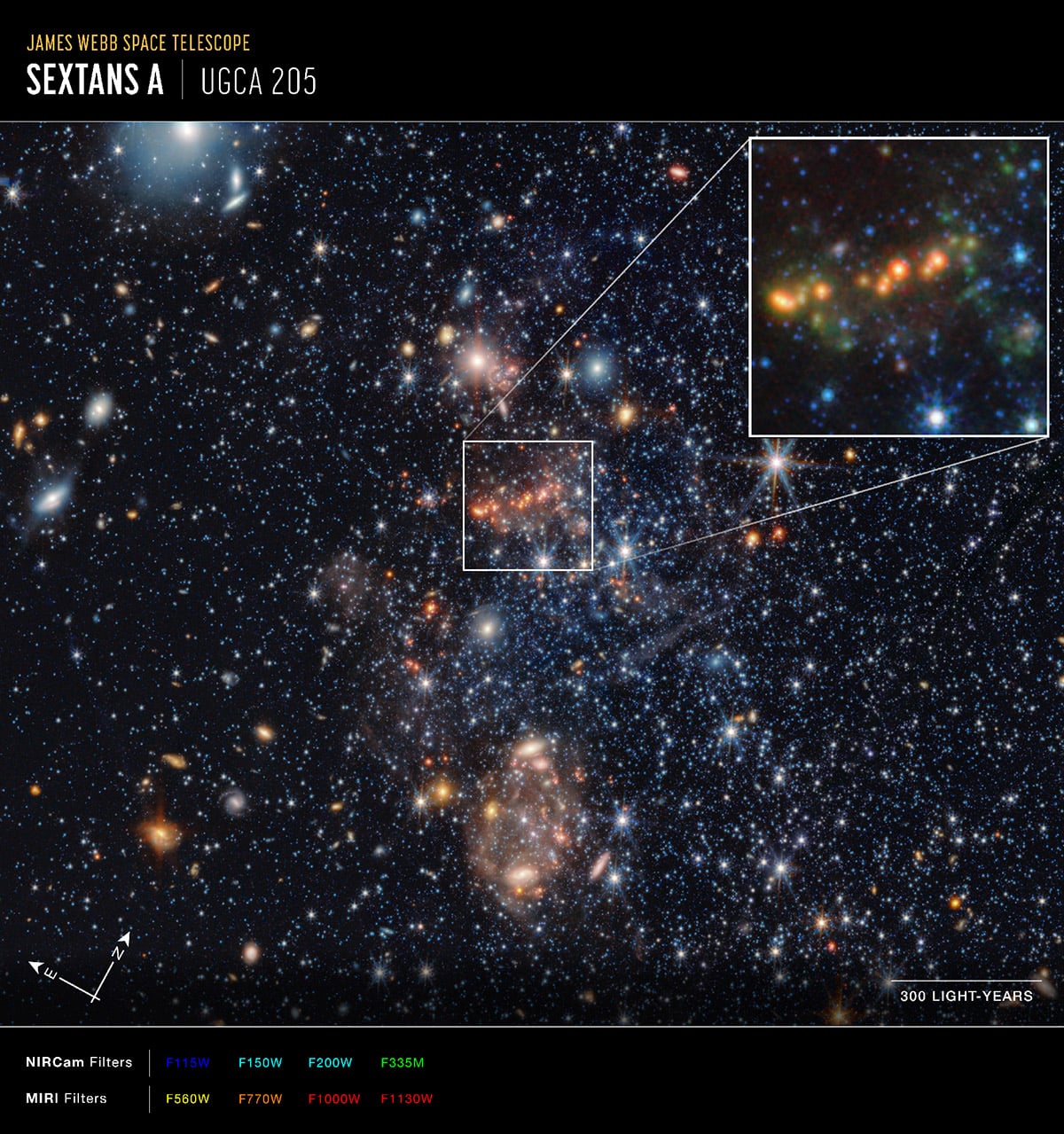
Polycyclic aromatic hydrocarbons emit light at specific mid-infrared wavelengths when energized by nearby stars. In past observations, these signals remained undetectable in very metal-poor galaxies. The emission was either too faint or too spatially confined. JWST overcomes both limitations. It detects subtle molecular features and resolves them into compact regions only a few light-years across.
This capability explains why PAHs were previously absent. They were never widespread across Sextans A. Instead, they exist in small pockets where local conditions allow their formation and survival. JWST’s infrared vision finally makes those pockets visible.

The unexpected detection of PAHs
The discovery of PAHs in Sextans A marks a significant shift in how astronomers think about organic chemistry in low-metallicity environments. PAHs are large carbon-based molecules composed of fused aromatic rings. In galaxies like the Milky Way, they are common in star-forming regions and diffuse interstellar clouds. They also play an important role in heating interstellar gas and regulating chemical reactions.
Previously, astronomers believed PAHs required relatively high metallicity to form efficiently. Carbon abundance, dust shielding, and stable molecular environments all seemed necessary. Sextans A contradicts this assumption. Despite its low carbon and dust content, it hosts measurable PAH emissions.
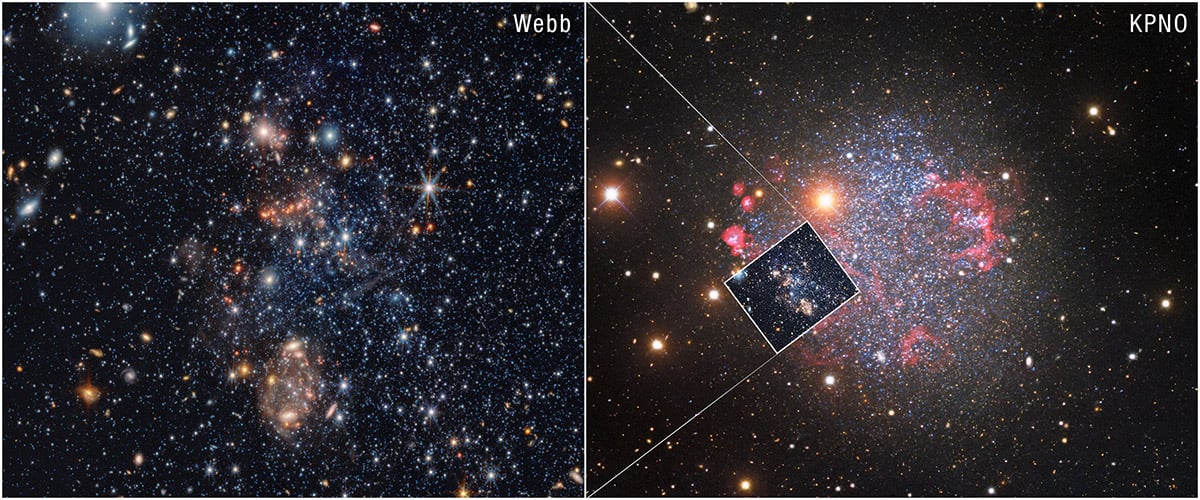
Even more important is the spatial distribution of these molecules. JWST shows that PAHs cluster in dense knots rather than spread evenly across the galaxy. These knots coincide with regions where gas density is higher, and ultraviolet radiation is partially shielded. In such environments, molecules can survive destructive radiation from nearby young stars.
This finding suggests that PAH formation does not require a galaxy-wide metal richness. Instead, it depends on local conditions that briefly mimic more evolved environments. That realization changes how astronomers interpret molecular signals in distant galaxies.

Rare dust types in an early environment
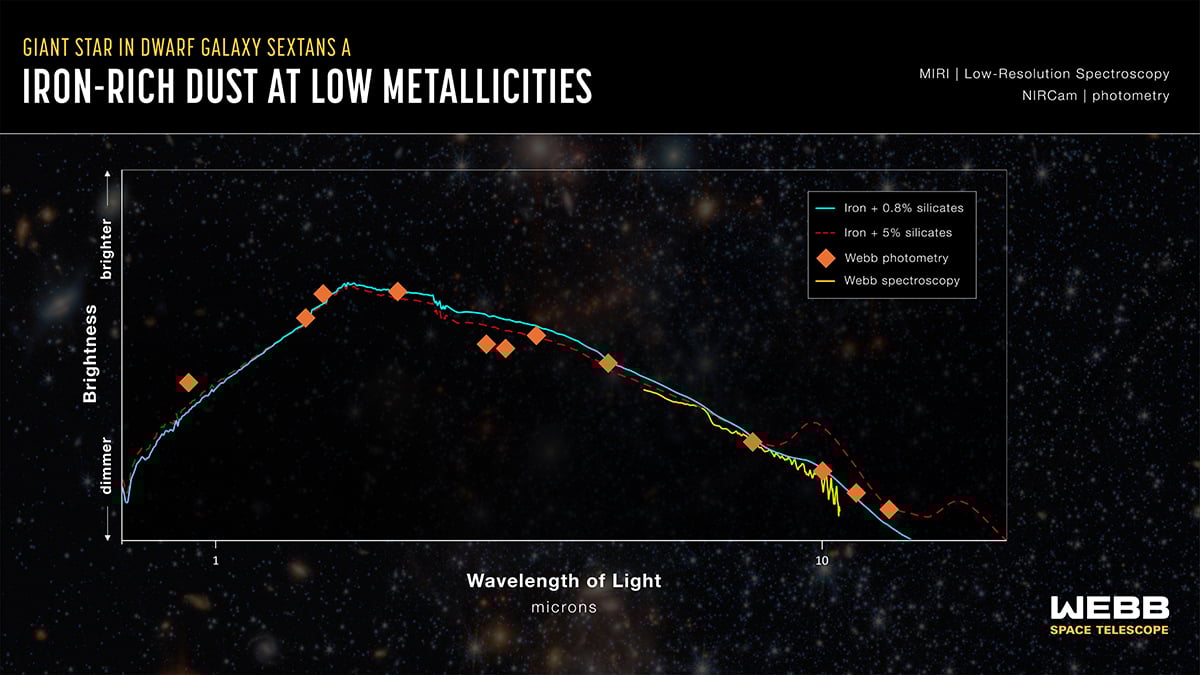
Spectroscopic observations show signatures of unusual dust grains in Sextans A. These include silicon carbide and metallic iron dust. Both are associated with evolved stars shedding material into the surrounding space. The presence of metallic iron dust is particularly striking. In metal-rich galaxies, silicate dust dominates. It forms from elements like silicon, magnesium, and oxygen. Sextans A lacks sufficient amounts of these elements. Yet dust still forms. The data suggest that stars in this galaxy follow alternative chemical pathways when producing solid grains.
This insight carries strong implications for early cosmic history. In the young universe, many galaxies likely resembled Sextans A. If such galaxies could produce dust through unconventional routes, then dust may have appeared earlier and more widely than models predicted. That dust would have influenced star formation by cooling gas clouds and enabling further collapse.
Thus, JWST’s findings help resolve a long-standing puzzle. Astronomers have observed large amounts of dust in very distant galaxies. Until now, it was unclear how that dust formed so quickly after the Big Bang. Sextans A provides a nearby example of how dust production can proceed under extreme chemical limitations.
The current results represent only the beginning of JWST’s study of Sextans A. Astronomers plan further observations using higher-resolution spectroscopy. Future observations may also compare Sextans A with other metal-poor dwarf galaxies. By building a sample, scientists can determine whether Sextans A is unique or representative of a broader population.
Clear skies!
See more from DIYPhotography.net on Google
Add DIYPhotography.net as a trusted source. This makes
our stories more likely to appear in your Google Search results.
 Add as a preferred source on Google

Soumyadeep Mukherjee
Soumyadeep Mukherjee is an award-winning astrophotographer from India. He has a doctorate degree in Linguistics. His work extends to the sub-genres of nightscape, deep sky, solar, lunar and optical phenomenon photography. He is also a photography educator and has conducted numerous workshops. His works have appeared in over 40 books & magazines including Astronomy, BBC Sky at Night, Sky & Telescope among others, and in various websites including National Geographic, NASA, Forbes. He was the first Indian to win “Astronomy Photographer of the Year” award in a major category.



Join the Discussion
DIYP Comment Policy
Be nice, be on-topic, no personal information or flames.