




















JWST Spots the Earliest Known Supernova: Discovery of GRB 250314A
Dec 10, 2025
Soumyadeep Mukherjee
Soumyadeep Mukherjee is an award-winning astrophotographer from India. He has a doctorate degree in Linguistics. His work extends to the sub-genres of nightscape, deep sky, solar, lunar and optical phenomenon photography. He is also a photography educator and has conducted numerous workshops. His works have appeared in over 40 books & magazines including Astronomy, BBC Sky at Night, Sky & Telescope among others, and in various websites including National Geographic, NASA, Forbes. He was the first Indian to win “Astronomy Photographer of the Year” award in a major category.
Share:

Astronomers received an alert on March 14, 2025, and most of them treated it like another late-night gamma-ray burst notification. These alerts rarely point to anything extraordinary. But this one felt different. The light was faint and stretched. It carried the signature of something very distant. Within minutes, telescopes across the world began tracking the fading afterglow. What started as a routine observation soon turned into the most distant confirmed supernova ever seen. Months later, the James Webb Space Telescope delivered the final confirmation. It revealed a supernova that exploded when the Universe was only about 730 million years old, long before most galaxies took their current shapes.
A burst that set the astronomical community in motion
Gamma-ray bursts are the most energetic explosions known. Satellites detect them first, then observatories rush to capture their fading light. GRB 250314A followed the same pattern. The burst lasted long enough to suggest the collapse of a massive star, but the spectral stretch signaled a deeper story. Early measurements hinted that the event originated from the early Universe.
Teams worldwide watched the signal dim by the hour. They took photometry, compared models, and checked for any nearby galaxy that could explain the flash. Nothing nearby fit. The data pushed astronomers toward one possibility: the burst came from a time when the Universe was still young, dense, and forming its first generations of stars.
To confirm that idea, astronomers needed deeper imaging. Ground telescopes could not reach that far. Hubble did not have the sensitivity. Only JWST could test the hypothesis with the clarity required. Once JWST received the request, it used Director’s Discretionary Time to observe the field. The decision paid off.
JWST’s infrared vision settles the mystery
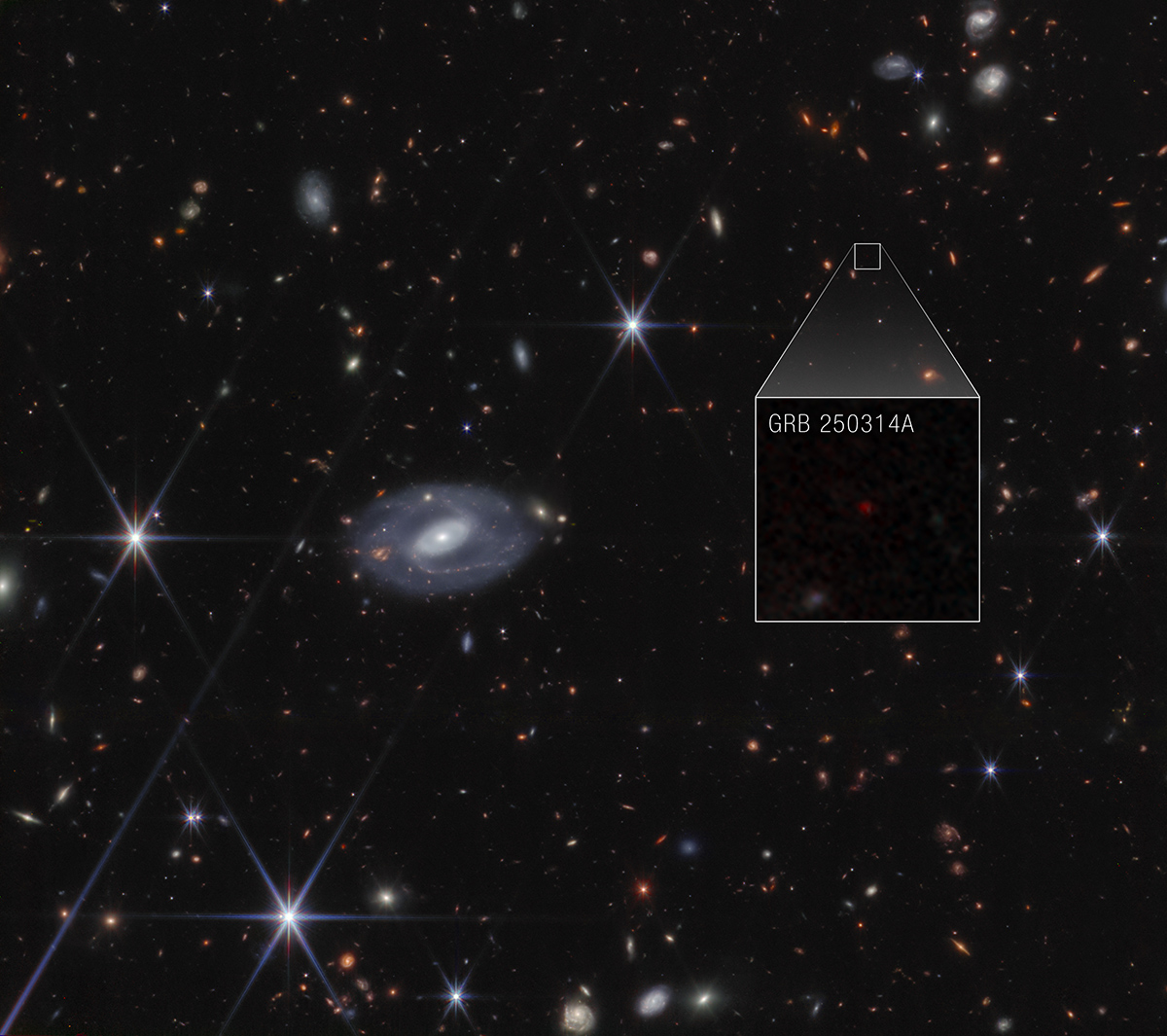
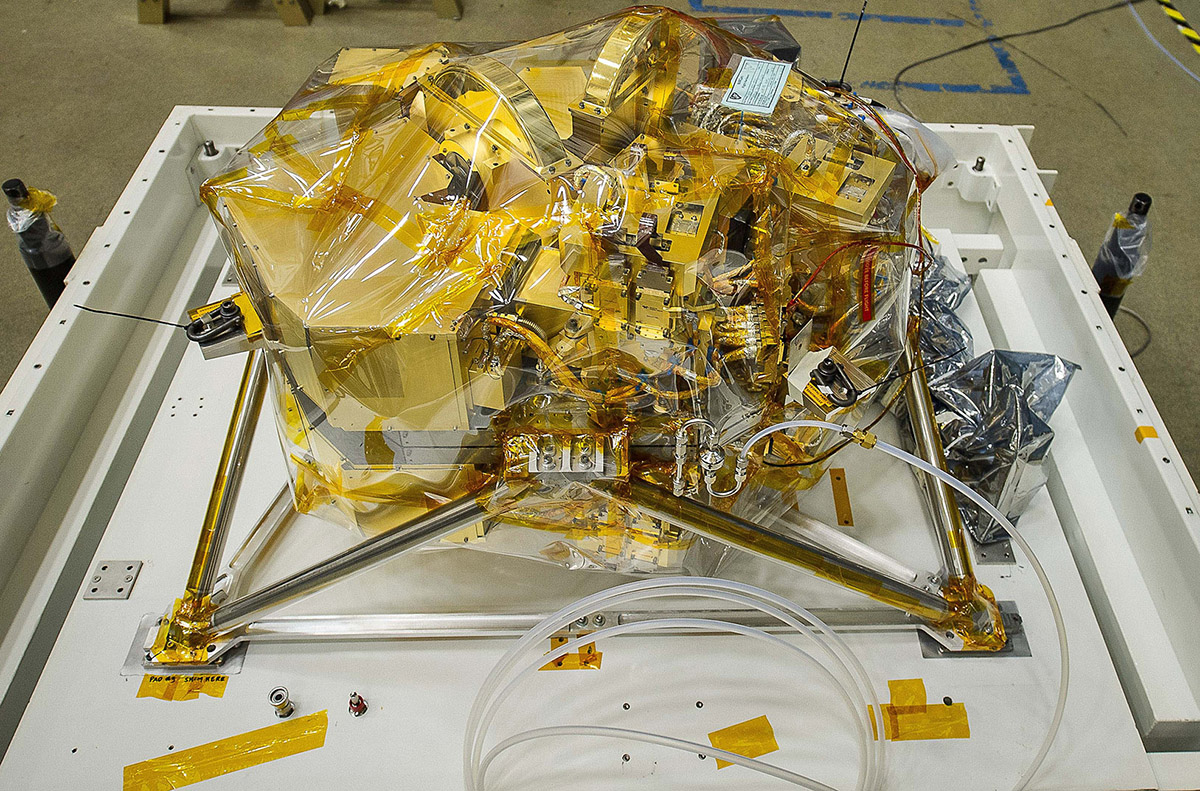
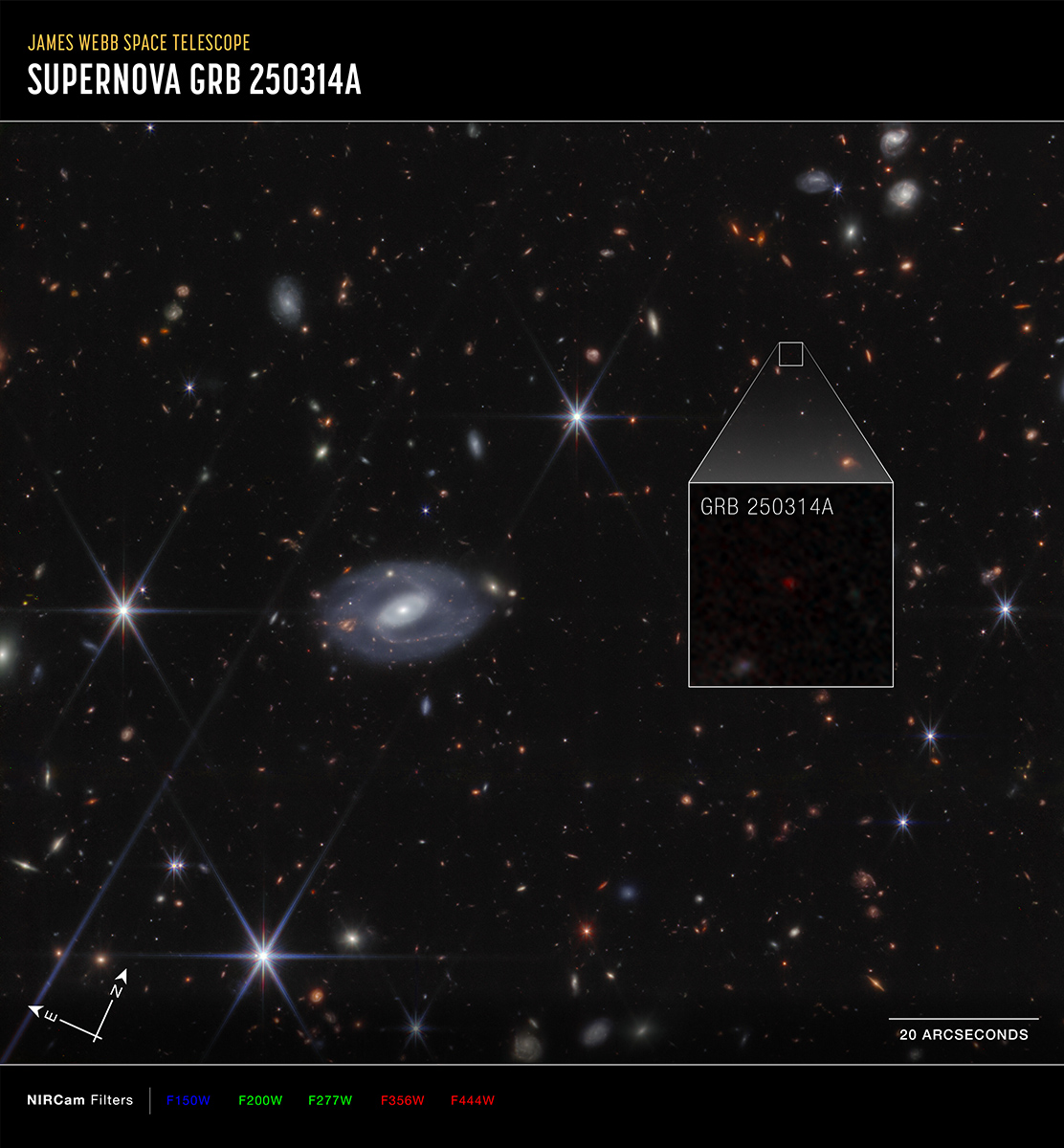
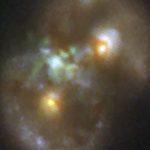
JWST’s NIRCam instrument captured the field months after the burst. The camera revealed a dim, red point of light exactly where the fading afterglow had been seen. The timing fit the expected decline of a distant supernova. The color matched what astronomers expect when light travels for more than 13 billion years and stretches into the infrared.
The next step was to measure distance. Scientists analyzed the brightness and wavelength distribution of the faint source. Their calculations placed the event at a redshift close to z ≈ 7.3. This corresponds to a time about 730 million years after the Big Bang. That is deeper into cosmic time than any confirmed supernova before. It pushed the observational limit by more than a billion years.
The faint smudge that changed the story
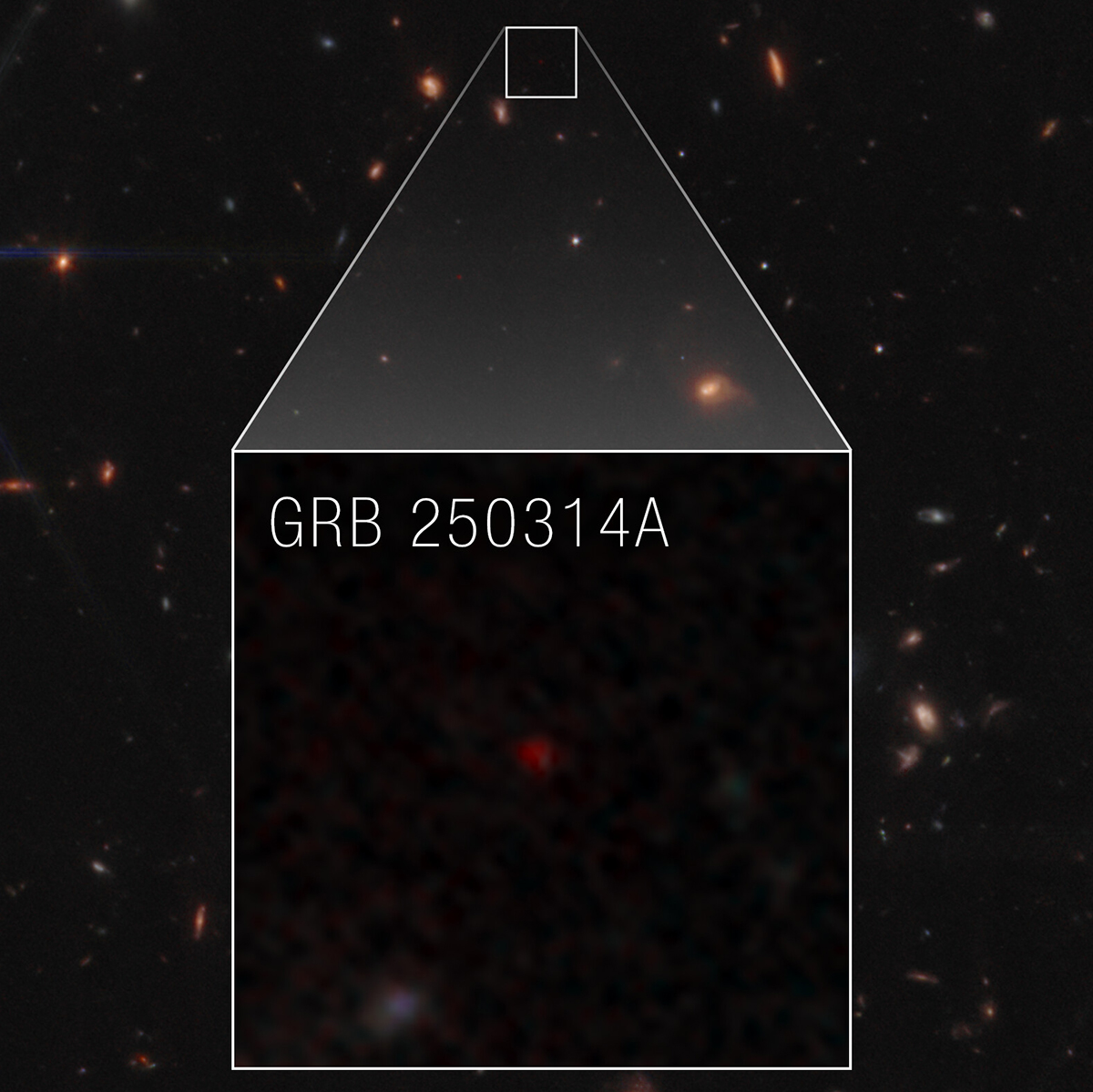
In addition to the supernova’s afterglow, JWST detected another feature: a tiny, extremely faint host galaxy. It appeared as a small, reddened patch of light near the supernova location. Many early-Universe bursts appear “hostless” because their galaxies are too faint to detect. Seeing a host galaxy offers a firm marker for distance and environment.
This galaxy was likely a compact, metal-poor system forming stars rapidly. Early galaxies often looked like this, small bodies growing in short, intense bursts. Detecting it gave astronomers a rare chance to study a star-forming region from the dawn of galaxies. It also confirmed that the supernova truly belonged to that early cosmic era. Without the host, the distance estimate would have carried more uncertainty. With it, the case became much stronger.
An ancient supernova that behaves like a modern one
After confirming the distance, astronomers examined the supernova’s behavior. They expected an explosion from this early era to look unusual. The first generations of stars likely formed from metal-poor gas. Their structures may have differed from modern stars. Their deaths might have followed different physical paths.
But GRB 250314A looked surprisingly familiar. Its afterglow faded as a typical long-duration burst. Its brightness and decline matched the profile of massive stars collapsing into black holes. In other words, even with 13 billion years between us and the explosion, the physics looked consistent.
This finding suggests that massive stars followed similar life cycles even in the Universe’s first billion years. Heavy elements were scarce back then, yet the basic mechanisms of stellar death seem unchanged. More data will test this idea, but the discovery already reshapes how scientists think about early stellar evolution.

A milestone in our exploration of cosmic time
The confirmation of this supernova marks a major moment for the James Webb Space Telescope. JWST was built to look deeper into cosmic history than any previous observatory. GRB 250314A shows that it can do more than detect early galaxies. It can capture the violent deaths of stars from a time when the Universe was young and rapidly changing.
This single observation expands the timeline of known supernovae by a wide margin. It opens the door for new studies of early stellar populations. GRB 250314A is now the earliest supernova ever confirmed. It exploded in a small, faint galaxy long before most galaxies had formed their mature structures. Its light traveled more than 13 billion years to reach us. JWST caught the last traces of that journey.
Clear skies!
See more from DIYPhotography.net on Google
Add DIYPhotography.net as a trusted source. This makes
our stories more likely to appear in your Google Search results.
 Add as a preferred source on Google

Soumyadeep Mukherjee
Soumyadeep Mukherjee is an award-winning astrophotographer from India. He has a doctorate degree in Linguistics. His work extends to the sub-genres of nightscape, deep sky, solar, lunar and optical phenomenon photography. He is also a photography educator and has conducted numerous workshops. His works have appeared in over 40 books & magazines including Astronomy, BBC Sky at Night, Sky & Telescope among others, and in various websites including National Geographic, NASA, Forbes. He was the first Indian to win “Astronomy Photographer of the Year” award in a major category.
Join the Discussion
DIYP Comment Policy
Be nice, be on-topic, no personal information or flames.