






















A Mysterious Cosmic Explosion Photographed by ESO’s Very Large Telescope
Sep 10, 2025
Soumyadeep Mukherjee
Soumyadeep Mukherjee is an award-winning astrophotographer from India. He has a doctorate degree in Linguistics. His work extends to the sub-genres of nightscape, deep sky, solar, lunar and optical phenomenon photography. He is also a photography educator and has conducted numerous workshops. His works have appeared in over 40 books & magazines including Astronomy, BBC Sky at Night, Sky & Telescope among others, and in various websites including National Geographic, NASA, Forbes. He was the first Indian to win “Astronomy Photographer of the Year” award in a major category.
Share:

Astronomers have studied gamma-ray bursts for decades. These powerful cosmic flashes are the brightest explosions ever seen in the universe. They usually last just a few seconds or minutes before fading away. But in July 2025, astronomers detected a signal that changed this understanding.
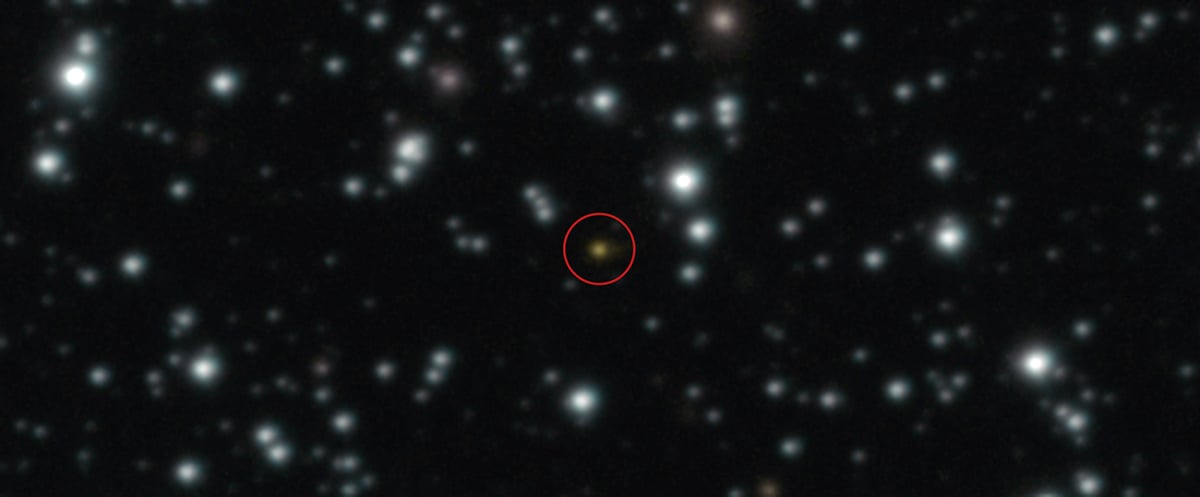
The event, named GRB 250702B, was not a typical gamma-ray burst. Instead of fading quickly, it produced repeated flares for more than a day. This made it the longest gamma-ray burst ever recorded and one of the most mysterious explosions in modern astronomy. To trace its origin, scientists turned to the ESO’s Very Large Telescope (VLT) in Chile. Using its advanced infrared imaging system, the VLT photographed the afterglow and revealed that the event came from far beyond the Milky Way.
What are Gamma-ray bursts (GRB)?
A gamma-ray burst (GRB) is a short but powerful flash of gamma radiation. GRBs are so bright that, for a few seconds, they can outshine entire galaxies. They were first detected by satellites in the 1960s. Since then, astronomers have divided them into two main types. Short GRBs last less than two seconds. They are believed to form when two neutron stars collide. Long GRBs can last up to a few minutes. They are usually linked to the collapse of massive stars into black holes. Both types release unimaginable amounts of energy.
What makes GRB 250702B stand out is that it lasted 100 to 1000 times longer than normal bursts. Instead of being a single flash, it produced several flares across an entire day. This behavior does not fit into either the short or long category of GRBs.

The role of ESO’s Very Large Telescope
ESO’s Very Large Telescope, located on Cerro Paranal in Chile, is one of the most powerful optical observatories on Earth. Its four 8.2-meter telescopes can work individually or together to achieve extraordinary sensitivity. When satellites detected GRB 250702B, astronomers needed ground-based confirmation. They quickly directed the VLT to the burst’s position. The telescope’s HAWK-I infrared camera captured detailed images of the fading glow.
These images were decisive. They showed that the gamma-ray burst originated outside our galaxy, in a distant host galaxy. This ruled out local explanations and confirmed its extragalactic nature. Without the VLT’s sharp vision, astronomers would not have been able to pinpoint the source of this unusual cosmic signal. The observation underscored the significance of ESO’s VLT astronomy in unraveling some of the universe’s most profound mysteries.

GRB 250702B
The extreme duration of GRB 250702B makes it one of the most unusual cosmic explosions ever detected. Most GRBs fade within minutes, but this one continued for more than 24 hours. No gamma-ray burst in the last 50 years has shown such behavior. Even more surprising was its repeating nature. Instead of one giant explosion, astronomers saw multiple peaks of activity. This suggests that a different kind of astrophysical process might be responsible.
One theory is that a black hole tore apart a star. This is called a tidal disruption event, and it can produce bright and long-lasting flares. But even tidal disruptions rarely create signals as extended and complex as GRB 250702B. To explain it fully, scientists may need new models that go beyond the current categories of gamma-ray bursts.
The detection of this mysterious cosmic explosion has opened a major puzzle in astrophysics. GRB 250702B does not fit neatly into existing theories. Its repeating and long-lived gamma-ray signal suggests we may have encountered a new type of phenomenon.
Clear skies!
See more from DIYPhotography.net on Google
Add DIYPhotography.net as a trusted source. This makes
our stories more likely to appear in your Google Search results.
 Add as a preferred source on Google

Soumyadeep Mukherjee
Soumyadeep Mukherjee is an award-winning astrophotographer from India. He has a doctorate degree in Linguistics. His work extends to the sub-genres of nightscape, deep sky, solar, lunar and optical phenomenon photography. He is also a photography educator and has conducted numerous workshops. His works have appeared in over 40 books & magazines including Astronomy, BBC Sky at Night, Sky & Telescope among others, and in various websites including National Geographic, NASA, Forbes. He was the first Indian to win “Astronomy Photographer of the Year” award in a major category.


Join the Discussion
DIYP Comment Policy
Be nice, be on-topic, no personal information or flames.