























Markarian 178: Hubble Photographs a Dwarf Galaxy with Massive Stars
Dec 8, 2025
Soumyadeep Mukherjee
Soumyadeep Mukherjee is an award-winning astrophotographer from India. He has a doctorate degree in Linguistics. His work extends to the sub-genres of nightscape, deep sky, solar, lunar and optical phenomenon photography. He is also a photography educator and has conducted numerous workshops. His works have appeared in over 40 books & magazines including Astronomy, BBC Sky at Night, Sky & Telescope among others, and in various websites including National Geographic, NASA, Forbes. He was the first Indian to win “Astronomy Photographer of the Year” award in a major category.
Share:

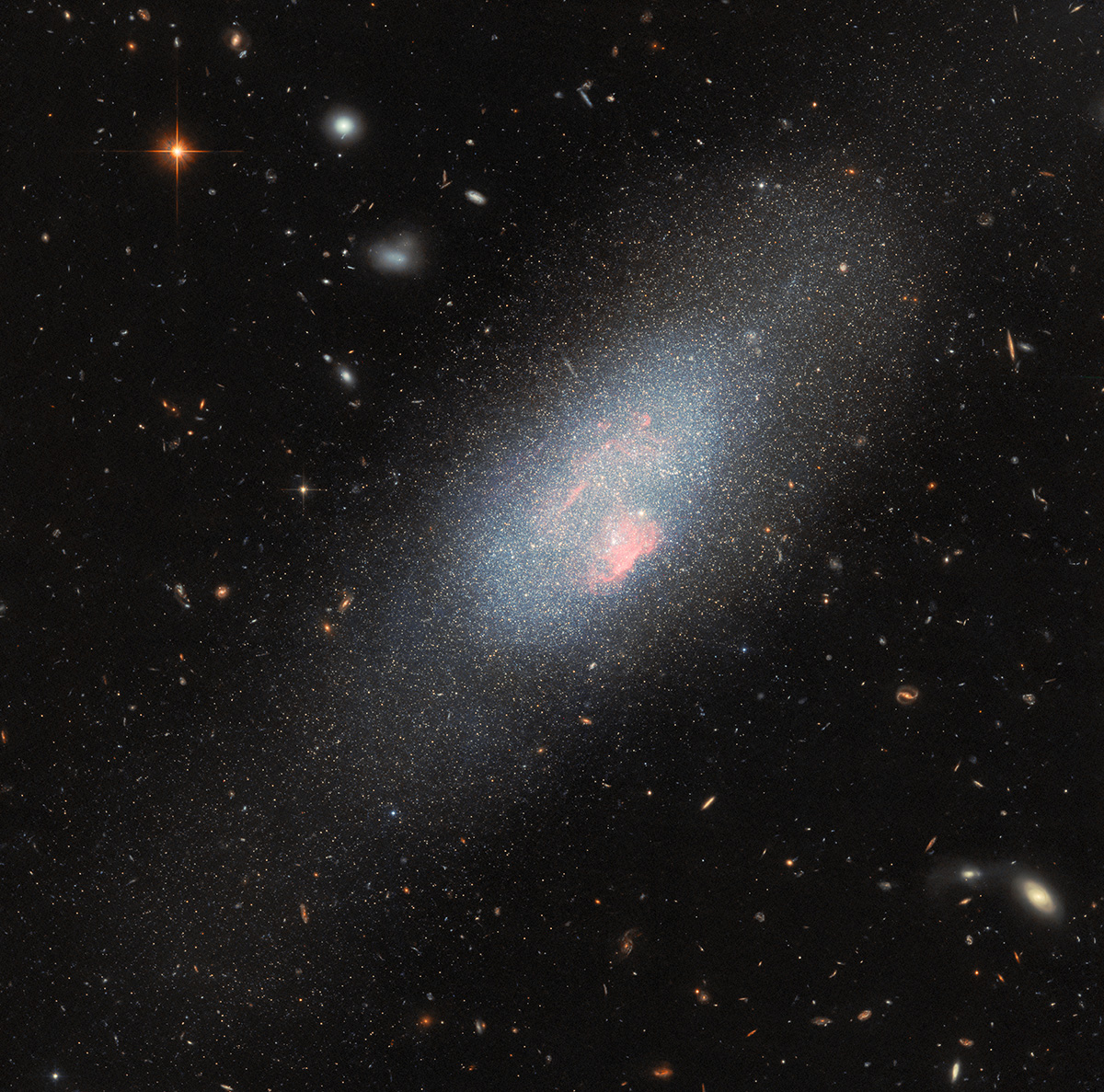
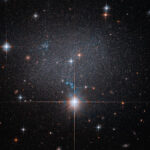
The Hubble Space Telescope has recently captured an image of a dwarf galaxy, Markarian 178. It looks like a soft, pale-blue blob hovering in the darkness. It doesn’t look grand or dramatic. But that humble glow hides a burst of activity deep inside. Mrk 178 lies roughly 13 million light-years away in the constellation Ursa Major. It’s much smaller than our own Milky Way. Yet this tiny galaxy seems to be experiencing a surge of star formation that challenges what we know about how dwarf galaxies live and grow. With strong ultraviolet emission, tight clusters of young stars, and a handful of massive, unstable stars shedding powerful winds, Mrk 178 reveals a lively and complex life.
A blue compact dwarf with a bright heart
Mrk 178 belongs to a class of objects called blue compact dwarfs (BCD). These galaxies are small, contain relatively little dust, and shine brightly in ultraviolet and blue light. In the case of Mrk 178, the blue tint comes from a wealth of hot, young stars crammed into a compact space.
Astronomers estimate its diameter at about 5,700 light-years, tiny compared with the Milky Way’s roughly 100,000-light-year span. Rather than graceful spiral arms, Mrk 178 shows a dense core of stars surrounded by a more diffuse halo. Inside, you see bright clusters, gas glowing from ionization, and patches of reddish hue. That red glow marks places where massive stars are influencing their surroundings.
The massive stars light the red spots
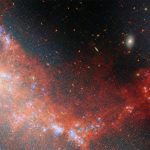
The red-tinged areas near the edge of Mrk 178’s blue cloud are not dust, but collections of rare, massive stars known as Wolf-Rayet stars (WR stars). These stars burn fiercely and live fast. They shed their outer layers through powerful stellar winds. Those winds energize surrounding gas, causing emissions, especially from ionized hydrogen and oxygen, that appear red in the Hubble filters.
In 2013, astronomers used integral-field spectroscopy to map Mrk 178 in detail. They located WR stars spread across a central region about 300 by 230 parsecs (around 1,000 by 750 light-years). Their analysis suggests there are at least ~20 WR stars in that region.
The presence of so many WR stars tells a critical story. These stars live only a few million years before they collapse into neutron stars or black holes. That fleeting existence means their birth must have happened recently. In other words, Mrk 178 is in the middle of a fresh starburst.
History of the galaxy
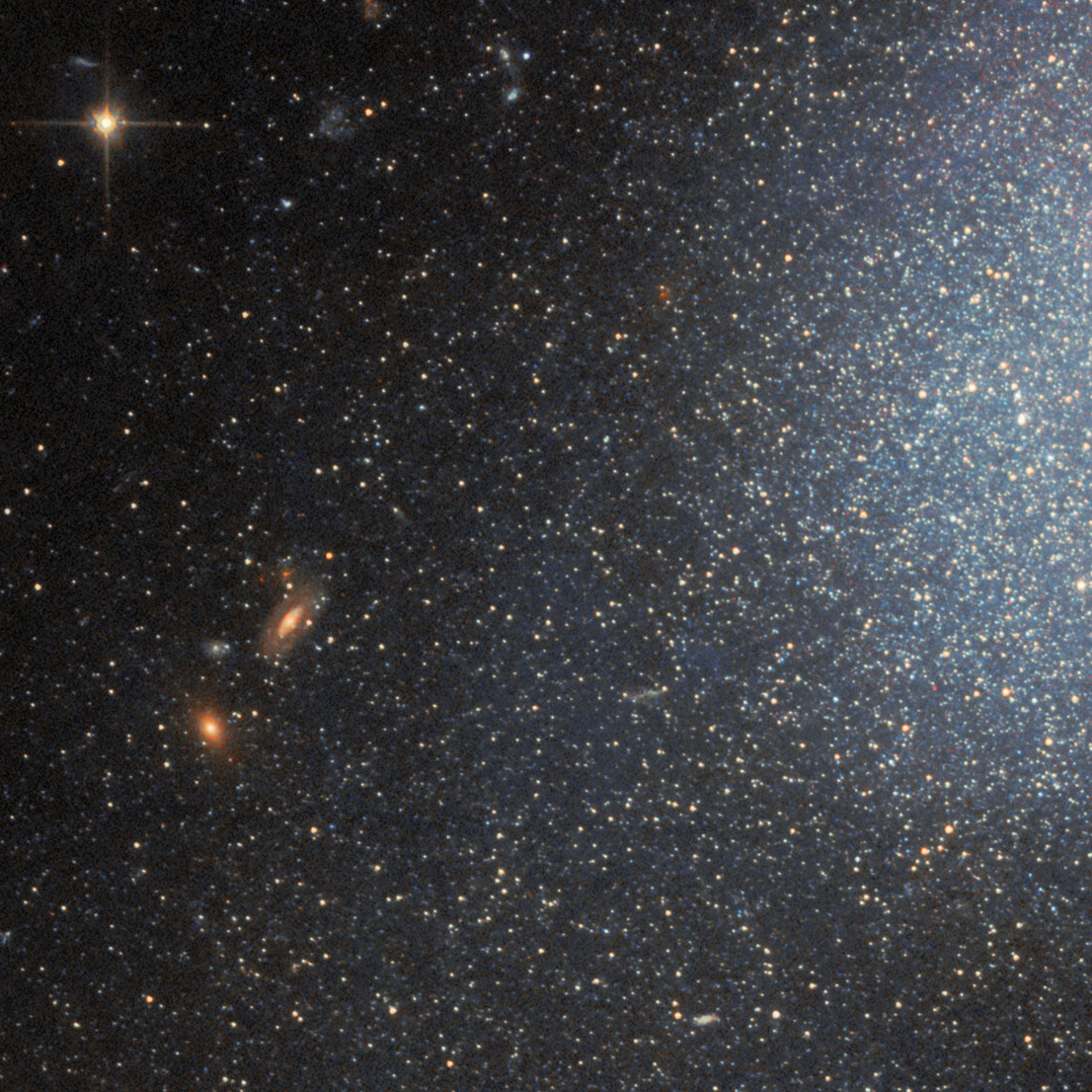
A galaxy drenched in blue often looks like a newborn. Mrk 178 might seem like a young galaxy just kicking off its star formation. But deeper observations tell a different story. Studies using near-infrared imaging from the space-based camera on the Hubble Space Telescope resolved dozens of individual, older stars in Mrk 178. Among them are red giants, stars that are at least 1–2 billion years old. These findings show that Mrk 178 has existed far longer than its youthful core reveals.
Beyond the red giants, researchers identified luminous asymptotic-giant-branch stars. Those suggest that the galaxy had another period of significant star formation hundreds of millions of years ago. In short, Mrk 178 was building stars long before the present burst. So Mrk 178 is not primordial in the sense of being “born now.” It carries a layered history. What we see today is just its latest chapter, a dramatic reawakening inside an older, more settled structure.
What could have triggered this starburst?
In many galaxies, starbursts happen after interactions, when gravity from a near neighbour stirs up gas. That gas collapses and forms new stars. But Mrk 178 doesn’t show a major companion nearby. That fact puzzles astronomers. One possibility involves a tiny, faint satellite galaxy or even a gas cloud colliding with Mrk 178 long ago. Such events may leave only subtle traces today. Another idea points to internal dynamics: the galaxy’s own gas may have moved or cooled enough to collapse under gravity.
Neutral hydrogen (HI) radio maps reveal that the gas surrounding Mrk 178 has an irregular, disturbed distribution. This irregular shape might hint at a past disturbance, even if the cause is now invisible. That suggests the trigger could have been subtle but enough to shake up the gas.
Because of that uncertainty, Mrk 178 becomes even more interesting. It challenges our idea that only big collisions spark starbursts. It shows that small galaxies can be triggered to light up by internal or minor external events.

What Hubble’s image adds
The latest Hubble image resolves compact star clusters, glowing gas patches, and the red knots of WR activity. The detail lets astronomers connect colour and structure across the galaxy. They can see where massive star formation concentrates, and where the older, diffuse halo lies.
Yet images alone don’t reveal everything. They cannot measure chemical abundances or show how gas moves. For that, we need spectroscopy, radio mapping, and deeper infrared observations. A 2013 study using integral-field spectroscopy did just that. It measured oxygen abundance, tracked ionized gas, and mapped WR features across the galaxy.
Still, many questions remain. What exactly triggered the recent burst? Could dust or faint companions hide evidence of past events? Are there older stars we have not detected yet? Future observations, maybe with infrared-sensitive next-generation telescopes, could help us answer these.
Clear skies!
See more from DIYPhotography.net on Google
Add DIYPhotography.net as a trusted source. This makes
our stories more likely to appear in your Google Search results.
 Add as a preferred source on Google

Soumyadeep Mukherjee
Soumyadeep Mukherjee is an award-winning astrophotographer from India. He has a doctorate degree in Linguistics. His work extends to the sub-genres of nightscape, deep sky, solar, lunar and optical phenomenon photography. He is also a photography educator and has conducted numerous workshops. His works have appeared in over 40 books & magazines including Astronomy, BBC Sky at Night, Sky & Telescope among others, and in various websites including National Geographic, NASA, Forbes. He was the first Indian to win “Astronomy Photographer of the Year” award in a major category.

Join the Discussion
DIYP Comment Policy
Be nice, be on-topic, no personal information or flames.