
























Hubble Reveals NGC 2775, Again: A Galaxy That Refuses Simple Labels
Sep 22, 2025
Soumyadeep Mukherjee
Soumyadeep Mukherjee is an award-winning astrophotographer from India. He has a doctorate degree in Linguistics. His work extends to the sub-genres of nightscape, deep sky, solar, lunar and optical phenomenon photography. He is also a photography educator and has conducted numerous workshops. His works have appeared in over 40 books & magazines including Astronomy, BBC Sky at Night, Sky & Telescope among others, and in various websites including National Geographic, NASA, Forbes. He was the first Indian to win “Astronomy Photographer of the Year” award in a major category.
Share:

Astronomers have long divided galaxies into three broad groups: spirals, ellipticals, and lenticulars. The system works for most galaxies, but not for all. Some galaxies combine features from more than one type. They blur the lines and resist simple labels. One of the most striking examples is NGC 2775, a galaxy recently imaged in detail by the Hubble Space Telescope.
NGC 2775 lies about 67 million light-years away in the constellation Cancer. It is also listed as Caldwell 48 in observing catalogs. To the eye of a casual observer, it looks like a soft spiral. But closer inspection shows much more complexity. Its bulge is smooth and gas-poor, like an elliptical. Its disk contains young stars, dust, and faint arms, like a spiral. Beyond that, a faint hydrogen tail suggests an active past. NGC 2775 is, in many ways, a galaxy in transition.
Hubble’s close look at NGC 2775
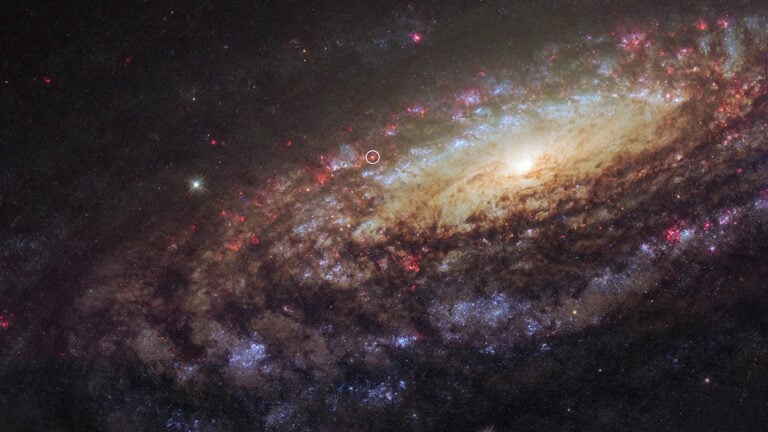
The Hubble Space Telescope has been capturing galaxy portraits for more than three decades. For NGC 2775, astronomers used Hubble’s Wide Field Camera 3. This instrument combines images taken through several filters. Light was collected across ultraviolet, visible, and near-infrared wavelengths. The result is a balanced view that highlights both young and old stars.
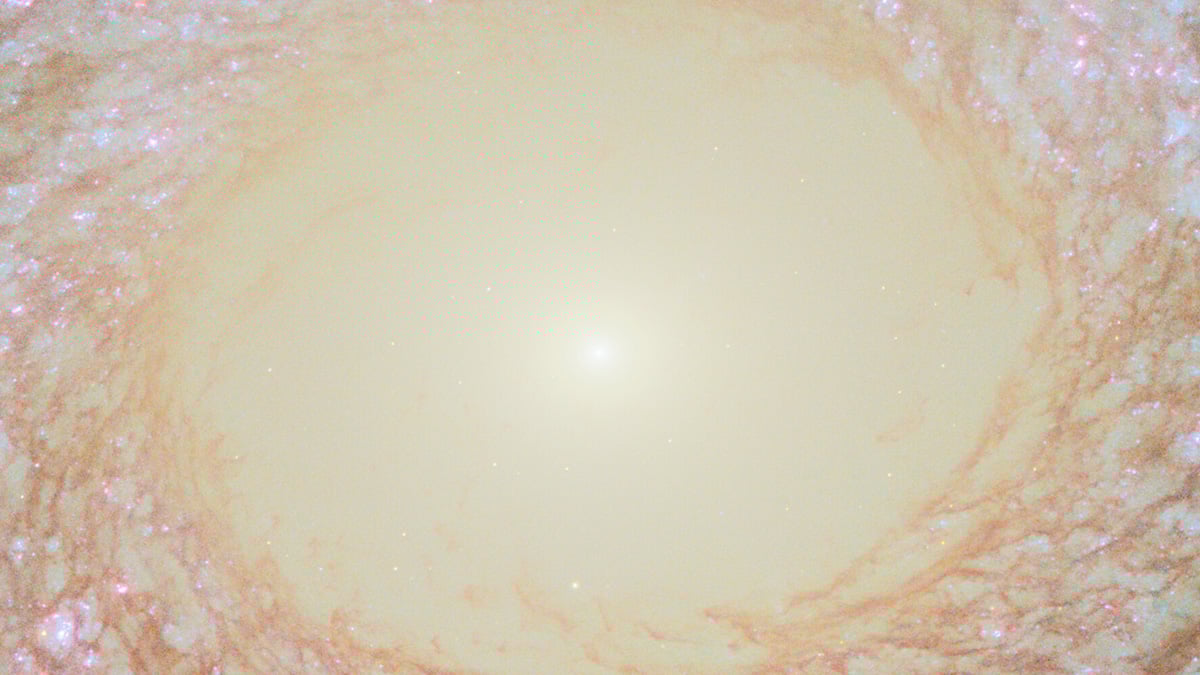
Blue clusters in the outer arms reveal pockets of recent star formation. Dusty lanes wind across the disk, absorbing light and shaping the visible pattern. Small reddish clouds mark regions where hot young stars excite hydrogen gas. These H-alpha emissions give clues about ongoing stellar nurseries. In sharp contrast, the bulge at the center appears smooth and featureless. The lack of gas means the core is no longer forming stars. Hubble’s image makes this contrast clear, showing a galaxy with two distinct stories unfolding simultaneously.

The empty heart of the galaxy
The most striking feature of NGC 2775 is its core. Unlike spiral galaxies such as the Milky Way, which show dust lanes cutting into the central region, NGC 2775’s bulge is clean and smooth. Astronomers note that very little interstellar gas remains in the bulge. Without gas, new stars cannot form. That makes the center resemble the core of an elliptical galaxy, dominated by older, redder stars.
This empty heart tells a story of the galaxy’s past. At some point, star formation in the center must have been intense. That period of rapid formation would have consumed or expelled most of the gas. Supernova explosions and stellar winds from massive stars may have pushed material outward. The current quiet state of the bulge is the result of that earlier activity.
Spiral arms that refuse definition
Looking at the galaxy as a whole, astronomers struggle to decide where it belongs. Its spiral arms are faint, fragmented, and patchy. They do not form the grand, well-defined patterns seen in galaxies like M51, the Whirlpool Galaxy. Instead, the arms of NGC 2775 look woolly or feathery. Astronomers use the term flocculent spiral to describe this structure. In such galaxies, spiral patterns are less pronounced and star-forming regions appear as disconnected clumps.
Flocculent spirals are not rare, but NGC 2775 is unusual because its arms sit alongside a bulge that looks more like an elliptical galaxy. This combination makes classification difficult. Some catalogs list it as a spiral, others as a lenticular, and some leave its type ambiguous.

Traces of a disturbed past
Beyond the main body of the galaxy, astronomers see faint signs of interaction. Observations reveal a long tail of neutral hydrogen gas stretching outward. This feature extends roughly 100,000 light-years beyond the visible disk. Such structures are usually created when galaxies interact or merge. Tidal forces pull gas away and scatter stars into faint streams.
In addition to the gas tail, astronomers have noted shell-like debris around NGC 2775. These faint arcs suggest the galaxy may have absorbed smaller companions in the past. Mergers like these can heat and redistribute gas, altering star formation patterns. They may also explain why the central bulge is now gas-poor. A history of encounters has likely shaped the structure we see today.

While Hubble provides detailed images, NGC 2775 is also visible to amateur astronomers. With a medium-sized telescope under dark skies, observers can spot it in Cancer. The galaxy appears as a faint oval patch of light, without the detail visible in professional images. Still, seeing it connects observers to a galaxy 67 million light-years away, a system that carries the marks of both youth and age.
Clear skies!
See more from DIYPhotography.net on Google
Add DIYPhotography.net as a trusted source. This makes
our stories more likely to appear in your Google Search results.
 Add as a preferred source on Google

Soumyadeep Mukherjee
Soumyadeep Mukherjee is an award-winning astrophotographer from India. He has a doctorate degree in Linguistics. His work extends to the sub-genres of nightscape, deep sky, solar, lunar and optical phenomenon photography. He is also a photography educator and has conducted numerous workshops. His works have appeared in over 40 books & magazines including Astronomy, BBC Sky at Night, Sky & Telescope among others, and in various websites including National Geographic, NASA, Forbes. He was the first Indian to win “Astronomy Photographer of the Year” award in a major category.



Join the Discussion
DIYP Comment Policy
Be nice, be on-topic, no personal information or flames.