

























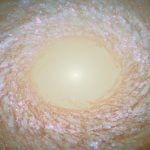
Hubble just sent back this incredible image of the NGC 2775 galaxy, 67 million light years away
Jul 7, 2020
John Aldred
John Aldred is a photographer with over 25 years of experience in the portrait and commercial worlds. He is based in Scotland and has been an early adopter – and occasional beta tester – of almost every digital imaging technology in that time. As well as his creative visual work, John uses 3D printing, electronics and programming to create his own photography and filmmaking tools and consults for a number of brands across the industry.
Share:

The Hubble Space Telescope is an incredible thing. Launched 30 years ago, it flies around the earth travelling at around 17,000 miles per hour snapping pictures deep into space. How deep? Well, at least 67 million light-years – or 393,867,900,000,000,000,000 miles. Yup, that’s a whole lot of zeros. But that’s how far away the NGC 2275 galaxy is from Earth. And the Hubble just shot and sent back its portrait.
The spiral pattern in the NGC 2775 galaxy, NASA/ESA says is notable because of its “delicate, feathery nature” and that it indicates the recent history of star formations in the galaxy. And, well, science aside, it sure is pretty.
The spiral pattern shown by the galaxy in this image from the NASA/ESA Hubble Space Telescope is striking because of its delicate, feathery nature. These “flocculent” spiral arms indicate that the recent history of star formation of the galaxy, known as NGC 2775, has been relatively quiet. There is virtually no star formation in the central part of the galaxy, which is dominated by an unusually large and relatively empty galactic bulge, where all the gas was converted into stars long ago.
Although NGC 2775 doesn’t have defined “arms” like our own Milky Way, although it’s still considered to be a spiral galaxy due to the obvious pattern. It may evolve into something resembling our home galaxy, and it may indeed already have done, given that we’re seeing how NGC 2775 looked 67 million years ago.

Millions of bright, young, blue stars shine in the complex, feather-like spiral arms, interlaced with dark lanes of dust. Complexes of these hot, blue stars are thought to trigger star formation in nearby gas clouds. The overall feather-like spiral patterns of the arms are then formed by shearing of the gas clouds as the galaxy rotates. The spiral nature of flocculent galaxies stands in contrast to the grand-design spirals, which have prominent, well defined-spiral arms.
Well, even if Canon can’t get a camera up in the sky, at least we still have the Hubble!
[via BGR – Images: NASA/JPL-Caltech/R. Hurt]
See more from DIYPhotography.net on Google
Add DIYPhotography.net as a trusted source. This makes
our stories more likely to appear in your Google Search results.
 Add as a preferred source on Google

John Aldred
John Aldred is a photographer with over 25 years of experience in the portrait and commercial worlds. He is based in Scotland and has been an early adopter – and occasional beta tester – of almost every digital imaging technology in that time. As well as his creative visual work, John uses 3D printing, electronics and programming to create his own photography and filmmaking tools and consults for a number of brands across the industry.


Join the Discussion
DIYP Comment Policy
Be nice, be on-topic, no personal information or flames.
3 responses to “Hubble just sent back this incredible image of the NGC 2775 galaxy, 67 million light years away”
How is this DIY photography?
Because Hubble is doing it itself, lol :D
None of several articles about this incredible NGC 2775 photo explain the source or reason for the galaxy’s overwhelmingly bright central light. Lots of swooning over its ‘furriness’ or the multitude of twinkling stars in its spiral and not a word explaining the most prominent central light— in fact, a couple articles remark how “nothing’s going on” in the middle—!! It makes no sense.