



















A Disruptive Neighbour NGC 1511: Hubble Captures a Galaxy Shaped by Chaos
Nov 10, 2025
Soumyadeep Mukherjee
Soumyadeep Mukherjee is an award-winning astrophotographer from India. He has a doctorate degree in Linguistics. His work extends to the sub-genres of nightscape, deep sky, solar, lunar and optical phenomenon photography. He is also a photography educator and has conducted numerous workshops. His works have appeared in over 40 books & magazines including Astronomy, BBC Sky at Night, Sky & Telescope among others, and in various websites including National Geographic, NASA, Forbes. He was the first Indian to win “Astronomy Photographer of the Year” award in a major category.
Share:
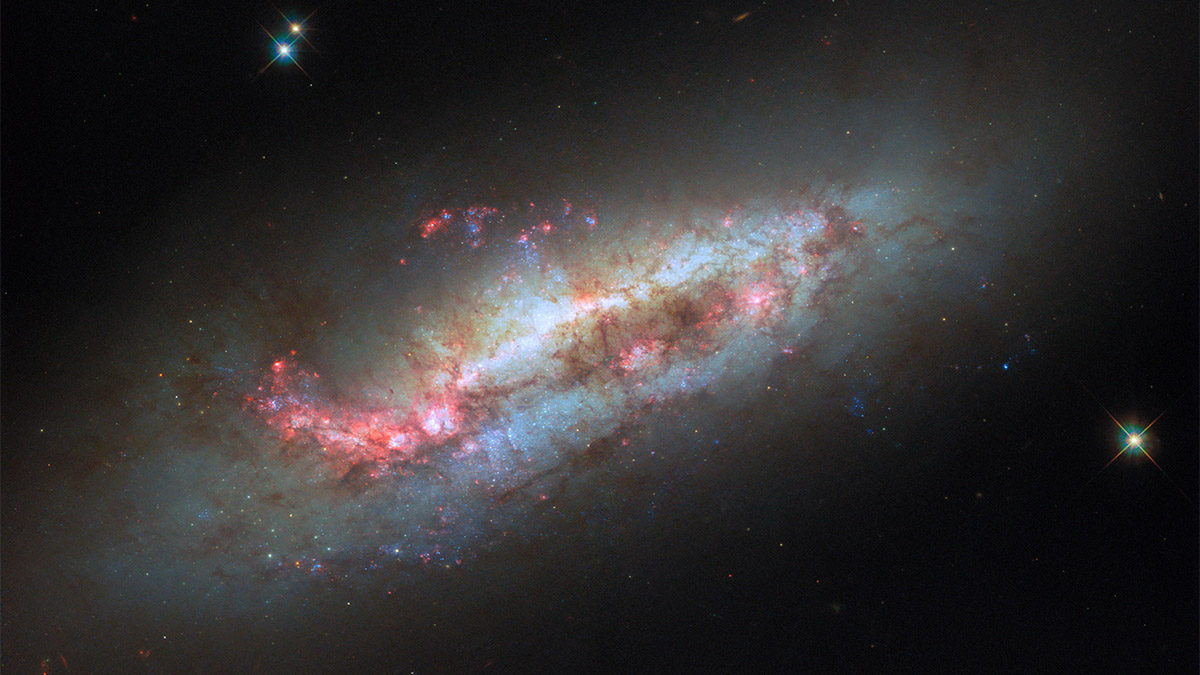
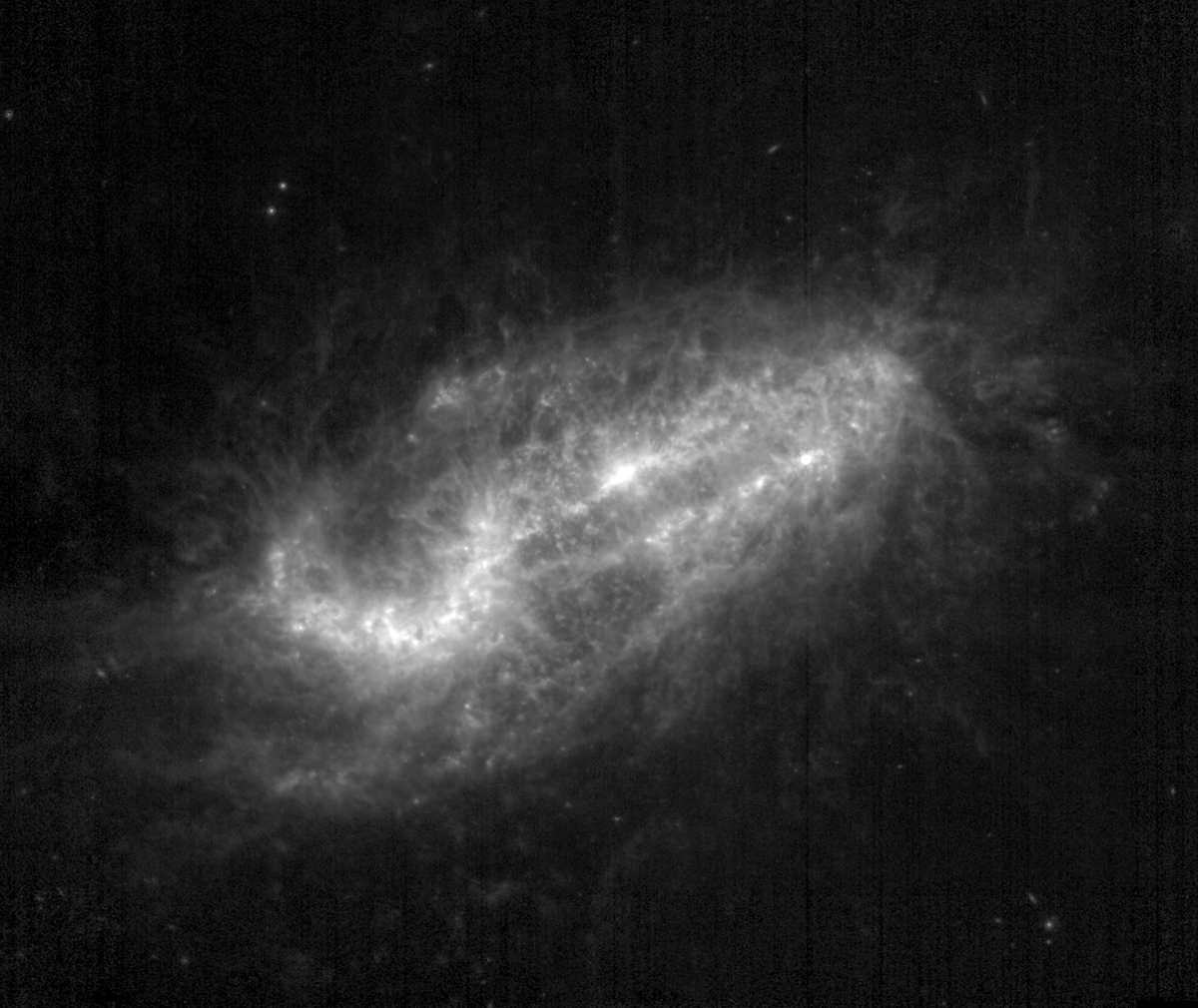
The Hubble Space Telescope has once again shown how violent and beautiful our universe can be. In its latest image, Hubble turns its eye toward NGC 1511, a spiral galaxy about 50 million light-years away in the southern constellation Hydrus.
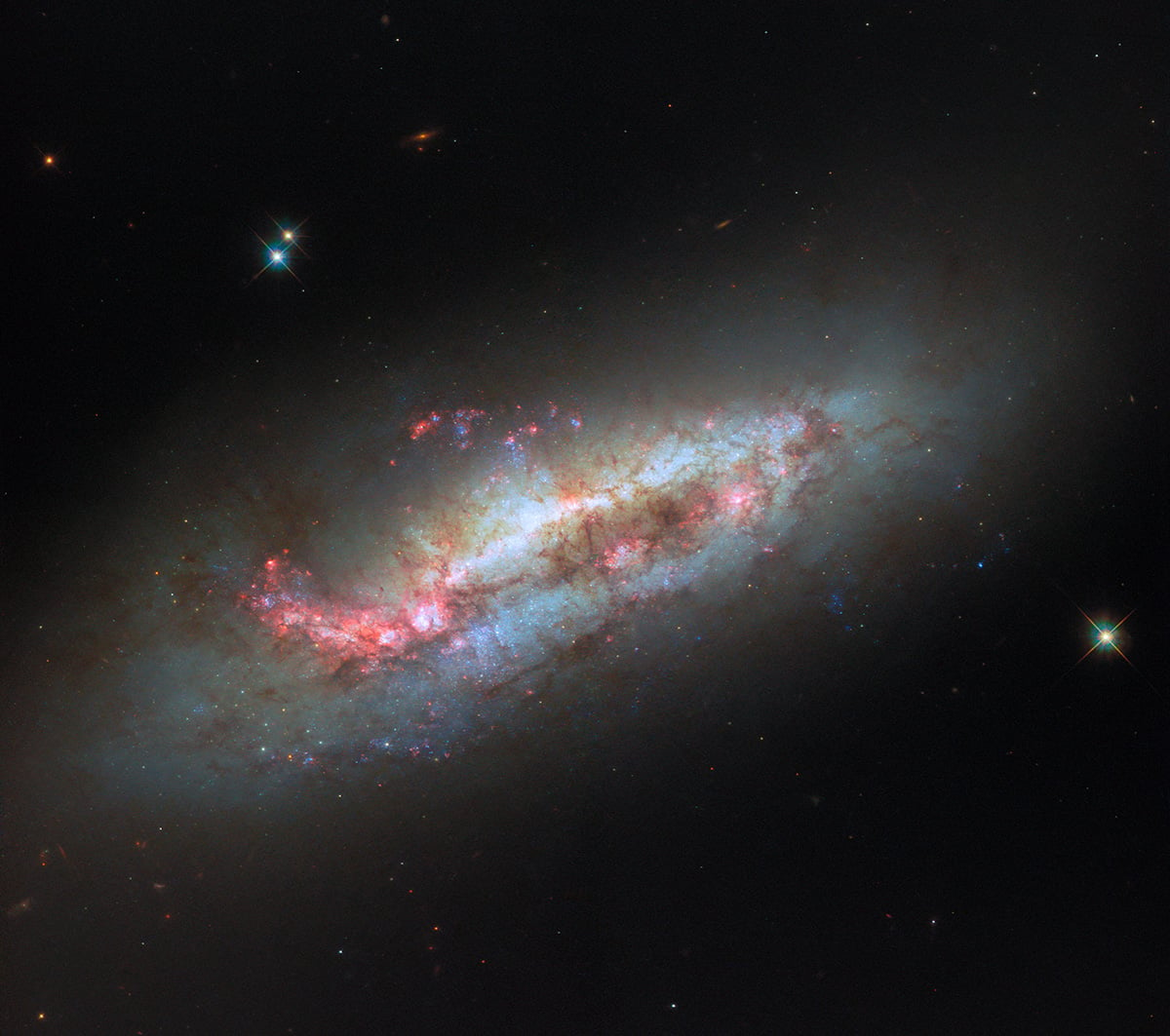
The galaxy appears graceful, a swirl of stars and dust glowing in shades of blue, pink, and white. A closer look, however, reveals something unusual. Its structure isn’t smooth. Its spiral arms appear warped. Bright knots of gas and newborn stars line its distorted disc. This is not a calm galaxy. It’s one in turmoil, reshaped by a cosmic encounter with its neighbours.
A galaxy in distress
NGC 1511 is what astronomers call a peculiar spiral galaxy. It belongs to a small group that includes NGC 1511A and NGC 1511B, its close companions. These three galaxies are locked in a slow, gravitational dance. Over millions of years, they’ve pulled on each other, distorting their shapes and stirring their internal gas. Hubble’s image clearly shows that interaction. The disc of NGC 1511 looks twisted and uneven, like a whirlpool disturbed by a passing ship. Faint plumes and loops extend from the edges. These are tidal features, made of stars and dust ripped out by gravitational forces.
Scientists believe that one of the companions, NGC 1511B, came so close that it formed a thin bridge of hydrogen gas between the two galaxies. This bridge connects their outer regions, evidence that a collision or near-collision occurred in the past.
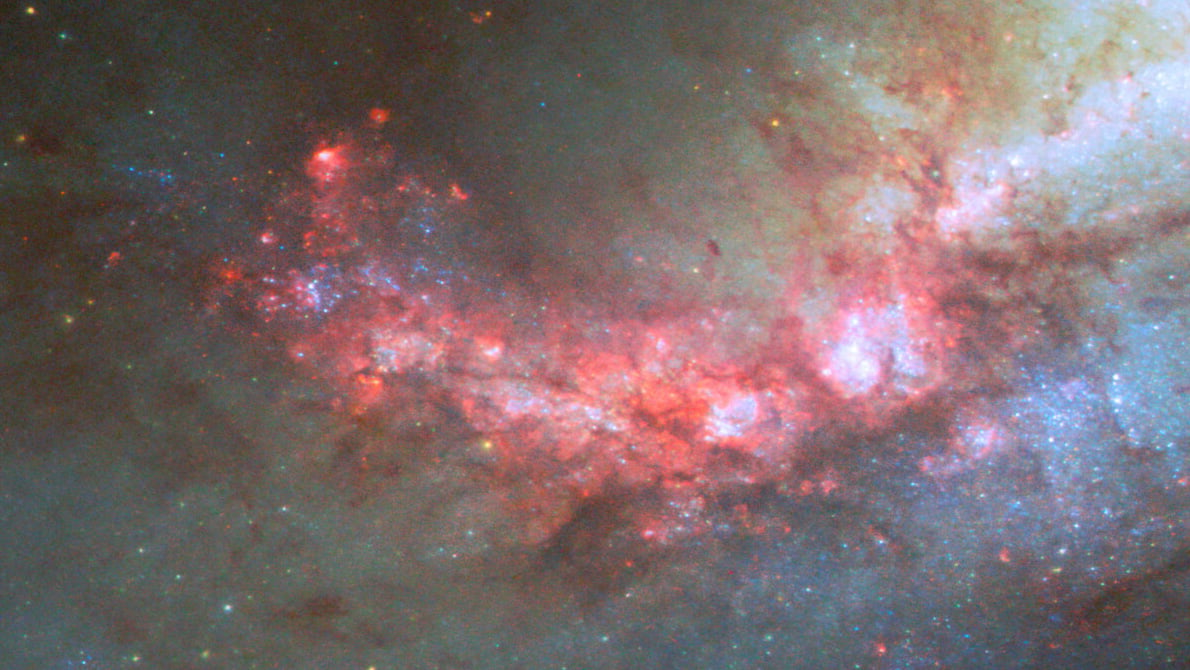
That encounter had consequences. It disturbed the gas inside NGC 1511, compressing it and triggering a burst of new star formation. The pinkish regions in Hubble’s image mark these active stellar nurseries. Each glowing patch contains clusters of young, hot stars that emit strong ultraviolet light and ionize the surrounding hydrogen gas.
Star formation on overdrive
Collisions may sound destructive, but in astronomy, they are also creative. When galaxies interact, their gas clouds collide and compress. The pressure triggers gravitational collapse, forming new stars in large numbers. NGC 1511 is a perfect example. It’s currently experiencing what astronomers call a starburst phase, a period of intense star formation. These bursts don’t last long on cosmic timescales, perhaps only tens of millions of years. But they can change a galaxy’s appearance completely.
In the Hubble image, blue regions trace young stars less than a few million years old. Pink and red hues come from hydrogen gas glowing in the presence of these stars. The mix of colours tells a clear story: the galaxy is alive with stellar birth, fuelled by the chaos of gravitational disturbance.
Even the central bulge looks active. Instead of a smooth yellow core, it’s dotted with patches of light. This shows that new stars are forming not only in the arms but also near the centre, something often triggered by gas funneled inward during galactic interactions.
How Hubble captured this view
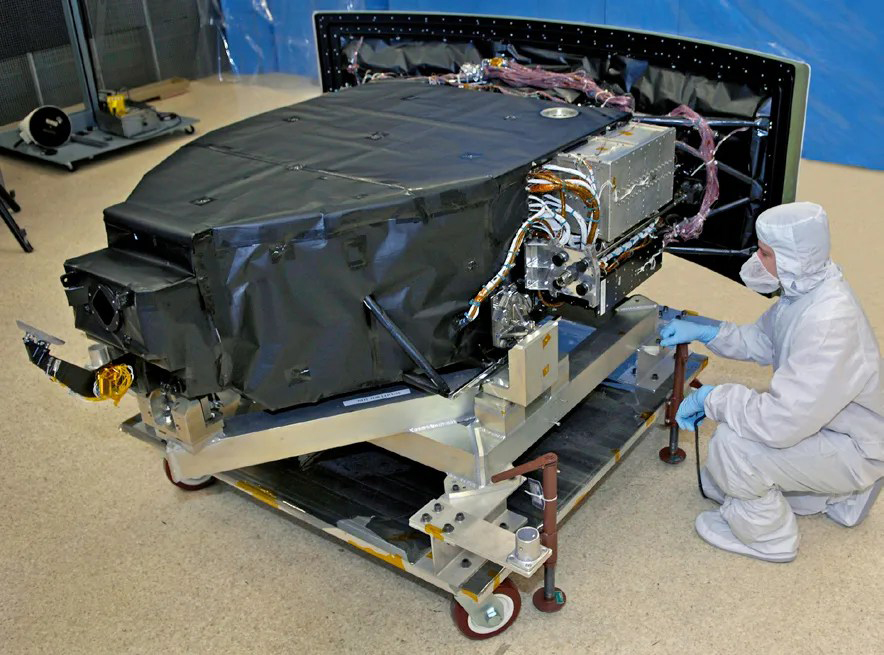
The image was taken using Hubble’s Wide Field Camera 3 (WFC3), one of the telescope’s most versatile instruments. It can observe in ultraviolet, visible, and near-infrared light, allowing scientists to combine data across wavelengths to create a complete picture. For this image, astronomers used several filters: ultraviolet (275 nm), optical U (336 nm), B (438 nm), V (555 nm), I (814 nm), and H-alpha (657 nm). Each filter highlights a different component of the galaxy: young stars, older stars, or regions of ionized hydrogen.
The result is a multi-wavelength composite that reveals both structure and activity. Ultraviolet light shows where massive young stars shine brightest. Optical filters reveal the distribution of older stars. The H-alpha filter isolates hydrogen emission, pinpointing zones of active star formation.
The turbulent history of NGC 1511
NGC 1511 isn’t new to astronomers. It has been studied across different wavelengths for decades. Radio observations have shown that its neutral hydrogen gas extends far beyond the visible stars. These radio maps reveal stretched and asymmetric patterns, evidence of past gravitational encounters. In fact, some studies suggest that NGC 1511 once had another companion galaxy that it completely absorbed or destroyed. The current irregularities in its structure could be the aftermath of that earlier event.
The galaxy’s companions, NGC 1511A and NGC 1511B, still orbit nearby. The smaller one, NGC 1511B, is clearly distorted, a casualty of the interaction. Astronomers think the gravitational tug-of-war between these three galaxies will continue. Over the next few hundred million years, they may merge into one larger system.
That’s how many galaxies evolve. The Milky Way itself will eventually merge with the Andromeda Galaxy in about 4 billion years. Hubble’s view of NGC 1511 offers a view into what that future collision might look like.
Clear skies!
See more from DIYPhotography.net on Google
Add DIYPhotography.net as a trusted source. This makes
our stories more likely to appear in your Google Search results.
 Add as a preferred source on Google

Soumyadeep Mukherjee
Soumyadeep Mukherjee is an award-winning astrophotographer from India. He has a doctorate degree in Linguistics. His work extends to the sub-genres of nightscape, deep sky, solar, lunar and optical phenomenon photography. He is also a photography educator and has conducted numerous workshops. His works have appeared in over 40 books & magazines including Astronomy, BBC Sky at Night, Sky & Telescope among others, and in various websites including National Geographic, NASA, Forbes. He was the first Indian to win “Astronomy Photographer of the Year” award in a major category.


Join the Discussion
DIYP Comment Policy
Be nice, be on-topic, no personal information or flames.