



















NGC 7496: Hubble Revisits a “Well-Studied” Spiral Galaxy after Three Years
Oct 13, 2025
Soumyadeep Mukherjee
Soumyadeep Mukherjee is an award-winning astrophotographer from India. He has a doctorate degree in Linguistics. His work extends to the sub-genres of nightscape, deep sky, solar, lunar and optical phenomenon photography. He is also a photography educator and has conducted numerous workshops. His works have appeared in over 40 books & magazines including Astronomy, BBC Sky at Night, Sky & Telescope among others, and in various websites including National Geographic, NASA, Forbes. He was the first Indian to win “Astronomy Photographer of the Year” award in a major category.
Share:

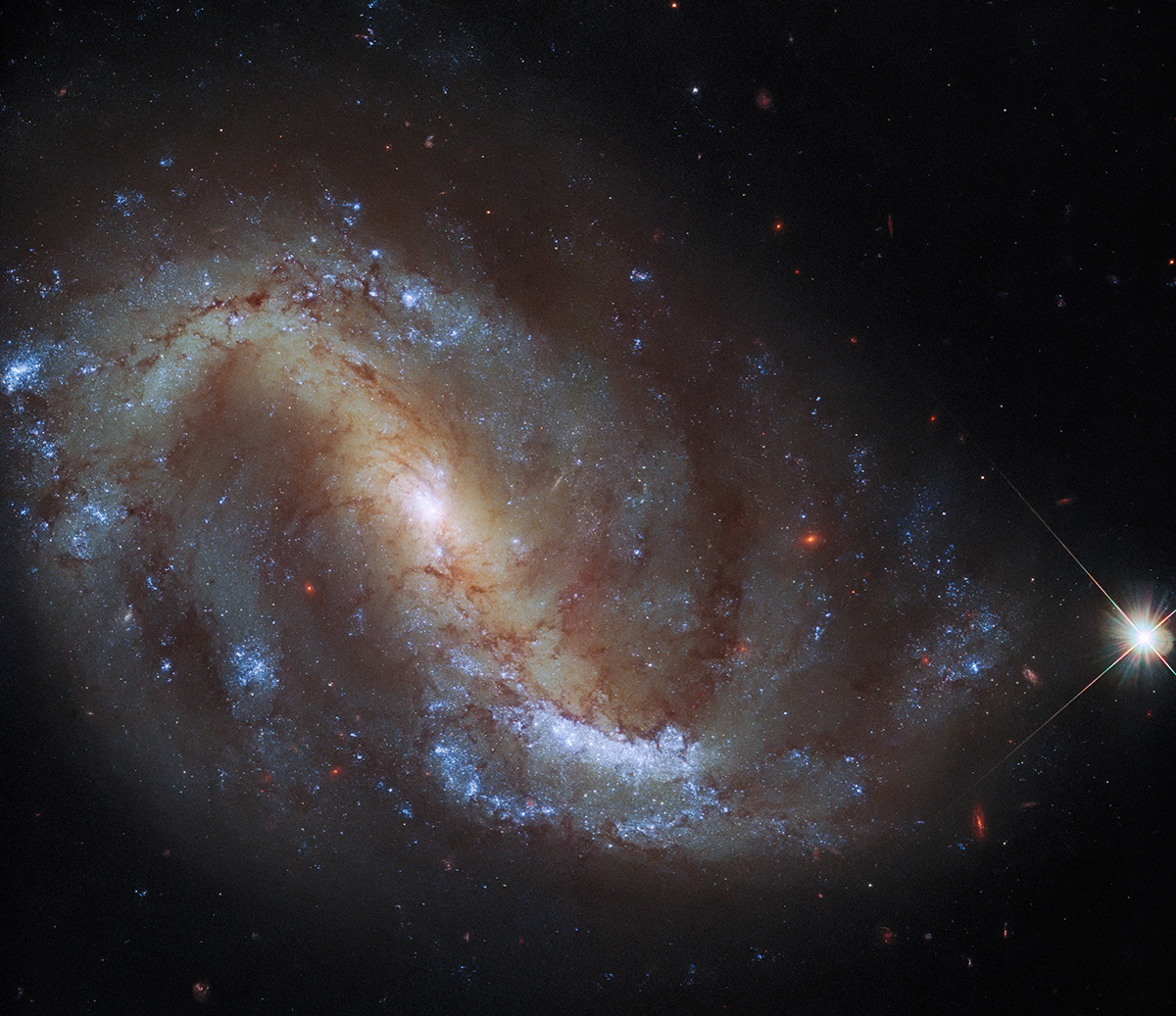
Some galaxies seem ordinary until science takes a closer look. NGC 7496, a barred spiral galaxy about 24 million light-years away, is one of them. To the eye, it’s a spiral in the southern constellation Grus. However, when the Hubble Space Telescope directs its sharp instruments at it, this galaxy reveals layers of structure, color, and energy that tell an extraordinary story about how galaxies evolve and grow.
In recent years, NGC 7496 has become one of the most closely studied galaxies in the nearby universe. It’s part of a massive international program called PHANGS, short for Physics at High Angular Resolution in Nearby Galaxies. It brings together data from Hubble, JWST, ALMA, and the Very Large Telescope. The goal is simple yet ambitious: to understand precisely how gas is transformed into stars within galaxies like our own.
A nearby galaxy with a distinct personality
NGC 7496 sits roughly 24 million light-years from Earth, a relatively small distance on the cosmic scale. It’s large enough to appear as a graceful spiral in telescopic views, but close enough for astronomers to zoom in on details as small as individual star-forming regions. The galaxy’s central bar, a linear structure of stars cutting through its core, stands out clearly in optical images. Bars like this play a key role in galactic evolution, funneling gas inward and often triggering bursts of star formation.
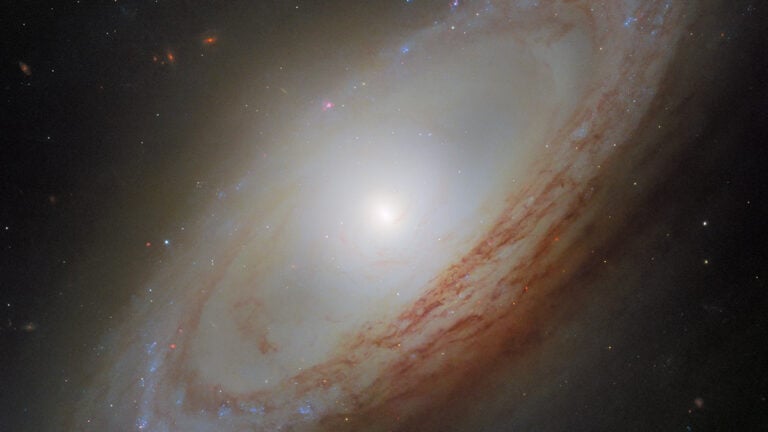
Through Hubble’s eyes, NGC 7496 glows with intricate structure. Dust lanes curl around the bright nucleus. Blue regions trace clusters of young, massive stars. Redder filaments mark glowing hydrogen gas, a sign that new stars have recently formed and are energizing their surroundings. It’s a busy, dynamic galaxy, filled with motion and transformation.
Beneath that beauty lies something that is even more interesting. NGC 7496 hosts an active galactic nucleus (AGN), a supermassive black hole that’s feeding on gas and dust. This activity produces radiation that influences the galaxy’s inner regions, linking small-scale black hole physics with large-scale galactic processes. That combination of a star-forming disk and an active nucleus makes NGC 7496 a particularly valuable target for multi-wavelength studies.
The PHANGS collaboration
The PHANGS program is one of the most comprehensive efforts ever undertaken to study nearby galaxies. It combines the power of several observatories, each sensitive to a different part of the electromagnetic spectrum. Hubble captures ultraviolet and optical light, revealing young stars and ionized gas. ALMA, the Atacama Large Millimeter/submillimeter Array, maps cold molecular gas, the raw material from which stars form. The Very Large Telescope contributes spectroscopic data to measure stellar motions. JWST adds the infrared perspective, penetrating the dust to uncover the youngest stars still cocooned within their birth clouds.
Together, these observatories create a full, layered view of galactic ecosystems. For NGC 7496, PHANGS provides data that link gas clouds, star clusters, and galactic structure in exquisite detail. Scientists can trace a continuous story, from the gas clouds that collapse into stars, to the feedback those stars produce, and finally to the large-scale patterns that shape the galaxy’s spiral arms.
Hubble’s view: The optical story
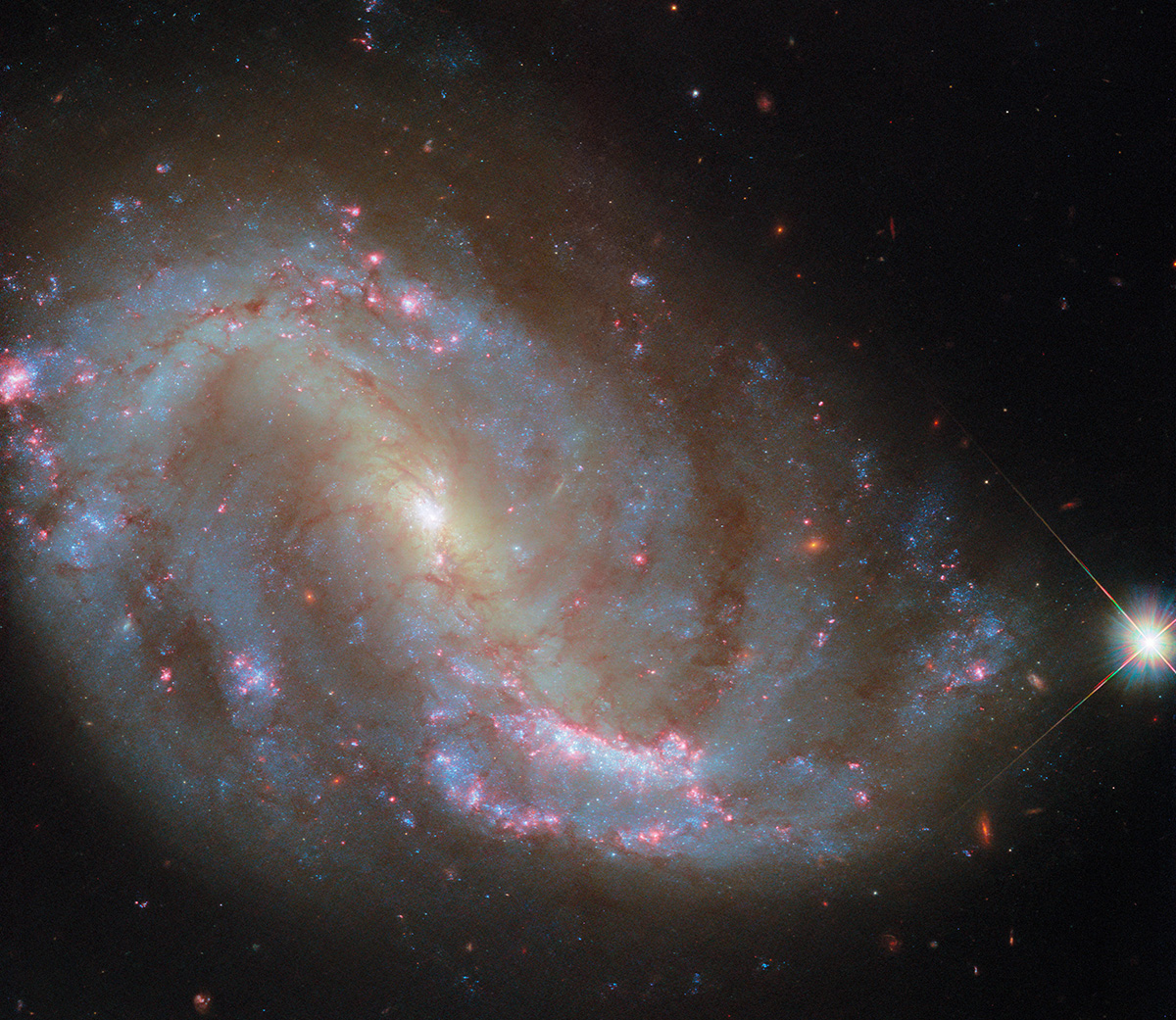
The Hubble Space Telescope’s image of NGC 7496 is a showcase of what precision optical imaging can achieve. The galaxy was captured using Hubble’s Wide Field Camera 3, combining multiple filters across ultraviolet, visible, and near-infrared light. Each filter isolates a different physical process: blue light traces hot young stars; red light maps hydrogen emission; and the darker streaks reveal cold dust.
With all layers combined, the image becomes a scientific map. Astronomers can count star clusters, measure their colors to estimate ages, and determine how star formation varies across the spiral arms and central bar. They can also identify where dust is thick enough to block starlight, indicating where future star formation might occur.
What stands out in Hubble’s portrait of NGC 7496 is its contrast. Bright stellar regions are intertwined with dark lanes, showing how turbulent and structured the interstellar medium can be. The spiral arms are filled with small, glowing nebulae, the telltale signs of young stellar nurseries. These details help researchers estimate how efficiently the galaxy converts its gas into stars, and how quickly that process changes from one region to another.
JWST and ALMA: Adding depth and texture
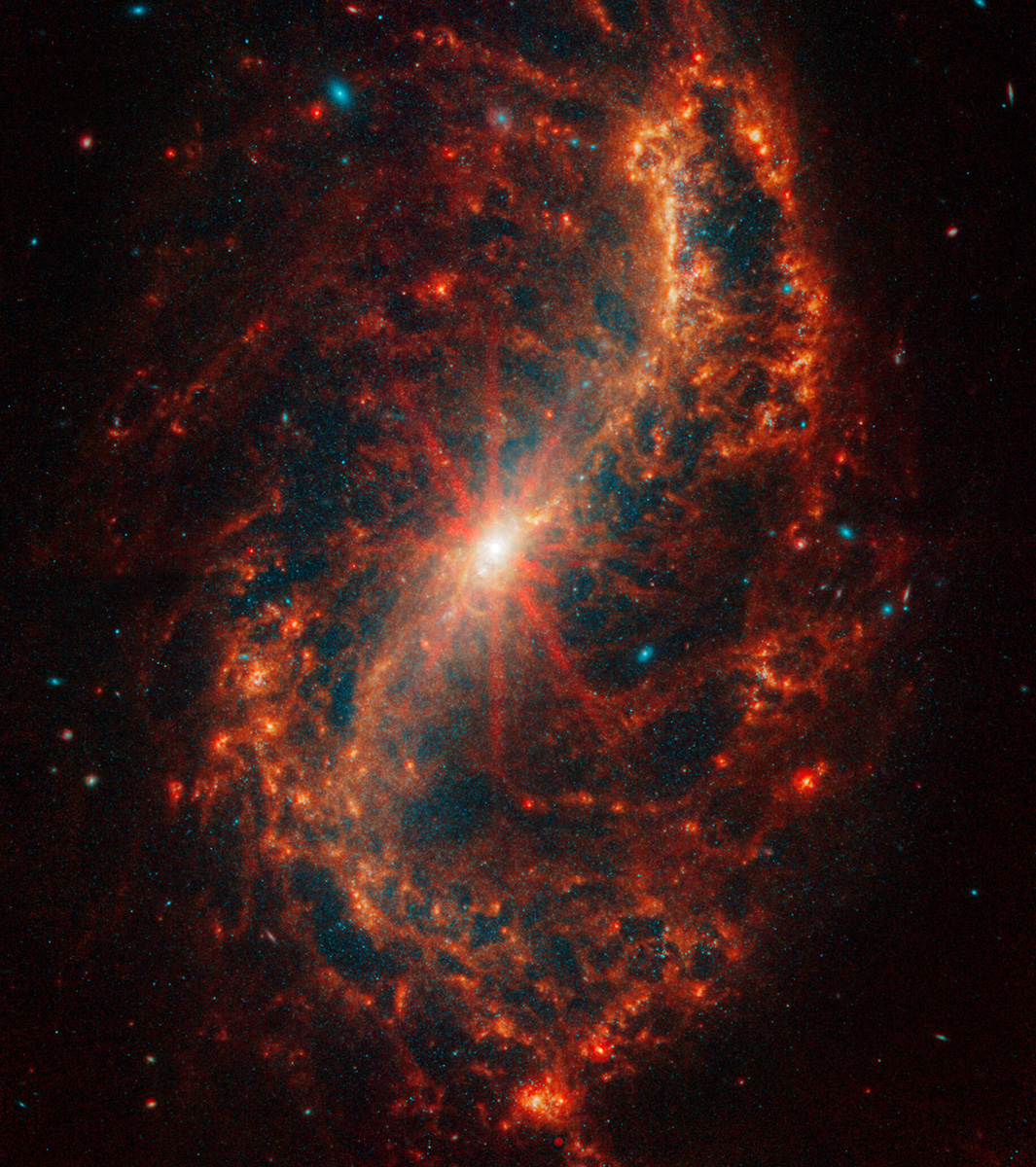
While Hubble’s optical vision captures light from stars and ionized gas, JWST and ALMA look deeper into the galaxy’s anatomy. JWST, operating in the infrared, can see through dust that obscures visible light. It reveals stars still in formation, the ones Hubble cannot see because they are buried in dense clouds. JWST also detects warm dust grains heated by nearby newborn stars, outlining the skeleton of active star-forming regions.
ALMA, on the other hand, detects the coldest material in the galaxy. Its millimeter-wavelength observations trace molecular gas, particularly carbon monoxide, which serves as a marker for dense star-forming clouds. When ALMA’s gas maps are overlaid with Hubble and JWST’s optical and infrared data, astronomers can literally watch the life cycle of stars unfold, from gas clouds to star clusters, to feedback-driven winds that reshape the surrounding medium.
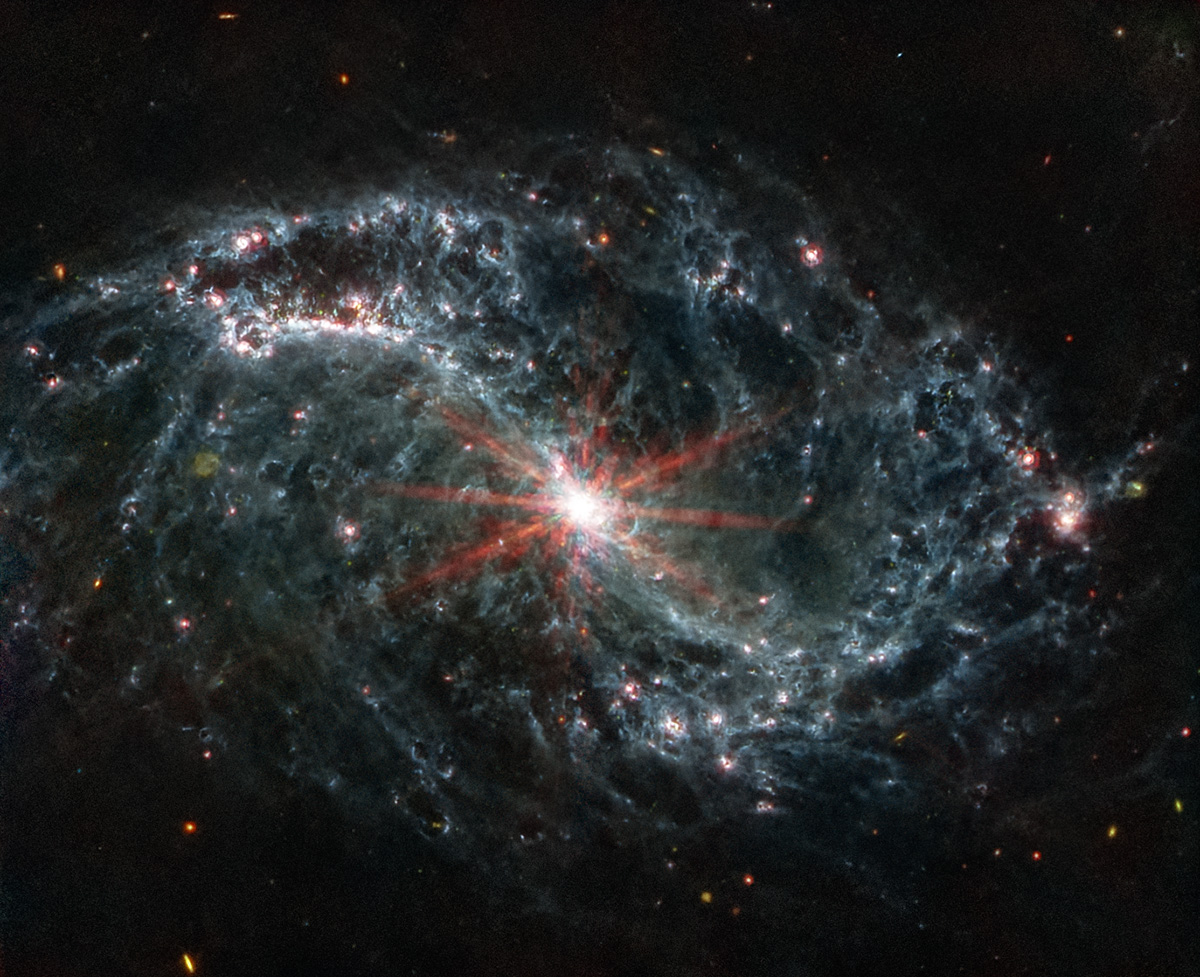
The ultimate goal of studying NGC 7496 is to understand how galaxies like it evolve. The PHANGS collaboration has already produced several key insights. By comparing data across wavelengths, scientists can measure how long it takes for gas to turn into stars, and how feedback from those stars affects surrounding material.
Clear skies!
See more from DIYPhotography.net on Google
Add DIYPhotography.net as a trusted source. This makes
our stories more likely to appear in your Google Search results.
 Add as a preferred source on Google

Soumyadeep Mukherjee
Soumyadeep Mukherjee is an award-winning astrophotographer from India. He has a doctorate degree in Linguistics. His work extends to the sub-genres of nightscape, deep sky, solar, lunar and optical phenomenon photography. He is also a photography educator and has conducted numerous workshops. His works have appeared in over 40 books & magazines including Astronomy, BBC Sky at Night, Sky & Telescope among others, and in various websites including National Geographic, NASA, Forbes. He was the first Indian to win “Astronomy Photographer of the Year” award in a major category.


Join the Discussion
DIYP Comment Policy
Be nice, be on-topic, no personal information or flames.