
























A Pulsar Broke the Milky Way’s “Bone”: Chandra Reveals a Galactic Fracture
Oct 13, 2025
Soumyadeep Mukherjee
Soumyadeep Mukherjee is an award-winning astrophotographer from India. He has a doctorate degree in Linguistics. His work extends to the sub-genres of nightscape, deep sky, solar, lunar and optical phenomenon photography. He is also a photography educator and has conducted numerous workshops. His works have appeared in over 40 books & magazines including Astronomy, BBC Sky at Night, Sky & Telescope among others, and in various websites including National Geographic, NASA, Forbes. He was the first Indian to win “Astronomy Photographer of the Year” award in a major category.
Share:
At the heart of our galaxy lies a chaotic, magnetic wilderness, a region filled with mysterious filaments, dense gas, and some of the most extreme objects in the universe. A discovery from NASA’s Chandra X-ray Observatory and powerful radio telescopes has uncovered a striking event in that turbulent zone.
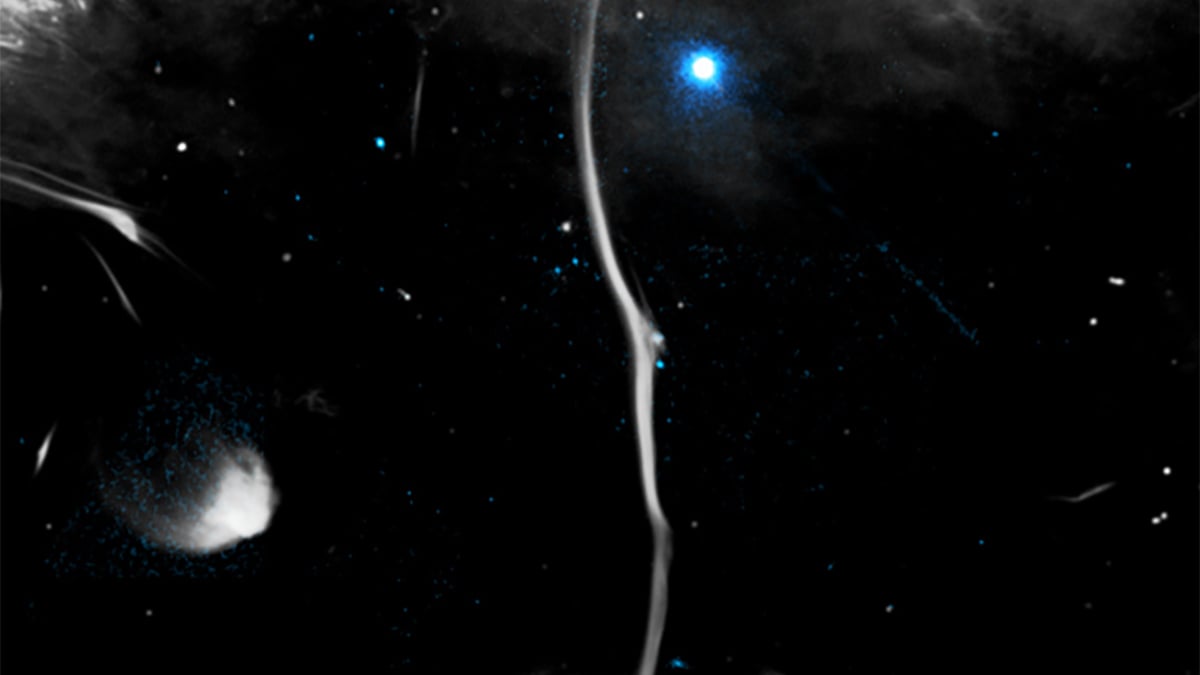
A long, thread-like structure known as the “Bone”, officially catalogued as G359.13142-0.20005, appears to have fractured. And scientists think they’ve found the cause: a fast-moving pulsar, a spinning neutron star, that likely crashed through it millions of years ago.
A cosmic fracture near the Galactic Center
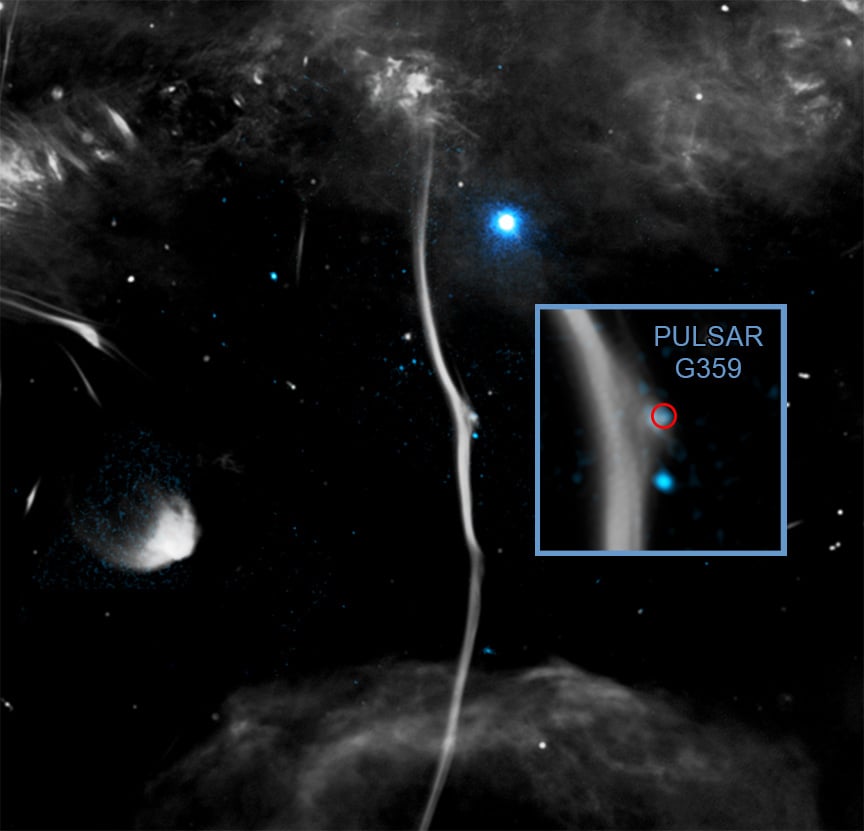
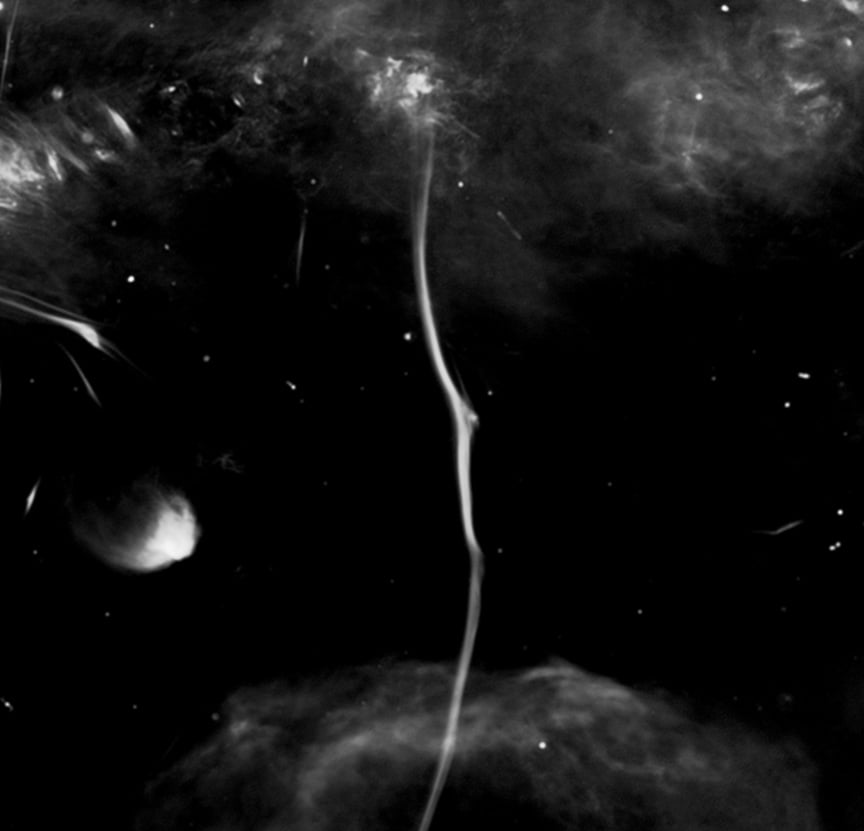
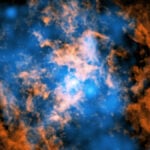
Seen in radio images, the Bone is an extraordinary filament. It stretches roughly 230 light-years across and lies some 26,000 light-years away, close to the crowded center of the Milky Way. It belongs to a family of narrow, magnetic filaments that crisscross this central region.
Astronomers have been studying these filaments for decades. Most appear smooth and continuous, like luminous threads stitched across the Galactic core. But one section of the Bone looks different. It bends sharply, showing what researchers describe as a “fracture.”
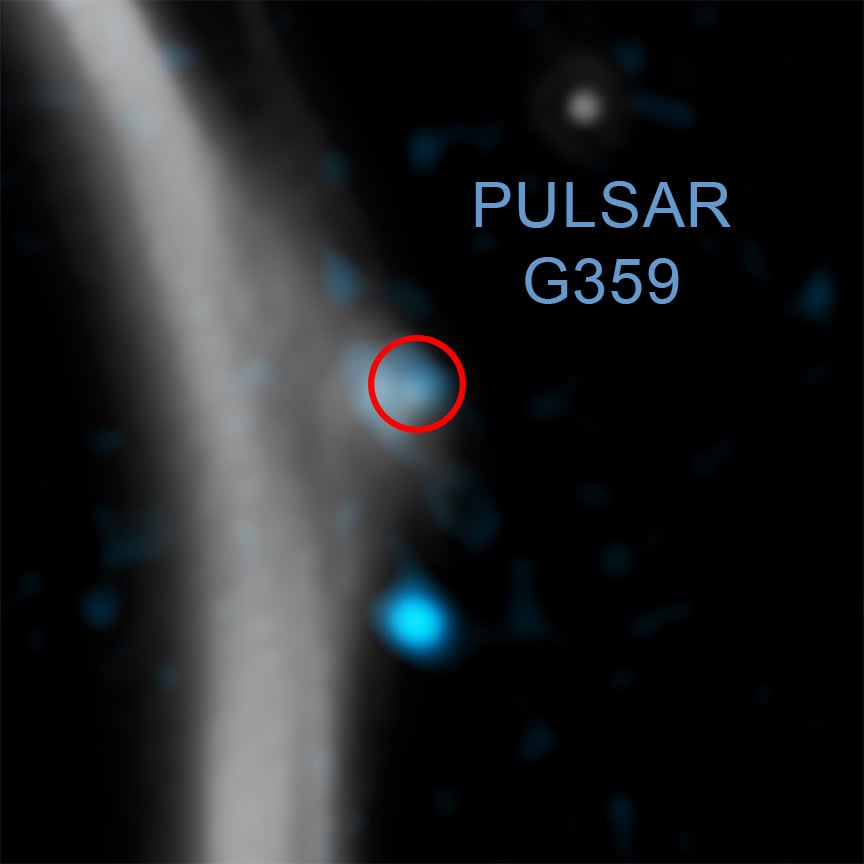
That strange kink caught attention when data from Chandra revealed faint X-ray emission right at the bend. When combined with high-resolution radio observations from the MeerKAT array in South Africa and the Very Large Array (VLA) in New Mexico, the X-ray glow matched a compact radio source at the same location. Something energetic was clearly happening there.

The culprit: A runaway pulsar
The team, led by Farhad Yusef-Zadeh of Northwestern University, began digging deeper. The compact source showed a steep radio spectrum, meaning it emits much more strongly at lower radio frequencies. That pattern is a known hallmark of pulsars or pulsar wind nebulae, regions powered by rapidly spinning neutron stars.
Pulsars are what remain after massive stars explode as supernovae. The explosion crushes the core into an object barely 20 kilometers wide but heavier than the Sun. As the star collapses, it can also receive a “kick,” sending the newborn neutron star speeding through space at incredible velocity. That’s likely what happened here. Modeling suggests this pulsar was hurtling at up to 1 to 2 million miles per hour when it struck the filament. The impact would have disturbed the local magnetic fields and injected fresh high-energy particles, creating the fracture we now see.
The X-rays mark where the pulsar’s powerful wind of charged particles collided with the filament’s magnetic structure. In that sense, the pulsar smashed into the Bone and bent it out of shape.
How astronomers diagnosed the “fracture”
The discovery was possible because Chandra and MeerKAT can see different sides of the same phenomenon. Chandra detects high-energy radiation from very hot gas and fast-moving particles. It revealed a subtle X-ray glow, concentrated at the filament’s kink. MeerKAT, meanwhile, sees synchrotron emission, radio waves released by electrons spiraling along magnetic field lines. That data showed that the radio structure was twisted and disrupted precisely where the X-rays appeared.
By comparing both datasets, astronomers realized they were seeing a single, connected event. The break, the X-rays, and the compact radio source all aligned perfectly in space. The images were then compared with archival data from the VLA, which confirmed the shape of the filament and helped trace how the disturbance propagated along it. Together, these observations built a strong case for the pulsar impact hypothesis.
What the fracture reveals about galactic filaments
Filaments like the Bone are still poorly understood. They are long, thin strands of magnetized plasma that stand out near the Galactic Center. Many run vertically, cutting across the plane of the Milky Way like luminous threads. They shine in radio because of synchrotron radiation, emission from electrons spiraling through strong magnetic fields at nearly the speed of light. But scientists have struggled to explain how these filaments form and remain stable.
The new fracture gives an important clue. It shows that filaments are not rigid structures. They can bend, twist, and even break when struck by energetic objects. The encounter with a pulsar provides direct evidence that the region’s magnetic fields are dynamic and reactive. In effect, the Bone’s fracture captures a moment of magnetic interaction frozen in time, a record of what happens when a compact, high-speed remnant crosses paths with a magnetized filament.
The wild heart of the Milky Way
The Galactic Center is one of the most extreme environments in the Milky Way. Within a few hundred light-years, it hosts dense molecular clouds, streams of ionized gas, and an enormous supermassive black hole, Sagittarius A*. Magnetic fields in this area are strong and highly ordered, but also under pressure from constant turbulence. Massive stars are born and die there at a rapid pace, leaving behind supernova remnants, black holes, and neutron stars.
Filaments like G359.13 trace these magnetic field lines and reveal how energy moves through the region. When a pulsar cuts across one, it injects new particles, stirs up the plasma, and changes how the structure shines.
This interaction gives astronomers a way to test models of particle acceleration and magnetic reconnection, processes that also occur in environments like supernova remnants and even in the Sun’s corona. The fracture becomes a natural experiment in high-energy astrophysics, playing out on a galactic scale.
Clear skies!
See more from DIYPhotography.net on Google
Add DIYPhotography.net as a trusted source. This makes
our stories more likely to appear in your Google Search results.
 Add as a preferred source on Google

Soumyadeep Mukherjee
Soumyadeep Mukherjee is an award-winning astrophotographer from India. He has a doctorate degree in Linguistics. His work extends to the sub-genres of nightscape, deep sky, solar, lunar and optical phenomenon photography. He is also a photography educator and has conducted numerous workshops. His works have appeared in over 40 books & magazines including Astronomy, BBC Sky at Night, Sky & Telescope among others, and in various websites including National Geographic, NASA, Forbes. He was the first Indian to win “Astronomy Photographer of the Year” award in a major category.


Join the Discussion
DIYP Comment Policy
Be nice, be on-topic, no personal information or flames.