























Full-Circle Rainbow Wins the Pot of Gold at The Weather Photographer of the Year Awards 2025
Nov 10, 2025
Alex Baker
Alex Baker is a portrait and lifestyle driven photographer based in Valencia, Spain. She works on a range of projects from commercial to fine art and has had work featured in publications such as The Daily Mail, Conde Nast Traveller and El Mundo, and has exhibited work across Europe
Share:
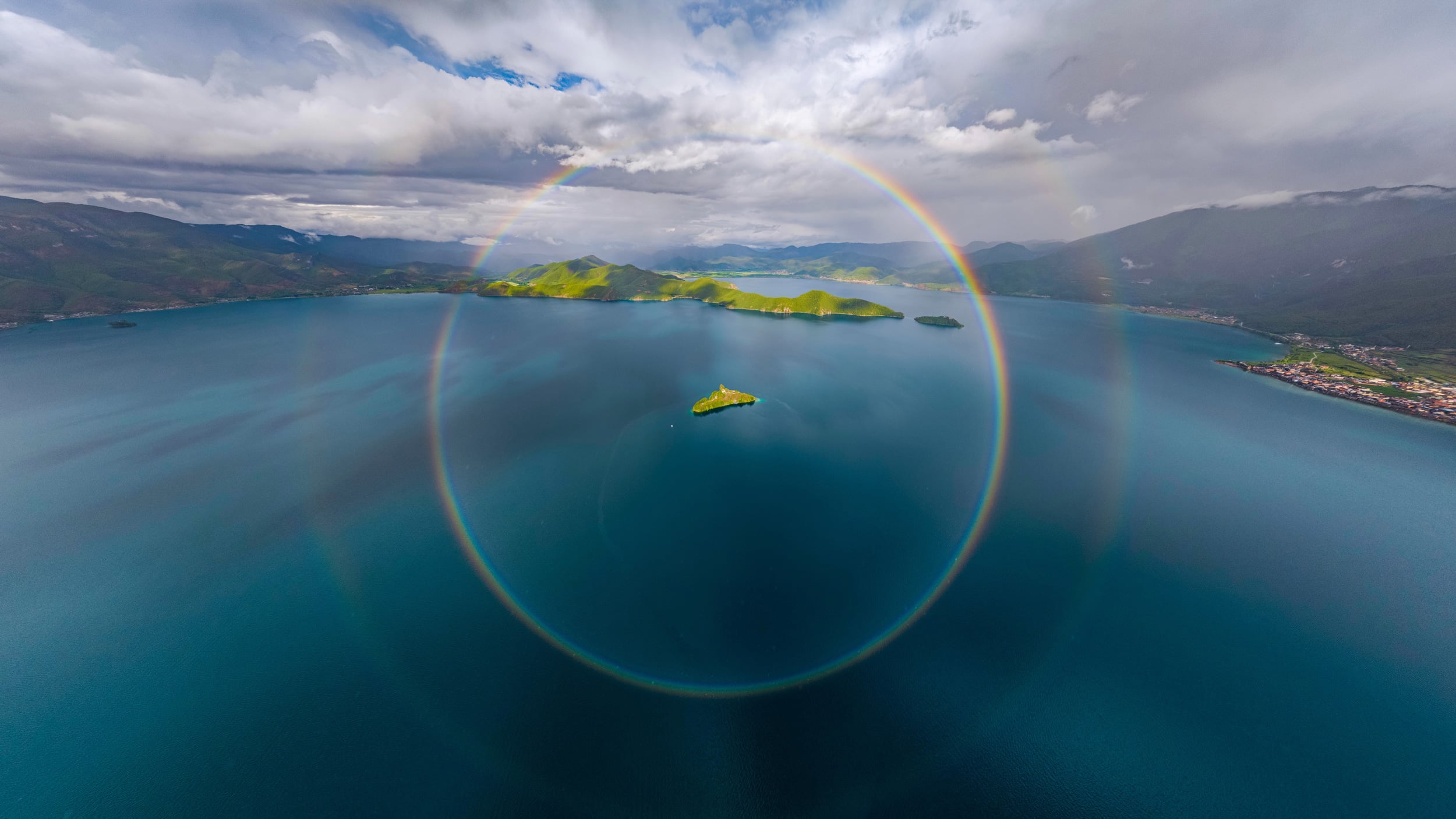
A full-circle rainbow hovering over China’s Lugu Lake has literally brought a “pot of gold” for photographers Geshuang Chen and Shuchang Dong, who take home the top prize at the 2025 Standard Chartered Weather Photographer of the Year Awards. Celebrating a decade of capturing the planet’s most stunning and extreme weather, this year’s competition received over 4,000 entries from 84 countries.
The judges, comprising a panel of meteorologists, climate experts, journalists, and ITV Weather presenters, singled out The Gorgeous Ring for its rare, perfectly aligned spectacle, earning the duo a £5,000 prize. Meanwhile, the public chose Lukáš Gallo’s Sky Surfing as their favourite. Here are the rest of the winning images.
Standard Chartered Weather Photographer of the Year 2025
Winner: Geshuang Chen, Shuchang Dong
“The Gorgeous Ring”
“It was drizzling on Lugu Lake [In China’s Yunnan Province]. I flew my drone to a height of 500 metres, passed through the rain curtain, with my lens facing away from the sun, and captured a complete circular rainbow, which was a ring given by the sun to the lake,” says engineer and astronomy photographer Geshuang Chen. Rainbows are a familiar sight, but full-circle rainbows are much less common. From the ground, the lower half of the circle is usually hidden below the horizon. From high above with the sun behind and rainfall ahead, it’s possible to see the entire circle.
Rainbows form when sunlight enters raindrops and is bent (refracted), then reflected off the inside of the droplet, and bent again as it exits. The result is a spectrum of colours forming a circle around the antisolar point: the spot directly opposite the sun from the viewer’s perspective. Since each observer’s position creates a slightly different angle of light, every rainbow is unique to the person seeing it. That makes this image particularly special: not just a rare view of a complete rainbow, but a moment of perfect alignment, with the small island framed precisely at its centre.”
Runner-Up: Jadwiga Piasecka
“I’ve loved big waves and storms since I was a kid – the power and energy of the sea have always fascinated me. So, when Storm Eunice rolled in, I knew I couldn’t miss the opportunity to witness it firsthand,” says photographer Jadwiga Piasecka.
She took this image from a sheltered place out of reach of the storm in Newhaven, on the south coast of the UK, where winds were gusting at over 80 miles per hour. “From my vantage point, I watched enormous waves battling against the sea wall, sending dramatic sprays of water high into the air…highlighting just how immense the storm’s fury truly was.”
Storm Eunice brought England’s highest recorded wind gust of 122 miles per hour. It was one of several intense European windstorms in early 2022, causing widespread disruption across the UK and Ireland, with record-breaking gusts, structural damage, and coastal flooding. Waves like these are driven by the storm’s low-pressure centre and fierce winds, which whip up the sea into towering swells. When those waves crash into sea defences, the spray can be immense.

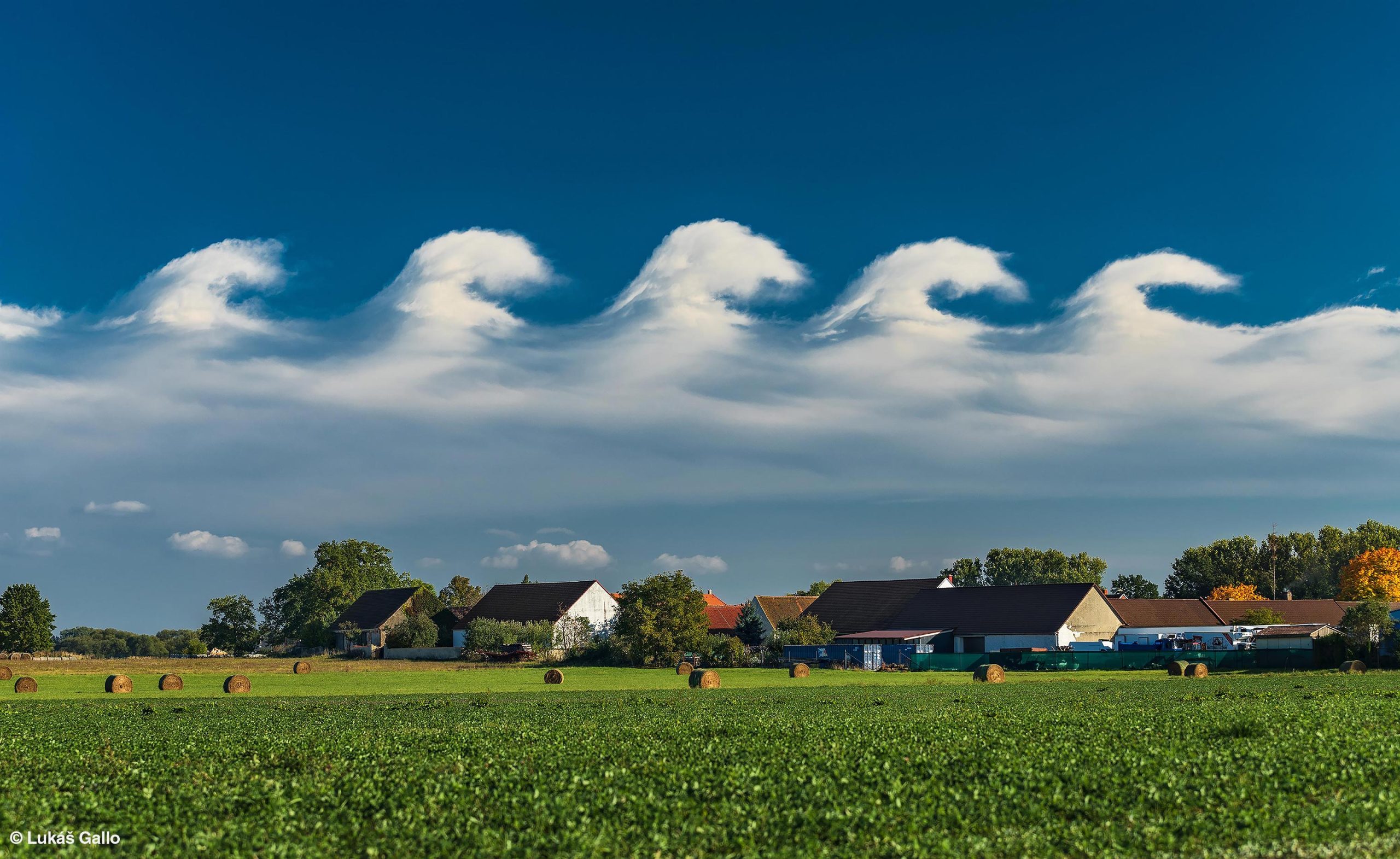
Third Place and Winner of Public Vote: Lukáš Gallo
While driving near Vodňany in South Bohemia, Czechia, photographer Lukáš Gallo noticed some unusual clouds beginning to form. He kept driving, watching the sky evolve, until about 30 minutes later, a stunning set of Kelvin-Helmholtz wave clouds appeared overhead. He quickly pulled over, grabbed his camera, and captured the momentary display from a roadside field. “I didn’t plan this; it was all of a sudden. But I think that’s the best kind of photograph,” he says.
These rare ‘wave’, or fluctus, clouds are formed when there’s a sharp difference in wind speed or direction between two layers of air, similar to the way wind can whip up waves on the surface of the sea. The result is a spectacular series of cloud curls that look like breaking ocean waves, as well as a clear visual warning of turbulence. Set against a peaceful rural landscape with round bales dotting green fields, the dramatic waves seem even more extraordinary, like nature briefly showing off above an everyday scene.
Though the composition was unplanned, judge Peter Gibbs praised the image: “The Kelvin-Helmholtz wave clouds are clearly the stars of the show, one of the best examples I’ve seen. These clouds are usually so fleeting.” These clouds typically last only minutes, making them difficult to spot and even harder to photograph.
Mobile Category
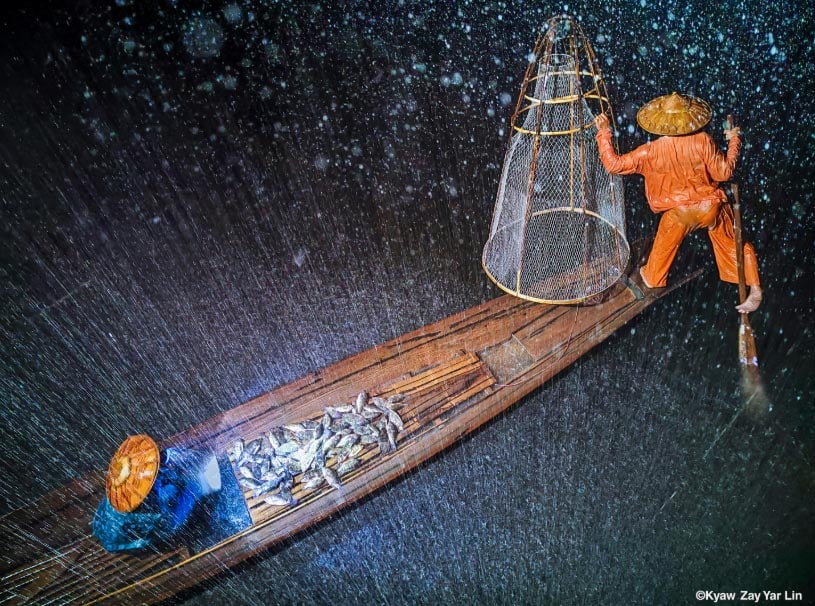
Winner: Kyaw Zay Yar Lin
This photo captures the urgent feeling of being caught in a sudden downpour. Two fishermen work quickly: one paddling through the dark water, the other bailing it out of the boat. Their bright orange and blue clothes stand out vividly, just like the heavy raindrops streaking across the frame. The motion blur of both the fishermen and the rain make the viewer feel part of the action, caught in the sudden intensity of a tropical storm. Raindrops fall in sheets and splash against the murky lake below as water fills the boat’s base. The rower uses the Intha people’s distinctive technique, standing at the stern with one leg wrapped around a single oar, enabling smooth, flowing paddling through the lake’s reeds.
Though Inle Lake is shallow, less than two metres deep on average, it supports a rich ecosystem and a way of life, both now under threat. Myanmar’s monsoon climate brings heavy seasonal rains, and fishing remains a vital livelihood even during storms like this. Deforestation in the surrounding hills has caused severe soil erosion, with sediment washing into the lake and shrinking it to half its original size. On top of this, climate change is altering rainfall patterns and increasing evaporation due to rising temperatures, causing water levels to fluctuate even more. Given the lake’s shallowness, these changes threaten fish stocks and fragile ecosystems.
Runner-Up: Tamás Kusza
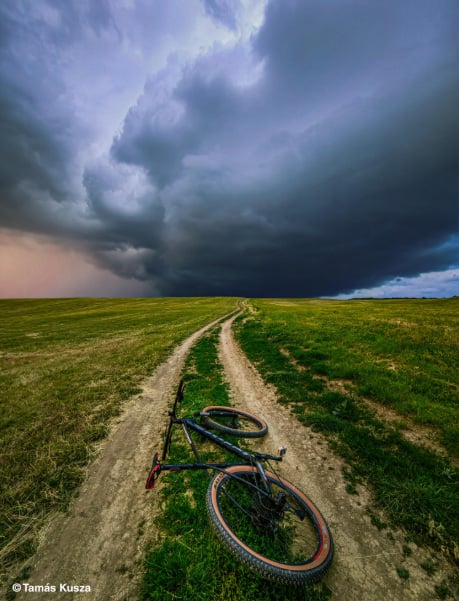
A dirt track cuts through the countryside in Ožďany, Slovakia, drawing the eye towards a sky heavy with dark, swirling clouds. In the middle of the path, a mountain bike lies still, its rider momentarily grounded by the sight ahead. “I have always been drawn to storms,” says photographer Tamás Kusza. “I love watching the sky darken, the clouds descend, and the majestic power of nature slowly unfold. Whenever I can, I hop on my bike and head for the border, where the sky and the earth meet, and where storms are born.”
That day, he watched dark clouds gather on the horizon. “I knew a special moment was coming. I rode the dirt road far enough until I had to stop: the sight was almost paralysing. I put my bike down and took out my camera. I stood there, facing the heart of the storm, where the power of nature and my own courage met. It was the moment before the silence. The world silently watched my steps. Would I stay and capture the storm, or turn back? But I knew: I was always heading toward the storm.”
Fast moving summer storms like this are common in central Europe, often arriving with torrential rain, high winds and lightning. For Kusza, it’s exactly that unpredictability that keeps him riding toward the horizon. As climate change intensifies, parts of central Europe are seeing longer summers with more unstable weather, including heavier downpours and faster storm development, especially over land.
Standard Chartered Young Weather Photographer of the Year 2025
Winner: Adrian Cruz
Captured from a passenger plane flying between Washington, DC and Orlando, Florida this photo reveals a spectacular view of a thunderstorm cloud glowing pink against a deepening blue sky. “We were flying alongside a lightning storm, which was a pretty cool sight,” says young photographer Adrian Cruz. The enormous cloud is a cumulonimbus, the towering kind that forms during thunderstorms.
These gigantic clouds are created when warm, moist air rises quickly into the sky. As it climbs, the air cools and water vapour condenses into tall clouds. When the updraughts are strong enough, they can punch high into the atmosphere, all the way to the tropopause: the boundary between the lower atmosphere (the troposphere) and the stratosphere. Once it reaches its maximum height, the cloud spreads out, forming the classic anvil shape seen in this photo.
The pink glow comes from the setting sun. At this time of day, sunlight travels through more of the atmosphere, scattering shorter blue wavelengths and allowing longer red and orange hues to dominate in a process known as Rayleigh scattering. Judge Becky Mantin praised the image: “This one really caught my eye. That towering cliff of bubbled-up cloud set against that beautiful backdrop of pink fanning out behind it. It feels like a peek into a landscape that we’re not supposed to see.”

Runner-Up: Ellen Ross
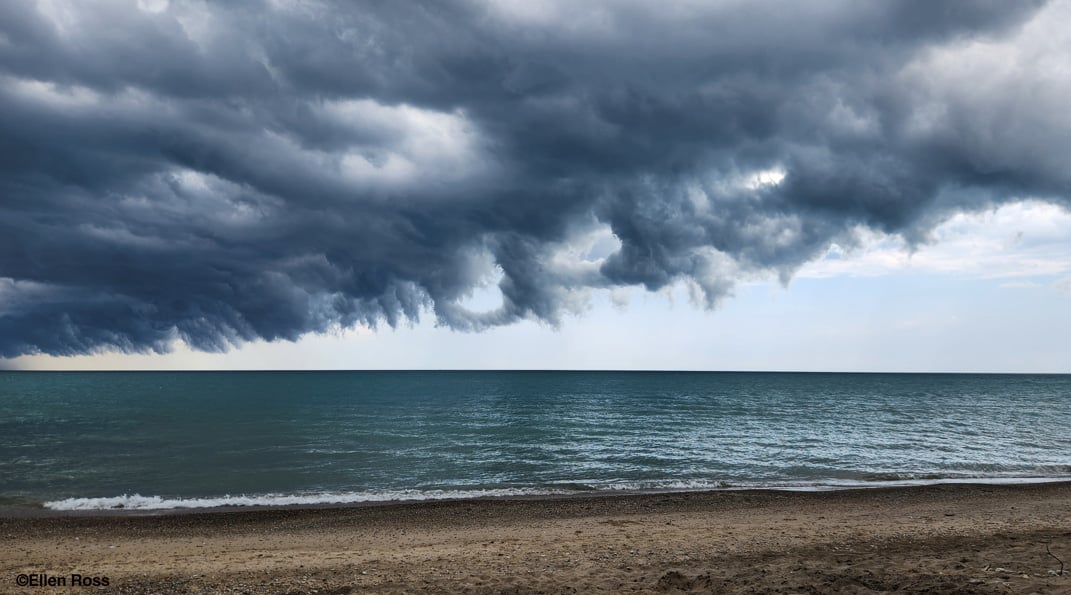
“My Dad and I were paddleboarding on Lake Michigan [USA] when this storm blew in,” says young photographer Ellen Ross. “I quickly grabbed my Dad’s phone and took this photo, because it’s rare to see such an interesting storm. Also because of the small patch of blue sky behind it. I think it shows good days to come.” That small patch of blue caught the eye of the judges too.
“The glimpse of blue sky beyond lets you know that the storm won’t last forever,” said judge Dan Green. “I absolutely love this photo — a weather drama unfolding over the lake. The clarity of the storm front is exceptional, with some interesting detail on the edges.” The photo captures a dramatic moment of transition. A towering storm cloud sweeps in across the water, its dark underside casting a visible shadow over the lake’s surface.
“It’s not often that such a clear change of type can be captured, but this one does it beautifully,” added judge Becky Mantin. “This is simply a great weather shot!” These clouds are likely to be part of a storm front, common over large bodies of water when warm, moist air meets cooler conditions: a classic sign of unstable weather. But, as Ellen spotted, even the most dramatic weather often passes quickly, leaving clear skies ahead.
Climate Award
Winner: Jonah Lange
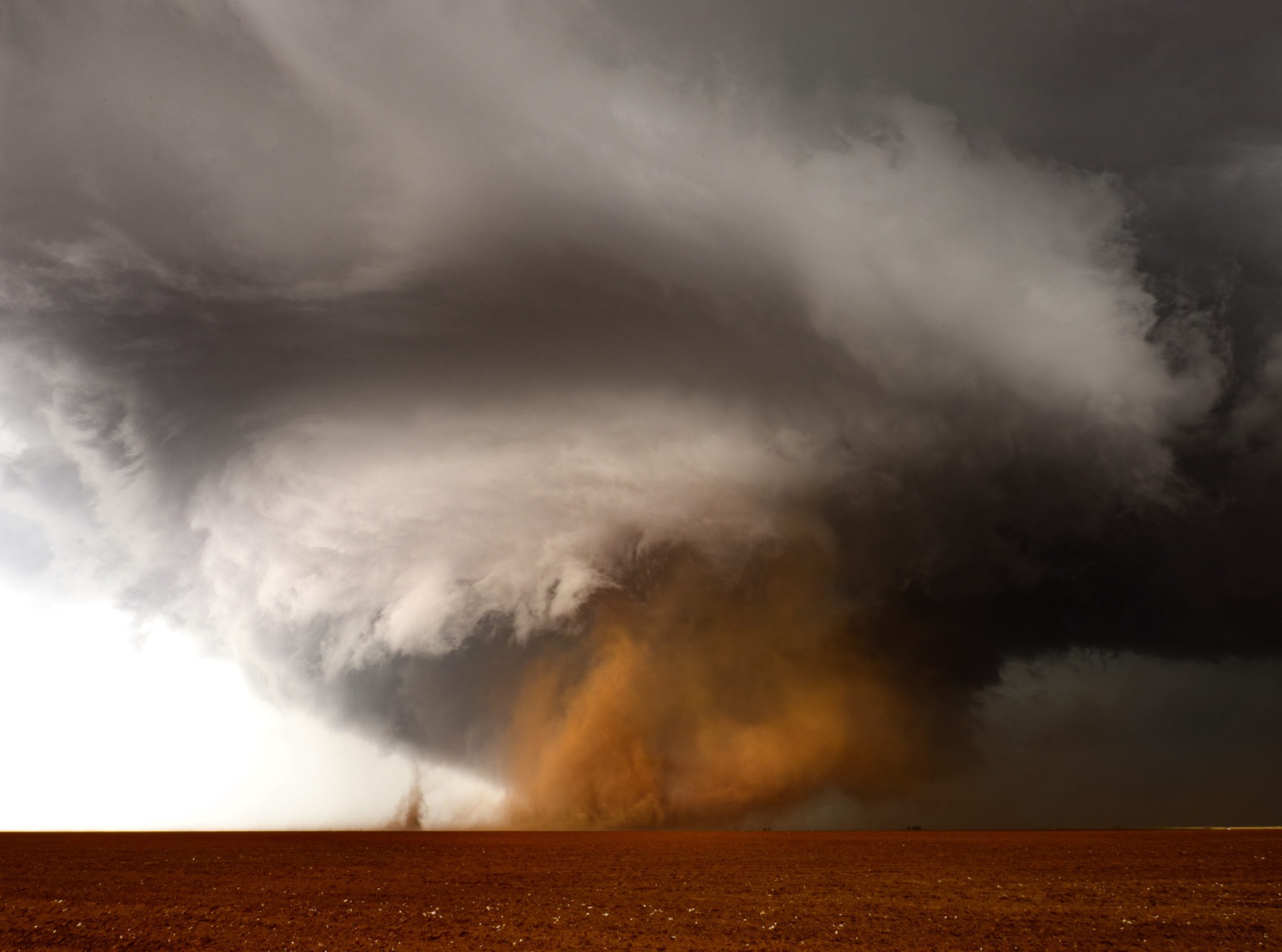
A spiralling column of dust and wind dominates the Texas Plains in this striking image, captured by photographer Jonah Lange on 25 April 2025 near Sudan, Texas, USA. “This tornado picked up tons of dust as it landed. I peered on from the south side as it moved slowly off to the east,” he says. “West Texas is known for dust … as shown here!”
The tornado churns with intense energy, its collar cloud clearly visible as it pulls red soil into the air. A smaller satellite vortex dances nearby, while an impressive dark hail core looms behind the spiral. On the day this image was taken, hailstones up to 3 inches (7.6 cm) in diameter were reported. Judge Mette Lampcov notes: “In Texas, this is a very real image. You feel the power of weather and nature impacting the land.”
This is more than just a dramatic weather moment: “Everything is becoming more extreme,” said judge and meteorologist Phillipa Drew. “This is a good example of an extreme case. It highlights the vastness of weather. We don’t stand much of a chance against that.”Climate change is amplifying extremes, turning open landscapes into arenas for ever more volatile and destructive weather. Drought conditions in West Texas are becoming more frequent and severe, drying out the soil and increasing the availability of loose dust. As temperatures rise, so does the intensity of thunderstorms, creating the perfect conditions for destructive events like this one.
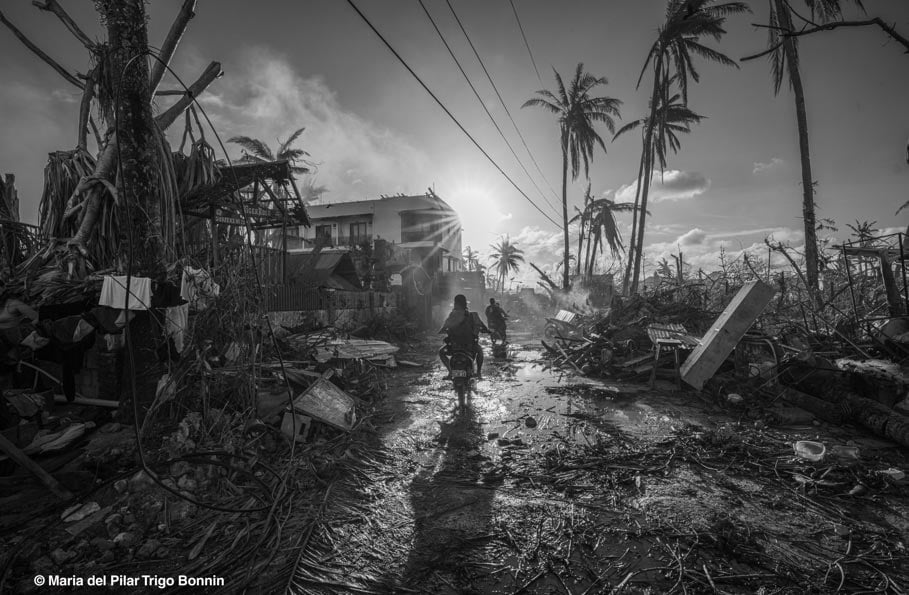
Runner-Up: Maria del Pilar Trigo Bonnin
Two men ride through a road strewn with debris, heading home to what remains after Typhoon Rai (locally named Odette) tore across Siargao Island, Philippines, in December 2021. Photographer Maria del Pilar Trigo Bonnin took the shot from the back of another motorbike as they made their way through the devastation. “I handheld the camera and captured the moment quickly the stillness, the chaos, and the long shadows told the story of what we had just lived through.”
Typhoon Rai struck as a Category 5 storm, with winds exceeding 250 km/h. It rapidly intensified over warm ocean waters before landfall, a pattern that is becoming more common with climate change. For many in Siargao, the storm was unlike anything they had seen in decades. Trees were flattened, homes torn apart, and lives upended in a matter of hours. The low afternoon sun casts long, cinematic shadows through the smoke and wreckage. “So much contrast between the lovely sunshine and the sheer devastation,” noted judge Phillipa Drew, “and the normality of the feeling of ‘heading home’. Bits of clothing and upturned boxes are things we’ve all experienced, but not on that level of destruction.”
Fellow judge Rezaur Rahman reflected that “this feels like a decisive moment for these people”. This quiet, determined moment clearly shows that the impacts of climate change are not distant or abstract, they are already reshaping lives, landscapes, and the homes we hope to return to.
Public Vote
Runner Up: Himadri Bhuyan
Captured in the early winter chill of Arunachal Pradesh, India, this image by Himadri Bhuyan reveals a frozen lake surface etched with delicate, fractal-like ice patterns. “The subzero temperature was hurting my hands and feet,” he recalls, “but the frozen patterns caught my attention, and I had to stop and capture them.” Taken near Pangateng Tso Lake in mid-November, the scene may look serene, but beneath its stillness lies a subtle sign of a changing climate.
As water freezes, it expands and crystallises from the edges inward. Variations in temperature, impurities and wind can create striking surface patterns: ridges, lines and bubbles etched in the ice as it forms. Each line captures a moment in the lake’s freezing process: a visible record of changing conditions. “Traditionally, such freeze patterns were predictable in timing and form, tied closely to the seasonal rhythm,” Bhuyan explains. “However, with changing climate conditions, the freeze-thaw cycles are becoming irregular, affecting not just the aesthetic beauty but the hydrological and ecological balance of the region.
Altered timing can disrupt plant cycles, aquatic life and water availability downstream. These delicate ice formations are not just natural art, they are climate signals, reminding us of the fragility and shifting patterns of high-altitude ecosystems in a warming world.” Judge Peter Gibbs praised the image as “A beautiful abstract image with exquisite detail in the ice forms. Technically excellent.”

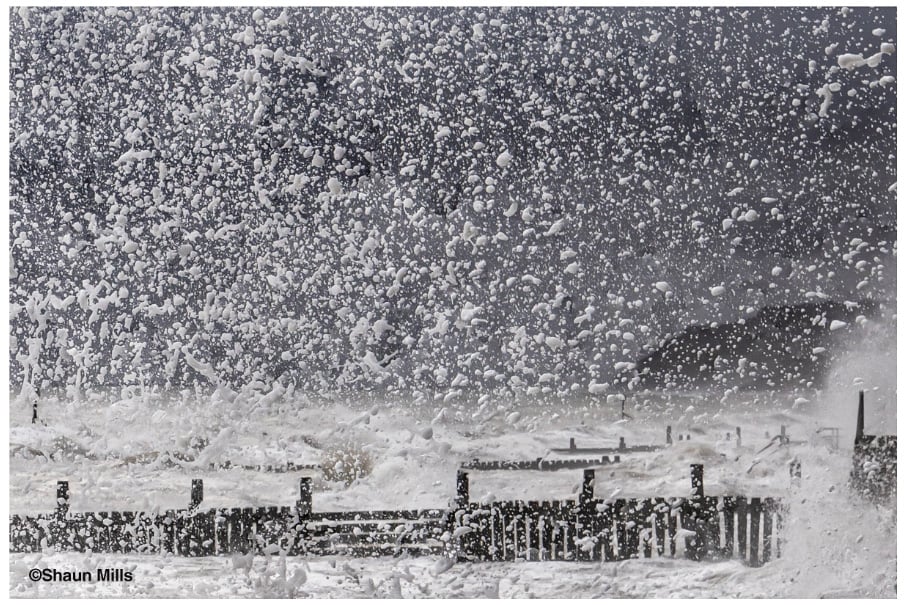
Third Place: Shaun Mills
During a storm on Britain’s east coast, waves crash against the sea defences at Overstrand, Norfolk, sending sea spray high into the air. Photographer Shaun Mills writes: “A photo trip to the Norfolk coast coincided with a storm, and I took the opportunity to capture some incredibly rough seas. The image was taken to isolate the individual spray, giving the impression of a snowstorm.”
Sea spray forms when strong winds tear across wave crests, ejecting tiny droplets of saltwater into the air. These airborne droplets can range in size from visible bursts to microscopic particles that influence cloud formation and weather patterns. Capturing them in motion requires fast shutter speeds and careful timing. Here, the image was cropped to fill the frame with the dynamic texture of spray.
The stormy conditions that produce such scenes are becoming more frequent and intense in a warming climate. As global temperatures rise, so too does the energy available to fuel extreme weather systems. At the same time, sea level rise poses an increasing threat to low-lying coastal regions like Norfolk. East Anglia’s coast is particularly vulnerable due to its soft, eroding cliffs and already subsiding land. Storm-driven wave action, combined with higher sea levels, can accelerate coastal erosion and overwhelm ageing defences.
The full winners’ gallery, complete with expert commentary on the meteorology and climate stories behind each shot, is now live on the Royal Meteorological Society website.
See more from DIYPhotography.net on Google
Add DIYPhotography.net as a trusted source. This makes
our stories more likely to appear in your Google Search results.
 Add as a preferred source on Google

Alex Baker
Alex Baker is a portrait and lifestyle driven photographer based in Valencia, Spain. She works on a range of projects from commercial to fine art and has had work featured in publications such as The Daily Mail, Conde Nast Traveller and El Mundo, and has exhibited work across Europe
Related Posts
 2020 Weather Photographer of the Year winners prove that you can take stunning photos in any weather
 Surreal image of lava-illuminated cloud wins 2023 Weather Photographer of the Year
 Incredible dance of red sprites wins Weather Photographer of the Year 2024
 Powerful image of Storm Eunice wins 2022 Weather Photographer of the Year
Join the Discussion
DIYP Comment Policy
Be nice, be on-topic, no personal information or flames.