
























Hubble’s New Portrait of Galaxy NGC 4571 Reveals Active Star Formation
Oct 28, 2025
Soumyadeep Mukherjee
Soumyadeep Mukherjee is an award-winning astrophotographer from India. He has a doctorate degree in Linguistics. His work extends to the sub-genres of nightscape, deep sky, solar, lunar and optical phenomenon photography. He is also a photography educator and has conducted numerous workshops. His works have appeared in over 40 books & magazines including Astronomy, BBC Sky at Night, Sky & Telescope among others, and in various websites including National Geographic, NASA, Forbes. He was the first Indian to win “Astronomy Photographer of the Year” award in a major category.
Share:

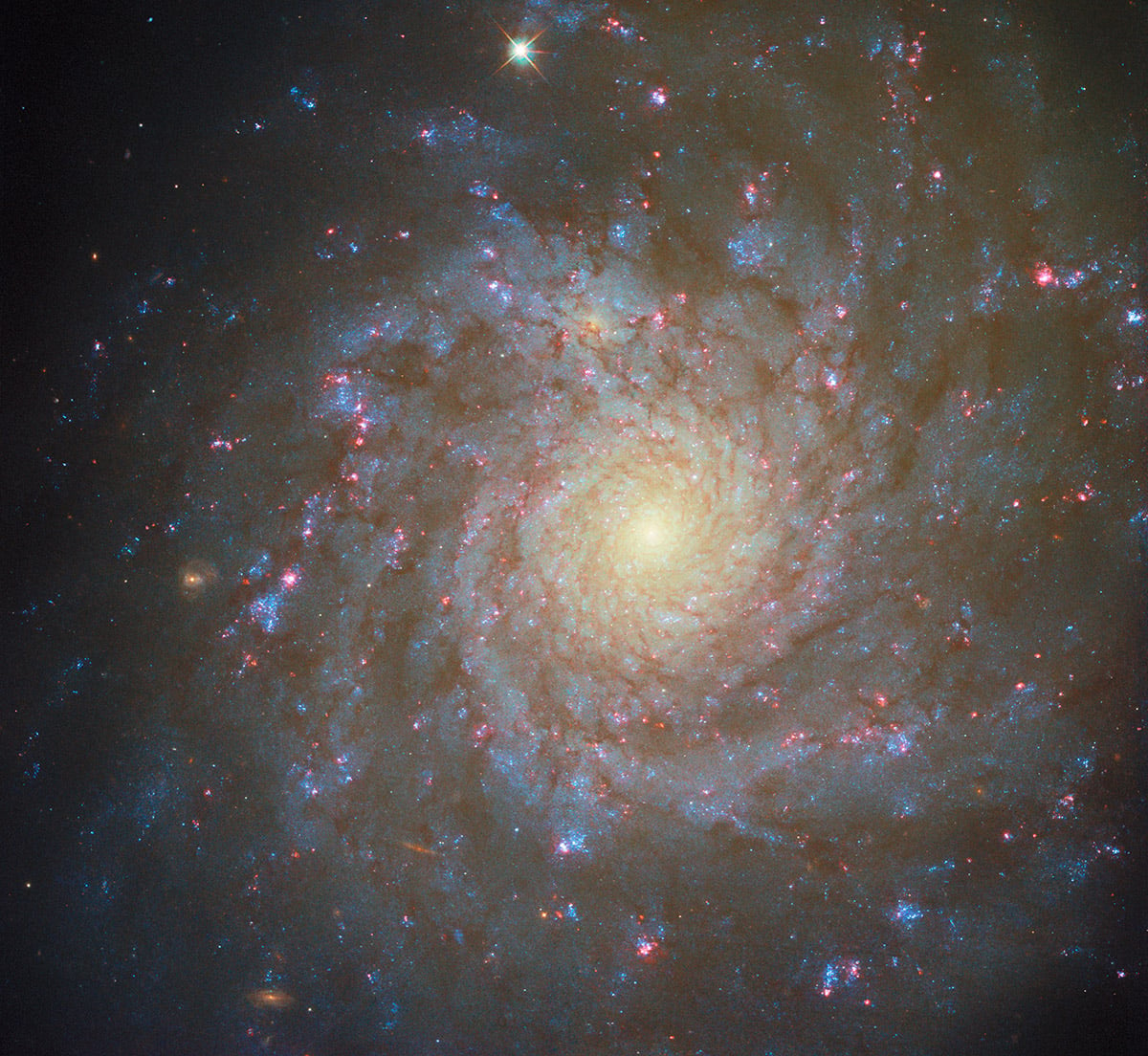
In the vast stillness of space, galaxies keep their own rhythm, swirling, glowing, and quietly giving birth to new stars. One of them, NGC 4571, has recently taken the spotlight thanks to a breathtaking new image from the Hubble Space Telescope. Released by ESA, this view of the galaxy has been titled “Spiralling Star Factory”, and it’s easy to see why. The image captures a rich, face-on spiral design filled with young stars, glowing gas, and dust lanes, a miniature cosmos of creation in motion.
A galaxy seen face-on
NGC 4571 lies about 60 million light-years away in the constellation Coma Berenices. Astronomers describe it as a classic spiral galaxy. The galaxy has a bright central region surrounded by graceful arms that unwind like a pinwheel. Seen almost directly face-on from our vantage point on Earth, it gives scientists and the public alike a clear look at its structure, a rare chance to examine how spiral arms organize gas and stars.
The view is astonishingly detailed. The bright yellow core marks a dense cluster of older stars. And the blue patches scattered through the spiral arms point to regions of active star formation. The subtle pinkish glow seen in several places traces hydrogen gas ionized by hot, newly formed stars. Dust filaments snake across the scene, shaping the galaxy’s visual texture and hinting at colder reservoirs of raw material waiting to form the next generation of stars.
This orientation makes NGC 4571 a particularly valuable subject for study. Face-on spirals reveal how star-forming regions connect. It also shows how gas moves along the arms, and how older stellar populations coexist with fresh clusters. It’s a natural laboratory for understanding how galaxies grow and sustain themselves over billions of years.
The instrument behind the view
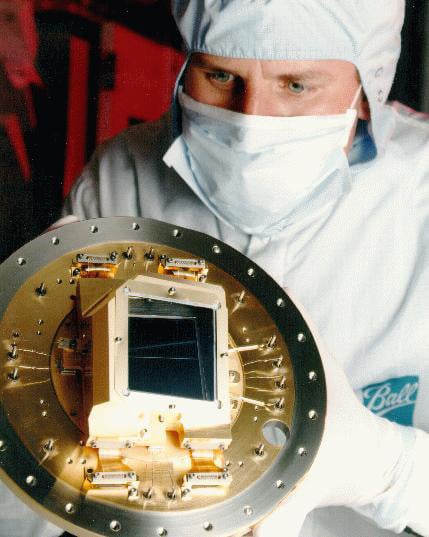
The image was captured using Hubble’s Wide Field Camera 3 (WFC3), a workhorse instrument that records light from the ultraviolet to the near-infrared. This wide range allows astronomers to see both the youngest, hottest stars that blaze in ultraviolet light and the cooler, older stars that shine more strongly in visible and infrared wavelengths.
For this observation, Hubble used several filters, including ones that isolate H-alpha emission, a specific wavelength of light produced by hydrogen gas excited by young stars. Combining these exposures produces a composite that shows multiple stages of stellar evolution in a single frame. Each color tells a part of the story: blue for young, massive stars; yellow for mature stars in the galactic core; and pink for the gas clouds where new stars are being born.
The field of view in this image spans about 2.7 by 2.5 arcminutes, corresponding to tens of thousands of light-years across at the galaxy’s distance. At that scale, individual star-forming regions appear as glowing knots, and faint lanes of interstellar dust can be traced through the arms.
What the colors mean
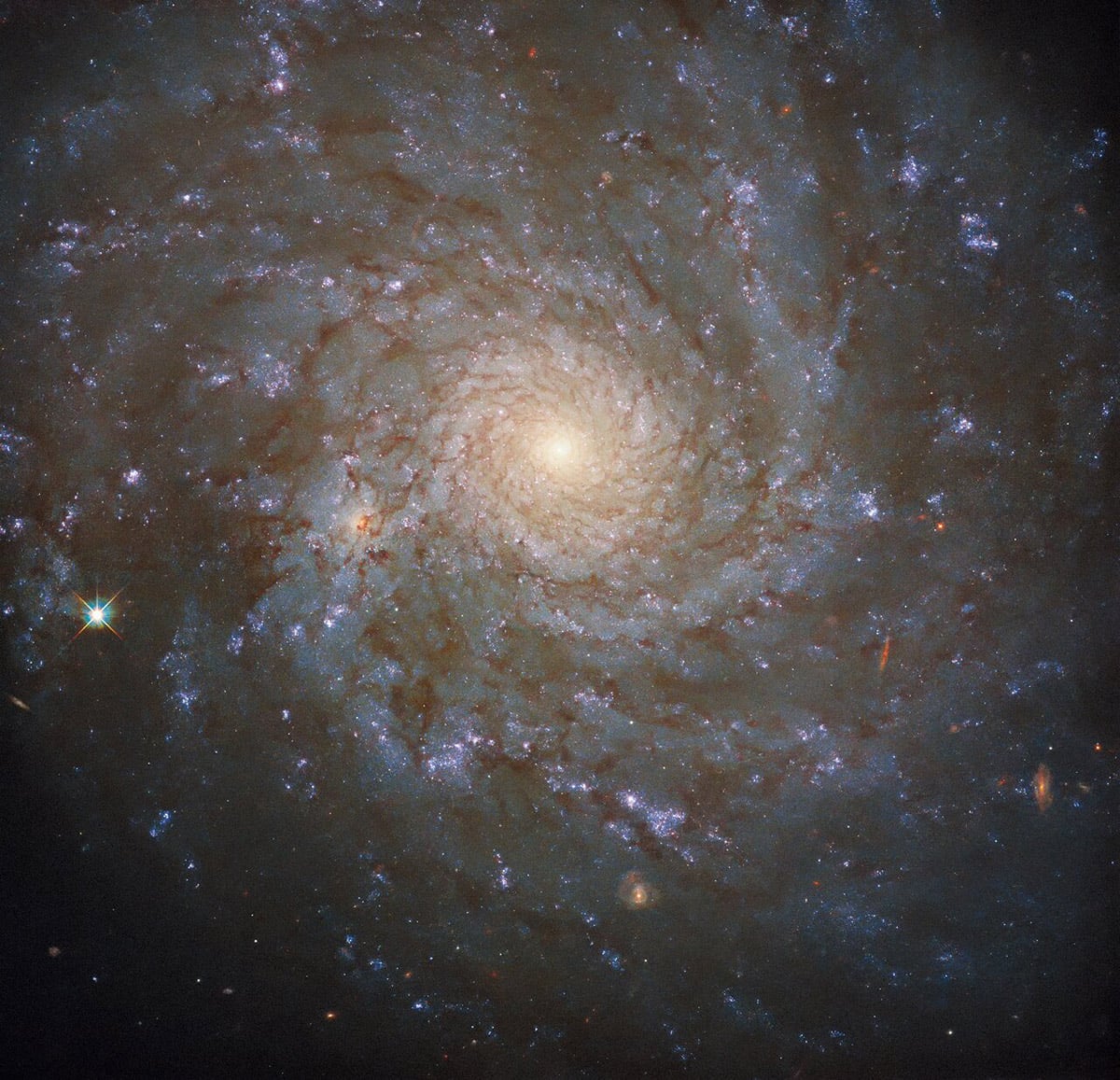
In astronomical images like this, color is data. The blue tones highlight the presence of young star clusters. These stars emit intense ultraviolet light, which appears blue when rendered for human eyes. That energy ionizes nearby hydrogen, causing clouds of gas to glow. Those regions, tinted pink or red in the final composite, are the nurseries of stellar birth.
The dark streaks that cut across the arms mark lanes of cold dust. This dust is not uniform; it consists of microscopic grains of carbon, silicates, and other heavy elements. Earlier generations of stars produce these elements. Dust both hides and enables star formation. It blocks visible light, creating the shadowy structures we see. But it also helps gas cool enough to collapse under gravity and form new stars.
That interplay between dust, gas, and radiation gives the galaxy its depth and texture. What we see as beauty is, in reality, a continuous cycle of creation and transformation. Every blue cluster and pink nebula marks a brief chapter in a process that will continue long after our own Sun fades away.

Star factories in motion
The nickname “Spiralling Star Factory” fits NGC 4571 perfectly. Spiral arms in galaxies are not fixed objects; they are density waves, regions where material crowds together as it orbits the galactic center. Gas entering these denser regions compresses and triggers star formation. As new stars ignite, they illuminate the surrounding gas, outlining the arm’s pattern. Over time, the stars drift away, and new waves of formation take their place.
This dynamic process is what gives spiral galaxies their characteristic appearance. In NGC 4571, Hubble’s resolution allows astronomers to trace how tightly the arms are wound and where the youngest clusters lie. Comparing such images across many galaxies helps researchers test theories about how star formation propagates.
NGC 4571’s relatively calm and undisturbed shape suggests that it has evolved without major collisions in recent times. That makes it an ideal example of a “normal” spiral, unaffected by the gravitational chaos that often distorts galaxies.
Hubble’s image of NGC 4571 is part of a larger scientific effort. Astronomers are using observations like this to explore how dust affects the measurement of young stars in nearby spirals. Dust can absorb and scatter light, making it hard to estimate the true brightness of stellar populations. By observing galaxies in multiple wavelengths, researchers can correct for those effects and obtain more accurate star-formation rates.
Clear skies!
See more from DIYPhotography.net on Google
Add DIYPhotography.net as a trusted source. This makes
our stories more likely to appear in your Google Search results.
 Add as a preferred source on Google

Soumyadeep Mukherjee
Soumyadeep Mukherjee is an award-winning astrophotographer from India. He has a doctorate degree in Linguistics. His work extends to the sub-genres of nightscape, deep sky, solar, lunar and optical phenomenon photography. He is also a photography educator and has conducted numerous workshops. His works have appeared in over 40 books & magazines including Astronomy, BBC Sky at Night, Sky & Telescope among others, and in various websites including National Geographic, NASA, Forbes. He was the first Indian to win “Astronomy Photographer of the Year” award in a major category.

Join the Discussion
DIYP Comment Policy
Be nice, be on-topic, no personal information or flames.