


















James Webb Space Telescope Photographs a “Celebrity” Galaxy Cluster
Jan 24, 2026
Soumyadeep Mukherjee
Soumyadeep Mukherjee is an award-winning astrophotographer from India. He has a doctorate degree in Linguistics. His work extends to the sub-genres of nightscape, deep sky, solar, lunar and optical phenomenon photography. He is also a photography educator and has conducted numerous workshops. His works have appeared in over 40 books & magazines including Astronomy, BBC Sky at Night, Sky & Telescope among others, and in various websites including National Geographic, NASA, Forbes. He was the first Indian to win “Astronomy Photographer of the Year” award in a major category.
Share:

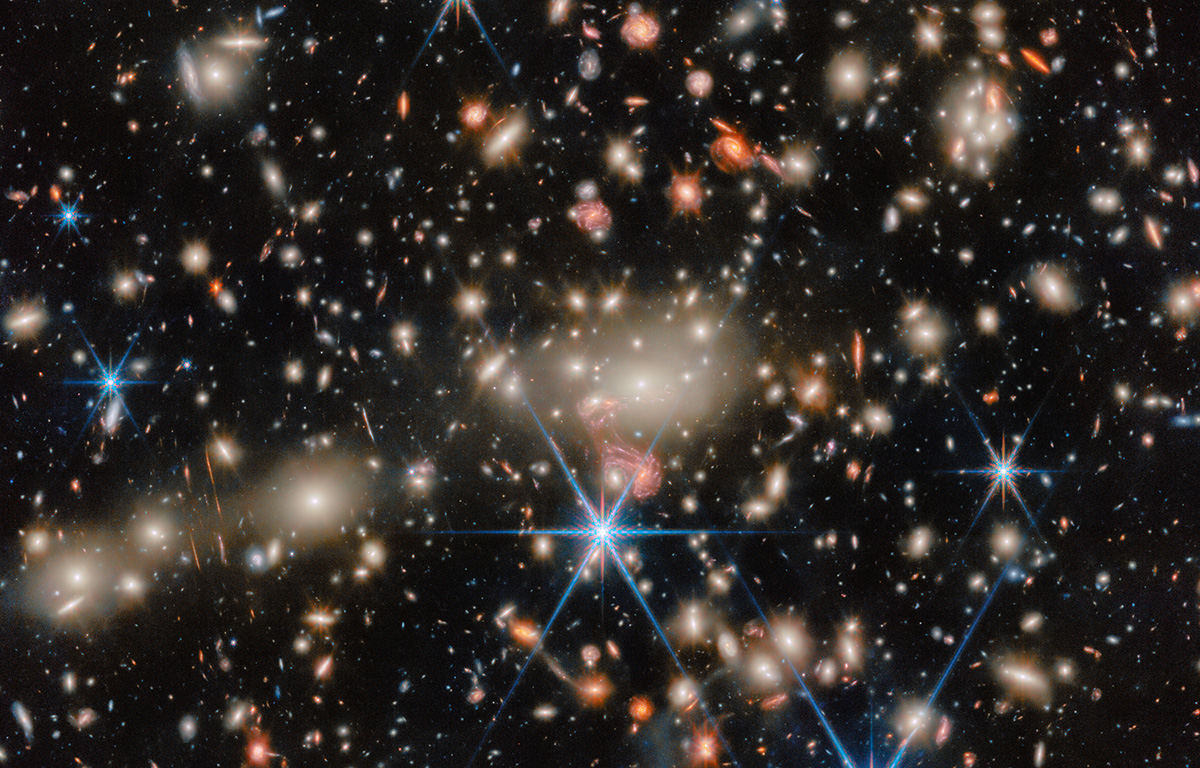
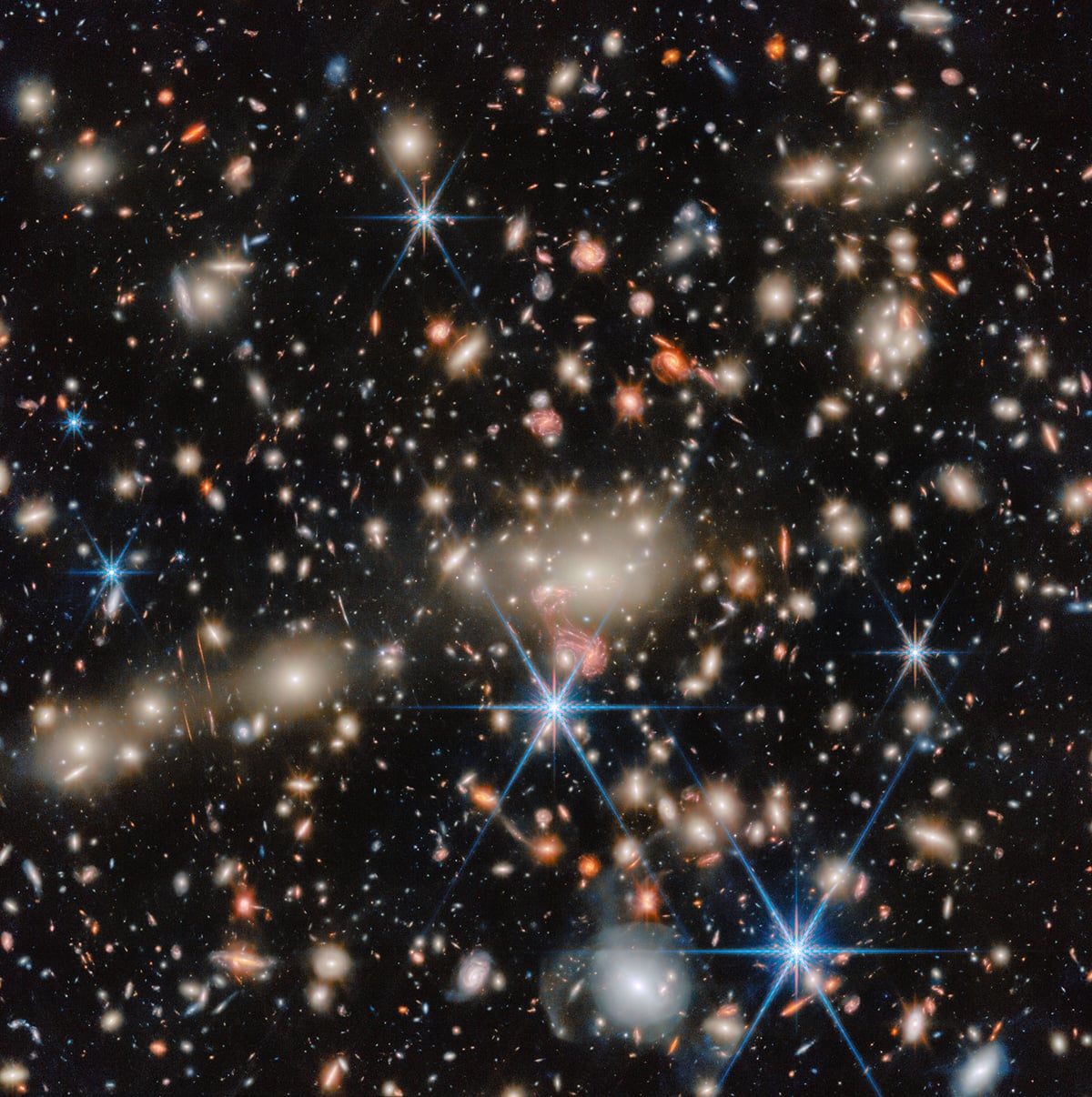
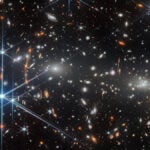
Galaxy clusters sit at the top of the cosmic hierarchy. They trace the largest concentrations of matter in the Universe and mark the nodes of the cosmic web. Among them, a small number stand out because of their extreme mass and lensing power. MACS J1149.5+2223 is one of those rare systems. The latest James Webb Space Telescope Picture of the Month, released in January 2026, places this cluster under renewed scrutiny. The image does not merely extend previous observations. Instead, it reframes the cluster as a precision tool for studying cosmic structure, dark matter, and the earliest galaxies.
Located roughly five billion light-years away in the constellation Leo, MACS J1149 is massive enough to bend spacetime on a dramatic scale. Its gravitational field distorts and magnifies light from galaxies far beyond it. JWST’s infrared sensitivity now resolves those distortions with unprecedented clarity. As a result, the image functions both as a portrait of a galaxy cluster and as a deep probe into the early Universe.
A dense environment dominated by gravity
MACS J1149.5+2223 belongs to a class of galaxy clusters formed through billions of years of hierarchical growth. Smaller galaxy groups merged under gravity. Gas accumulated and heated. Dark matter shaped the structure long before stars became visible. Today, the cluster contains hundreds of galaxies moving within a deep gravitational potential.
The brightest galaxies lie near the cluster core. These systems are large, elliptical, and old. Their stars formed early and now evolve slowly. Surrounding them are fainter galaxies that show signs of interaction and distortion. The environment is harsh. Gravity dominates galaxy evolution here.
However, the visible galaxies represent only a small fraction of the cluster’s total mass. Observations show that dark matter accounts for most of the mass. JWST does not see dark matter directly. Instead, it traces its presence through gravitational lensing. Every arc and warped shape marks where invisible mass bends light.

Gravitational lensing in the image
Gravitational lensing defines this image. The effect arises when massive objects curve spacetime, forcing light to follow bent paths. In MACS J1149, the lensing strength is extreme. Background galaxies stretch into arcs. Some appear mirrored. Others form elongated streaks across the image.
These distortions encode precise information about mass distribution. Astronomers use them to reconstruct the cluster’s gravitational field. JWST’s resolution significantly improves that reconstruction.
Near the cluster center, the lensing becomes particularly complex. Multiple images of the same background galaxy appear at different positions. In earlier Hubble data, this region already attracted attention. JWST now resolves the internal structure within those lensed galaxies. Spiral arms, star-forming knots, and dust lanes become visible in infrared light.
Because lensing magnifies distant galaxies, JWST effectively gains a natural telescope boost. Galaxies that would remain undetectable appear clearly. This advantage makes MACS J1149 one of the most valuable cosmic laboratories available.
The infrared advantage of JWST
Hubble established MACS J1149 as a benchmark cluster. Yet Hubble operated mainly in visible and near-visible wavelengths. JWST shifts the observational regime into the infrared. The expansion of the Universe stretches light from early galaxies into infrared wavelengths. JWST captures that stretched light efficiently. As a result, the telescope detects galaxies formed within the first billion years after the Big Bang.
JWST also penetrates dust more effectively. Many distant galaxies contain dust that obscures visible light. Infrared wavelengths pass through with less attenuation. This capability reveals star formation that remained hidden before.
In this image, JWST resolves faint red galaxies scattered across the field. Many belong to the background Universe, not the cluster itself. Their colors reflect age, dust content, and redshift. Combined with spectroscopy, these colors help astronomers measure distances and physical conditions.
A “celebrity” cluster with a scientific legacy
MACS J1149 earned its prominence during the Hubble Frontier Fields program. Astronomers selected it because of its strong lensing power. Hubble spent hundreds of hours observing the cluster. Those observations revealed galaxies at extreme distances and mapped dark matter with high precision.
One discovery brought global attention. A supernova exploded in a background galaxy. Because of lensing, astronomers observed the same explosion multiple times at different positions. This event confirmed predictions of general relativity and time delays in lensing systems.
JWST now builds directly on this legacy. It revisits the same field with superior sensitivity. The comparison between Hubble and JWST data reveals how dramatically infrared observations extend our reach.
Recent JWST studies within this cluster identified galaxies from the epoch of reionisation, when the first stars altered the ionization state of the Universe. One such galaxy hosts a supermassive black hole that appears too massive for its age. That result challenges current theories of black hole formation.

CANUCS and coordinated observations
The image originates from the Canadian NIRISS Unbiased Cluster Survey (CANUCS). This JWST program combines imaging and spectroscopy to study galaxy clusters and their lensed backgrounds. CANUCS uses multiple JWST instruments. NIRCam provides deep imaging. NIRISS and NIRSpec deliver spectroscopy. Together, they measure galaxy redshifts, star formation rates, and chemical composition.
Spectroscopic data remain critical. Imaging alone cannot determine precise distances. Spectra reveal how much the Universe has expanded since the light left the galaxy. They also identify emission lines tied to star formation and ionized gas. CANUCS focuses on low-mass galaxies at high redshift. These galaxies likely drove cosmic reionisation. Yet they remained poorly understood because they are faint. JWST’s sensitivity changes that.
The program also refines gravitational lens models. Accurate mass maps ensure that astronomers correctly interpret magnified background galaxies. Without these models, physical measurements would remain uncertain. As JWST continues to observe, clusters like MACS J1149 will anchor our understanding of the Universe. They connect dark matter, galaxy evolution, and cosmic expansion into a single framework.
Clear skies!
See more from DIYPhotography.net on Google
Add DIYPhotography.net as a trusted source. This makes
our stories more likely to appear in your Google Search results.
 Add as a preferred source on Google

Soumyadeep Mukherjee
Soumyadeep Mukherjee is an award-winning astrophotographer from India. He has a doctorate degree in Linguistics. His work extends to the sub-genres of nightscape, deep sky, solar, lunar and optical phenomenon photography. He is also a photography educator and has conducted numerous workshops. His works have appeared in over 40 books & magazines including Astronomy, BBC Sky at Night, Sky & Telescope among others, and in various websites including National Geographic, NASA, Forbes. He was the first Indian to win “Astronomy Photographer of the Year” award in a major category.

Join the Discussion
DIYP Comment Policy
Be nice, be on-topic, no personal information or flames.