





















James Webb Space Telescope Photographs a New Moon Orbiting Uranus
Aug 19, 2025
Soumyadeep Mukherjee
Soumyadeep Mukherjee is an award-winning astrophotographer from India. He has a doctorate degree in Linguistics. His work extends to the sub-genres of nightscape, deep sky, solar, lunar and optical phenomenon photography. He is also a photography educator and has conducted numerous workshops. His works have appeared in over 40 books & magazines including Astronomy, BBC Sky at Night, Sky & Telescope among others, and in various websites including National Geographic, NASA, Forbes. He was the first Indian to win “Astronomy Photographer of the Year” award in a major category.
Share:
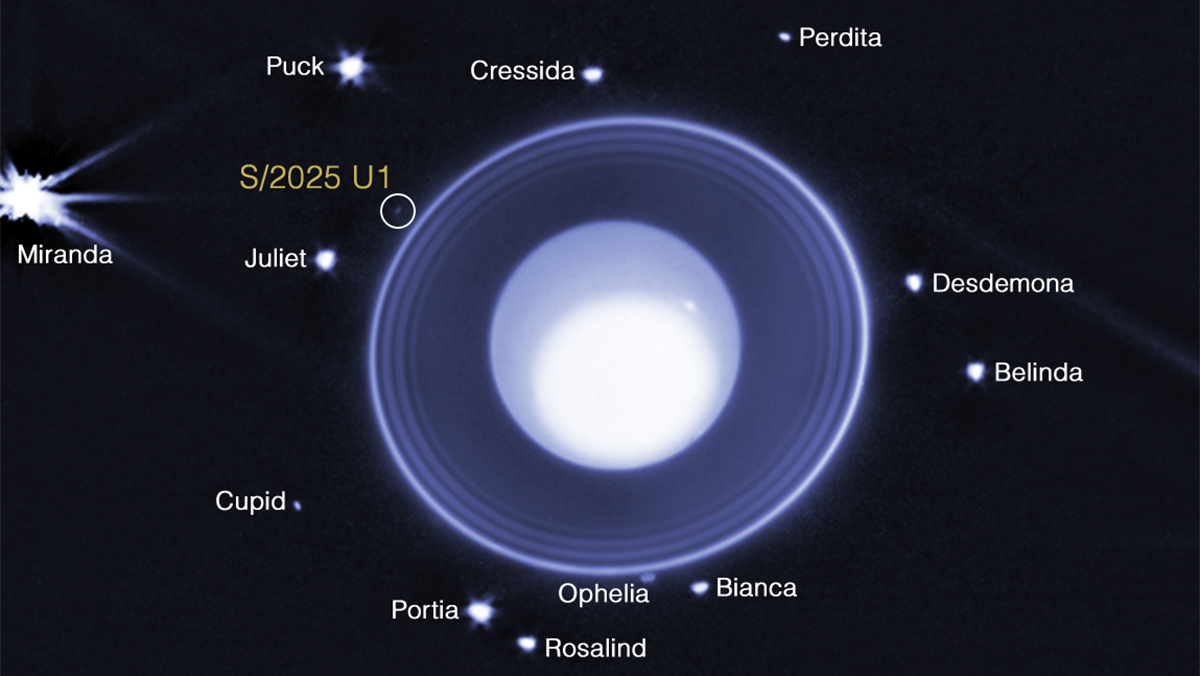
For decades, Uranus has seemed like a fairly well-mapped world. Voyager 2 flew past in 1986, Hubble tracked its changing atmosphere, and astronomers counted 28 moons circling the tilted planet. Yet even with all that history, Uranus has revealed a surprise. The James Webb Space Telescope has detected a new, tiny moon orbiting deep within the planet’s inner system. The object, provisionally named S/2025 U 1, is only about ten kilometers across but adds an entirely new entry to the catalog of Uranian satellites. With this discovery, Uranus’ moon count rises to 29, showing once again that even nearby worlds can still hold hidden secrets.
A telescope built for subtle discoveries
The James Webb Space Telescope (JWST) is often associated with stunning views of distant galaxies, glowing nebulae, and the earliest stars. But JWST is also transforming how we see planets closer to home. Its infrared sensitivity allows astronomers to pick out objects that would otherwise be invisible. That capability proved crucial for finding a moon that even Voyager 2, during its close flyby in 1986, failed to detect. The discovery came from a series of observations taken on February 2, 2025, with JWST’s Near-Infrared Camera (NIRCam). Astronomers captured ten exposures, each lasting forty minutes, for a total of six hours of data. The long exposures gave the team the ability to trace moving objects in Uranus’ vicinity against the relatively fixed background of stars.
JWST’s NIRCam offers two critical advantages. It can detect faint infrared light, and it can do so while suppressing the glare from bright nearby sources. Uranus itself is extremely bright compared to a ten-kilometer moon. So are its rings. By using NIRCam’s wide F150W2 filter, which captures light between one and 2.4 microns, the team balanced sensitivity and contrast. The technique revealed the small, shifting speck of light that proved to be S/2025 U 1.
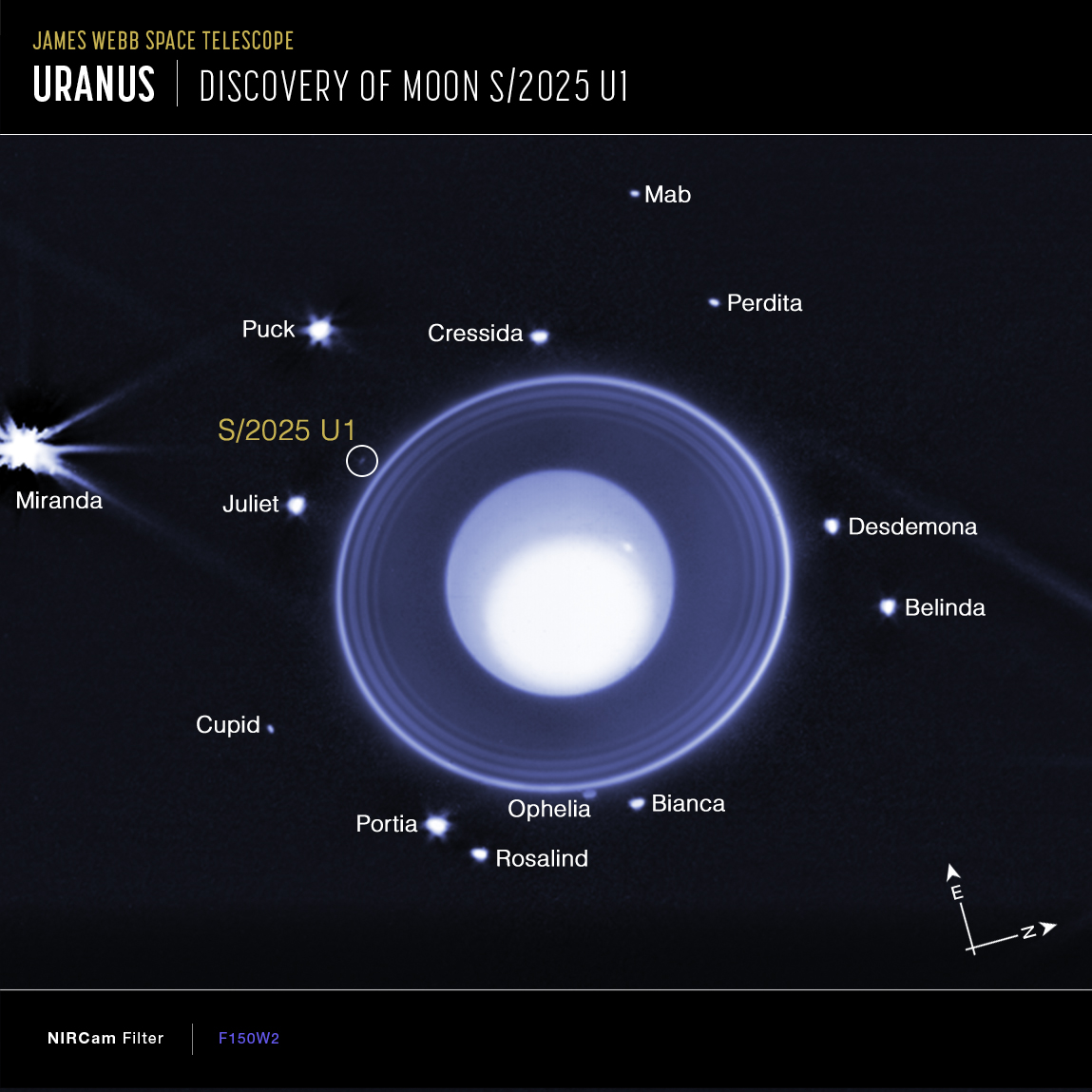
Voyager missed it, JWST didn’t
The contrast between Voyager 2’s historic mission and Webb’s modern capabilities is striking. Voyager’s instruments were designed for rapid flybys of multiple worlds. In 1986, it mapped Uranus’ major moons, charted its faint rings, and provided our first close-up view of the ice giant. But Voyager had only hours to observe, and its detectors were limited by the technology of the time. Webb operates in an entirely different way. Stationed a million miles from Earth at the Sun-Earth L2 point, it can stare at a single target for as long as needed. Its detectors are vastly more sensitive, designed to capture faint signals from the distant universe. In planetary science, that same sensitivity makes it possible to reveal worlds that have escaped detection for decades. S/2025 U 1 is one of those worlds.
The new moon occupies a place deep within Uranus’ inner system. It orbits about 56,000 kilometers from the planet’s center, positioned between two known moons, Ophelia and Bianca. These inner satellites play key roles in shaping Uranus’ rings. Their gravity helps confine narrow rings, preventing particles from spreading out. Based on brightness, the team estimates the diameter of the new moon to be approximately ten kilometers. The actual size depends on how reflective its surface is. A darker body would need to be larger to reflect the same amount of light, while a brighter body could be smaller. For now, ten kilometers is a reasonable middle value. That makes S/2025 U 1 one of the smallest known moons of Uranus, and one of the smallest detected around any giant planet.

Uranus and its system
Uranus is the seventh planet from the Sun, classified as an ice giant. It has a diameter of about 51,000 kilometers, making it the third-largest planet in our solar system. Its composition is dominated by water, methane, and ammonia ices. What makes it especially distinctive is its axial tilt of nearly 98 degrees, causing it to roll around the Sun on its side. This tilt produces seasons unlike anything on Earth. For decades at a time, one pole faces the Sun continuously, then darkness, while the other experiences the opposite. These extreme lighting conditions affect both the planet’s atmosphere and the appearance of its rings and moons.
Before Webb, the main sources of data on Uranus were Voyager 2’s flyby and later observations from the Hubble Space Telescope and ground-based observatories. Voyager gave us a snapshot in 1986. Hubble has tracked atmospheric changes over time. Ground-based telescopes have added details about rings and larger moons. Now Webb is extending this story by providing infrared data that penetrates the planet’s haze and reveals its faintest satellites. With S/2025 U 1, the number of known Uranian moons increases to 29. Four large outer moons: Titania, Oberon, Umbriel, and Ariel, dominate by size. Dozens of smaller moons, some irregular and far-flung, fill in the picture. The discovery of another inner moon shows that even in the most studied regions, surprises remain.
For Uranus, a planet with an odd tilt, a complex ring system, and a family of moons already full of variety, this discovery enriches an already fascinating story. As our instruments improve, the outer solar system will continue to reveal surprises.
Clear skies!
See more from DIYPhotography.net on Google
Add DIYPhotography.net as a trusted source. This makes
our stories more likely to appear in your Google Search results.
 Add as a preferred source on Google

Soumyadeep Mukherjee
Soumyadeep Mukherjee is an award-winning astrophotographer from India. He has a doctorate degree in Linguistics. His work extends to the sub-genres of nightscape, deep sky, solar, lunar and optical phenomenon photography. He is also a photography educator and has conducted numerous workshops. His works have appeared in over 40 books & magazines including Astronomy, BBC Sky at Night, Sky & Telescope among others, and in various websites including National Geographic, NASA, Forbes. He was the first Indian to win “Astronomy Photographer of the Year” award in a major category.


Join the Discussion
DIYP Comment Policy
Be nice, be on-topic, no personal information or flames.
One response to “James Webb Space Telescope Photographs a New Moon Orbiting Uranus”
Where are the instructions so I can build my own space telescope and get photos like these? This is a do-it-yourself site, right?