

























Hubble Reveals the Largest Known Planet-Forming Disc
Dec 25, 2025
Soumyadeep Mukherjee
Soumyadeep Mukherjee is an award-winning astrophotographer from India. He has a doctorate degree in Linguistics. His work extends to the sub-genres of nightscape, deep sky, solar, lunar and optical phenomenon photography. He is also a photography educator and has conducted numerous workshops. His works have appeared in over 40 books & magazines including Astronomy, BBC Sky at Night, Sky & Telescope among others, and in various websites including National Geographic, NASA, Forbes. He was the first Indian to win “Astronomy Photographer of the Year” award in a major category.
Share:

Protoplanetary discs form as a natural outcome of star formation. Angular momentum conservation causes collapsing molecular cloud material to flatten into a rotating disc around a young star. These discs supply the dust and gas required for planet formation. Observations over the past three decades have shown that most such discs extend a few hundred astronomical units from their host stars. Larger discs exist, but they remain rare and poorly understood.
New observations from the NASA/ESA Hubble Space Telescope now identify the largest planet-forming disc ever detected in visible light. The disc surrounds the young stellar object IRAS 23077+6707. Its size, vertical structure, and apparent instability place it well outside the parameter space of most known protoplanetary systems. The object provides an important opportunity to study disc evolution under extreme physical conditions.
The stellar system: IRAS 23077+6707
IRAS 23077+6707 lies at a distance of approximately 1,000 light-years in the constellation Cepheus. Astronomers classify it as a deeply embedded young stellar object. The system remains partially enshrouded in the remnants of its parent molecular cloud. This environment strongly influences the disc’s appearance and evolution.
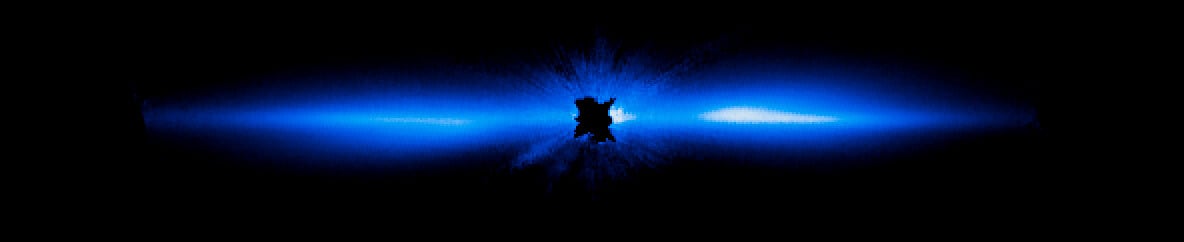
Hubble does not resolve the central star directly. Dense dust along the disc midplane absorbs and blocks visible radiation. Instead, the image reveals scattered starlight reflected by dust grains above and below the disc plane. This geometry indicates that the system is viewed close to edge-on.
Such an orientation allows astronomers to study the disc’s vertical structure in detail. In most systems, this information remains difficult to extract. Here, it becomes one of the defining observational features.

An unprecedented scale for a protoplanetary disc
Measurements show that the disc surrounding IRAS 23077+6707 spans roughly 400 billion miles, or about 640 billion kilometres, from edge to edge. This corresponds to nearly 40 times the diameter of the Solar System. No other known protoplanetary disc observed in visible light approaches this scale. The disc’s extent implies an enormous reservoir of material. Estimates based on luminosity and dust scattering suggest a mass between 10 and 30 times that of Jupiter. This amount of matter far exceeds the minimum required to form multiple giant planets.
Such a size challenges existing theoretical models. Disc stability typically decreases as the radius increases. Large discs tend to fragment or dissipate over time. The continued presence of this structure suggests either ongoing mass replenishment or stabilising physical mechanisms that remain poorly constrained.
The most striking feature of the disc is its vertical extent. Dust clouds rise far above and below the central midplane. This vertical thickness exceeds that of most previously observed discs by a significant margin. The scattered light reveals irregular filaments and asymmetric features. One side of the disc appears more extended and diffuse than the other. This imbalance indicates that the disc does not exist in a steady, equilibrium state. The observed asymmetry suggests external influence rather than internal evolution alone. The disc likely interacts strongly with its environment, making it a dynamic rather than isolated system.
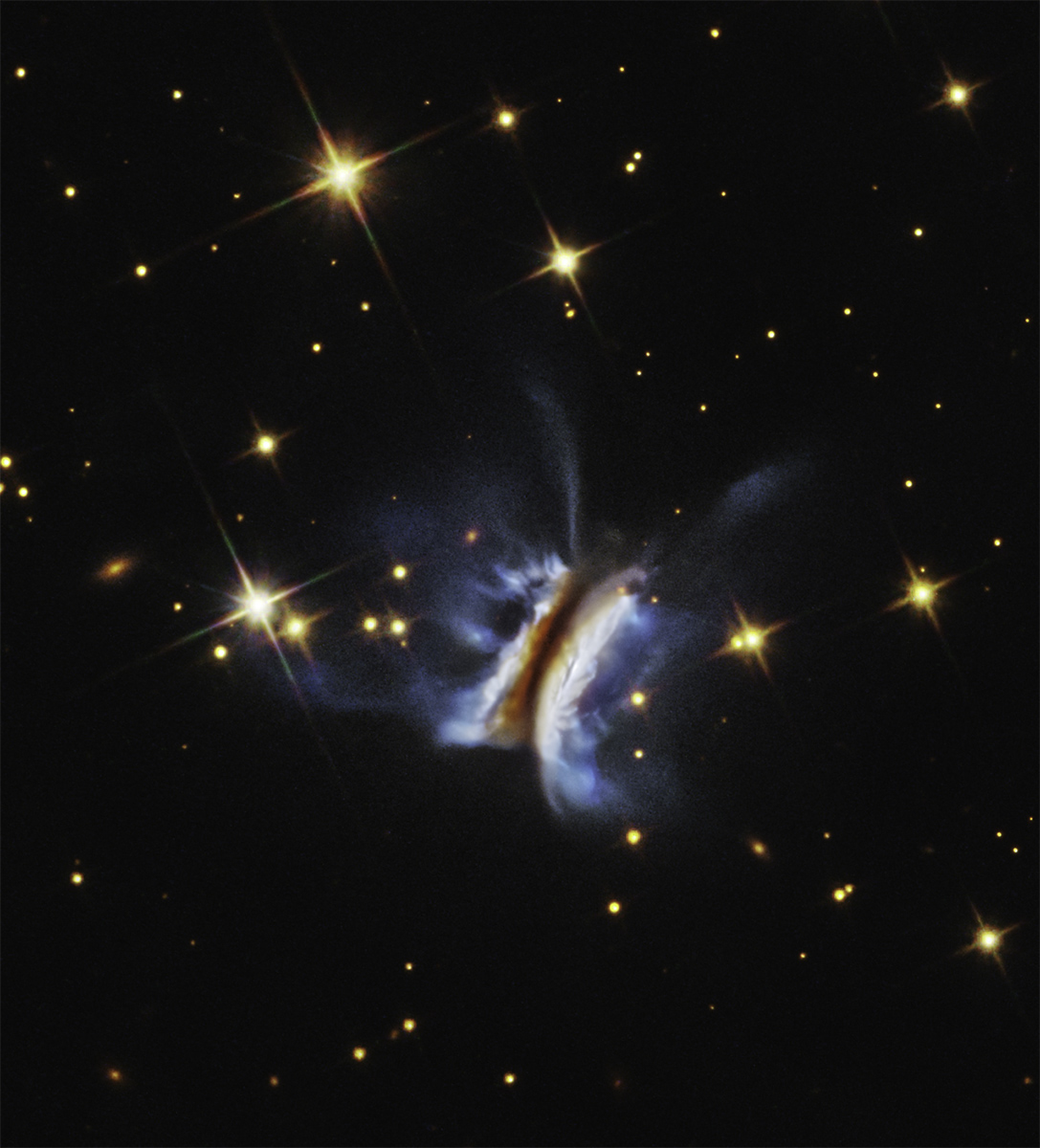
Hubble Space Telescope’s image
While radio and infrared observatories dominate disc studies, Hubble offers a unique advantage. Its ability to image scattered visible light allows astronomers to trace fine dust structures at high spatial resolution. In this case, Hubble reveals the full vertical and radial extent of the disc. Infrared observations alone may underestimate its size, especially in low-density outer regions. Visible-light scattering highlights these faint boundaries.
The discovery underscores Hubble’s continued relevance. Even as newer observatories operate, Hubble remains essential for certain types of disc diagnostics. Its long operational history also allows comparisons across decades of observations. This finding reinforces the value of multi-wavelength studies. Each wavelength probes a different component of the system. Together, they build a complete physical picture.
Disc stability and evolution
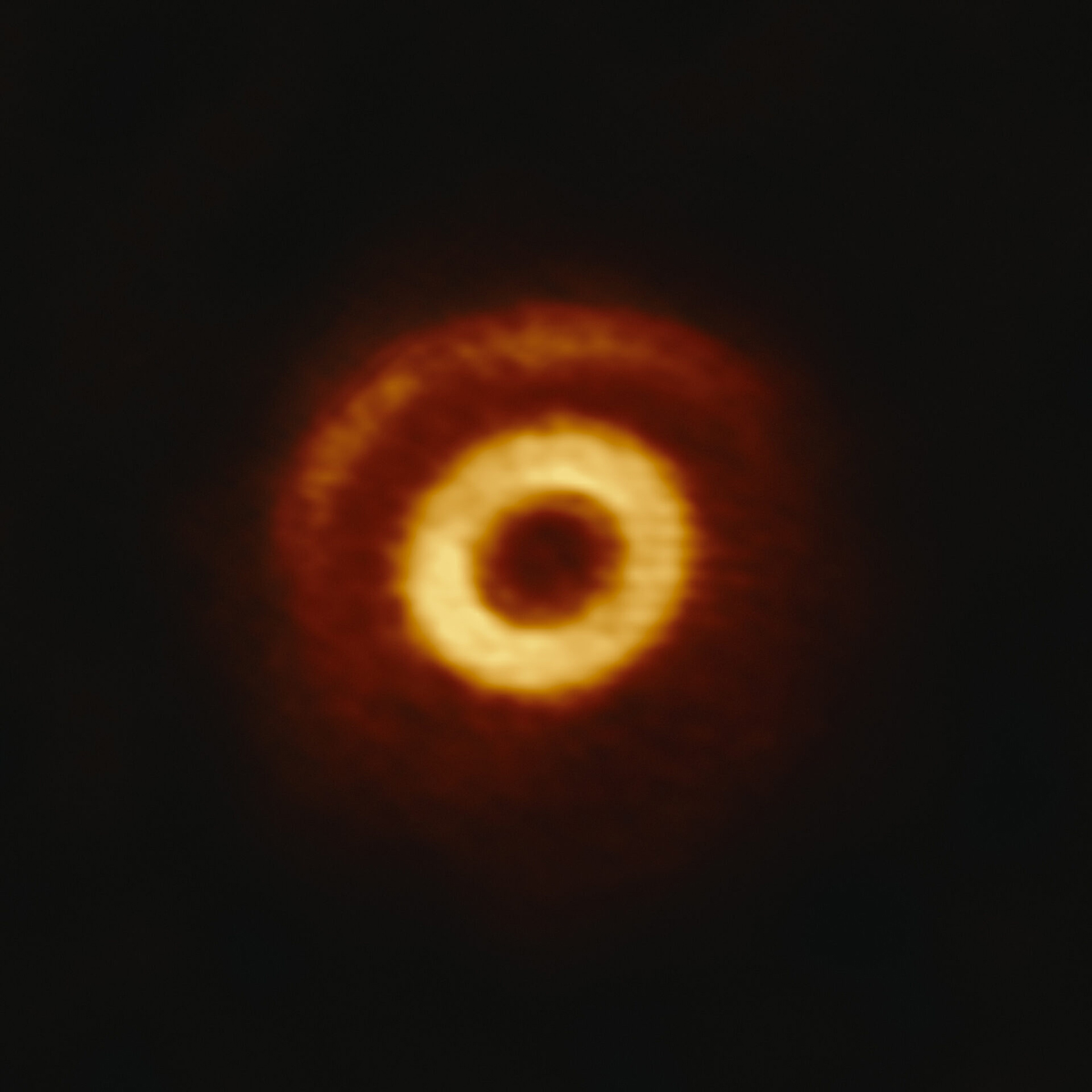
The existence of such a massive disc raises fundamental questions. How does it remain gravitationally stable? Why has it not fragmented into multiple stellar companions? One possibility involves continuous mass inflow. Material from the surrounding cloud may replenish the disc while redistributing angular momentum. Another explanation involves magnetic braking, which could regulate rotational support.
The disc may also represent a transient phase. Its current structure might persist only for a short period in astronomical terms. If so, systems like this would be rare and difficult to observe. Further modelling will require precise measurements of gas motion and temperature. Spectroscopic observations can reveal velocity gradients and turbulence levels. These data will test whether current disc theories can accommodate such extreme systems.
Follow-up observations will focus on probing the disc’s interior. Infrared instruments, including the James Webb Space Telescope, can penetrate the dust and potentially reveal the central star. JWST may also detect chemical signatures linked to planet formation. Radio interferometers can trace molecular gas dynamics across the disc. These measurements will help determine whether gravitational instability plays a dominant role.
Clear skies!
See more from DIYPhotography.net on Google
Add DIYPhotography.net as a trusted source. This makes
our stories more likely to appear in your Google Search results.
 Add as a preferred source on Google

Soumyadeep Mukherjee
Soumyadeep Mukherjee is an award-winning astrophotographer from India. He has a doctorate degree in Linguistics. His work extends to the sub-genres of nightscape, deep sky, solar, lunar and optical phenomenon photography. He is also a photography educator and has conducted numerous workshops. His works have appeared in over 40 books & magazines including Astronomy, BBC Sky at Night, Sky & Telescope among others, and in various websites including National Geographic, NASA, Forbes. He was the first Indian to win “Astronomy Photographer of the Year” award in a major category.


Join the Discussion
DIYP Comment Policy
Be nice, be on-topic, no personal information or flames.