
























Dark Energy Camera Unveils Sombrero Galaxy in New Depth
Apr 25, 2026
Soumyadeep Mukherjee
Soumyadeep Mukherjee is an award-winning astrophotographer from India. He has a doctorate degree in Linguistics. His work extends to the sub-genres of nightscape, deep sky, solar, lunar and optical phenomenon photography. He is also a photography educator and has conducted numerous workshops. His works have appeared in over 40 books & magazines including Astronomy, BBC Sky at Night, Sky & Telescope among others, and in various websites including National Geographic, NASA, Forbes. He was the first Indian to win “Astronomy Photographer of the Year” award in a major category.
Share:
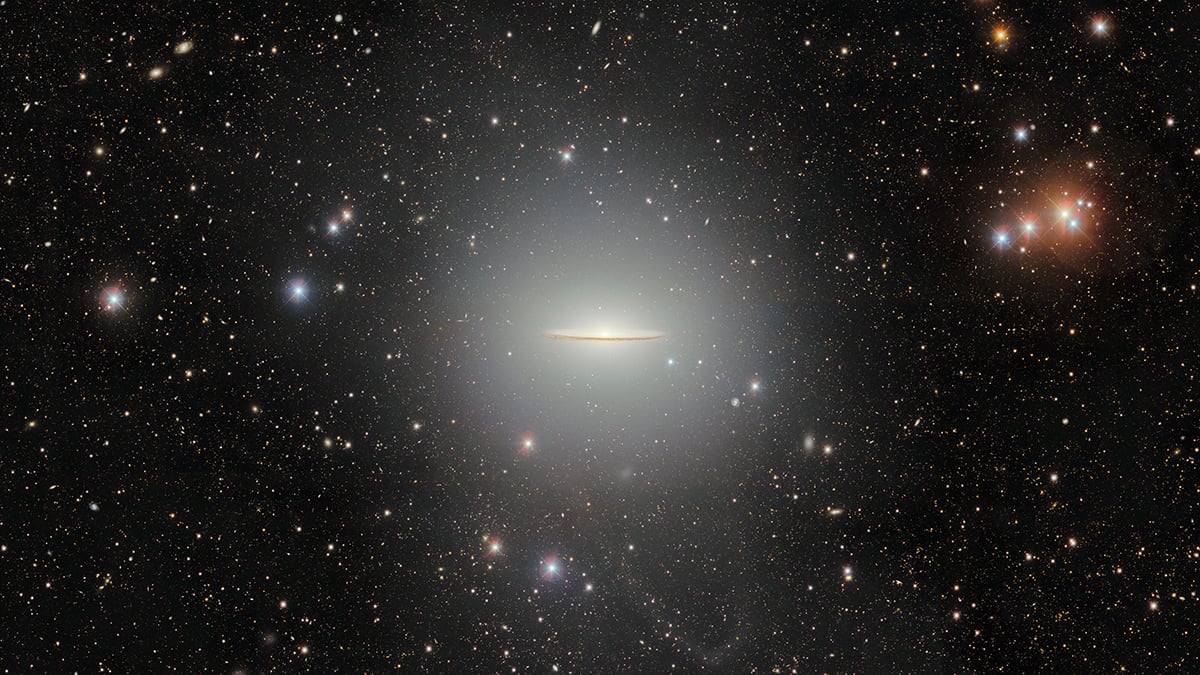
The Sombrero Galaxy (Messier 104) remains one of the most structurally distinctive galaxies in the nearby universe. Its nearly edge-on orientation provides a clear view of both its luminous bulge and embedded disk, making it a standard reference object in extragalactic studies. Over time, observations across wavelengths have established its basic morphology and stellar content. However, its outer regions have remained comparatively less constrained due to their low surface brightness.
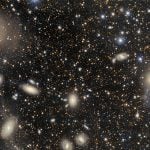
NSF NOIRLab has released a new image of the galaxy. The newly captured image by the Dark Energy Camera (DECam) extends well beyond the high surface brightness core and reveals a large-scale stellar halo surrounding the galaxy. This halo, along with faint substructures embedded within it, provides important constraints on the system’s formation history.
Revisiting the Classical Structure of Messier 104
At its core, the Sombrero Galaxy retains the structure that has defined it for over a century. A massive central bulge dominates the light distribution. This bulge consists primarily of older stellar populations and contributes most of the galaxy’s luminosity.
Surrounding the bulge is a relatively thin stellar disk. Embedded within this disk is the well-known dust lane, which appears as a dark band crossing the galaxy. This feature arises from dense interstellar dust that absorbs and scatters visible light. The edge-on orientation enhances its visibility, creating a high-contrast profile associated with the galaxy.
The system also hosts a supermassive black hole at its center. Measurements indicate that its mass significantly exceeds that of the Milky Way’s central black hole. In addition, the galaxy contains an unusually large population of globular clusters. These clusters extend far into the halo and provide valuable tracers of the galaxy’s gravitational potential.
Although these components are well documented, they do not fully describe the system. The new image highlights that the visible disk represents only a fraction of the galaxy’s total extent.
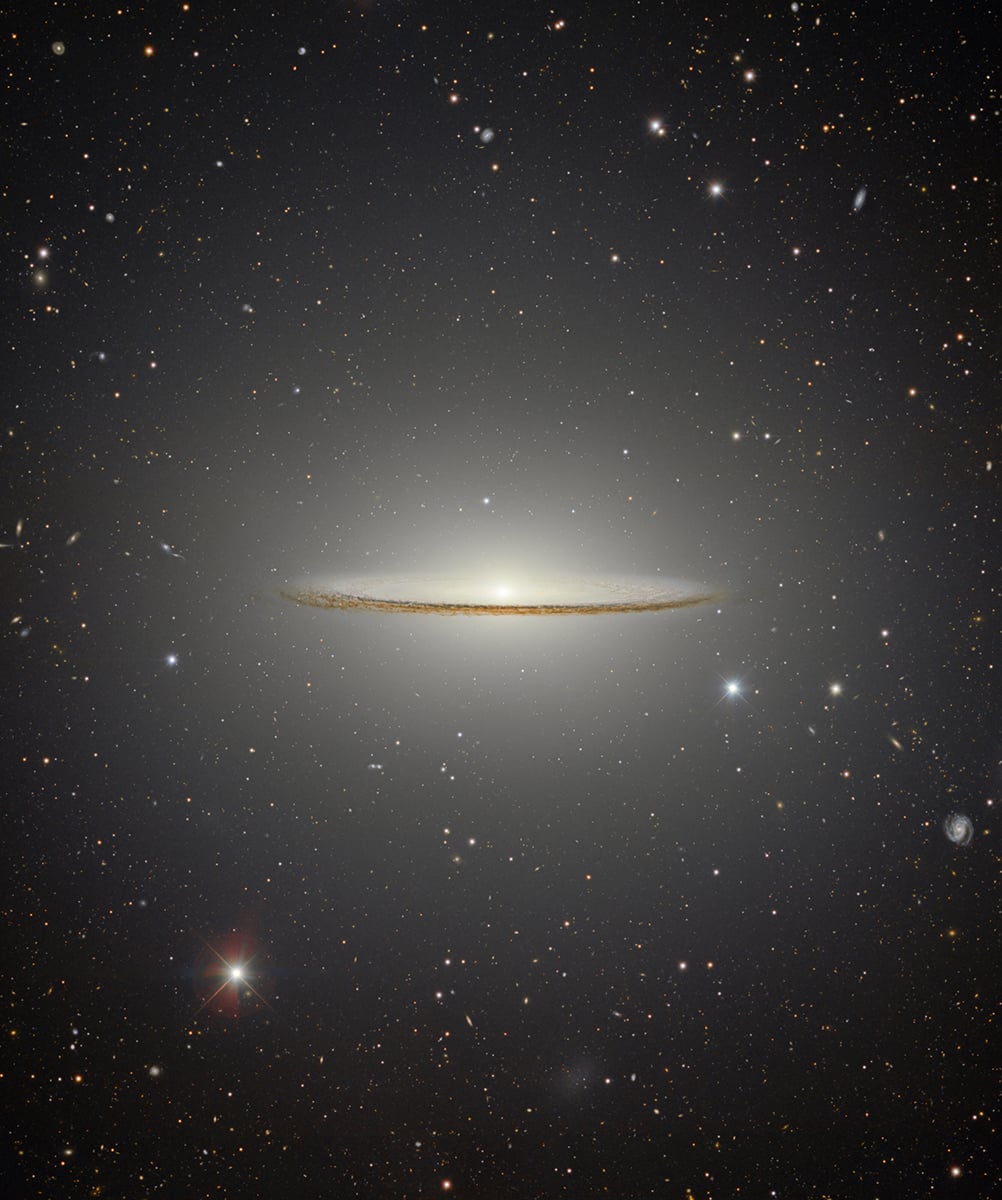
The stellar halo of the galaxy
The most significant result of the NOIRLab image is the clear detection of an extended stellar halo. This halo surrounds the galaxy and extends to several times the radius of the visible disk. It consists of stars that are gravitationally bound to the galaxy but do not participate in the ordered rotation of the disk.
The halo appears diffuse and exhibits a smooth radial gradient in brightness. However, closer inspection reveals localized irregularities. These include faint stellar streams and asymmetries that interrupt the otherwise uniform distribution.
Detecting such features requires imaging at very low surface brightness levels. In many cases, the brightness of the halo falls close to the background sky level. As a result, even small systematic errors can obscure these structures. The success of this observation reflects both the sensitivity of DECam and the quality of the data reduction process.
The scale of the halo suggests that the Sombrero Galaxy is significantly larger than previously assumed. When the halo is included, the galaxy’s effective size increases substantially, which has implications for its total mass and gravitational influence.
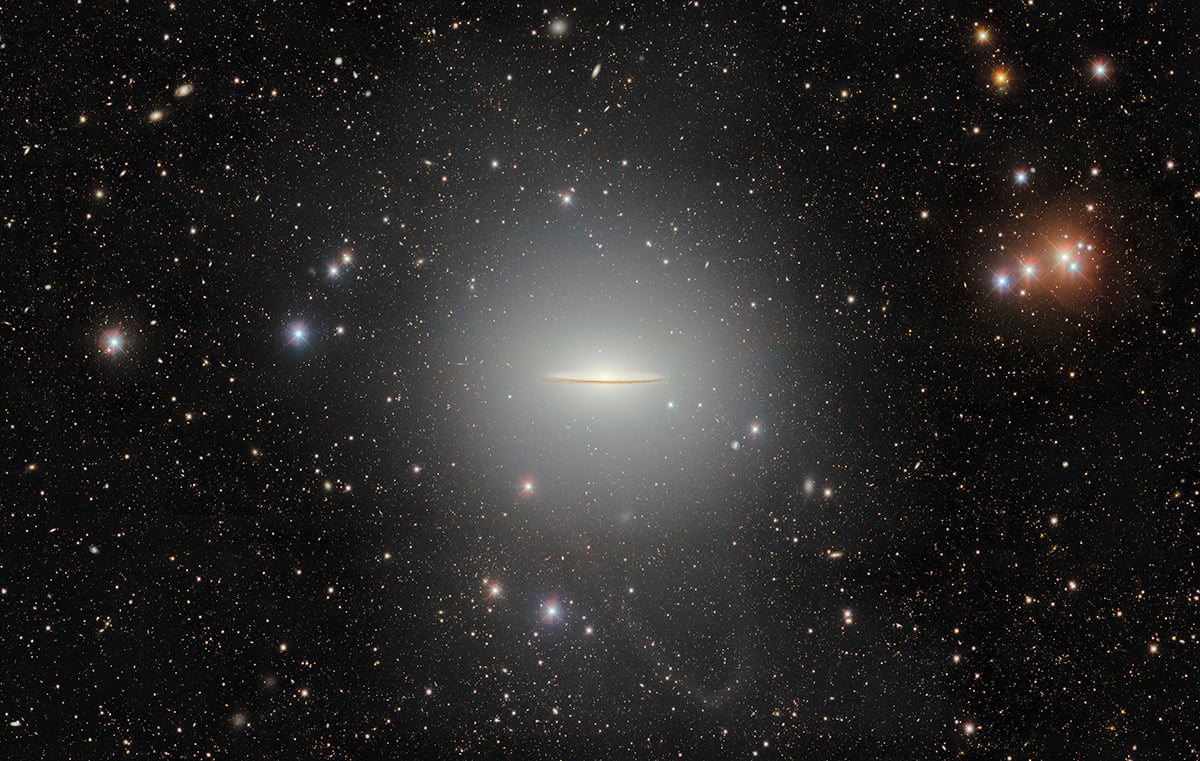
Evidence of past interactions and accretion
The presence of stellar streams within the halo provides direct evidence of past interactions. These streams form when tidal forces disrupt smaller galaxies during close encounters. As the smaller system is pulled apart, its stars spread into elongated structures that persist for billions of years.
In the Sombrero Galaxy, these features indicate a history of hierarchical growth. Rather than forming in isolation, the galaxy likely accreted multiple smaller companions over time. Each merger contributed stars to the outer halo and may have influenced the structure of the central bulge.
This interpretation aligns with current models of galaxy formation within a cosmological context. Large galaxies are expected to grow through repeated mergers and accretion events. The halo, in this framework, serves as a repository of these interactions.
The relatively smooth appearance of much of the halo suggests that many of these events occurred in the distant past. Over time, stellar streams disperse and blend into the background. However, the remaining substructures provide a snapshot of more recent activity.
DECam and the Blanco telescope: Capturing the faint outer galaxy
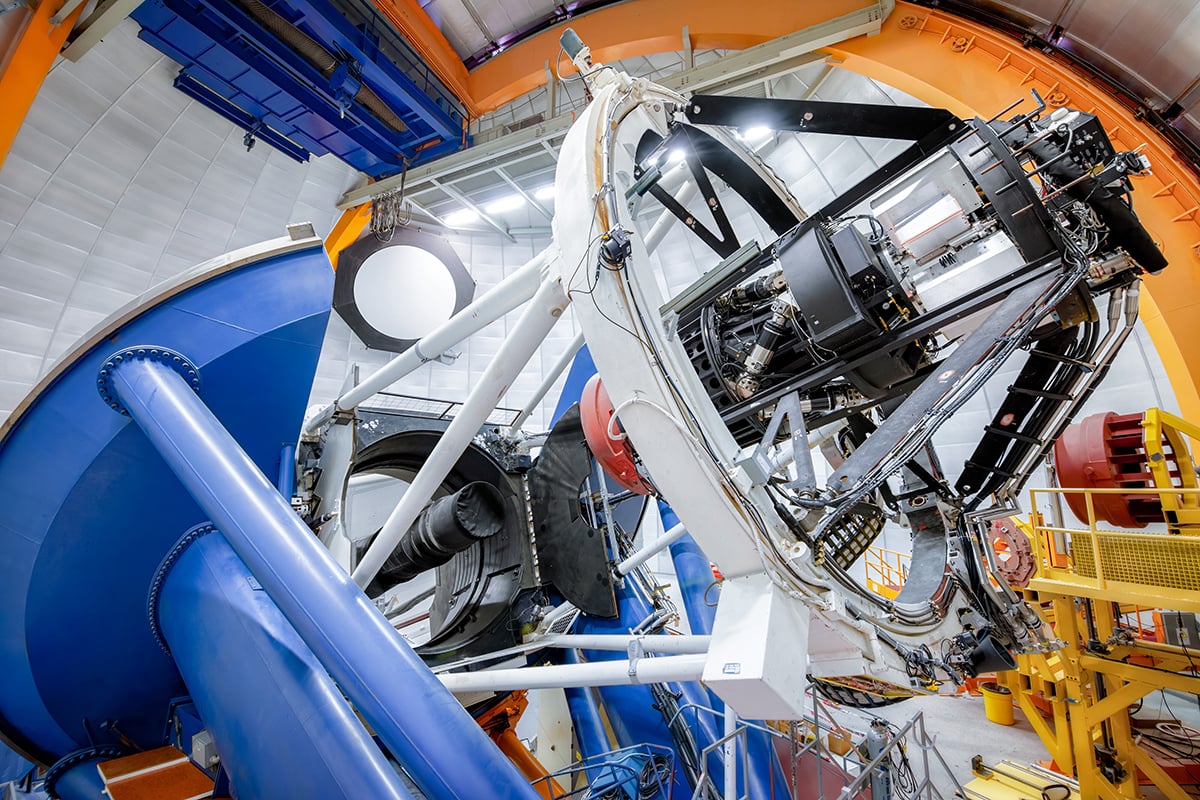
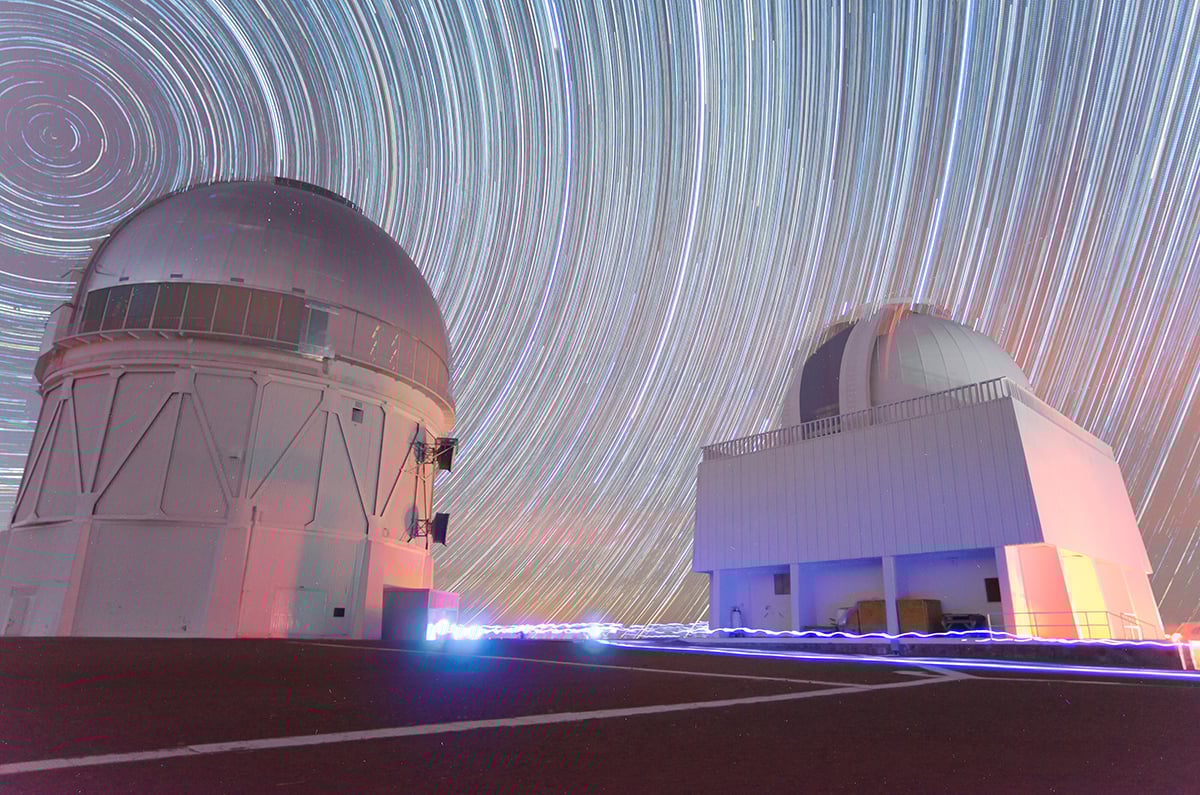
The image was produced using the Victor M. Blanco 4-meter Telescope, located in Chile. Mounted on this telescope is the Dark Energy Camera, a wide-field instrument designed for deep optical surveys.
DECam offers a large field of view combined with high sensitivity. This combination is very useful for studying low surface brightness structures. In the case of the Sombrero Galaxy, the central bulge is extremely bright, while the outer halo is several orders of magnitude fainter. Capturing both regions within the same dataset requires careful exposure control and advanced processing.
The data used for this image were collected as part of broader survey programs. However, the final rendering focuses on extracting faint light from the outskirts of the galaxy. By stacking multiple exposures and applying calibration, astronomers were able to suppress noise and enhance extended features. This allows the halo to emerge without saturating the core.
Clear skies!
See more from DIYPhotography.net on Google
Add DIYPhotography.net as a trusted source. This makes
our stories more likely to appear in your Google Search results.
 Add as a preferred source on Google

Soumyadeep Mukherjee
Soumyadeep Mukherjee is an award-winning astrophotographer from India. He has a doctorate degree in Linguistics. His work extends to the sub-genres of nightscape, deep sky, solar, lunar and optical phenomenon photography. He is also a photography educator and has conducted numerous workshops. His works have appeared in over 40 books & magazines including Astronomy, BBC Sky at Night, Sky & Telescope among others, and in various websites including National Geographic, NASA, Forbes. He was the first Indian to win “Astronomy Photographer of the Year” award in a major category.



Join the Discussion
DIYP Comment Policy
Be nice, be on-topic, no personal information or flames.