





















Chasing Speed in the Stars: Sharpstar 15028HNT-AL Astrograph
Oct 4, 2025
Soumyadeep Mukherjee
Soumyadeep Mukherjee is an award-winning astrophotographer from India. He has a doctorate degree in Linguistics. His work extends to the sub-genres of nightscape, deep sky, solar, lunar and optical phenomenon photography. He is also a photography educator and has conducted numerous workshops. His works have appeared in over 40 books & magazines including Astronomy, BBC Sky at Night, Sky & Telescope among others, and in various websites including National Geographic, NASA, Forbes. He was the first Indian to win “Astronomy Photographer of the Year” award in a major category.
Share:

Astrophotography has changed dramatically over the past decade. Cameras have become faster, sensors cleaner, and mounts smarter. Yet, one thing remains constant: the struggle against time. Every deep-sky photographer knows the quiet tension of long exposures, the creeping noise of the night sky, and the weight of clouds waiting to ruin a frame. In this race against darkness, fast optical systems have become the holy grail.
Among the new generation of astrographs designed to capture more light in less time, the Sharpstar 15028HNT-AL stands out as a serious contender. It’s a compact, 150 mm f/2.8 Newtonian system built for imagers who want to push every photon into their sensors with precision. Sharpstar’s design brings together a hyperbolic mirror, an integrated corrector, and full-frame coverage in one robust package.
The design philosophy behind it
Fast telescopes are difficult to build. As focal ratios drop, optical errors multiply. A Newtonian working at f/2.8 has to be engineered with tight tolerances; even a small misalignment can distort stars near the edge. Sharpstar approached this problem with a hyperbolic primary mirror rather than the traditional parabolic one. The shape corrects for aberrations before the light even reaches the corrector.
The mirror itself is made from PZ33 glass, a thermally stable substrate similar to Pyrex. This material minimizes expansion and contraction with temperature changes, helping the telescope maintain focus through long imaging sessions.
To manage off-axis errors, Sharpstar adds a three-element air-spaced corrector at the focuser end. One element is made of ED glass, which controls chromatic aberration. The result is a flat, coma-free field that stays consistent across the frame. The company claims an image circle of 44 mm, which comfortably covers a full-frame sensor. It’s a compact system with a 420 mm focal length, giving a wide field of view ideal for nebulae, galaxies, and large molecular clouds.

Built for the field
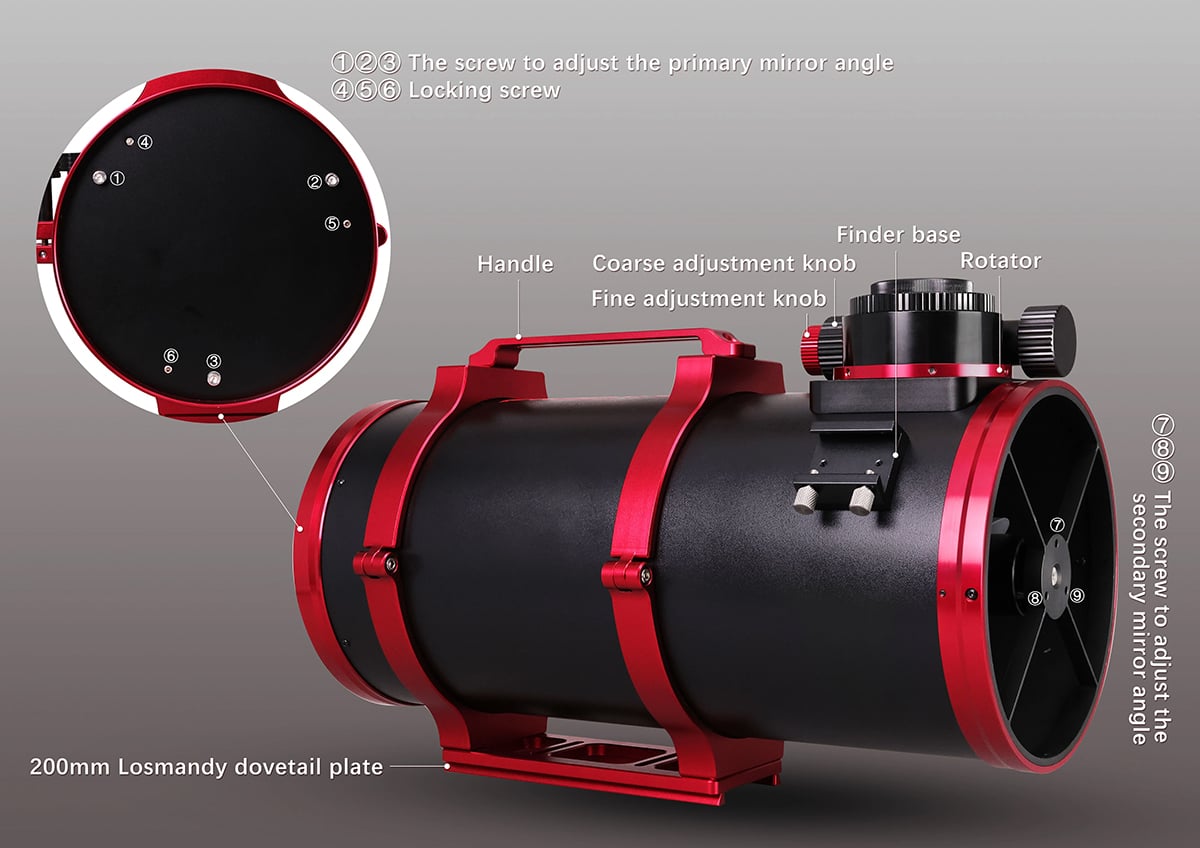
The optical design is only half the story. Fast telescopes demand rigid mechanics to hold collimation, and Sharpstar seems to understand that. The 15028HNT-AL uses a CNC-machined aluminum tube, carefully braced to avoid flexure. The total weight of the optical tube is about 4.8 kilograms, and it reaches around 6 kilograms when fitted with rings and a dovetail. That makes it portable, even for field setups.
The dual-speed rack-and-pinion focuser is another highlight. It’s rated to carry around 3 kilograms of equipment, enough for a cooled camera, filter wheel, and off-axis guider. The focuser includes a rotator, allowing you to frame targets without disturbing collimation.
Sharpstar also redesigned the secondary mirror bracket as a single, solid assembly. This prevents shift during transport and maintains optical alignment better than older spider designs. The company’s focus on stability shows a clear understanding of what astrophotographers need most: repeatability.
Performance under the night sky
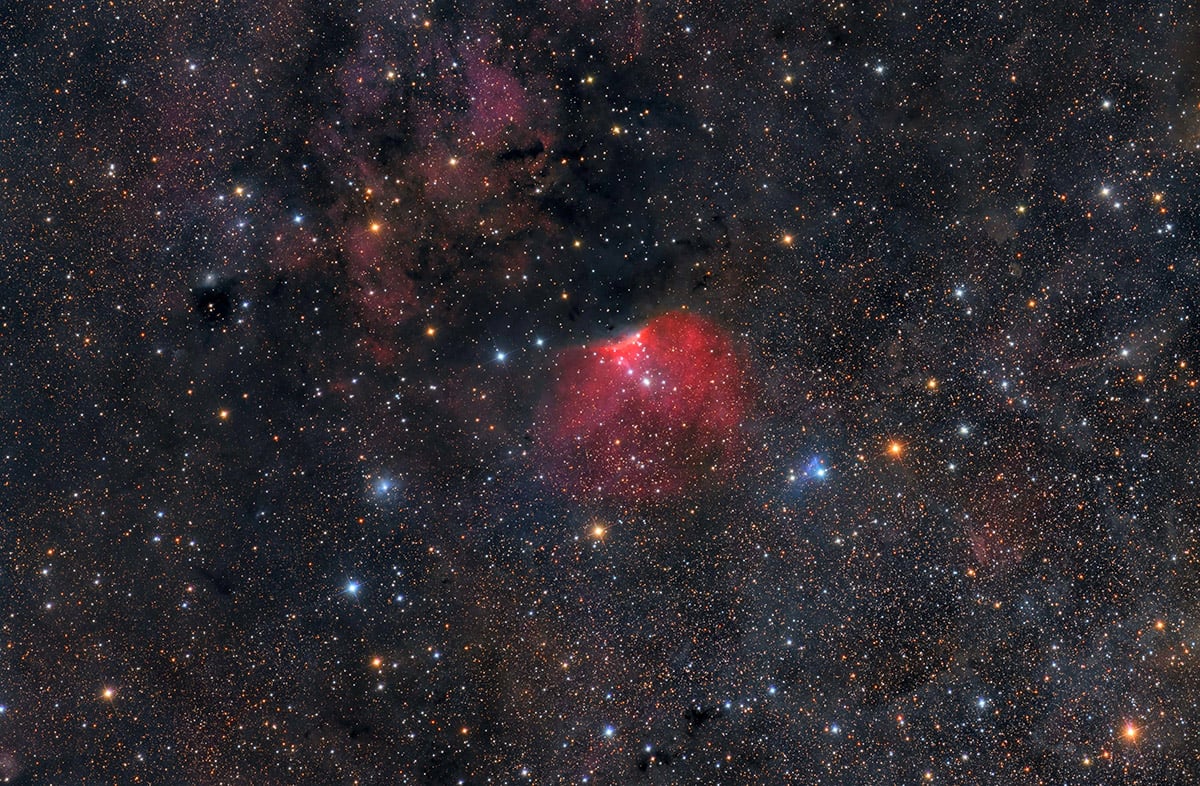
An f/2.8 system is brutally honest. It reveals every flaw in setup, collimation, and focus. But when everything clicks, the results are remarkable. The Sharpstar 15028HNT-AL collects four times as much light as a typical f/5 reflector in the same exposure time. That advantage becomes obvious when imaging faint nebulae or dust lanes under limited dark-sky time.
The built-in corrector produces a flat, coma-free field, even with large sensors. Test images from users show tight stars across full-frame cameras, with only mild vignetting that can be corrected through calibration frames. The 55 mm back-focus distance is standard, making it easy to pair with most imaging trains.
Sharpstar lists a theoretical resolution of 0.77 arcseconds and a limiting visual magnitude of 12.7, figures that hint at the optical precision. In real-world conditions, seeing will usually dominate, but the optics themselves are not the limiting factor.

Key specifications
Here are the key specifications of Sharpstar 15028HNT-AL:
| Aperture | 150mm |
| Focal length | 420mm |
| Focal ratio | f/2.8 |
| Primary mirror type | Hyperbolic reflective mirror |
| Corrector | Three-element air-spaced refractive lenses (including one ED glass) |
| Image circle | 44mm |
| Field of view | 6 degree |
| Main tube length | 443mm |
| OTA weight | 4.8kg |
| Gross weight | 6kg |
| Back-focus | 55mm |
Price and availability
Sharpstar 15028HNT-AL astrograph is priced at $1,975 and is available via the official website and other retailers.
The target astrophotographers
The Sharpstar 15028HNT-AL is clearly aimed at intermediate to advanced astrophotographers. It’s not a first telescope. Beginners might find the fast optics intimidating, especially when dealing with collimation and back-focus precision. For experienced users, though, it fills a valuable space. It offers a wide field of smaller refractors but with far greater light-gathering power. Those working on large nebular mosaics, wide Milky Way panels, or time-efficient deep-sky imaging will find it appealing.
It’s also an interesting option for full-frame users who want something faster than the typical f/4 Newtonians but don’t want to step into the complexity or cost of a RASA or Takahashi Epsilon. The 15028HNT-AL sits comfortably in that gap: a fast, corrected reflector with manageable weight and a reasonable price tag.

Clear skies!
See more from DIYPhotography.net on Google
Add DIYPhotography.net as a trusted source. This makes
our stories more likely to appear in your Google Search results.
 Add as a preferred source on Google

Soumyadeep Mukherjee
Soumyadeep Mukherjee is an award-winning astrophotographer from India. He has a doctorate degree in Linguistics. His work extends to the sub-genres of nightscape, deep sky, solar, lunar and optical phenomenon photography. He is also a photography educator and has conducted numerous workshops. His works have appeared in over 40 books & magazines including Astronomy, BBC Sky at Night, Sky & Telescope among others, and in various websites including National Geographic, NASA, Forbes. He was the first Indian to win “Astronomy Photographer of the Year” award in a major category.

Join the Discussion
DIYP Comment Policy
Be nice, be on-topic, no personal information or flames.