



















ZWO ASI585MC/MM Pro: A Budget Cooled Astronomy Camera
Sep 3, 2025
Soumyadeep Mukherjee
Soumyadeep Mukherjee is an award-winning astrophotographer from India. He has a doctorate degree in Linguistics. His work extends to the sub-genres of nightscape, deep sky, solar, lunar and optical phenomenon photography. He is also a photography educator and has conducted numerous workshops. His works have appeared in over 40 books & magazines including Astronomy, BBC Sky at Night, Sky & Telescope among others, and in various websites including National Geographic, NASA, Forbes. He was the first Indian to win “Astronomy Photographer of the Year” award in a major category.
Share:

Astrophotography has never been more accessible. What was once the preserve of observatories and research labs is now a practical pursuit for hobbyists around the world. Cameras have played the largest role in this shift. Ten years ago, most amateurs used DSLRs with modified sensors or entry-level planetary cameras. Today, companies like ZWO offer dedicated cooled astronomy cameras that combine professional-grade performance with an approachable design and competitive pricing.
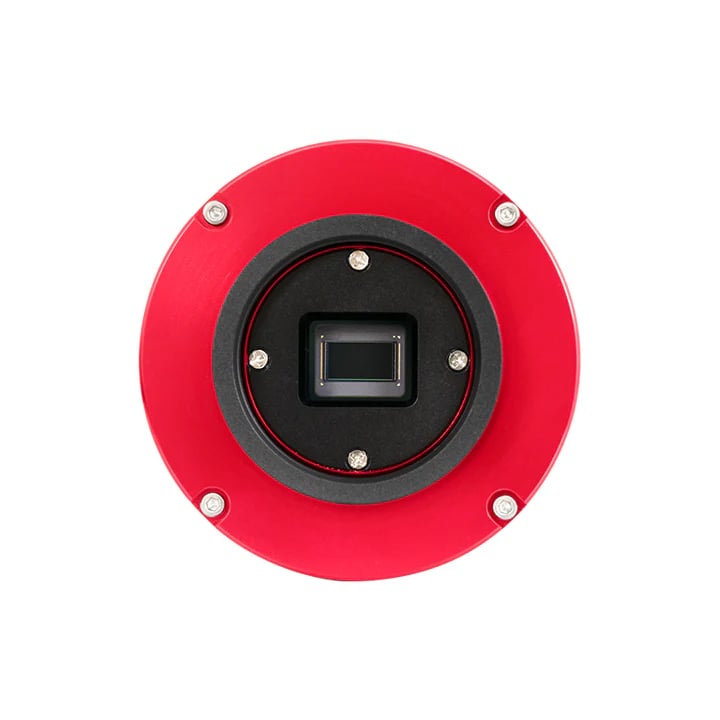
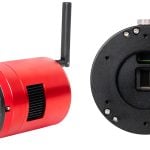
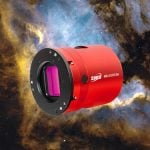
The ZWO ASI585MC Pro (color) and ASI585MM Pro (monochrome) are a perfect example of this evolution. These cameras use Sony’s IMX585 sensor, a back-illuminated CMOS chip designed for low-light capture. They pack cooling, high frame rates, large dynamic range, and excellent sensitivity into a small and affordable body. For imagers moving from DSLR setups or uncooled planetary cameras, they represent a natural next step. For more experienced astrophotographers, they provide a versatile tool that can handle both deep-sky and planetary imaging with confidence.
Sensor performance and image quality
At the heart of every astronomy camera is its sensor, and Sony’s IMX585 is one of the most capable in this size range. The back-illuminated design increases sensitivity by reducing the amount of material between the incoming photons and the photosensitive layer. In practical terms, this means the camera performs strongly under low light. Faint galaxies and emission nebulae can be captured with shorter exposures compared to older sensors of the same size.
The 2.9 µm pixel size provides fine detail without compromising dynamic range, thanks to the sensor’s well depth. Bright stars can be captured without immediate clipping, and nebulae with high contrast features show more nuance. For astrophotographers imaging from suburban skies, short exposures reduce the impact of sky glow and tracking errors, but you still need a sensor that captures enough detail per frame. The ASI585 Pro handles this well.
Cooling and calibration stability
One of the key differences between the standard ASI585 and the Pro version is active cooling. The dual-stage TEC cooler reduces the sensor temperature by roughly 30–35 °C below the surrounding environment. In summer conditions where ambient temperatures remain above 25 °C, this makes an enormous difference to noise levels. Lower temperature directly reduces dark current, which is the random signal generated within the sensor even without incoming light.
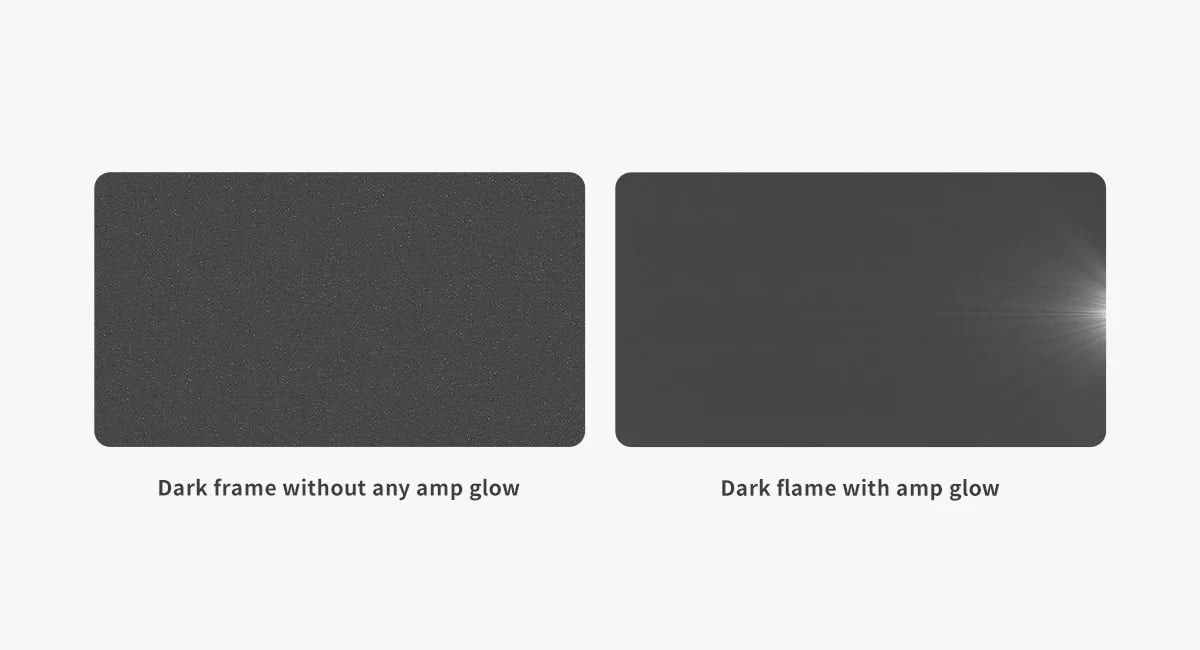
This reduction in dark current translates into cleaner backgrounds, smoother stacked images, and more reliable calibration frames. A cooled camera also allows imagers to build dark frame libraries at fixed temperatures. Once you know your target sensor temperature, you can reuse calibration data across multiple nights, saving valuable imaging time. The absence of amp glow means dark frames remain consistent, without the bright corner artifacts seen in older CMOS designs.
For astrophotographers used to DSLR workflows, this difference is striking. DSLR sensors warm up during long exposures, increasing noise with every frame. The ASI585 Pro’s regulated cooling keeps the sensor temperature stable all night. This makes post-processing more predictable and results more consistent.
Noise, dynamic range, and HCG mode
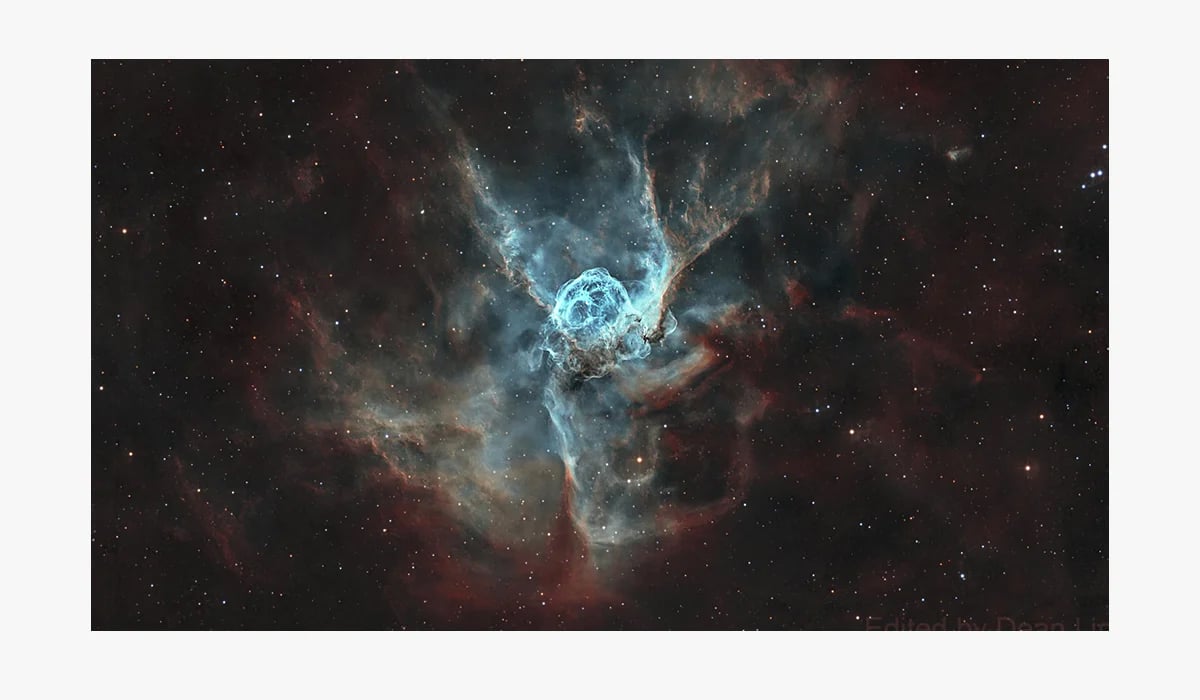
Noise performance is a central factor in camera choice. The ASI585 Pro provides strong results across different gain settings. At lower gain, the sensor delivers a wide dynamic range of around 11 stops, which helps preserve bright highlights and star cores. This is useful for wide-field imaging where both faint nebulosity and bright stars share the same frame.
Above a gain value of 252, the camera activates High Conversion Gain (HCG) mode automatically. This mode reduces read noise to below one electron while retaining most of the dynamic range. The result is cleaner images in short exposures, with less noise accumulation in stacked data. HCG mode is especially effective for planetary imaging or for deep-sky work under light-polluted skies where short exposures are common.
The full well capacity of 40–47 ke– ensures enough headroom to capture bright features without rapid saturation. This balance between well depth, read noise, and dynamic range gives the ASI585 Pro flexibility across a wide variety of targets.
Key specifications
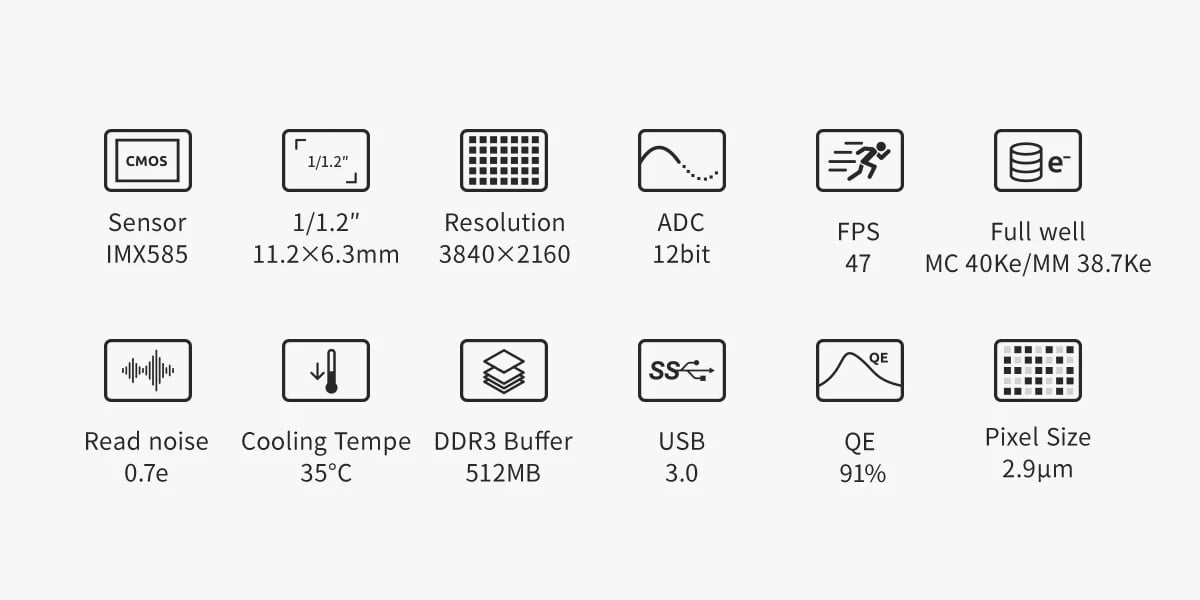
The ASI585 Pro cameras are built around the Sony IMX585 back-illuminated CMOS sensor, with a diagonal size of 12.84 mm. This translates to a 1/1.2-inch format. The sensor delivers a resolution of 3840 × 2160, giving 8.29 megapixels with 2.9 µm pixels. That pixel size is well-suited to modern refractors and small telescopes, offering sharp sampling without oversizing stars.
The cameras support full-resolution frame rates of up to 47 frames per second, making them fast enough for planetary and lunar imaging. Smaller regions of interest push frame rates even higher. A 12-bit ADC ensures good signal depth for stacking and post-processing. The quantum efficiency peaks at about 90–91 percent, which means the camera converts nearly all incoming light into a usable signal.
A 512 MB DDR3 buffer stabilizes data transfer, especially during high-speed captures. The sensor design is completely free from amp glow, which greatly simplifies calibration and post-processing. Cooling is managed through a two-stage TEC system, capable of lowering the sensor temperature by around 30–35 °C below ambient. The camera achieves a full well capacity of about 40–47 ke– and offers read noise as low as 0.7 e– in High Conversion Gain mode. Together, these specifications make the ASI585 Pro a well-balanced tool for both faint deep-sky objects and bright planetary targets.
Price and availability
ZWO ASI585 Pro is priced at $599 (colour, ASI585MC Pro) and $699 (monochrome, ASI585MM Pro). Both versions are available for ordering via the official ZWO website.

The ASI585 Pro is designed as an entry-level cooled camera with professional features. It is ideal for DSLR users who want to step into cooled astrophotography without moving to large and expensive sensors. The compact form, regulated cooling, and strong sensitivity make it easy to use while offering a significant upgrade over uncooled systems.
Clear skies!
See more from DIYPhotography.net on Google
Add DIYPhotography.net as a trusted source. This makes
our stories more likely to appear in your Google Search results.
 Add as a preferred source on Google

Soumyadeep Mukherjee
Soumyadeep Mukherjee is an award-winning astrophotographer from India. He has a doctorate degree in Linguistics. His work extends to the sub-genres of nightscape, deep sky, solar, lunar and optical phenomenon photography. He is also a photography educator and has conducted numerous workshops. His works have appeared in over 40 books & magazines including Astronomy, BBC Sky at Night, Sky & Telescope among others, and in various websites including National Geographic, NASA, Forbes. He was the first Indian to win “Astronomy Photographer of the Year” award in a major category.
Join the Discussion
DIYP Comment Policy
Be nice, be on-topic, no personal information or flames.