
























NASA’s Chandra Captures an “X-Ray Dot” from the Early Universe
Apr 29, 2026
Soumyadeep Mukherjee
Soumyadeep Mukherjee is an award-winning astrophotographer from India. He has a doctorate degree in Linguistics. His work extends to the sub-genres of nightscape, deep sky, solar, lunar and optical phenomenon photography. He is also a photography educator and has conducted numerous workshops. His works have appeared in over 40 books & magazines including Astronomy, BBC Sky at Night, Sky & Telescope among others, and in various websites including National Geographic, NASA, Forbes. He was the first Indian to win “Astronomy Photographer of the Year” award in a major category.
Share:
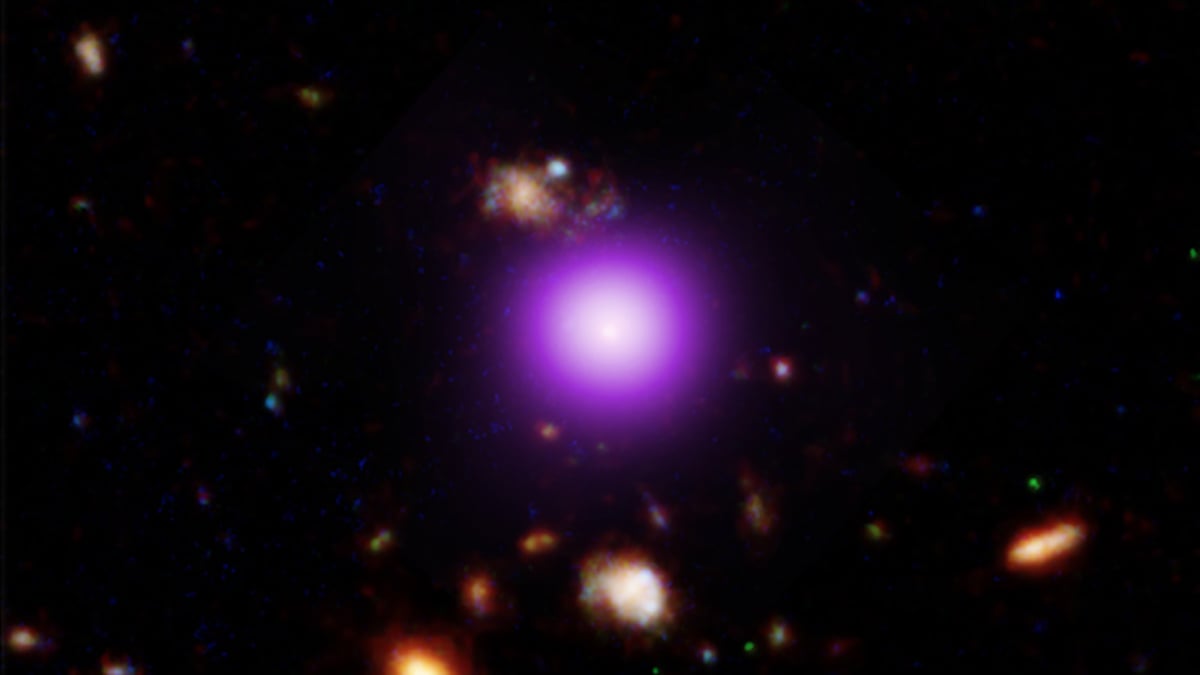
Observations across multiple wavelengths have begun to resolve a long-standing gap in our understanding of early black hole evolution. Recent data from NASA’s Chandra X-ray Observatory, combined with infrared observations from the James Webb Space Telescope, have identified a compact, high-redshift source that emits both infrared and X-ray radiation.
The object, cataloged as 3DHST-AEGIS-12014 and informally referred to as the “X-ray dot,” exhibits properties that place it between heavily obscured accreting systems and fully exposed active galactic nuclei. This detection provides observational support for a transitional phase in the growth of supermassive black holes in the early universe.
The emergence of Little Red Dots in deep surveys
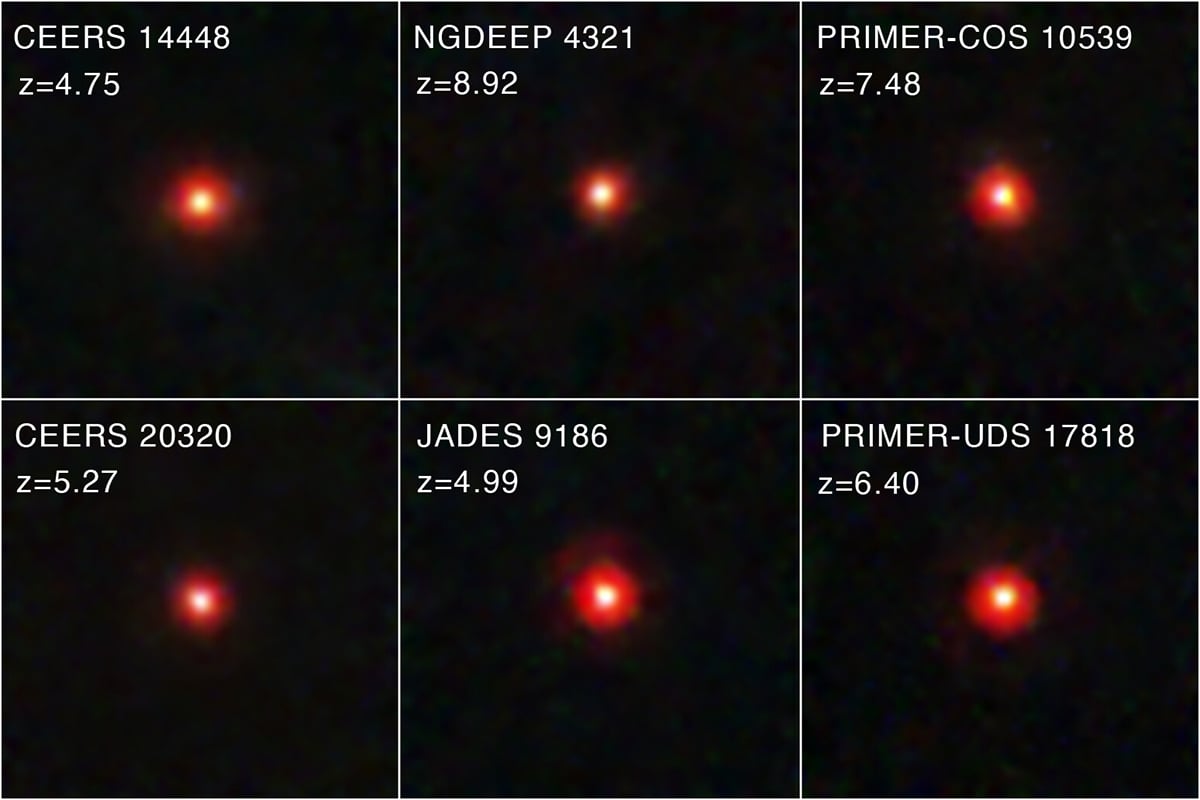
Earlier deep extragalactic surveys with the James Webb Space Telescope have revealed a population of compact, redshifted sources that appear as faint, unresolved points in infrared images. These objects, commonly known as “little red dots,” occupy a parameter space that does not align with typical star-forming galaxies. Their spectral energy distributions suggest strong emission from hot dust and compact cores, while their spatial extent remains limited.
Initially, astronomers considered several interpretations. Some proposed that these sources represent dense star clusters or early galaxies with intense star formation. However, their luminosities and compactness often exceed what stellar processes can produce on their own. As a result, attention shifted toward accreting black holes as the dominant energy source.
Despite this, a major inconsistency persisted. Most little red dots lacked detectable X-ray emission. In standard accretion models, material falling into a black hole produces high-energy radiation. The absence of such signals implied that either these systems behave differently or their emission remains hidden. Consequently, researchers began to explore scenarios involving heavy obscuration by gas and dust.
Detection of X-ray emission from 3DHST-AEGIS-12014
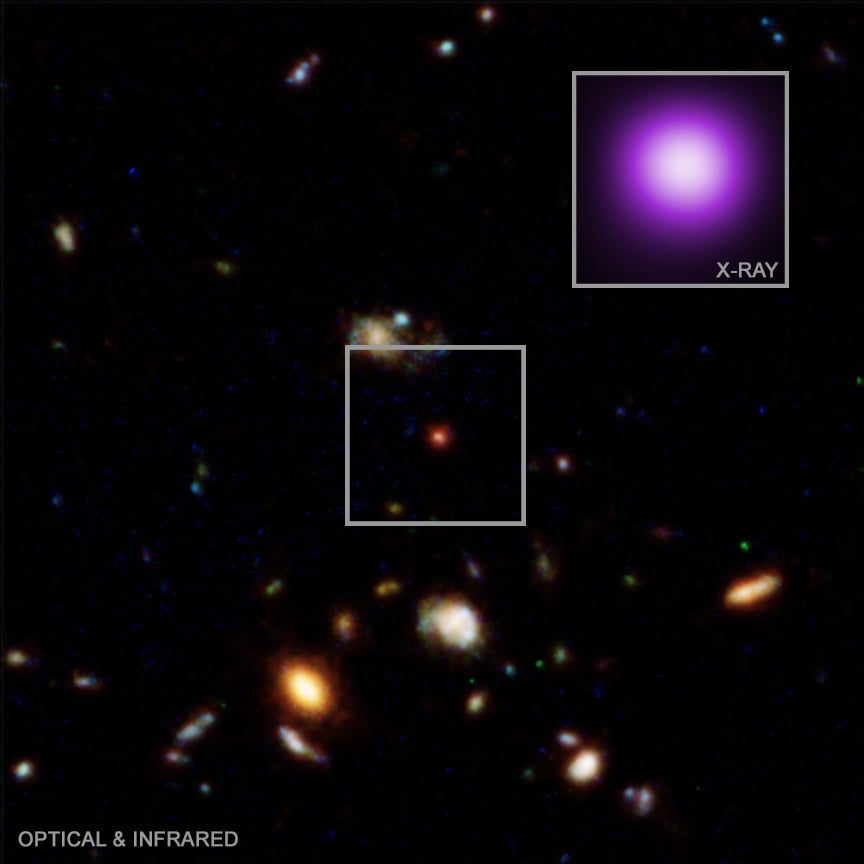
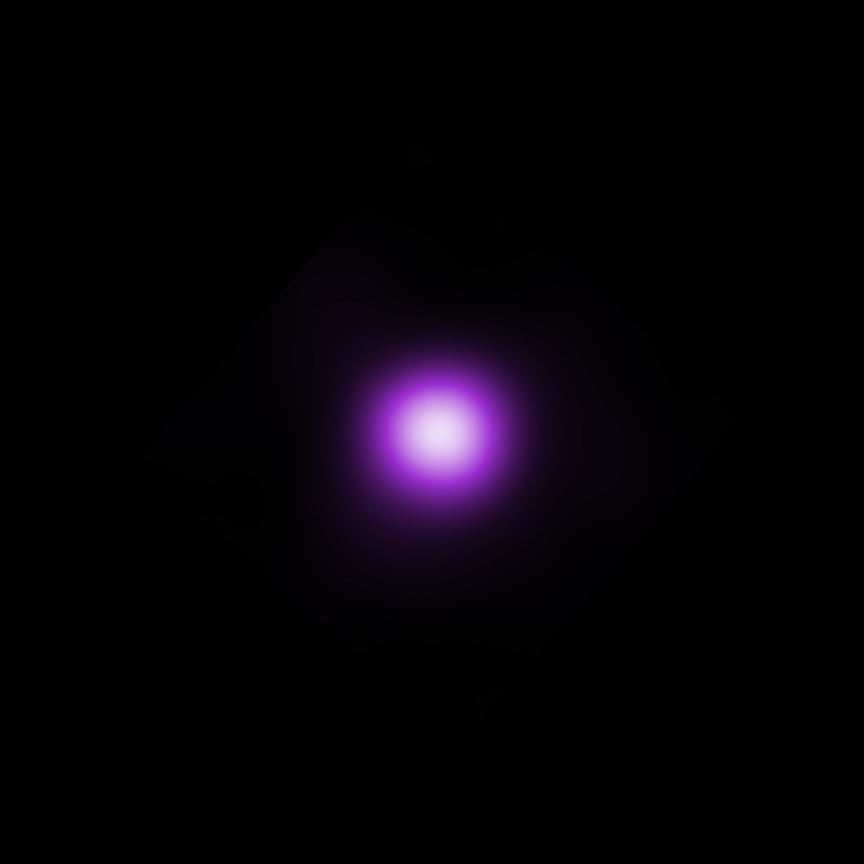
The identification of X-ray emission from 3DHST-AEGIS-12014 marks a turn in this discussion. Observations with the Chandra X-ray Observatory revealed a compact source with significant high-energy output, spatially coincident with a previously cataloged little red dot. The detection establishes the presence of an actively accreting black hole within the system.
Spectral analysis indicates that the X-ray emission originates from hot plasma in the inner accretion region. As gas spirals inward, gravitational energy converts into heat, producing photons in the X-ray regime. This process is well understood in the context of active galactic nuclei. Therefore, the observed signal confirms that at least some little red dots host black holes undergoing substantial growth.
At the same time, the X-ray flux appears partially attenuated. This suggests that absorbing material still surrounds the central engine. However, the level of attenuation does not fully suppress the emission. This partial visibility differentiates the X-ray dot from the majority of little red dots, which remain undetected in X-ray surveys.
Interpreting a transitional accretion phase
The combined infrared and X-ray properties of the X-ray dot support a model in which the system occupies an intermediate evolutionary stage. In the early phase of black hole growth, the central engine remains embedded within a dense, optically thick environment. Gas and dust absorb high-energy radiation, allowing only longer wavelengths to escape. Such systems appear as infrared-bright but X-ray faint sources.
As accretion proceeds, feedback from the black hole begins to alter its surroundings. Radiation pressure and energetic outflows can disrupt the surrounding medium. Over time, the distribution of gas becomes clumpy rather than uniform. This structural change creates channels through which radiation can escape.
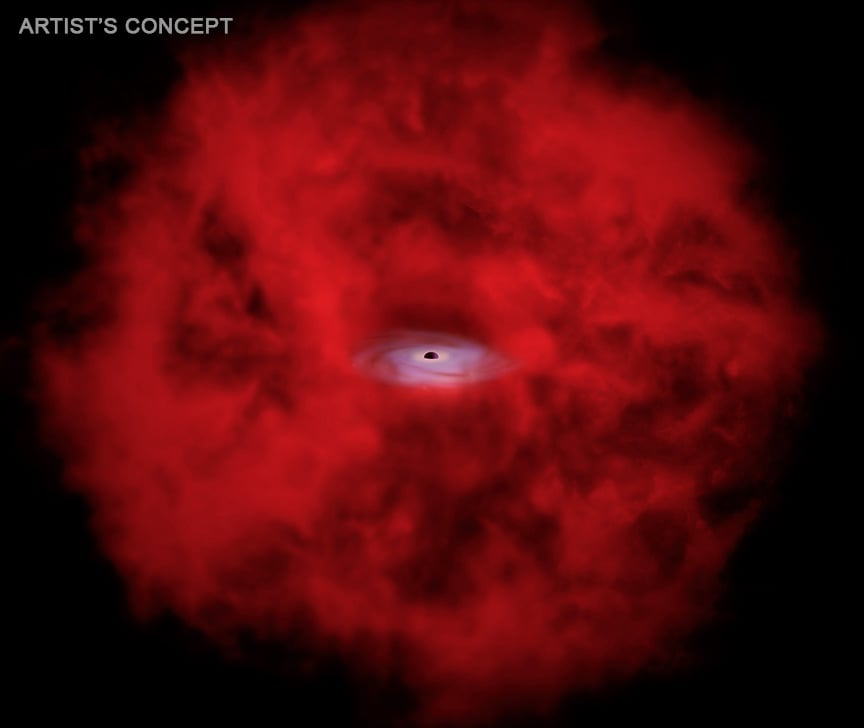
The X-ray dot likely represents this phase of partial clearing. Its infrared emission indicates that a significant amount of dust remains. However, the detection of X-rays implies that the obscuring medium has developed gaps. Through these gaps, high-energy photons reach the observer.
This interpretation aligns with theoretical models of black hole growth that predict a sequence of obscured and unobscured phases. The transitional stage is expected to be short-lived. As a result, objects in this state should be rare. The identification of even a single example provides strong support for this evolutionary pathway.
Multi-wavelength observations
The discovery of the X-ray dot is an example of the importance of combining data from different observational regimes. Infrared observations reveal the presence of dust and star formation, while X-ray observations trace high-energy processes near black holes. Each wavelength provides a partial view of the system.
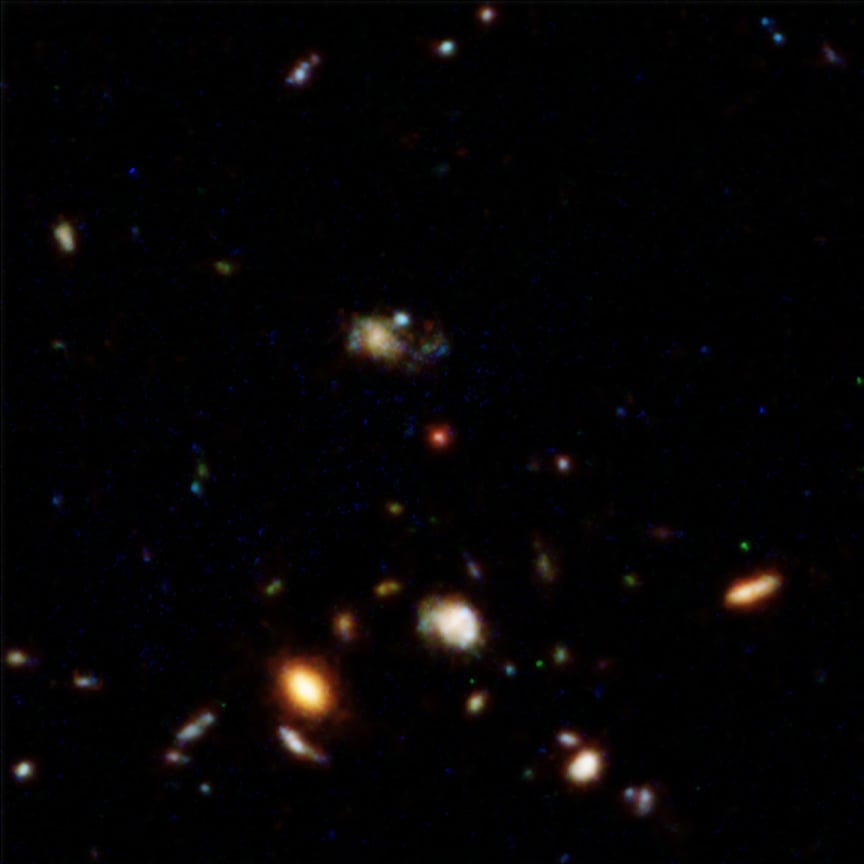
By integrating these perspectives, astronomers can reconstruct the full physical picture. The James Webb Space Telescope identifies candidate systems through their infrared signatures. The Chandra X-ray Observatory then probes their energetic cores.
This approach will continue to play a key role in future research. Upcoming surveys and deeper observations will expand the sample of known little red dots. Coordinated X-ray follow-up will determine how many of these objects exhibit similar transitional behavior.
Clear skies!
See more from DIYPhotography.net on Google
Add DIYPhotography.net as a trusted source. This makes
our stories more likely to appear in your Google Search results.
 Add as a preferred source on Google

Soumyadeep Mukherjee
Soumyadeep Mukherjee is an award-winning astrophotographer from India. He has a doctorate degree in Linguistics. His work extends to the sub-genres of nightscape, deep sky, solar, lunar and optical phenomenon photography. He is also a photography educator and has conducted numerous workshops. His works have appeared in over 40 books & magazines including Astronomy, BBC Sky at Night, Sky & Telescope among others, and in various websites including National Geographic, NASA, Forbes. He was the first Indian to win “Astronomy Photographer of the Year” award in a major category.



Join the Discussion
DIYP Comment Policy
Be nice, be on-topic, no personal information or flames.