























Spring in Space: Chandra’s X-ray Views of Six Stellar Nurseries
Mar 30, 2026
Soumyadeep Mukherjee
Soumyadeep Mukherjee is an award-winning astrophotographer from India. He has a doctorate degree in Linguistics. His work extends to the sub-genres of nightscape, deep sky, solar, lunar and optical phenomenon photography. He is also a photography educator and has conducted numerous workshops. His works have appeared in over 40 books & magazines including Astronomy, BBC Sky at Night, Sky & Telescope among others, and in various websites including National Geographic, NASA, Forbes. He was the first Indian to win “Astronomy Photographer of the Year” award in a major category.
Share:
Star formation proceeds inside cold molecular clouds where gravity competes with turbulence, radiation pressure, and magnetic fields. These processes regulate how gas fragments into dense cores and how those cores collapse into stars. However, optical observations alone cannot fully trace these early stages. Dust absorbs visible light and hides embedded stellar populations. X-ray observations overcome this limitation because high-energy photons penetrate dense gas and reveal magnetically active young stars that remain invisible at shorter wavelengths.
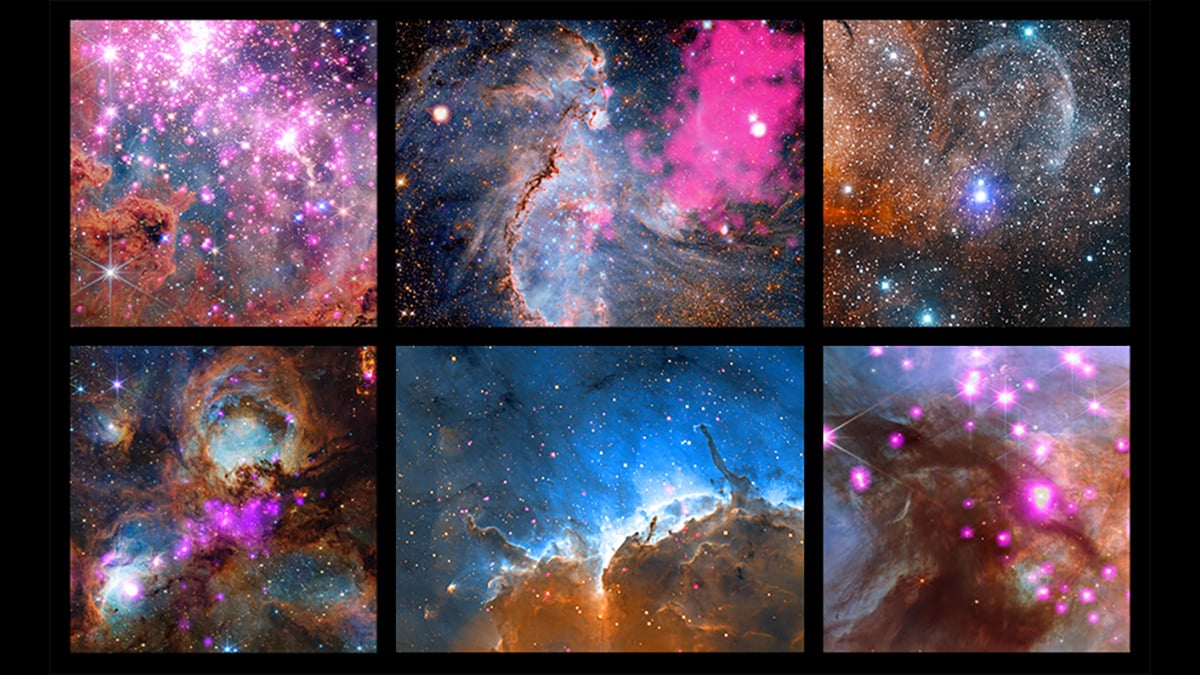
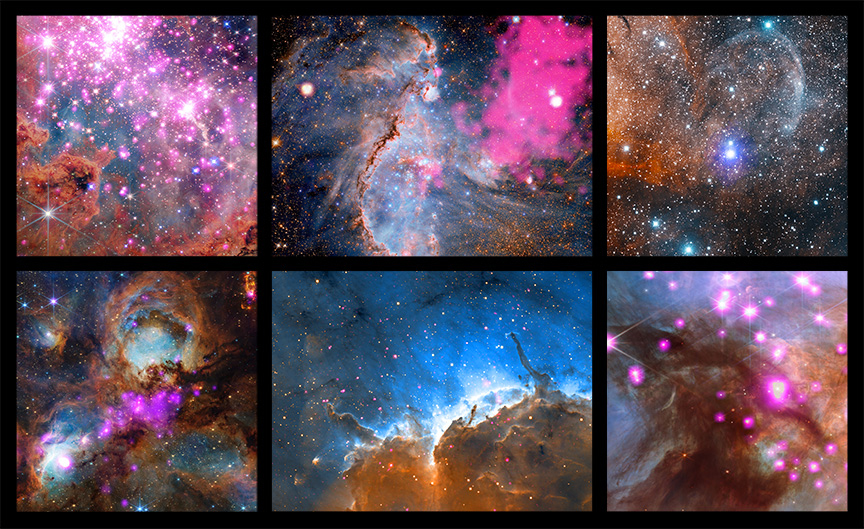
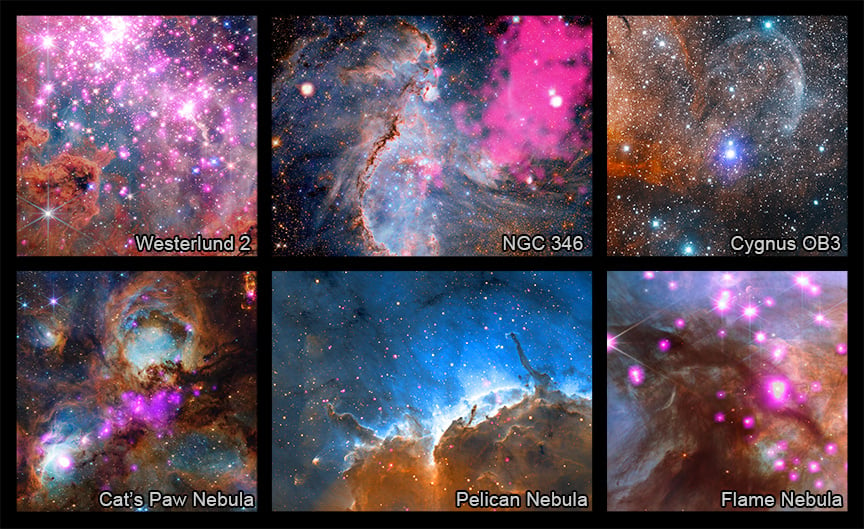
The Spring 2026 collection release from the Chandra X-ray Observatory presents six star-forming environments observed across multiple wavelengths. The targets include Westerlund 2, NGC 346, Cygnus OB3, the Cat’s Paw Nebula, the Pelican Nebula, and the Flame Nebula. These regions span distances from nearby molecular clouds to a neighboring dwarf galaxy. They also represent a range of evolutionary stages, cluster densities, and feedback conditions. As a result, the collection provides a comparative framework for understanding how stellar birth proceeds under different physical environments.
Chandra’s Spring collection of images
Chandra observations play a central role in this study. Young stars produce strong X-ray emission through magnetic reconnection events and accretion shocks. Massive stars generate additional high-energy radiation through powerful stellar winds and wind-collision zones in binary systems. When combined with infrared and optical imaging, these observations reveal both embedded stellar populations and the large-scale structure of the surrounding interstellar medium.
These multi-wavelength images allow astronomers to connect individual young stars with the larger molecular cloud complexes that host them. It also clarifies how radiation from massive stars modifies nearby gas and influences later generations of star formation. The six regions highlighted in the Spring 2026 release form a coherent observational sample that traces the structure and evolution of stellar nurseries across widely different environments.
Westerlund 2: A young massive cluster
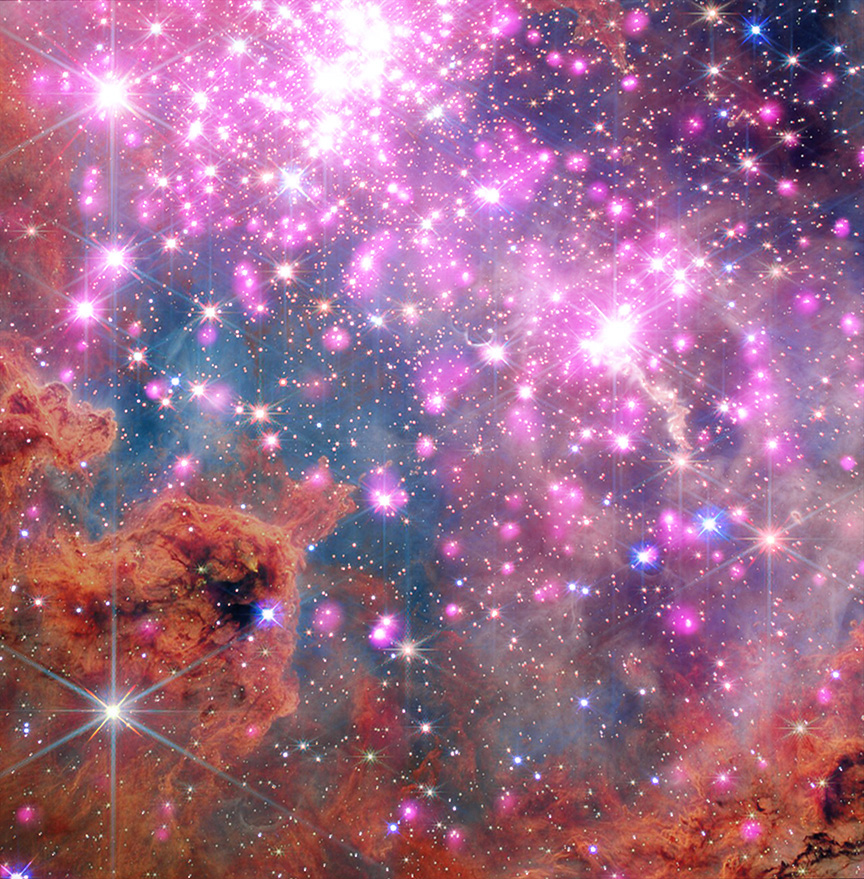
Westerlund 2 lies inside the Carina spiral-arm region of the Milky Way at a distance of roughly 13,000 light-years. The cluster remains embedded within the emission nebula RCW 49, which still contains large quantities of molecular gas and dust. This environment indicates that star formation continues in the region. At the same time, strong stellar feedback has already begun reshaping the surrounding cloud.
Chandra observations detect hundreds of X-ray sources across the cluster field. Many correspond to pre-main-sequence stars that remain deeply embedded inside dusty gas. These young stars exhibit strong magnetic activity. Consequently, they produce intense X-ray emission that allows astronomers to identify cluster members even when optical observations fail to detect them.
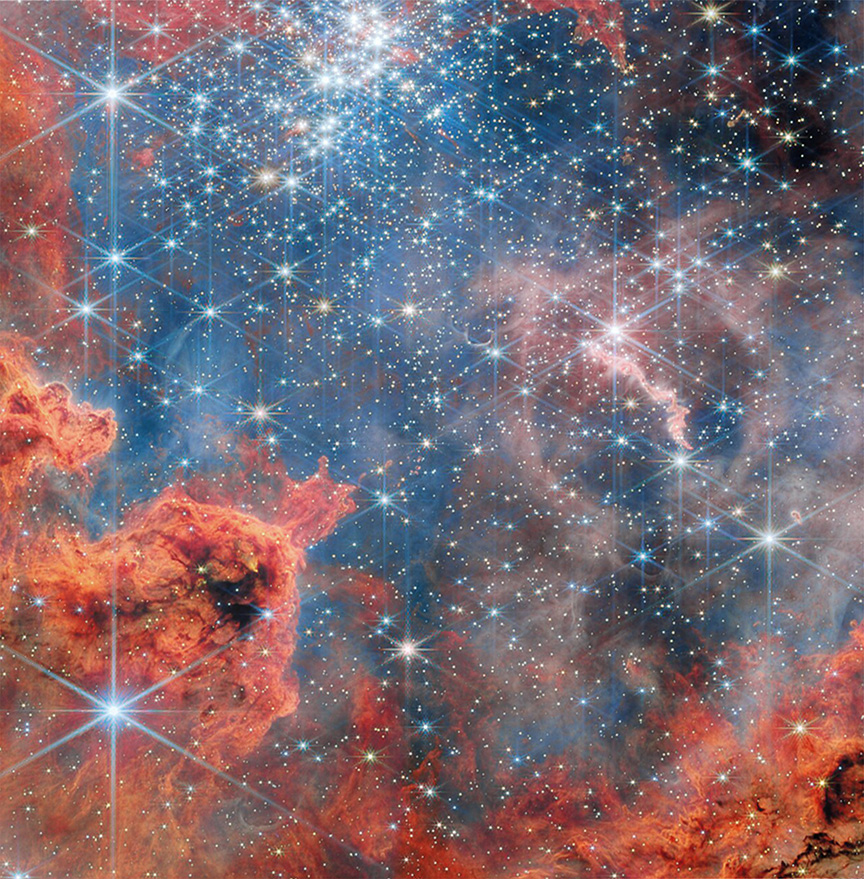
The cluster hosts several very massive O-type stars whose ultraviolet radiation ionizes nearby hydrogen gas. As a result, the surrounding nebula shows extended regions of ionized emission. Stellar winds from these stars carve cavities inside the molecular cloud. These cavities expand with time and compress nearby gas layers. In turn, compressed gas may collapse and form additional stars along the edges of the expanding shells.
Chandra also detects bright emission from colliding-wind binary systems inside the cluster. In these systems, supersonic stellar winds interact and produce high-temperature plasma. The resulting shocks generate strong X-ray radiation that traces energy transfer within the cluster environment.
NGC 346: A metal-poor laboratory for extragalactic star formation
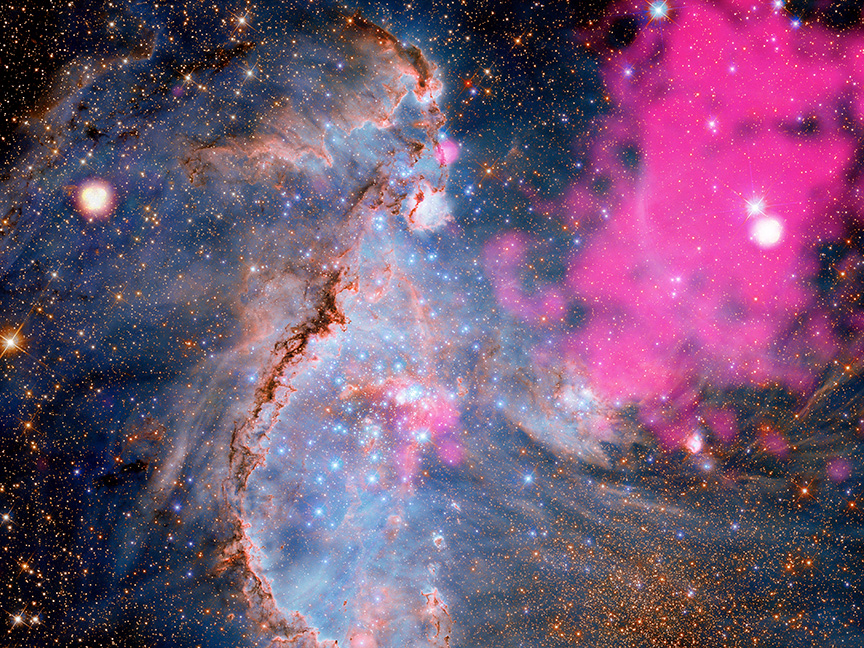
NGC 346 lies within the Small Magellanic Cloud at a distance of nearly 200,000 light-years. It represents the most active star-forming region in that galaxy. Because the Small Magellanic Cloud contains fewer heavy elements than the Milky Way, this region provides a useful comparison with star-forming environments in the early universe.
The central cluster contains several hundred young stars distributed across a compact area. Many formed during recent episodes of star formation that occurred within the last few million years. Chandra observations reveal strong X-ray emission from both low-mass and intermediate-mass members of the cluster.
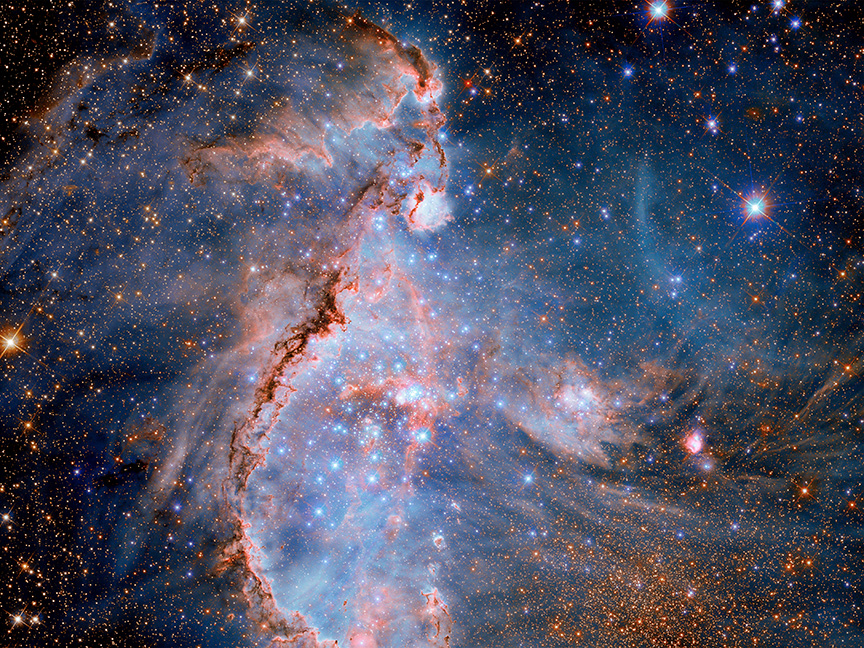
The surrounding nebula shows complex filamentary structures shaped by radiation from massive stars. These stars emit intense ultraviolet light that ionizes nearby gas. As the ionized region expands, it modifies the density structure of the surrounding molecular cloud. Consequently, star formation shifts toward the edges of the expanding cavities.
Infrared imaging reveals circumstellar disks around several intermediate-mass stars. These disks represent potential sites of planet formation. Their detection confirms that disk formation proceeds even in metal-poor environments.
Chandra observations also reveal variability in the X-ray emission of several cluster members. These variations reflect magnetic reconnection events and accretion processes that occur during early stellar evolution. Such activity strongly influences the structure of circumstellar disks and the rotation rates of young stars.
Cygnus OB3: A stellar association near a historic black hole system
Cygnus OB3 forms part of the extended Cygnus star-forming complex located along the Orion Arm of the Milky Way. This complex contains multiple stellar associations, molecular clouds, and emission nebulae distributed across several hundred light-years. The region represents one of the most active large-scale star-forming environments in our galaxy.
The association itself contains numerous massive stars formed from the same parent molecular cloud. These stars emit strong ultraviolet radiation that ionizes surrounding gas and produces large emission regions visible across the Cygnus complex. Chandra observations detect many X-ray sources associated with both massive stars and embedded lower-mass cluster members.
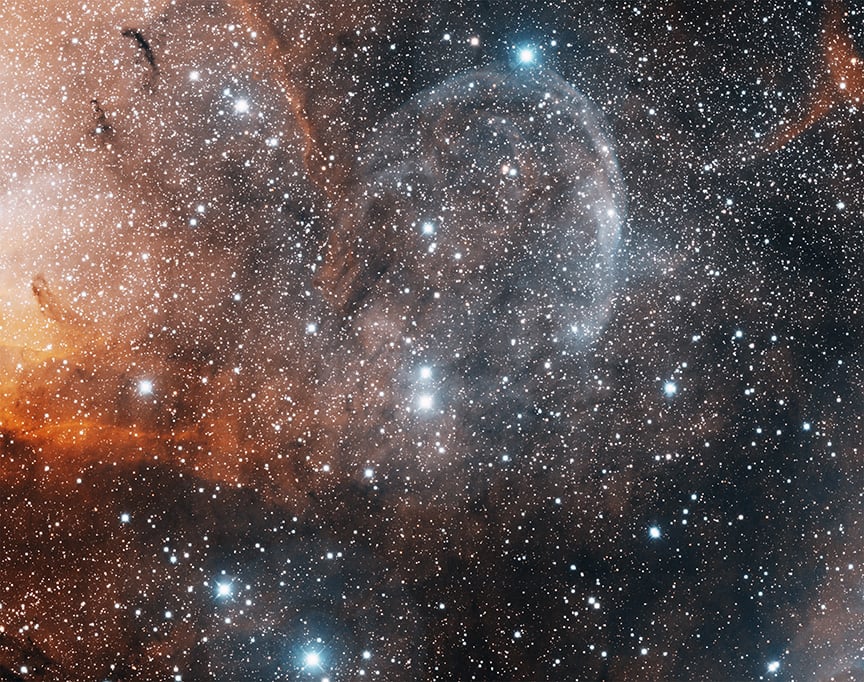
Cygnus OB3 lies close to the well-known X-ray binary Cygnus X-1. This system contains a stellar-mass black hole orbiting a massive blue supergiant companion star. Gas from the companion star accretes onto the black hole and produces strong X-ray emission. Observations of this system provided some of the earliest compelling evidence for the existence of stellar-mass black holes.
Infrared surveys reveal numerous embedded clusters scattered throughout the region. Chandra observations help identify additional young stars that remain hidden within dense gas layers.
Massive stars inside the association will eventually explode as supernovae. These explosions will enrich the surrounding gas with heavy elements and reshape the local interstellar medium. In this way, Cygnus OB3 connects early stellar evolution with the later stages that produce compact remnants such as neutron stars and black holes.
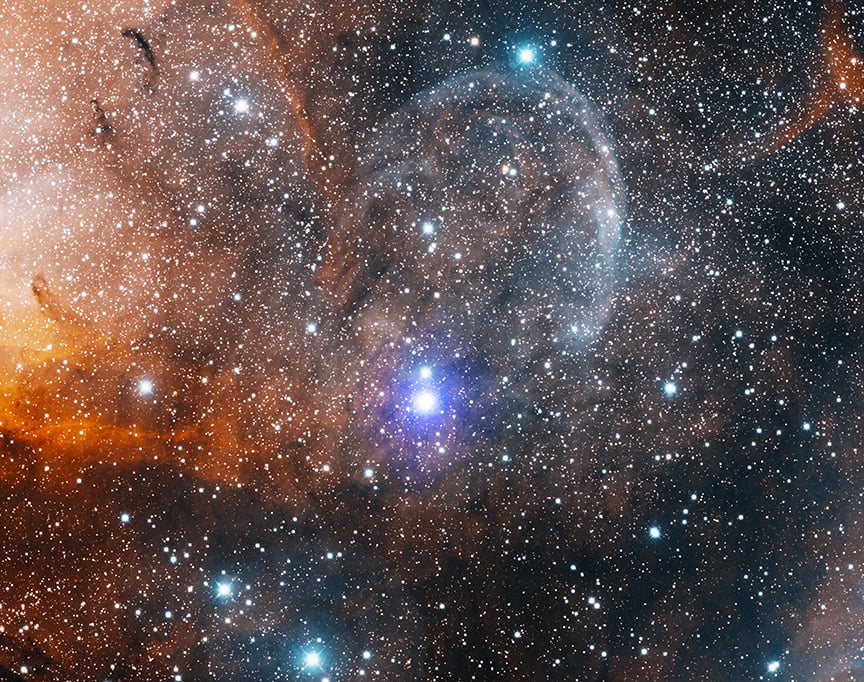
Cat’s Paw Nebula: A rich network of filaments
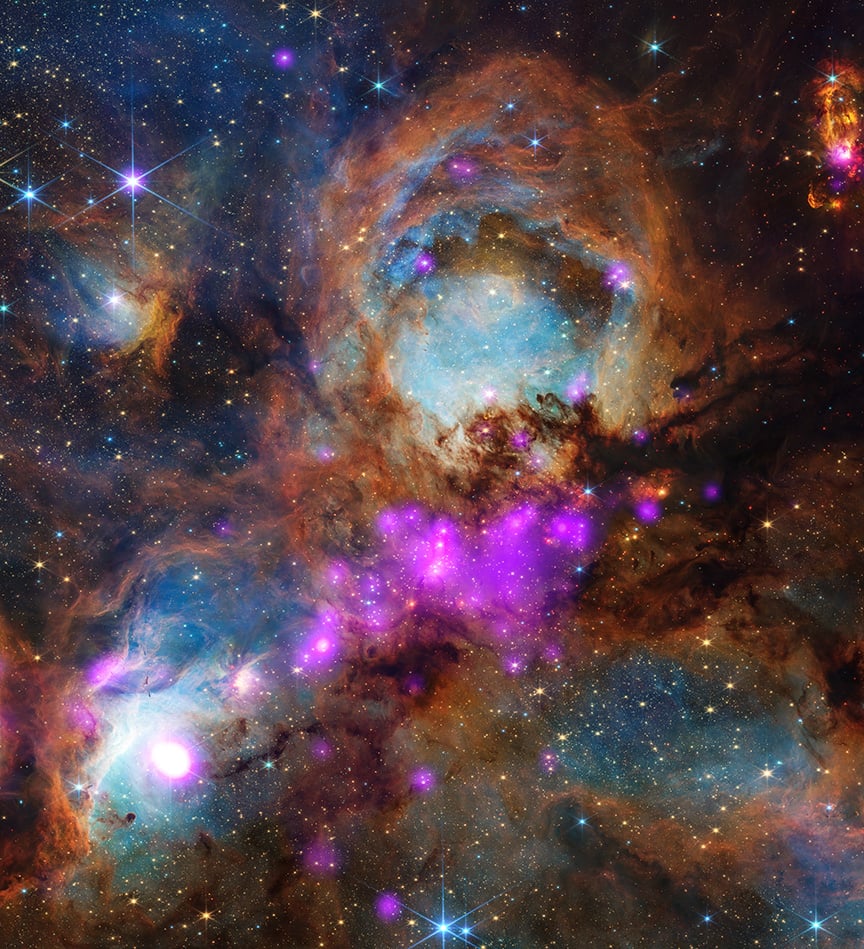
The Cat’s Paw Nebula, also known as NGC 6334, lies about 5,500 light-years away in the constellation Scorpius. It represents one of the most active massive star-forming complexes in the Milky Way. The nebula contains several dense molecular cores aligned along a large filamentary structure that extends across tens of light-years.
These dense cores host clusters of young stars still embedded inside thick dust clouds. Chandra observations detect numerous X-ray sources associated with these clusters. Many correspond to pre-main-sequence stars whose optical emission remains obscured by dust. As a result, X-ray observations provide an essential tool for identifying the cluster population.
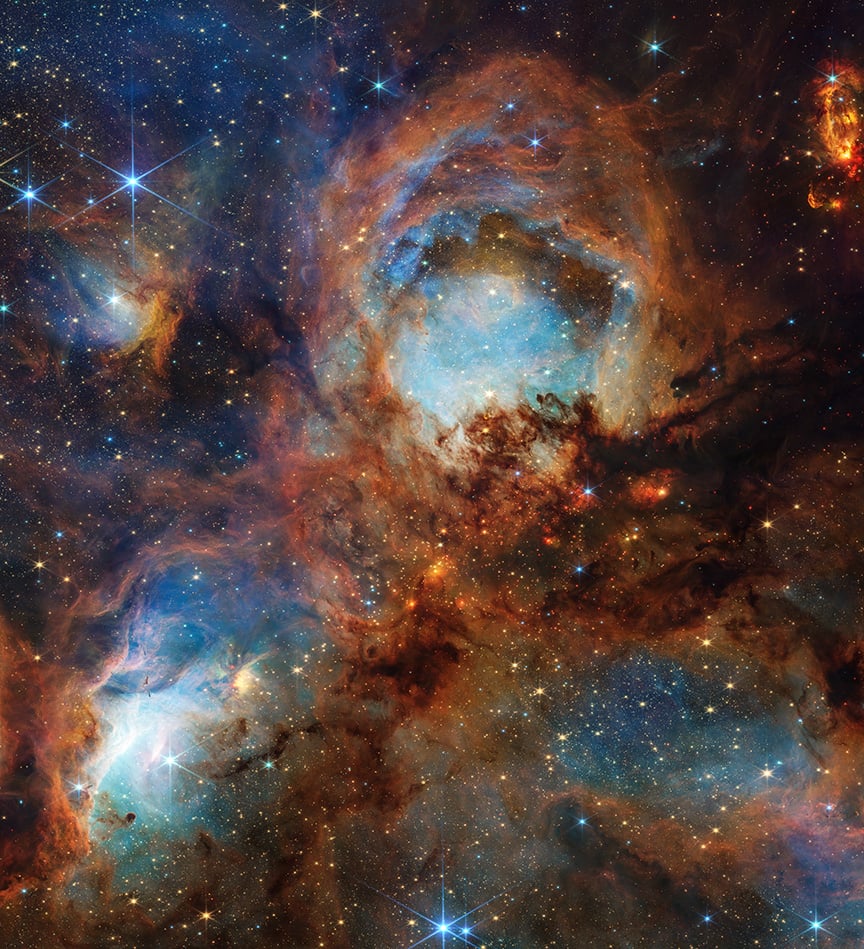
Infrared imaging reveals complex networks of filaments that trace the distribution of cold molecular gas throughout the nebula. These filaments fragment into dense clumps under the influence of gravity and turbulence. Each clump can collapse to form a small group of stars. Consequently, the nebula contains multiple cluster-forming sites distributed across the cloud.
The region also hosts several high-mass protostars that remain deeply embedded inside their natal envelopes. These objects continue accreting material from surrounding gas. Their radiation already influences nearby cloud structure even before they reach the main sequence.
Stellar winds from newly formed massive stars create expanding bubbles that reshape the surrounding environment. These bubbles compress nearby gas layers and sometimes trigger additional star formation along their edges. Such feedback processes influence the long-term evolution of the entire molecular cloud complex.
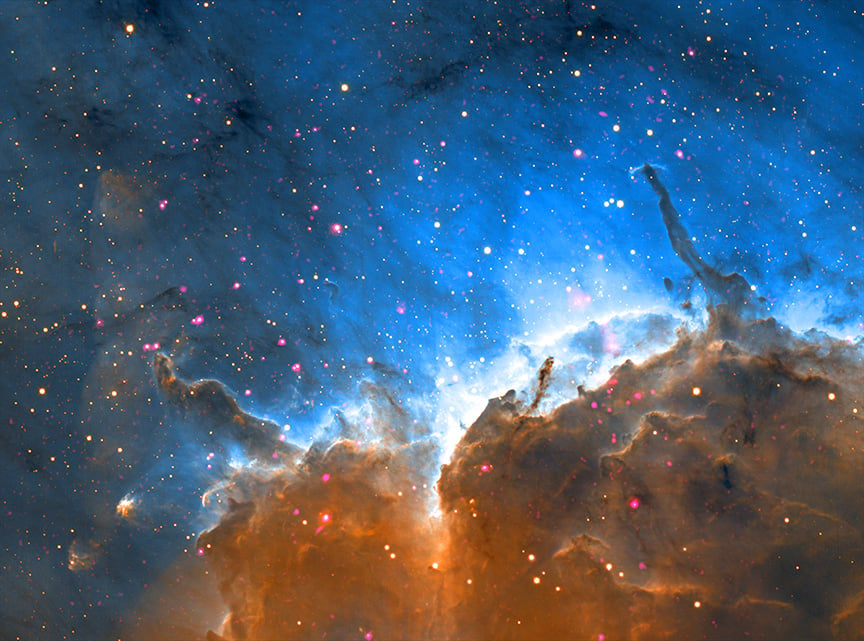
Pelican Nebula: Inside a nearby molecular cloud complex
The Pelican Nebula forms part of the Cygnus molecular cloud complex at a distance of approximately 2,600 light-years. It lies adjacent to the North America Nebula and shares the same large reservoir of molecular gas. These structures represent one of the nearest large star-forming complexes accessible to detailed observation.
Ultraviolet radiation from nearby massive stars illuminates the surface layers of the cloud and produces bright emission structures visible in optical images. However, dense dust within the cloud hides the youngest stellar populations. Chandra observations reveal these embedded stars through their strong X-ray emission.
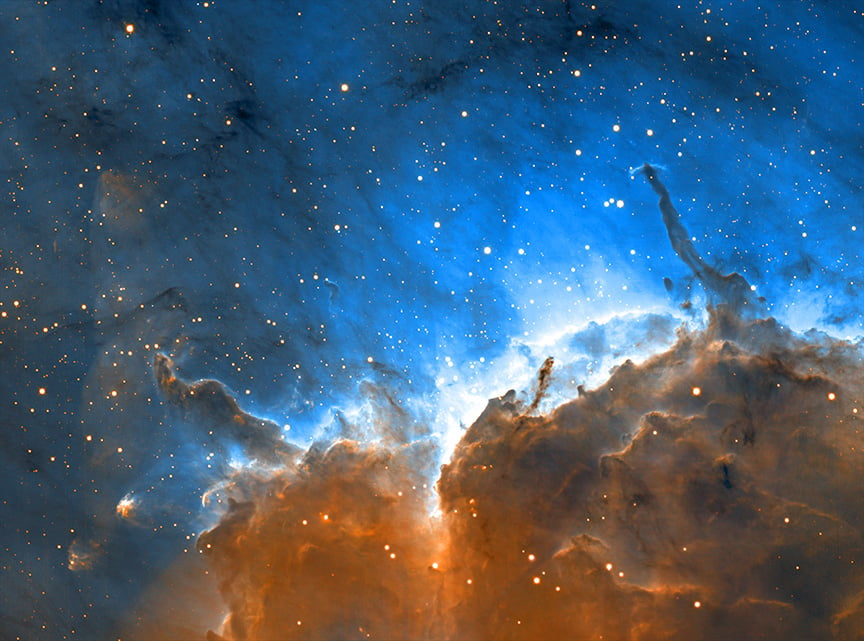
Infrared imaging shows elongated pillars of gas extending away from the direction of the ionizing radiation sources. These pillars form as radiation erodes less dense material surrounding denser cores. The remaining dense regions persist longer and eventually collapse to form stars. As a result, the nebula displays a striking pattern of radiation-shaped structures.
Several compact stellar clusters appear within the molecular cloud. These clusters formed from fragmented gas cores that collapsed under gravity. Observations of their structure help astronomers understand how cluster formation proceeds inside large molecular complexes.
Young stars inside the Pelican Nebula produce strong X-ray emission through magnetic reconnection events in their outer atmospheres. These events influence stellar rotation and the evolution of circumstellar disks. Consequently, they affect the early conditions under which planetary systems may develop.
Flame Nebula: A cluster inside the Orion molecular cloud complex
The Flame Nebula lies within the Orion Molecular Cloud Complex at a distance of roughly 1,350 light-years. This complex represents one of the nearest major star-forming environments to the Solar System. Its proximity allows astronomers to study embedded stellar populations with high spatial resolution.
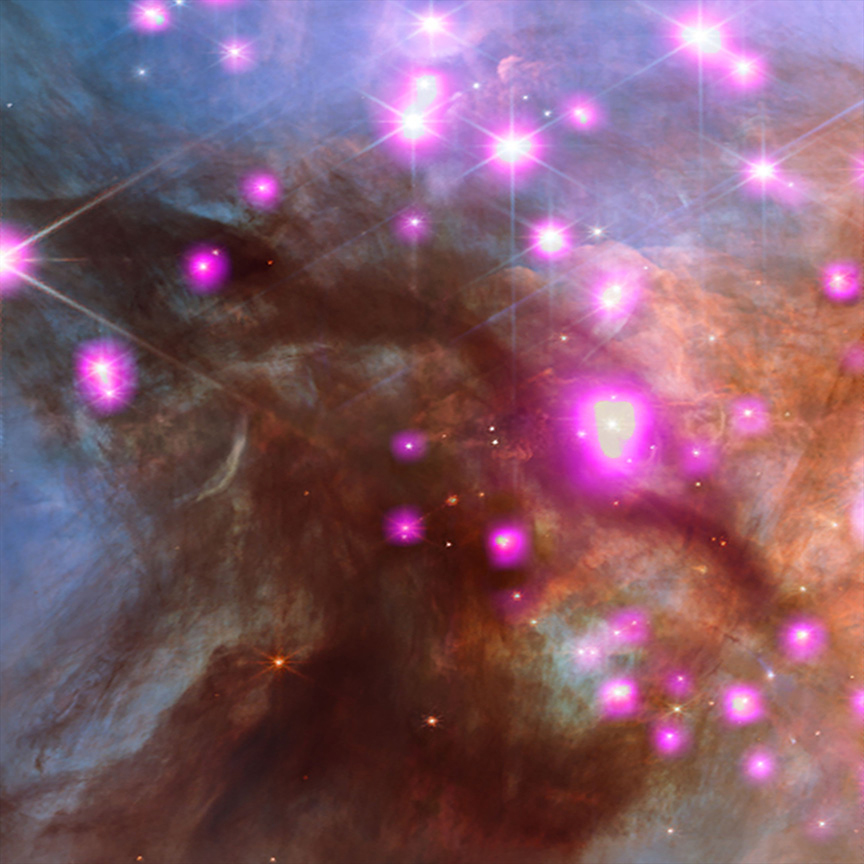
The nebula contains a young cluster hidden behind dense foreground dust lanes. Optical observations reveal only the outer illuminated layers of the cloud. Infrared and X-ray observations penetrate deeper into the region and expose the embedded stellar population.
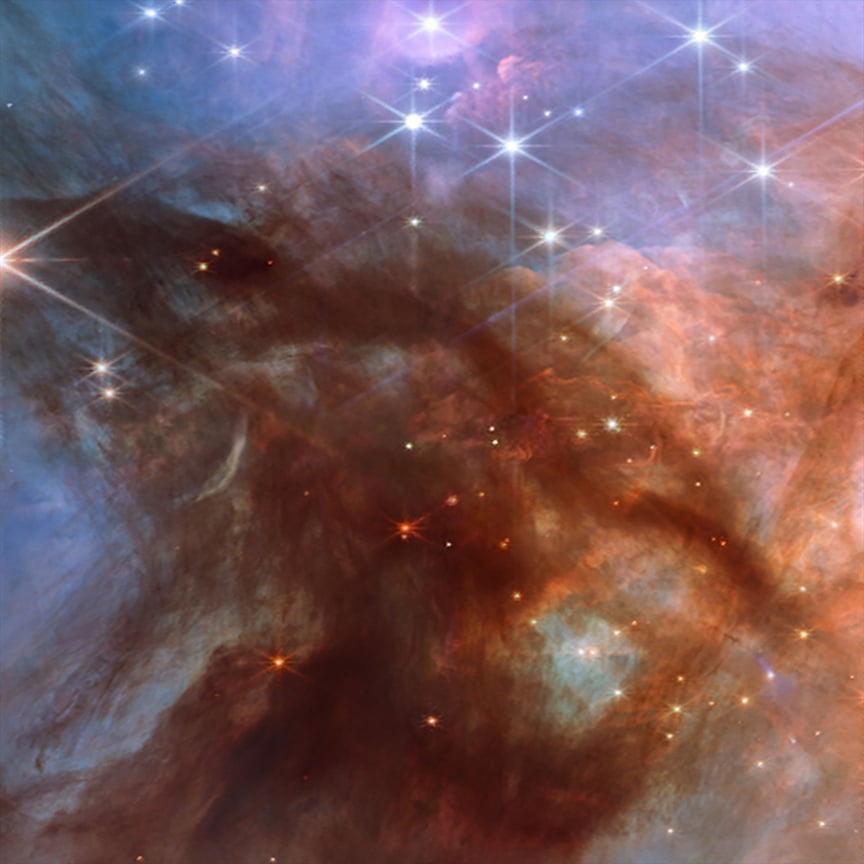
Radiation from nearby massive stars ionizes hydrogen gas within the nebula and produces bright emission regions visible in optical images. At the same time, dense dust structures create dark lanes that obscure the cluster interior. These lanes trace the distribution of cold molecular material inside the cloud.
Chandra observations detect X-ray emission from many young stars inside the cluster. These emissions arise from strong magnetic activity and accretion processes associated with early stellar evolution. Observations of this activity help astronomers measure the age distribution of cluster members.
At least one massive O-type star inside the region strongly influences the surrounding cloud structure. Its radiation compresses nearby gas and contributes to additional episodes of star formation within the molecular complex.
X-ray Observations: A window into the earliest phases of stellar evolution
The Spring 2026 Chandra image collection highlights six regions that span a wide range of star-forming environments across the Milky Way and nearby galaxies. Each region illustrates a different combination of cloud structure, stellar density, and feedback strength. When considered together, they provide a comparative view of how stars form under diverse physical conditions.
X-ray observations remain essential for identifying embedded stellar populations that remain invisible at optical wavelengths. They also reveal high-temperature plasma generated by stellar winds, magnetic activity, and accretion processes. When combined with infrared and optical data, these observations allow astronomers to trace both individual young stars and the structure of their parent molecular clouds.
Massive stars play a central role in shaping the evolution of these environments. Their radiation ionizes the surrounding gas, while their winds compress nearby cloud layers. Over time, their supernova explosions will enrich the interstellar medium with heavy elements and influence future generations of star formation.
Clear skies!
See more from DIYPhotography.net on Google
Add DIYPhotography.net as a trusted source. This makes
our stories more likely to appear in your Google Search results.
 Add as a preferred source on Google

Soumyadeep Mukherjee
Soumyadeep Mukherjee is an award-winning astrophotographer from India. He has a doctorate degree in Linguistics. His work extends to the sub-genres of nightscape, deep sky, solar, lunar and optical phenomenon photography. He is also a photography educator and has conducted numerous workshops. His works have appeared in over 40 books & magazines including Astronomy, BBC Sky at Night, Sky & Telescope among others, and in various websites including National Geographic, NASA, Forbes. He was the first Indian to win “Astronomy Photographer of the Year” award in a major category.


Join the Discussion
DIYP Comment Policy
Be nice, be on-topic, no personal information or flames.