


























Cosmic Steering Wheel: DECam Reveals the Structure of NGC 1269
Mar 11, 2026
Soumyadeep Mukherjee
Soumyadeep Mukherjee is an award-winning astrophotographer from India. He has a doctorate degree in Linguistics. His work extends to the sub-genres of nightscape, deep sky, solar, lunar and optical phenomenon photography. He is also a photography educator and has conducted numerous workshops. His works have appeared in over 40 books & magazines including Astronomy, BBC Sky at Night, Sky & Telescope among others, and in various websites including National Geographic, NASA, Forbes. He was the first Indian to win “Astronomy Photographer of the Year” award in a major category.
Share:

Astronomers classify galaxies by their shapes, internal structures, and stellar distributions. These properties reveal how galaxies formed and evolved over cosmic time. Spiral galaxies, for instance, typically show a central bulge surrounded by a rotating disk and spiral arms. However, some galaxies display additional structures such as bars, rings, or disrupted disks. These features often point to past gravitational interactions.
A recent image released by NSF’s NOIRLab highlights one such galaxy. The object, NGC 1269, lies in the southern constellation Eridanus at a distance of roughly 33 million light-years. Astronomers observed it with the Dark Energy Camera (DECam) mounted on the Víctor M. Blanco 4-meter Telescope at Cerro Tololo Inter-American Observatory in Chile. The observation reveals an unusual pattern of rings surrounding the galaxy’s center. Together with a prominent bar structure, these rings create an appearance that resembles a giant steering wheel. For this reason, astronomers informally refer to the galaxy as the “Cosmic Steering Wheel.”
A spiral galaxy viewed almost face-on
NGC 1269 belongs to the broad class of spiral galaxies, systems that contain rotating stellar disks embedded in halos of dark matter. In many spirals, bright arms extend outward from the center and trace regions of active star formation. However, NGC 1269 presents a somewhat different appearance.
The galaxy appears almost face-on from Earth. This viewing angle allows astronomers to observe the arrangement of its internal structures with unusual clarity. Instead of dominant spiral arms, the most noticeable features are concentric ring-like structures surrounding the galaxy’s bright nucleus.

At the center lies a compact stellar bulge, which contains a dense population of older stars. Crossing this region is a distinct bar structure. Galactic bars are elongated concentrations of stars that extend from the nucleus into the surrounding disk. They are commonly found in many spiral galaxies and often influence the movement of gas and stars in the inner regions.
In NGC 1269, the bar cuts across the nucleus and connects with the surrounding disk. Meanwhile, the ring structures form circular patterns around the central region. Together, these components create the distinctive wheel-like geometry visible in the DECam image.

The role of the Dark Energy Camera
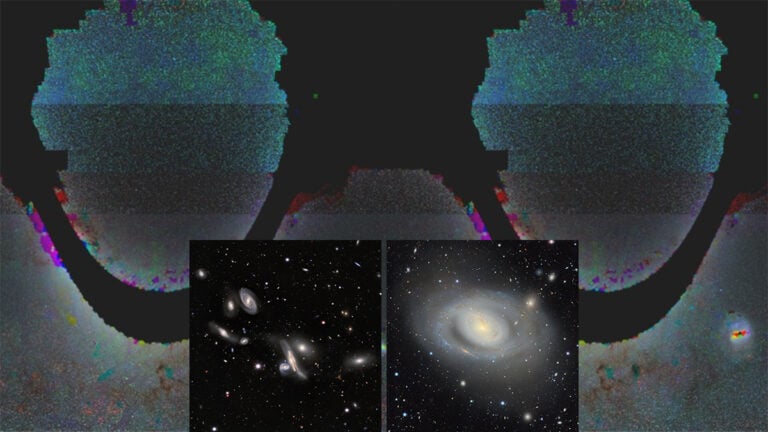
The image of NGC 1269 was captured by the Dark Energy Camera, commonly referred to as DECam. This instrument ranks among the most powerful wide-field optical cameras currently used in astronomy.
DECam contains 74 large charge-coupled device detectors arranged in a mosaic pattern. Together they produce highly detailed digital images while covering a wide area of the sky. The camera can observe a region about two degrees across in a single exposure, which corresponds to several times the apparent diameter of the full Moon.
Scientists originally built DECam for the Dark Energy Survey, an international project that operated between 2013 and 2019. The survey aimed to measure the large-scale distribution of galaxies across the southern sky. Astronomers hoped that these measurements would reveal the influence of dark energy, the unknown component responsible for the accelerated expansion of the universe.
During the survey, DECam recorded images of hundreds of millions of galaxies. The resulting dataset remains one of the most extensive optical surveys ever conducted.
Although the main survey has concluded, DECam continues to operate at Cerro Tololo. Astronomers now use the instrument for many other research programs. These include studies of nearby galaxies, observations of supernovae, and searches for near-Earth asteroids. The image of NGC 1269 comes from data obtained during these observations. Scientists later processed the data to create the final color image released by NOIRLab.

The Blanco Telescope and Cerro Tololo Observatory
DECam operates on the Víctor M. Blanco Telescope, a major research instrument in the Southern Hemisphere. The telescope sits at Cerro Tololo Inter-American Observatory (CTIO) in northern Chile.
The site provides excellent observing conditions. It lies more than 2,200 meters above sea level, where the atmosphere remains stable and dry. In addition, the region experiences many clear nights throughout the year. These factors allow telescopes to capture sharp and sensitive images of faint celestial objects.
The Blanco telescope uses a 4-meter primary mirror to collect light from distant sources. When combined with a sensitive instrument such as DECam, the telescope can detect extremely faint galaxies and subtle structures within them.
Today, CTIO operates as part of NSF’s NOIRLab, an organization that manages several major astronomical facilities funded by the U.S. National Science Foundation. These facilities support a wide range of research programs and provide astronomers with access to modern observational tools.
Large survey projects rely on observatories like CTIO because they can gather enormous volumes of data over many years. Researchers then analyze these datasets to explore questions about the structure and evolution of the universe.

Background galaxies in the field of view
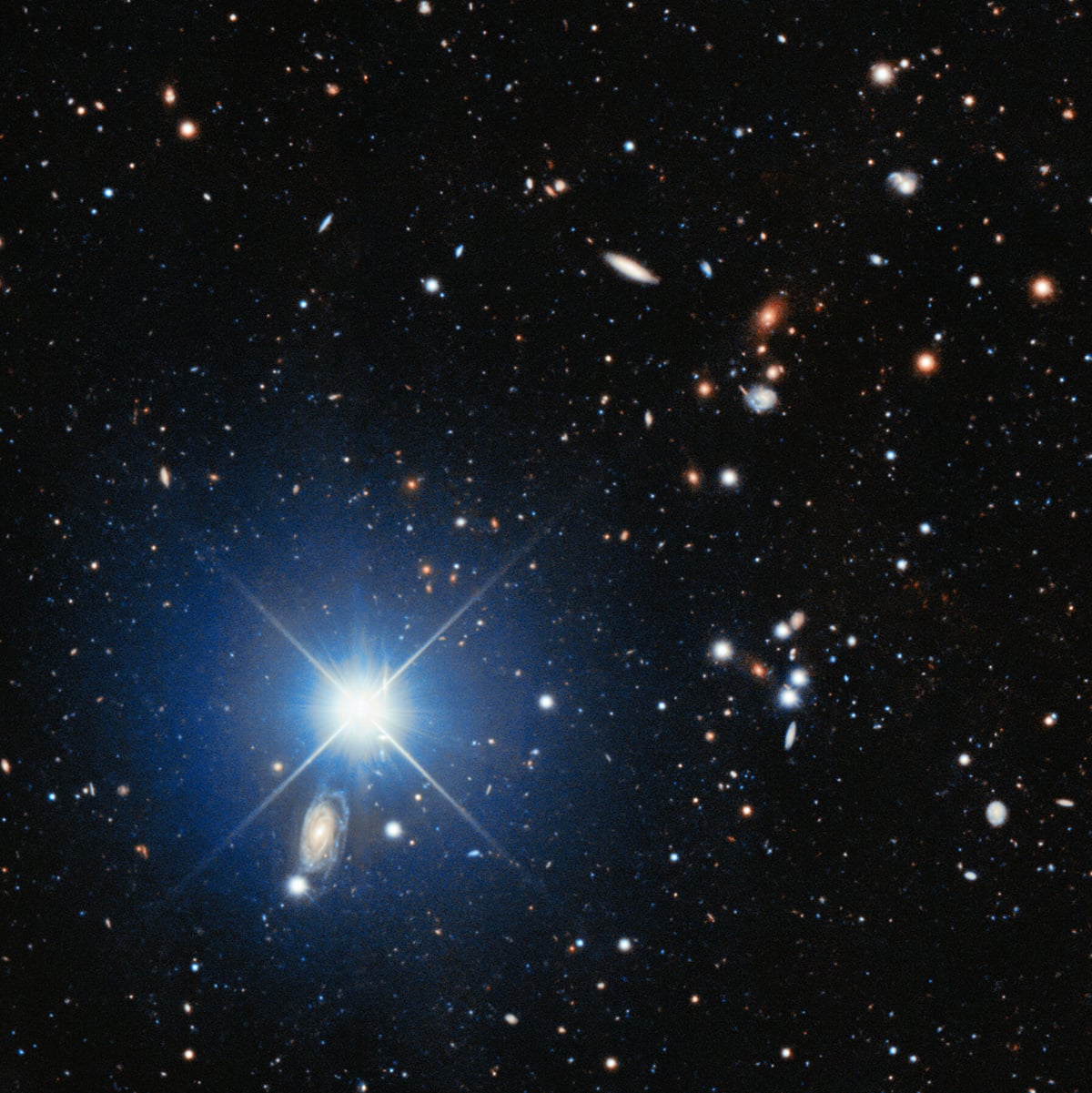
While NGC 1269 dominates the DECam image, the surrounding field contains many additional galaxies. These distant systems appear as faint smudges scattered across the background.
Each of these objects represents a separate galaxy containing billions of stars. Many lie hundreds of millions or even billions of light-years away from Earth. Their presence illustrates the depth of modern astronomical observations.
Wide-field cameras such as DECam frequently record these background galaxies during observations of nearby objects. The long exposures needed to capture faint structures in the main target also reveal distant systems located far behind it.
These background galaxies are not merely visual curiosities. Astronomers often analyze them to study the large-scale distribution of matter in the universe. In some cases, researchers measure slight distortions in their shapes caused by gravitational lensing. This phenomenon occurs when massive objects bend the path of light traveling through space.
By studying these distortions, scientists can map the distribution of dark matter between Earth and the distant galaxies. Thus, even a single wide-field observation can contribute to several areas of research at once.
Clear skies!
See more from DIYPhotography.net on Google
Add DIYPhotography.net as a trusted source. This makes
our stories more likely to appear in your Google Search results.
 Add as a preferred source on Google

Soumyadeep Mukherjee
Soumyadeep Mukherjee is an award-winning astrophotographer from India. He has a doctorate degree in Linguistics. His work extends to the sub-genres of nightscape, deep sky, solar, lunar and optical phenomenon photography. He is also a photography educator and has conducted numerous workshops. His works have appeared in over 40 books & magazines including Astronomy, BBC Sky at Night, Sky & Telescope among others, and in various websites including National Geographic, NASA, Forbes. He was the first Indian to win “Astronomy Photographer of the Year” award in a major category.


Join the Discussion
DIYP Comment Policy
Be nice, be on-topic, no personal information or flames.