
























Dark Matter and Cosmic Collisions: DECam “Bites” the Bullet Cluster
Jan 26, 2026
Soumyadeep Mukherjee
Soumyadeep Mukherjee is an award-winning astrophotographer from India. He has a doctorate degree in Linguistics. His work extends to the sub-genres of nightscape, deep sky, solar, lunar and optical phenomenon photography. He is also a photography educator and has conducted numerous workshops. His works have appeared in over 40 books & magazines including Astronomy, BBC Sky at Night, Sky & Telescope among others, and in various websites including National Geographic, NASA, Forbes. He was the first Indian to win “Astronomy Photographer of the Year” award in a major category.
Share:

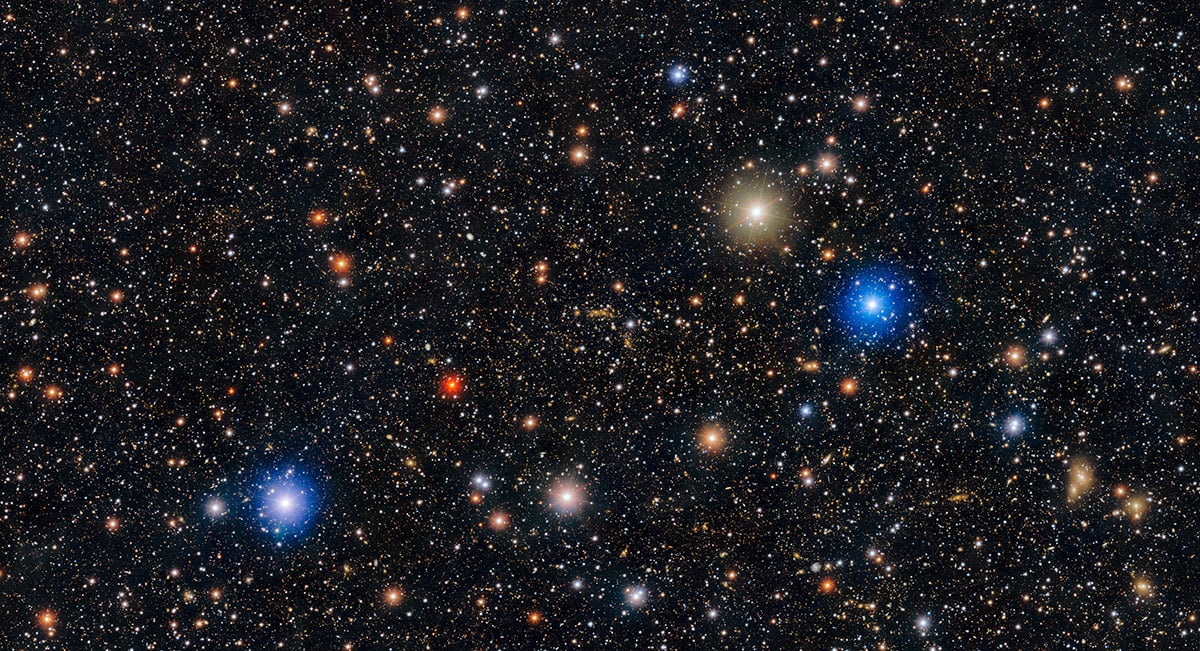
For decades, astronomers have sought direct evidence of the unseen mass that dominates our universe. They call this mass dark matter, a mysterious substance that does not emit, reflect, or absorb light but exerts a powerful gravitational influence. The Bullet Cluster, officially designated 1E 0657-56, has become one of the most compelling cosmic laboratories for studying dark matter. Now, a new ultra-high-resolution image taken with the Dark Energy Camera (DECam) and released by NSF’s NOIRLab offers an unprecedented view of this dramatic collision between two galaxy clusters.
A look at a historic collision
The Bullet Cluster lies about 3.7 billion light-years from Earth, in the southern constellation Carina. It is the result of a collision between two massive galaxy clusters, each a vast collection of hundreds of galaxies, enormous clouds of superheated gas, and massive halos of dark matter.
This collision did not happen in the distant past in cosmic time; it began roughly 150 million years ago, which is a recent event in the history of the universe. As the smaller cluster passed through the larger one, the components behaved differently. Stars and galaxies largely surge through each other because they are widely spaced and interact only through gravity. However, the hot gas in each cluster, which contributes most of the visible, baryonic matter, slammed into the opposing gas and slowed dramatically due to friction and pressure.
The result was a spectacular cosmic event with enormous energy release. Astronomers detected this shock front as a bow-shaped X-ray feature rising from gas heated to tens of millions of degrees. This shockwave has a power equivalent to that of millions of quasars, making the Bullet Cluster one of the most energetic collisions since the Big Bang.
The Dark Energy camera: Capturing the cosmic landscape
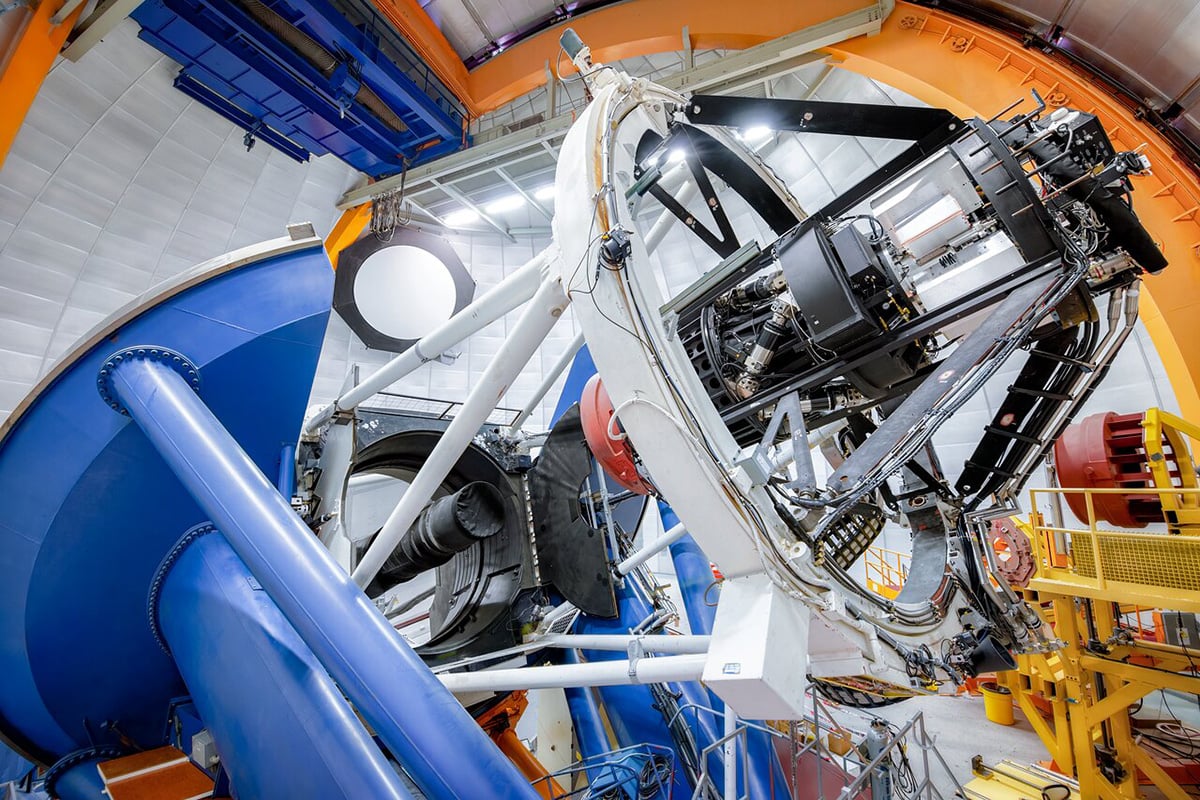
The new image of the Bullet Cluster was taken with the Dark Energy Camera (DECam). DECam is one of the most advanced optical instruments in astronomy. Its 570-megapixel sensor is built to capture wide swaths of sky with exceptional clarity. Located on the Víctor M. Blanco 4-meter Telescope at the Cerro Tololo Inter-American Observatory in Chile, DECam was originally developed for the Dark Energy Survey, a major program to map the expansion of the universe and explore what drives its acceleration.
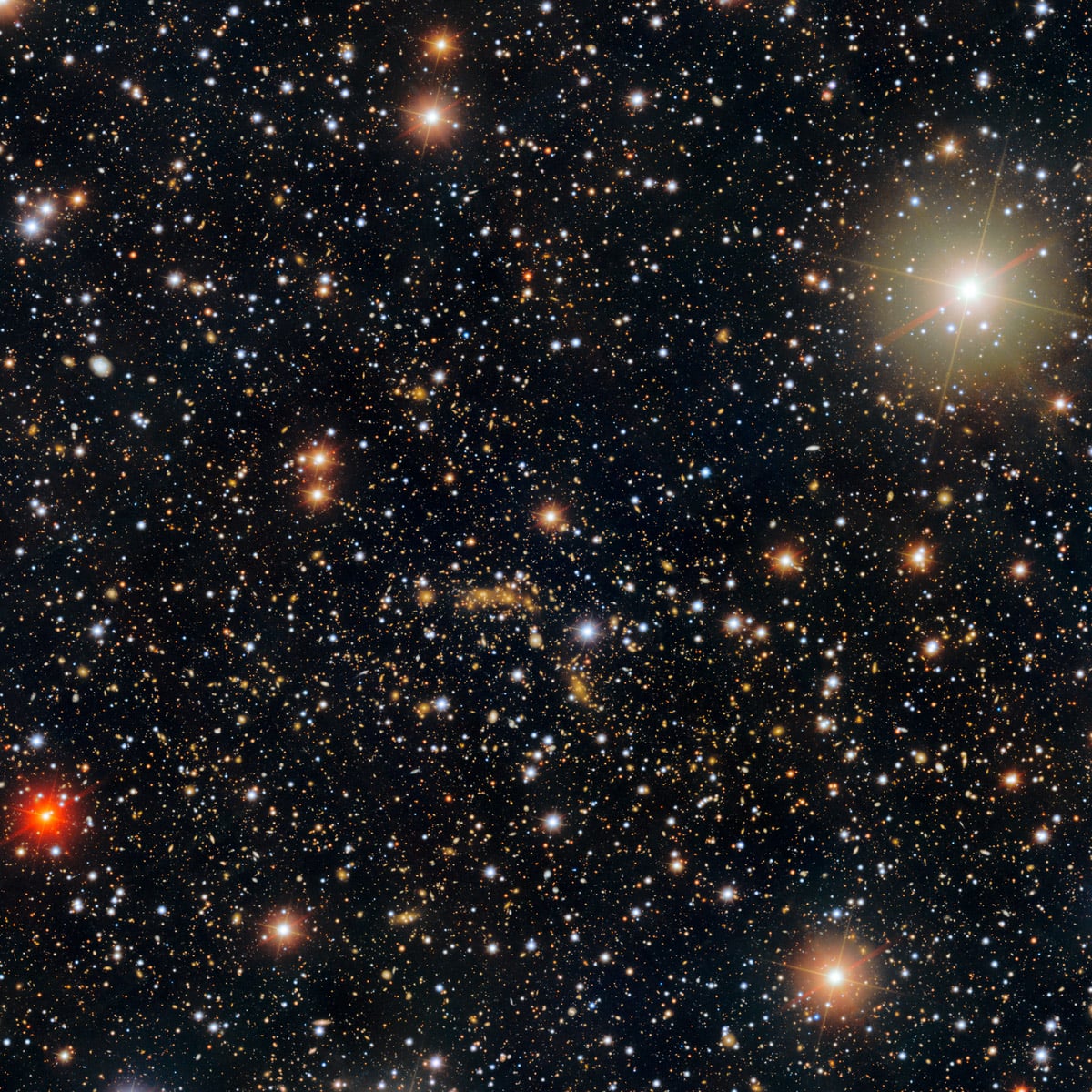
After the formal end of the Dark Energy Survey, DECam continued to produce world-class science. The Bullet Cluster image released by NOIRLab is extraordinarily large, nearly 20,000 pixels wide and over 10,000 pixels tall at full resolution, and provides a detailed optical view of the cluster field. This enables the resolution of countless galaxies, distant background objects, and subtle distortions caused by gravitational lensing.
DECam observes in optical wavelengths, similar to what human eyes would perceive if we could see faint astronomical objects. Each point of light in the DECam image represents a galaxy, whether part of the cluster or far behind it. The camera’s depth and resolution help scientists study the distribution of matter and the lensing effects that reveal invisible mass.
Gravitational lensing: Mapping invisible mass
One of the most remarkable features of the Bullet Cluster is how it bends light from galaxies behind it. This bending, known as gravitational lensing, occurs because massive objects warp space-time, altering the path of light from distant sources. The stronger the gravitational field, the more pronounced the effect.
When astronomers analyze the lensing patterns in the Bullet Cluster field, they can infer where most of the mass lies, even if that mass is not visible in optical or X-ray light. In the Bullet Cluster, the lensing signal does not align with the hot X-ray gas. Instead, the regions of strongest lensing coincide with the distribution of galaxies and, by extension, the invisible dark matter halos that surround them. These halos appear to have passed through the collision relatively unimpeded, unlike the collisional gas.
This separation of mass and visible gas is central to why the Bullet Cluster became such a pivotal observation. It provides empirical evidence that most of the cluster’s gravitational field is dominated by dark matter, a matter that does not interact significantly with itself or with light.
Bullet cluster: A cornerstone for dark matter research
Earlier, a landmark study using NASA’s Chandra X-ray Observatory and optical telescopes mapped the Bullet Cluster in multiple wavelengths. The researchers discovered that most of the mass, inferred from gravitational lensing, was offset from the hot gas detected in X-rays. The simplest explanation was that a major portion of the mass was in a form that did not interact electromagnetically and therefore slipped through the collision without slowing. This was exactly the predicted behavior of dark matter under standard cosmological models.
Alternative theories of gravity, such as Modified Newtonian Dynamics (MOND), strive to explain cosmic phenomena without invoking dark matter. However, those theories struggle to reproduce the clear separation seen between the visible gas and total mass in the Bullet Cluster. Because dark matter remains effectively collisionless, it remains aligned with the cluster’s galaxies rather than lagging behind the slowed gas.
The Bullet Cluster also provides constraints on the physical properties of dark matter particles. If dark matter interacted strongly with itself, astronomers would expect deviations in the distribution of lensing peaks after a collision. Instead, the halos inferred from lensing remain largely intact and aligned with the galaxies. This suggests that dark matter’s self-interaction cross-section is very low; in other words, it interacts primarily through gravity.

Complementary observations and new insights
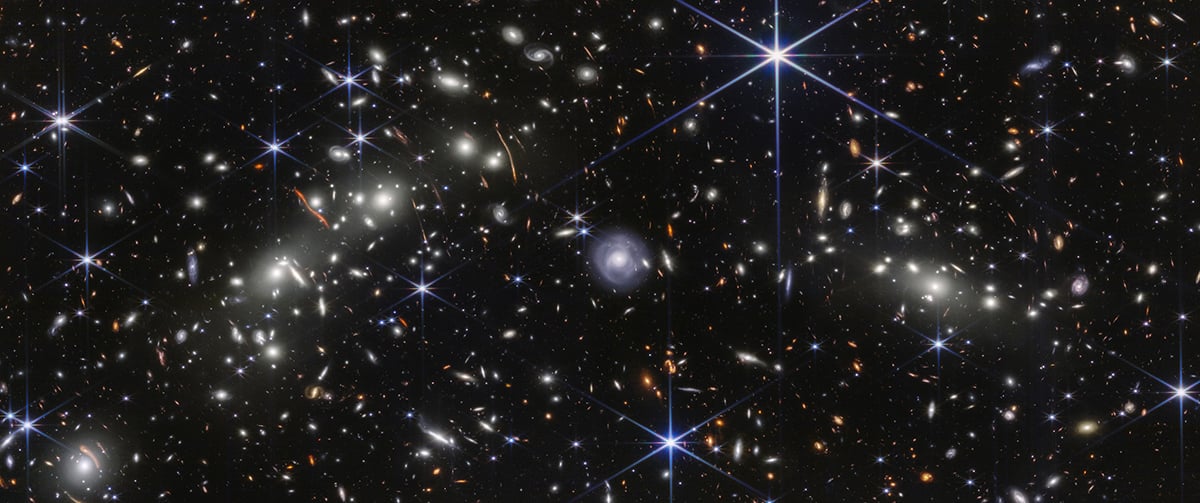
The DECam image adds a valuable optical perspective, but the Bullet Cluster is studied across the spectrum. X-ray observations reveal the hot intracluster gas and the shock front created by the collision. Infrared data from telescopes like the James Webb Space Telescope (JWST) refine measurements of the mass distribution and reveal stars that are no longer bound to individual galaxies, so-called intracluster stars, which can trace dark matter’s distribution.
Recent work combining data from JWST and DECam has shown that the Bullet Cluster may involve more complex mass structures than previously thought. For example, researchers identified asymmetries in the cluster’s mass distribution that hint at prior mergers or interactions. These multi-telescope studies help refine not only the mass estimates but also how the cluster evolved.
By layering optical, infrared, and X-ray data, astronomers gain a holistic view. Optical light reveals star systems and lensing distortions. Infrared light uncovers faint, distant galaxies and intracluster stars. X-rays show the superheated gas that dominates the visible matter. These views paint the most complete picture yet of a cosmic collision that shaped the cluster’s structure and continues to reveal details about dark matter.
Clear skies!
See more from DIYPhotography.net on Google
Add DIYPhotography.net as a trusted source. This makes
our stories more likely to appear in your Google Search results.
 Add as a preferred source on Google

Soumyadeep Mukherjee
Soumyadeep Mukherjee is an award-winning astrophotographer from India. He has a doctorate degree in Linguistics. His work extends to the sub-genres of nightscape, deep sky, solar, lunar and optical phenomenon photography. He is also a photography educator and has conducted numerous workshops. His works have appeared in over 40 books & magazines including Astronomy, BBC Sky at Night, Sky & Telescope among others, and in various websites including National Geographic, NASA, Forbes. He was the first Indian to win “Astronomy Photographer of the Year” award in a major category.


Join the Discussion
DIYP Comment Policy
Be nice, be on-topic, no personal information or flames.