
















Two Observatories Capture a New Supernova in a Nearby Galaxy
Nov 14, 2026
Soumyadeep Mukherjee
Soumyadeep Mukherjee is an award-winning astrophotographer from India. He has a doctorate degree in Linguistics. His work extends to the sub-genres of nightscape, deep sky, solar, lunar and optical phenomenon photography. He is also a photography educator and has conducted numerous workshops. His works have appeared in over 40 books & magazines including Astronomy, BBC Sky at Night, Sky & Telescope among others, and in various websites including National Geographic, NASA, Forbes. He was the first Indian to win “Astronomy Photographer of the Year” award in a major category.
Share:
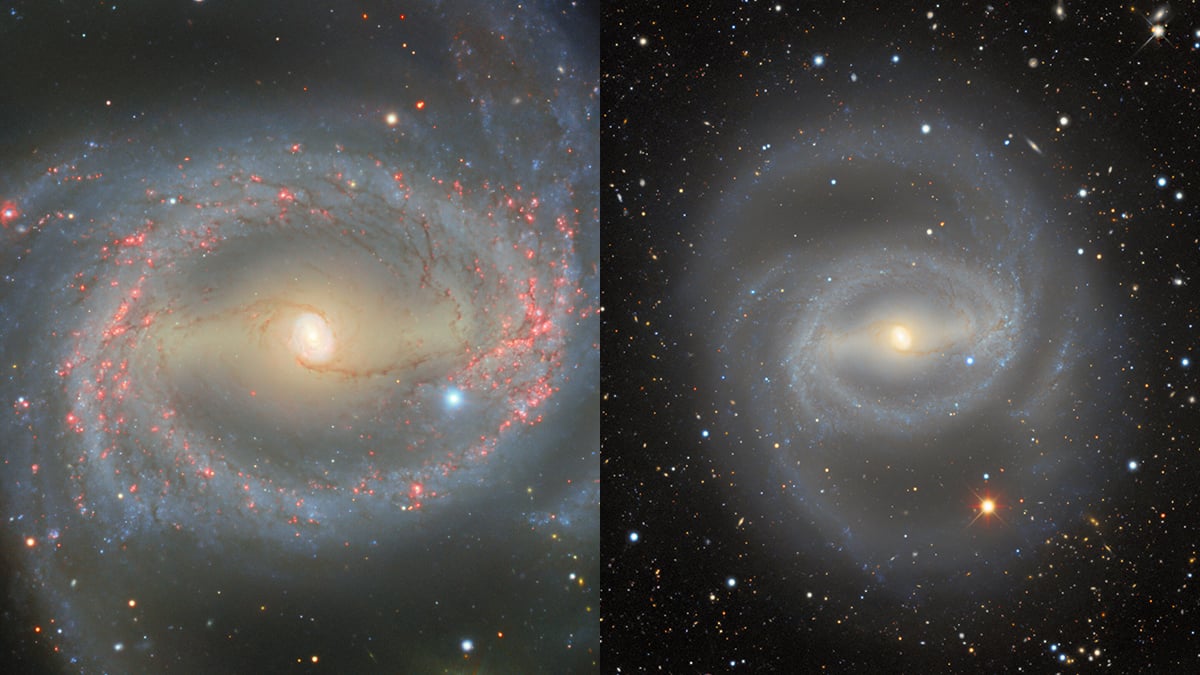
A supernova has appeared in the nearby spiral galaxy NGC 1433, and astronomers have caught it while its brightness is still increasing. The Asteroid Terrestrial-impact Last Alert System (ATLAS) discovered the object on November 2, 2026. Within days, two observatories in Chile turned their telescopes toward the galaxy. Their cameras captured the new explosion against the background of its spiral arms.
The first observation came from the Dark Energy Camera (DECam) at the Víctor M. Blanco 4-meter Telescope. Gemini South followed with an image taken using its Gemini Multi-Object Spectrograph (GMOS). The object, designated SN 2026ahvu, is a Type Ia supernova.
DECam and Gemini South photograph the same supernova
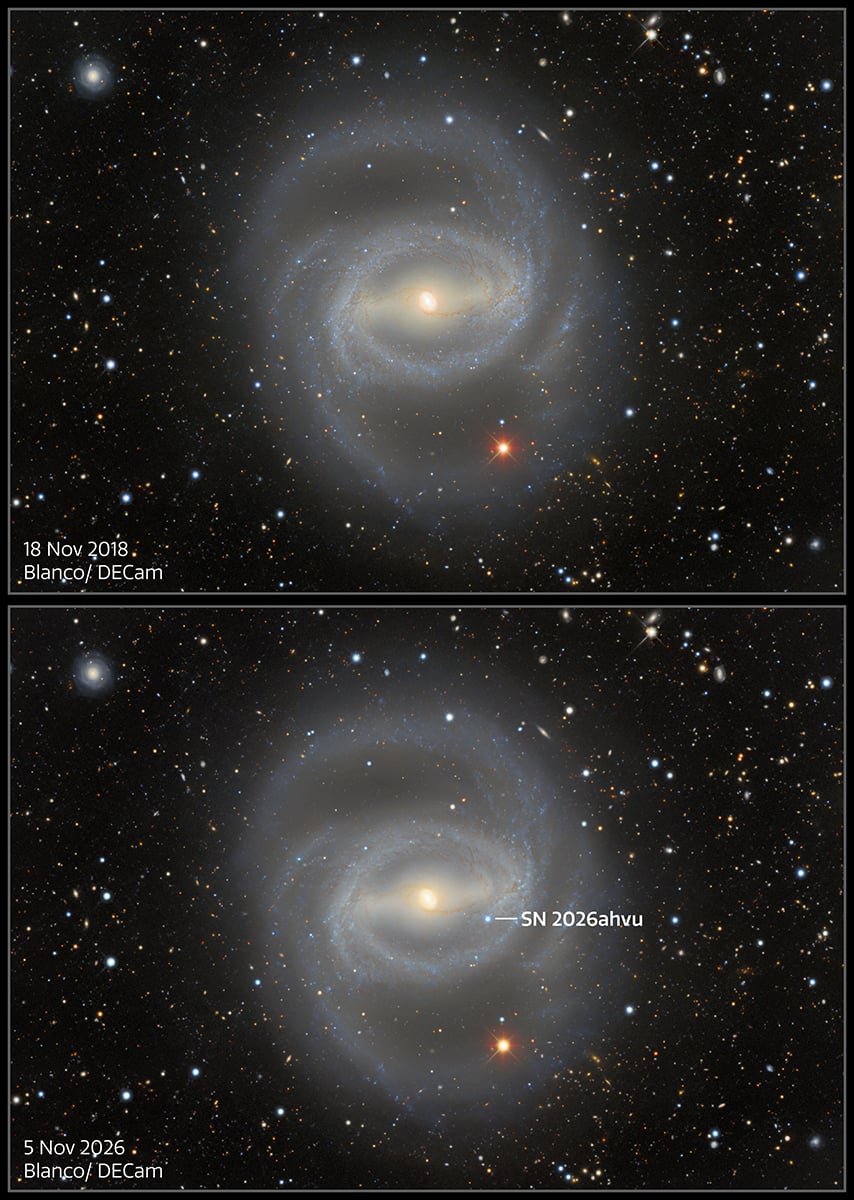
DECam captured the supernova images on November 5, just three days after ATLAS discovered it. The camera sits on the Víctor M. Blanco 4-meter Telescope at the Cerro Tololo Inter-American Observatory in Chile.
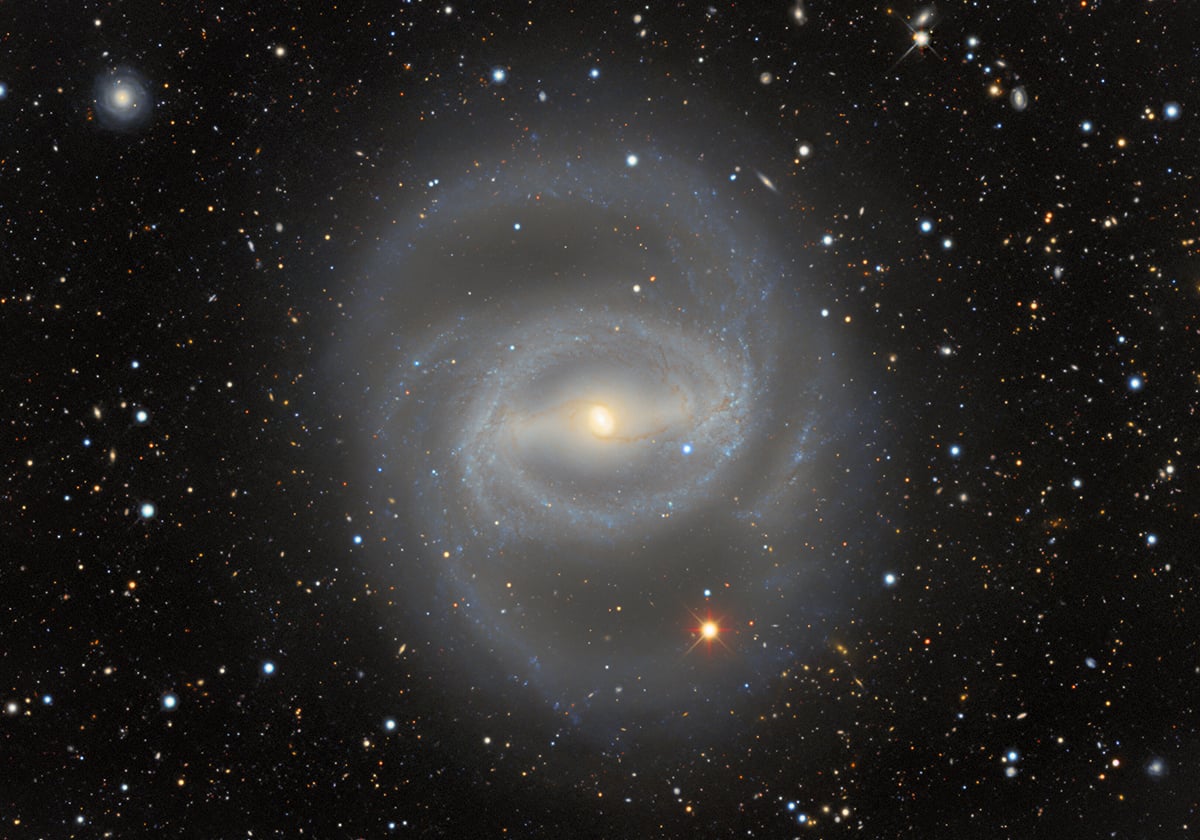
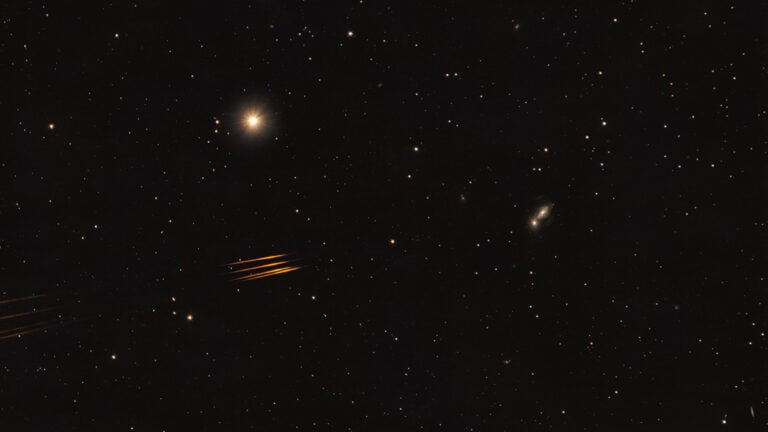
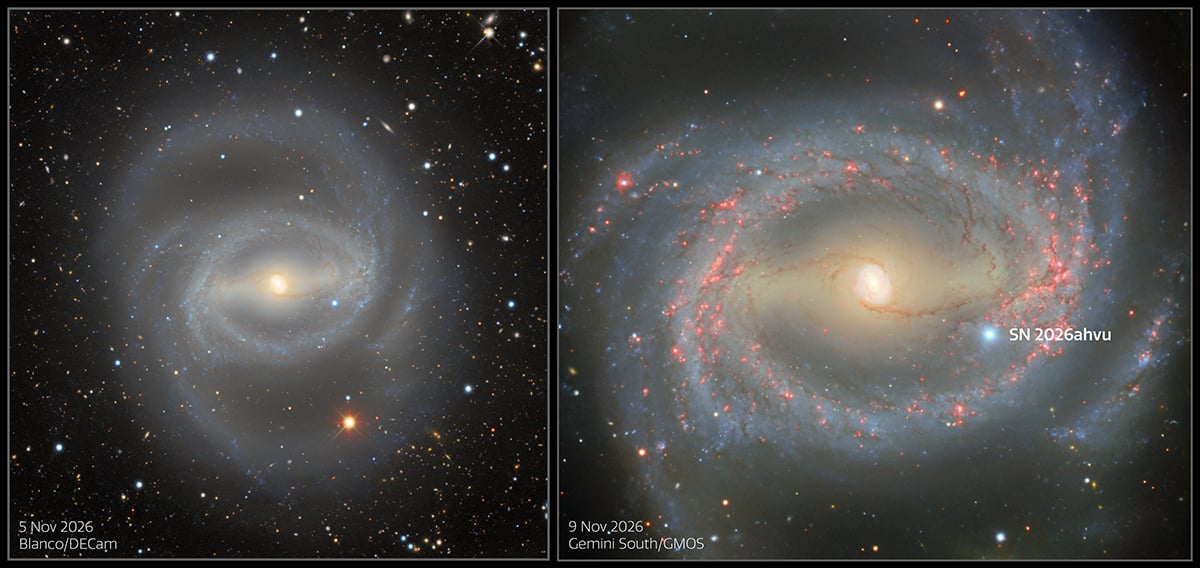
The image shows NGC 1433 surrounded by numerous foreground stars and distant background galaxies. The galaxy’s bright central region and spiral structure occupy the middle of the frame. SN 2026ahvu appears as a bright point of light to the right and slightly below the galaxy’s centre.
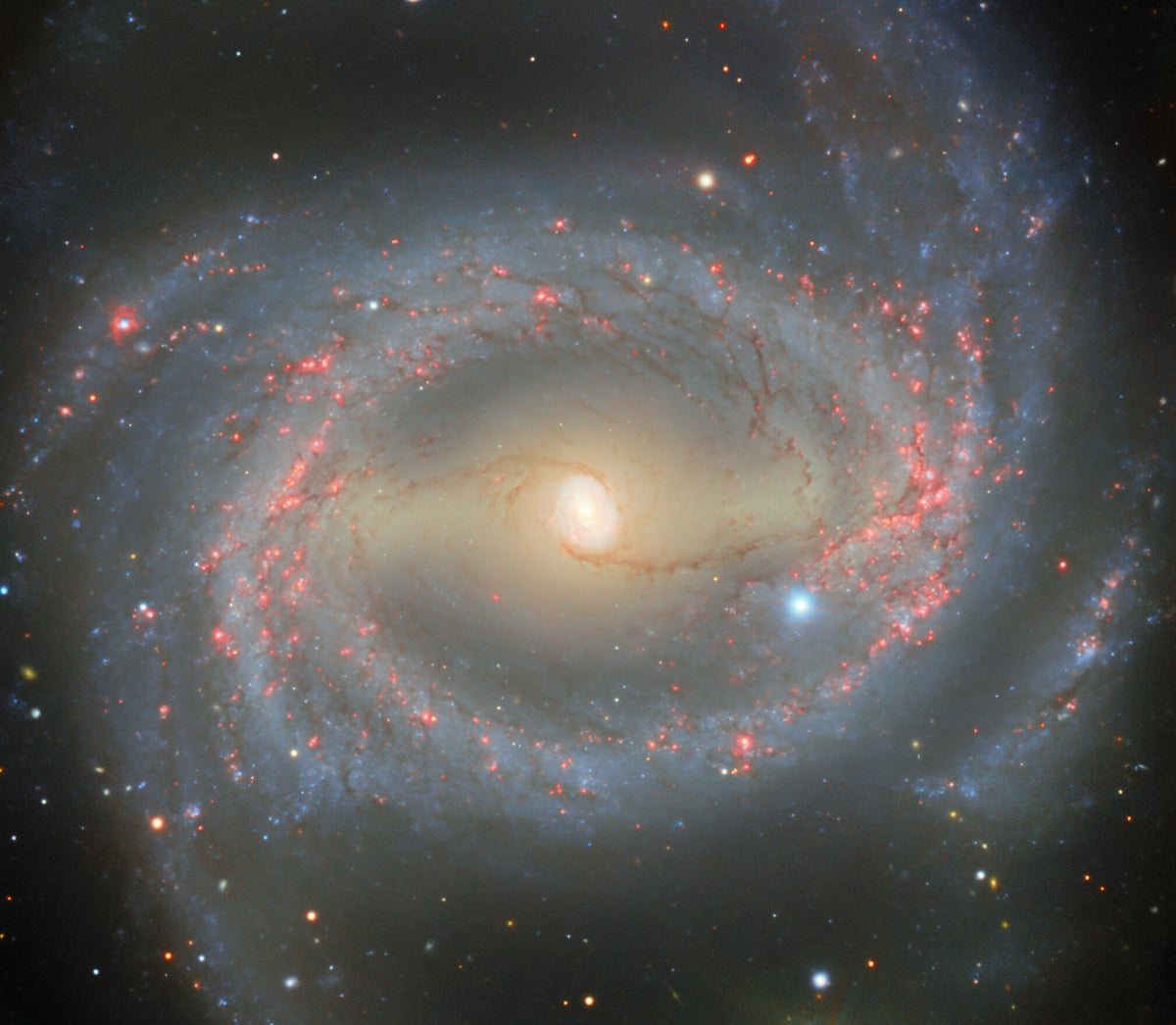
Four days later, on November 9, Gemini South photographed the same galaxy. The telescope used its Gemini Multi-Object Spectrograph to record the supernova and its surroundings. The resulting image shows the galaxy’s spiral arms and the bright regions scattered across them.
The galaxy before the explosion
Astronomers already had photographs of NGC 1433 from several years before SN 2026ahvu appeared. The camera collected those earlier observations during the Dark Energy Survey, a project led by the US Department of Energy’s Fermi National Accelerator Laboratory.
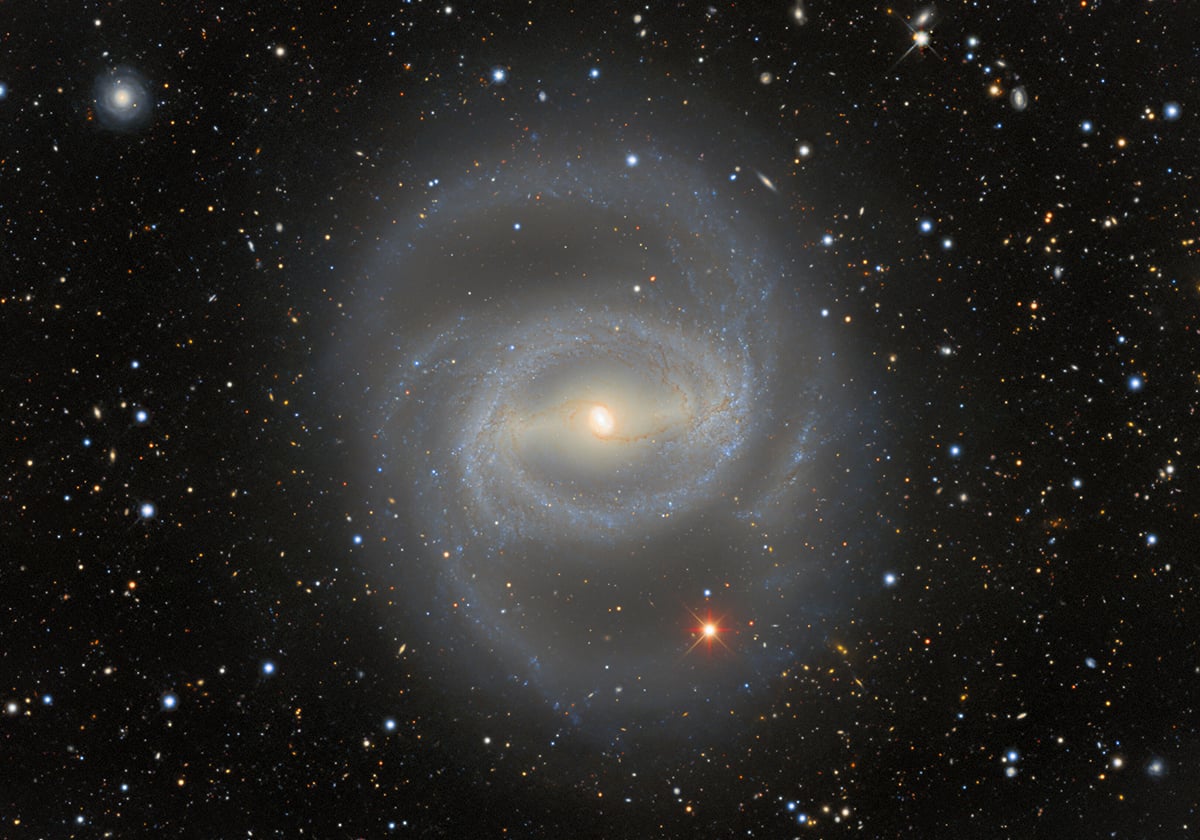
The survey ran from 2013 to 2019 and studied the distribution of galaxies across the southern sky. Its main goal was to investigate dark energy and understand the expansion of the universe. However, its extensive image archive now serves many other astronomical studies.
SN 2026ahvu: A Type Ia supernova
SN 2026ahvu is a Type Ia supernova, a category of stellar explosion involving a white dwarf. A white dwarf forms when a star similar to the Sun exhausts its nuclear fuel and sheds its outer layers. The remaining core becomes extremely dense. It can contain a substantial fraction of the Sun‘s mass within a volume comparable to Earth.
Many Type Ia supernova models involve a white dwarf in a binary system. The white dwarf pulls gas from a nearby companion star. As it accumulates material, conditions inside the star can trigger runaway thermonuclear reactions. The resulting explosion releases enormous energy and ejects stellar material into space.
Astronomers identified SN 2026ahvu as a young Type Ia supernova through spectroscopic observations. Spectroscopy allows researchers to study the light from an astronomical object across different wavelengths. The resulting spectrum contains features that help identify chemical elements and classify the explosion.
Clear skies!
See more from DIYPhotography.net on Google
Add DIYPhotography.net as a trusted source. This makes
our stories more likely to appear in your Google Search results.
 Add as a preferred source on Google

Soumyadeep Mukherjee
Soumyadeep Mukherjee is an award-winning astrophotographer from India. He has a doctorate degree in Linguistics. His work extends to the sub-genres of nightscape, deep sky, solar, lunar and optical phenomenon photography. He is also a photography educator and has conducted numerous workshops. His works have appeared in over 40 books & magazines including Astronomy, BBC Sky at Night, Sky & Telescope among others, and in various websites including National Geographic, NASA, Forbes. He was the first Indian to win “Astronomy Photographer of the Year” award in a major category.


Join the Discussion
DIYP Comment Policy
Be nice, be on-topic, no personal information or flames.