




















Hubble and Chandra Catch a Rare Black Hole Eating a Star
Jul 28, 2025
Soumyadeep Mukherjee
Soumyadeep Mukherjee is an award-winning astrophotographer from India. He has a doctorate degree in Linguistics. His work extends to the sub-genres of nightscape, deep sky, solar, lunar and optical phenomenon photography. He is also a photography educator and has conducted numerous workshops. His works have appeared in over 40 books & magazines including Astronomy, BBC Sky at Night, Sky & Telescope among others, and in various websites including National Geographic, NASA, Forbes. He was the first Indian to win “Astronomy Photographer of the Year” award in a major category.
Share:

NASA’s Hubble and Chandra telescopes have spotted something extraordinary. For the first time in years, they caught a rare type of black hole in the middle of a cosmic feast. This black hole is not tiny like the ones left behind by dead stars. It is not massive like the ones sitting in galactic centers. Instead, it lies in between. It is an intermediate-mass black hole, a long-hunted missing link in black hole science.
A black hole caught in the act
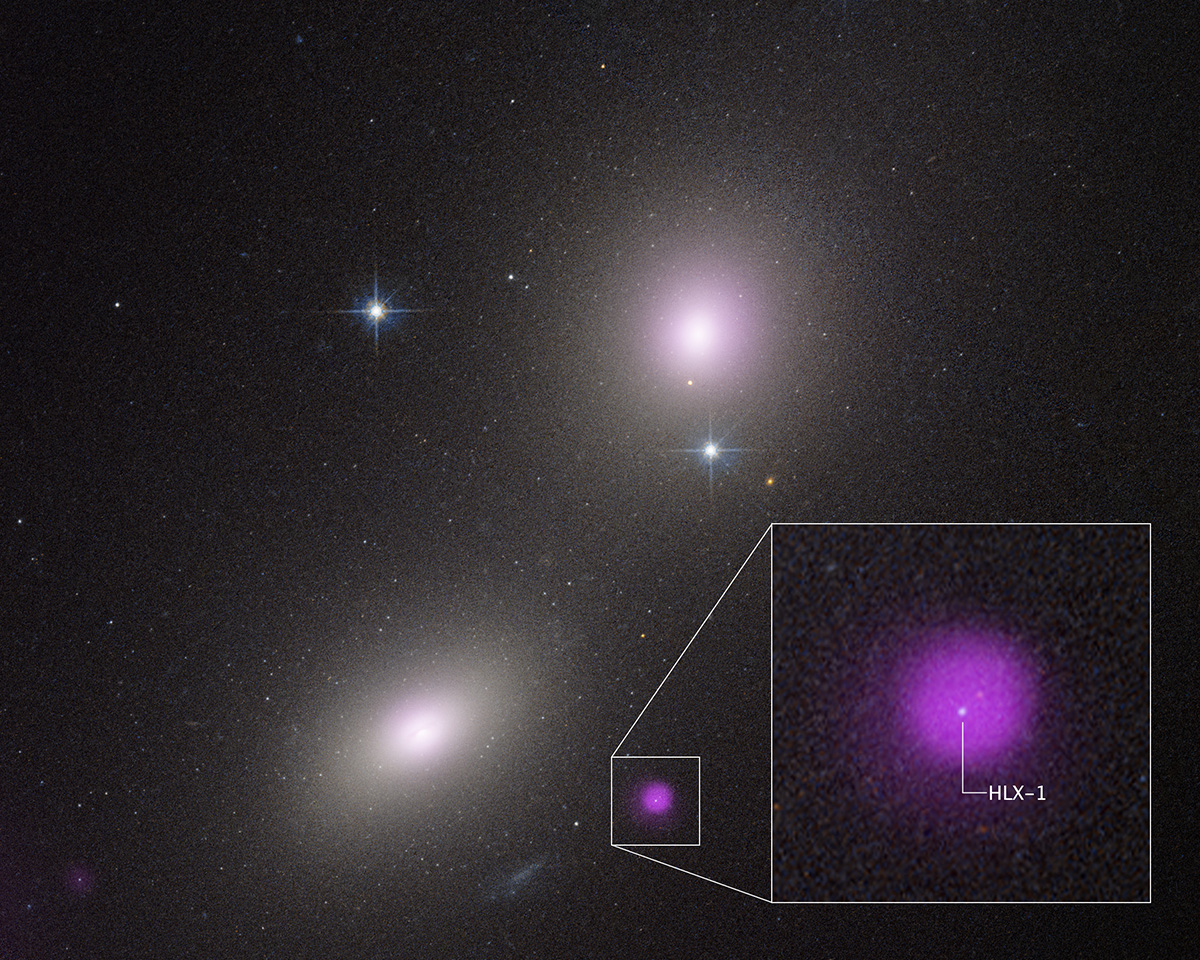
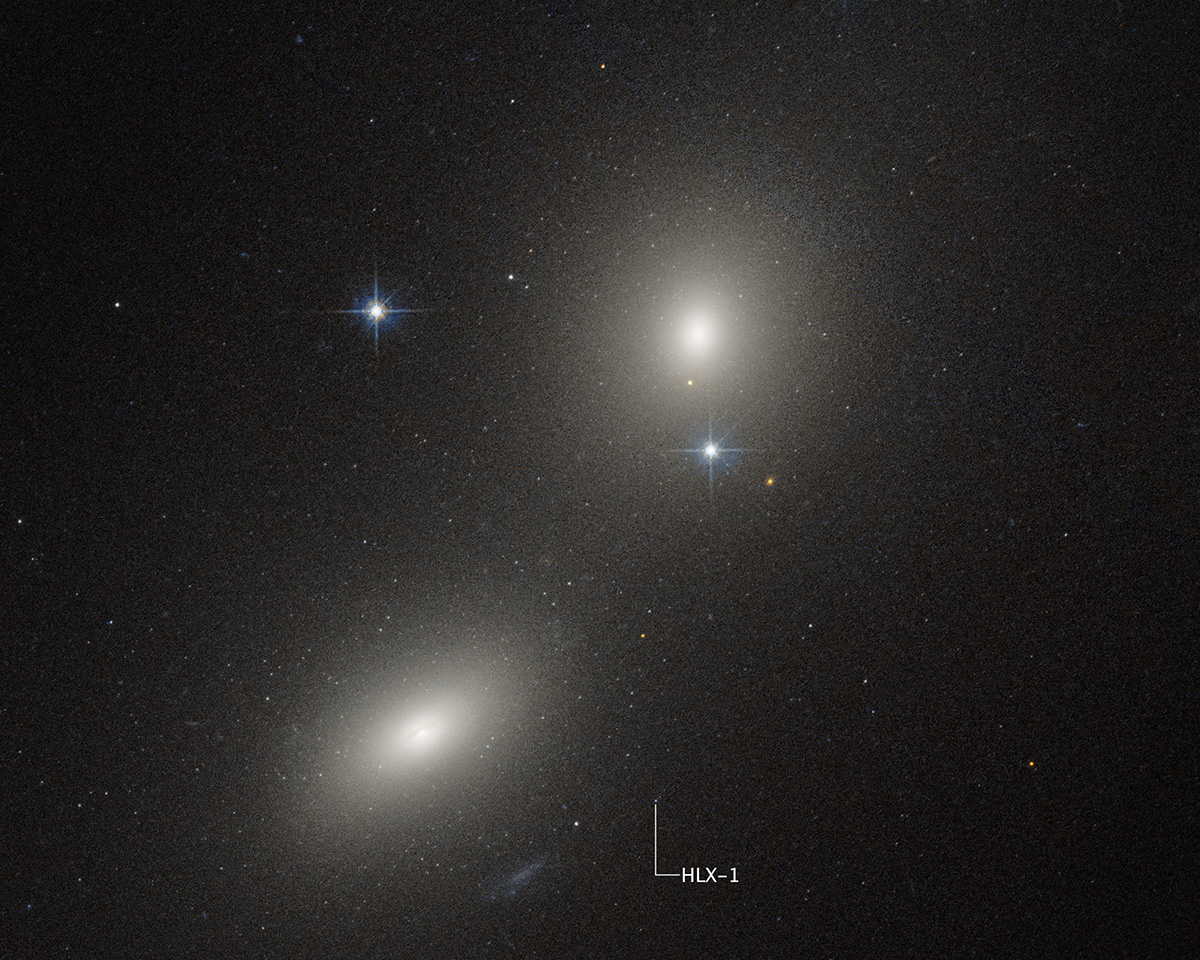
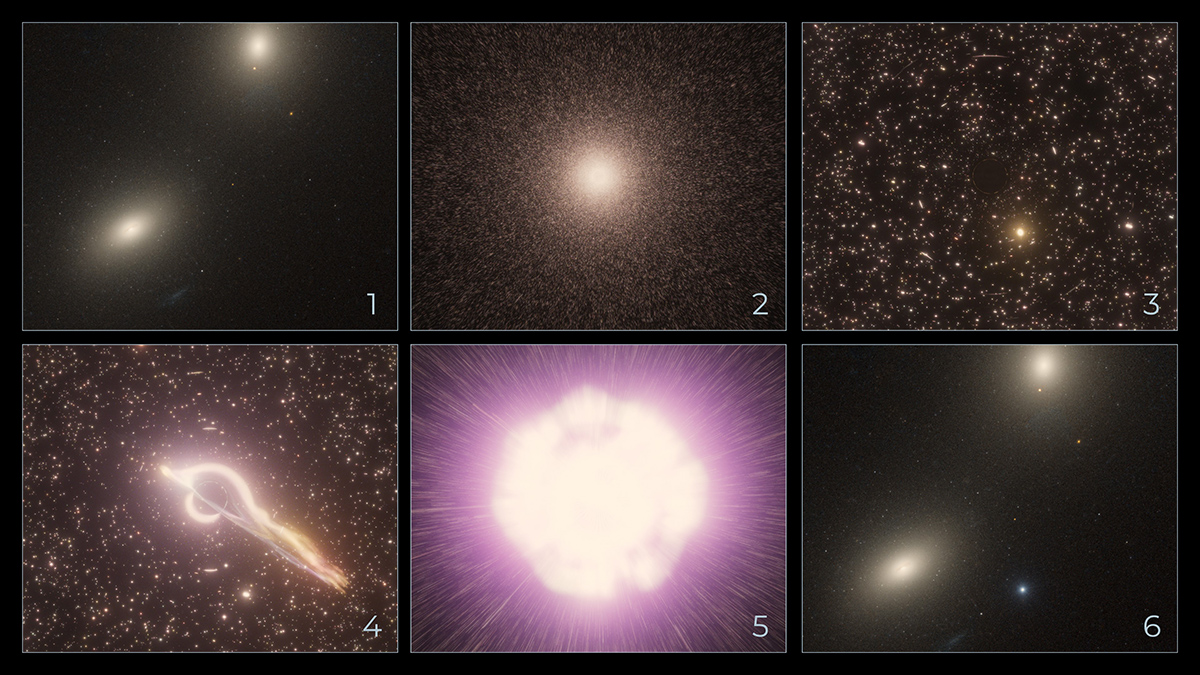
The black hole is named HLX-1, which stands for Hyper-Luminous X-ray source 1. It sits in the outskirts of a galaxy called NGC 6099, located about 450 million light-years away from Earth. Scientists have known about HLX-1 for over a decade. But something incredible happened recently. HLX-1 lit up again. It flared in X-rays, a sign that it was feeding. When a star gets too close to a black hole, gravity rips it apart. This event is called a tidal disruption event, or TDE. The black hole then swallows part of the star. As it does, it heats the surrounding material. This creates a powerful flare of radiation. NASA’s Chandra X-ray Observatory and Hubble Space Telescope worked together to watch this process unfold.
The intermediate-mass black hole
Black holes usually fall into two known types. One is the stellar-mass black hole, which forms when a massive star dies. These are usually a few times heavier than our Sun. The other is the supermassive black hole, found in the centers of galaxies. These can be millions or even billions of times more massive than the Sun. In between these two extremes, scientists have long predicted another type, the intermediate-mass black hole, or IMBH. IMBHs should weigh from hundreds to hundreds of thousands of solar masses. But they are incredibly hard to find. Most IMBHs do not emit strong signals. They are often quiet and hidden. That’s why spotting HLX-1 feeding again is so exciting.
HLX-1: a black hole in an odd place
One more thing makes HLX-1 strange. It is not located in the center of its galaxy. Instead, it lies in a dense star cluster on the galaxy’s edge. This hints at a wild past. Scientists think HLX-1 may have once been the central black hole of a dwarf galaxy. That small galaxy was later swallowed by the bigger galaxy NGC 6099. Its star cluster survived the merger. So did its black hole. Now, HLX-1 drifts in the outskirts of a much larger galaxy. It has become a rare example of a wandering black hole.
Chandra and Hubble join forces
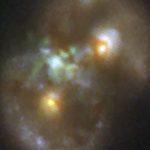
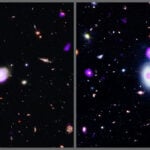
NASA used two powerful tools to study HLX-1. First, Chandra detected the X-ray outburst. This signaled that HLX-1 had started feeding again. The flare confirmed that a tidal disruption event was taking place. Then, Hubble provided detailed optical and ultraviolet images. These helped scientists see the black hole’s location and its surrounding star cluster. Together, the data painted a full picture. Chandra showed the high-energy activity. Hubble revealed the environment where it happened. The combined image showed a burst of purple (X-rays) against the soft glow of the host galaxy.
A star’s final moments
The star that got too close to HLX-1 never stood a chance. Its gravity could not resist the black hole’s pull. HLX-1 stretched the star like spaghetti. This process is called spaghettification. Some of the star’s material was flung away. Some of it formed a hot disk around the black hole. The disk glowed brightly in X-rays. This glow is what Chandra saw. The whole event lasted only a few weeks. But it gave scientists a goldmine of data.
NASA’s Hubble and Chandra telescopes have opened a rare window into the workings of a hidden class of black holes. HLX-1, once part of a small galaxy, now feeds in the shadows of a larger one. In the vast darkness of space, discoveries like this help light the way.
Clear skies!
See more from DIYPhotography.net on Google
Add DIYPhotography.net as a trusted source. This makes
our stories more likely to appear in your Google Search results.
 Add as a preferred source on Google

Soumyadeep Mukherjee
Soumyadeep Mukherjee is an award-winning astrophotographer from India. He has a doctorate degree in Linguistics. His work extends to the sub-genres of nightscape, deep sky, solar, lunar and optical phenomenon photography. He is also a photography educator and has conducted numerous workshops. His works have appeared in over 40 books & magazines including Astronomy, BBC Sky at Night, Sky & Telescope among others, and in various websites including National Geographic, NASA, Forbes. He was the first Indian to win “Astronomy Photographer of the Year” award in a major category.

Join the Discussion
DIYP Comment Policy
Be nice, be on-topic, no personal information or flames.