



















ZWO Launches a New Generation of Electronic Filter Wheels
Dec 12, 2025
Soumyadeep Mukherjee
Soumyadeep Mukherjee is an award-winning astrophotographer from India. He has a doctorate degree in Linguistics. His work extends to the sub-genres of nightscape, deep sky, solar, lunar and optical phenomenon photography. He is also a photography educator and has conducted numerous workshops. His works have appeared in over 40 books & magazines including Astronomy, BBC Sky at Night, Sky & Telescope among others, and in various websites including National Geographic, NASA, Forbes. He was the first Indian to win “Astronomy Photographer of the Year” award in a major category.
Share:
Astrophotography continues to push forward, and accessory makers often shape how far that push can go. ZWO is one of those companies that has steadily influenced the gear landscape, especially for amateur and semi-professional imagers using CMOS cameras. Their ASI cameras became widely adopted over the last decade, and the ecosystem around them now feels almost essential. The company’s Electronic Filter Wheel (EFW) series is a big part of that ecosystem. It has grown slowly but consistently, and the 2025 update introduces a comprehensive and well-structured set of models that cover almost every imaging need.
The new EFW series keeps its familiar approach: solid construction, simple control over USB, and seamless compatibility with ZWO’s cameras and ASIAIR systems. But the latest expansion includes a broader range of filter sizes, including a dedicated seven-slot wheel for 50 mm square filters. This is the kind of model that speaks to the changing demands of today’s imagers, especially as cameras with larger sensors continue to appear in the amateur segment.
Electronic filter wheel
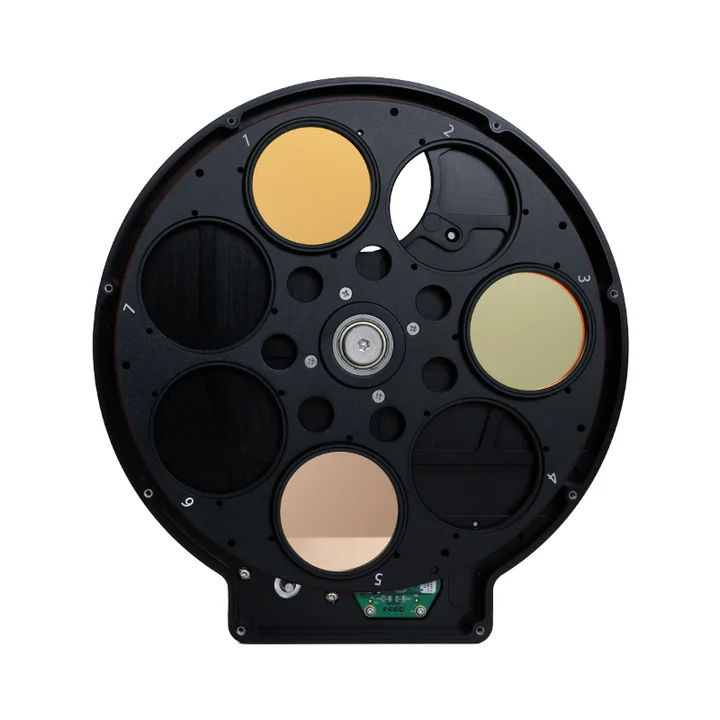
Before diving into the specific models, it helps to understand why electronic filter wheels are so useful. When you photograph deep-sky objects like galaxies or nebulae, you often use multiple filters for different wavelengths of light. These filters isolate specific colors or narrow wavelength bands such as Hydrogen-alpha (Ha), Oxygen-III (OIII), or Sulfur-II (SII). You may want to capture broadband images with red, green, and blue filters (RGB), or you may want to capture narrowband data to highlight specific emission features.
Manually swapping filters between exposures is slow and risks introducing dust or disturbance into your optical path. Electronic filter wheels solve this problem by housing multiple filters in a rotating wheel that can be controlled by software. With a single USB connection powered from the camera or a hub, these wheels automatically align the correct filter ahead of each exposure. This level of automation transforms long imaging sessions into efficient, hands-free operations. It also ensures consistent positioning and reduces the risk of human error.
ZWO’s EFW series is designed for compatibility with popular astrophotography software like ASIAIR, ASIStudio, and ASCOM, making it easy to integrate into your existing workflow.

Overview of ZWO EFW models: Six configurations
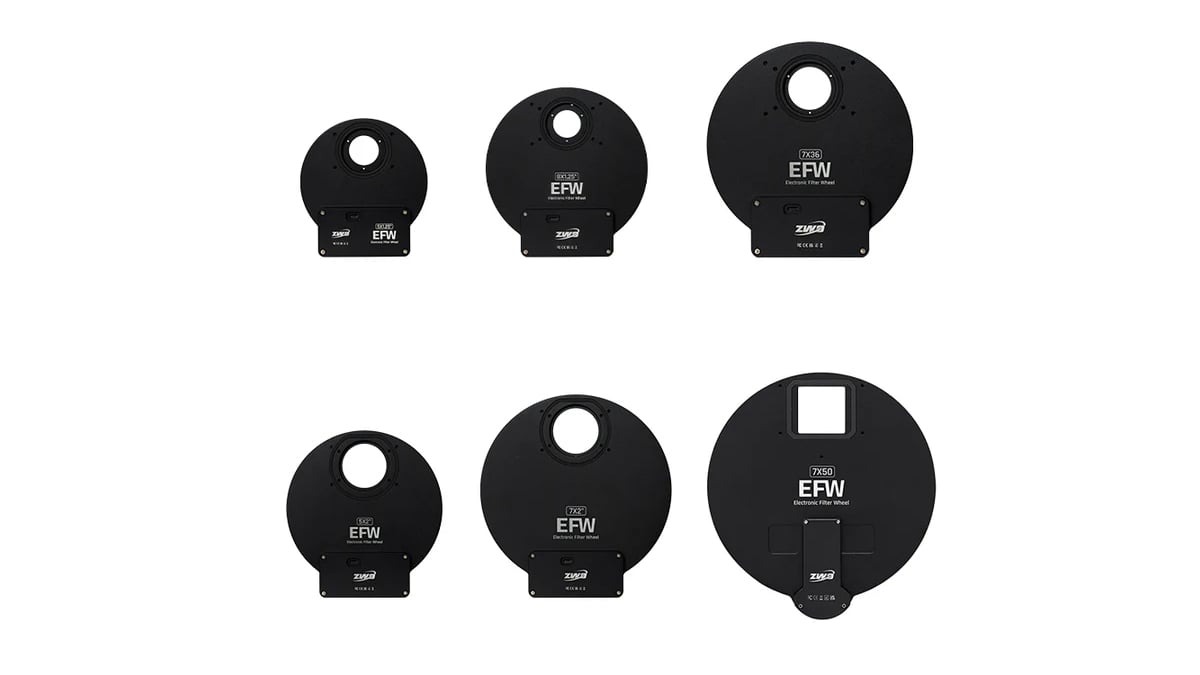
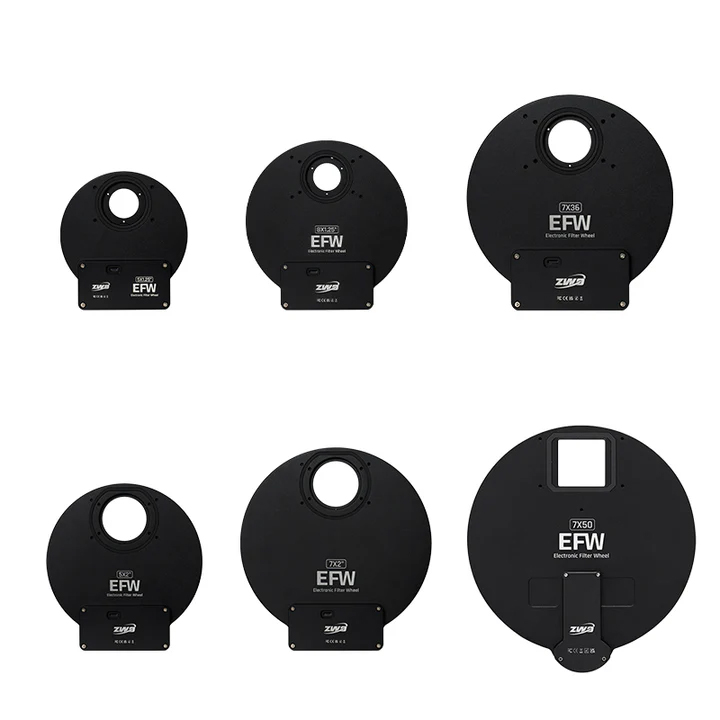
ZWO currently offers six practical EFW configurations that differ by filter size compatibility and number of slots. These configurations cover everything from traditional threaded filters to unmounted square filters. The six models are:
- EFW 5×1.25″
- EFW 8×1.25″
- EFW 7×36 mm
- EFW 5×2″
- EFW 7×2″
- EFW 7×50 mm Square
All models share a modern design with a USB-powered stepper motor and precise indexing that lets the wheel rotate in either direction under software control. They all draw power from a single USB connection, with no external power supply needed, and are compatible with major imaging platforms.
EFW 5×1.25″: Compact Power
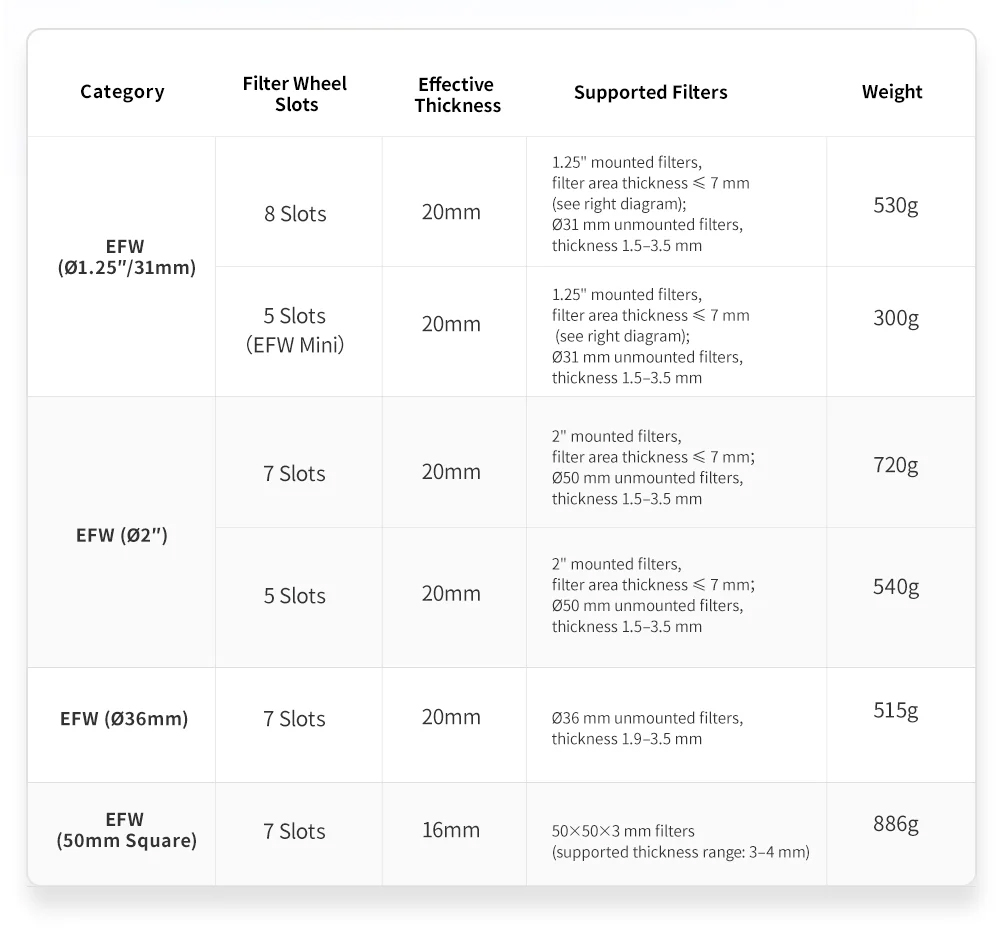
The 5×1.25″ EFW Mini is ZWO’s lightest and most compact filter wheel. It holds five 1.25″ threaded filters or 31 mm unmounted filters. This model is perfect for smaller cameras or entry-level setups where space and weight matter. It’s easy to mount and operates smoothly with a single USB cable, and because it uses the same high-precision stepper components as the rest of the lineup, it doesn’t compromise on reliability.
Despite its small size, this wheel brings significant capability to your rig. It’s ideal for a basic broadband set (e.g., LRGB) with perhaps one or two narrowband filters added. Its simplicity makes it a good choice for beginners or those with smaller sensor cameras.
EFW 8×1.25″: Maximum capacity for small filters
For users who want more filter options without stepping up to larger sizes, the 8×1.25″ EFW is a clear step up. Offering eight slots for 1.25″ mounted or 31 mm unmounted filters, it accommodates all the standard broadband filters and room for specialty filters like additional narrowband or custom bands.
This configuration is especially valuable for astrophotographers who want to experiment with different wavelengths in a single imaging session or capture more advanced imaging sequences without swapping filters manually. Its 20 mm thickness and lightweight CNC-milled aluminum body keep it compact in your imaging train.
EFW 7×36 mm: Versatile mid-size solution
Between the traditional 1.25″ and the larger 2″ filter wheel sizes sits the 7×36 mm EFW, a highly versatile option. The 36 mm diameter filters fit many modern APS-C and smaller full-frame setups without the cost of large 2″ filters. Because they are unmounted, they reduce unnecessary glass and metal in the optical path.
ZWO specifically developed this wheel with broader compatibility in mind. It includes mounting adjustments that bring the filters closer to the camera sensor and allow easier attachment to various ASI cameras. This makes the 36 mm wheel a strong option for imaging runs that include both broadband and narrowband filter sets.
EFW 5×2″: Entry level for large filters
Stepping up to 2″ filters fundamentally changes what you can do with larger sensors. These filters cover more of the imaging circle without vignetting on APS-C or full-frame cameras. The 5×2″ EFW houses five of these larger, threaded 2″ filters or 50.4 mm unmounted filters.
Controlling this wheel requires no more than a USB connection, and like other models, it rotates smoothly and precisely. This option is suitable for imaging systems that prioritize large broadband and narrowband filter sets but don’t yet need a large number of slots.
EFW 7×2″: More capacity for bigger filters
If you want even more flexibility with large filters, the 7×2″ EFW adds two extra filter slots over the 5-slot version. That allows for a full LRGB set plus multiple specialty filters in the same session.
Both 2″ configurations are thin and robust, designed with a CNC-machined body and the same reliable stepper motor system as the rest of the lineup. Switching between seven different wide and narrowband filters becomes a seamless part of your session, controlled by software without ever touching the wheel.
EFW 7×50 mm square: For full-frame and medium-format imaging
The largest model in the family is the 7×50 mm square EFW, which houses seven square filters sized 50 × 50 mm (thickness supported from 3 to 4 mm). This wheel is engineered for cameras with large sensors, including full-frame and medium-format systems, where round filters are either too small or risk vignetting.
This wheel is heavier and more substantial, weighing around 1 kg, but it maintains the same precision and compatibility as the smaller wheels. The square format also better covers the imaging circle for large sensors, giving you edge-to-edge data with minimal loss.
Shared features of ZWO EFWs
Across all six models, ZWO has applied a consistent philosophy. Each EFW is:
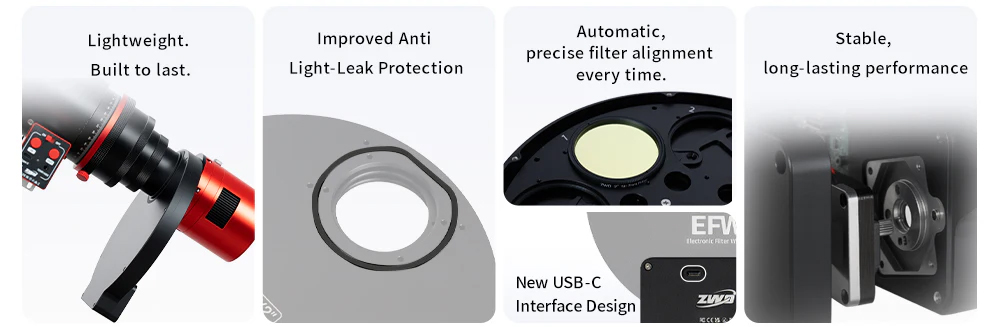
- Powered and controlled by USB: No external power supply is needed. A single USB plug provides both power and control signals to the wheel.
- Driven by high-precision steppers: All wheels use stepper motors from NPM (Nippon Pulse Motors) for reliable and accurate positioning.
- Thin and lightweight: With body thickness optimized (around 20 mm for most models), they minimize impact on your imaging train while preserving mechanical strength.
- Software-friendly: Native support for ASIAIR, ASIStudio, ASCOM, and a software developer kit (SDK) lets you integrate them into automated capture sequences.
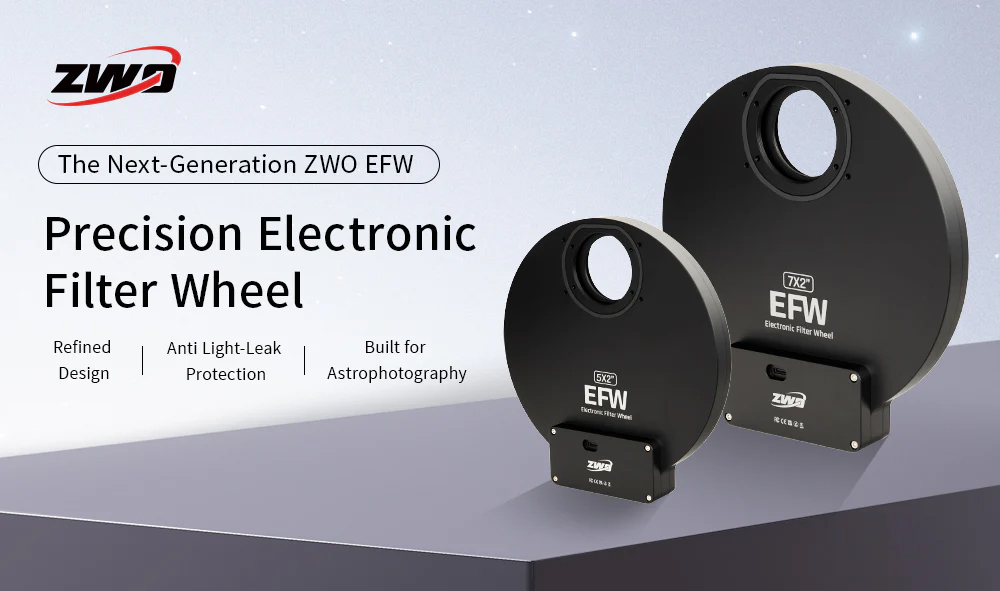
- Sealed to reduce light leak: Newer designs include refined sealing structures and dual light-blocking protection to keep stray light out of your exposures.
Price and availability
The complete line-up of ZWO EFWs is available for pre-ordering via ZWO’s official website. Here are the prices:
- EFW 5×1.25″: $199
- EFW 8×1.25″: $299
- EFW 7×36 mm: $299
- EFW 5×2″: $299
- EFW 7×2″: $399
- EFW 7×50 mm Square: $599 (available for ordering)
ZWO’s EFW series brings automation, precision, and flexibility to astrophotography filter handling. From the compact 1.25″ mini wheel, ideal for beginners or space-constrained rigs, to the expansive 50 mm square wheel built for cutting-edge large-sensor cameras, there is a model tailored to your needs. Each version combines a rugged CNC-milled body, modern USB-powered operation, and wide compatibility with astrophotography software.
Choosing the right wheel depends on your camera sensor size, the filters you already own or plan to acquire, and how many filters you want ready to use in a single session. Whether you are just starting with monochrome imaging or you are building a powerful deep-sky imaging station, ZWO’s EFW series offers tools that scale with your ambitions.
Clear skies!
See more from DIYPhotography.net on Google
Add DIYPhotography.net as a trusted source. This makes
our stories more likely to appear in your Google Search results.
 Add as a preferred source on Google

Soumyadeep Mukherjee
Soumyadeep Mukherjee is an award-winning astrophotographer from India. He has a doctorate degree in Linguistics. His work extends to the sub-genres of nightscape, deep sky, solar, lunar and optical phenomenon photography. He is also a photography educator and has conducted numerous workshops. His works have appeared in over 40 books & magazines including Astronomy, BBC Sky at Night, Sky & Telescope among others, and in various websites including National Geographic, NASA, Forbes. He was the first Indian to win “Astronomy Photographer of the Year” award in a major category.



Join the Discussion
DIYP Comment Policy
Be nice, be on-topic, no personal information or flames.