





















JWST Uncovers MoM-z14: The Most Distant Galaxy Ever Detected
Jan 29, 2026
Soumyadeep Mukherjee
Soumyadeep Mukherjee is an award-winning astrophotographer from India. He has a doctorate degree in Linguistics. His work extends to the sub-genres of nightscape, deep sky, solar, lunar and optical phenomenon photography. He is also a photography educator and has conducted numerous workshops. His works have appeared in over 40 books & magazines including Astronomy, BBC Sky at Night, Sky & Telescope among others, and in various websites including National Geographic, NASA, Forbes. He was the first Indian to win “Astronomy Photographer of the Year” award in a major category.
Share:
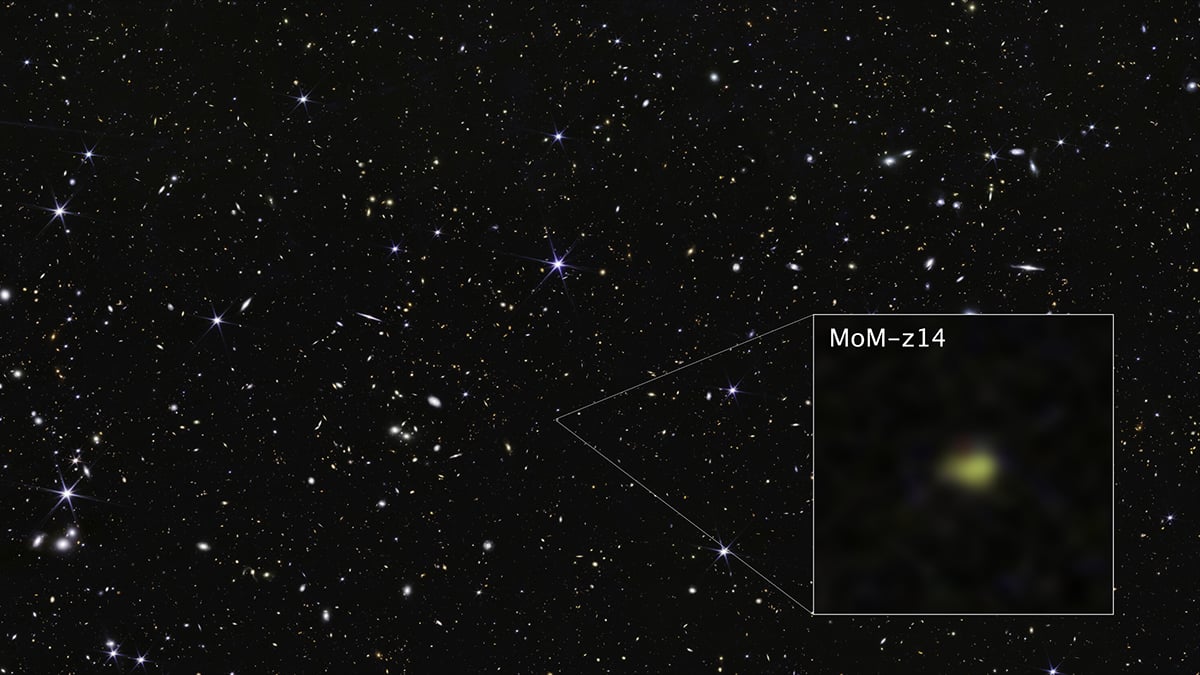
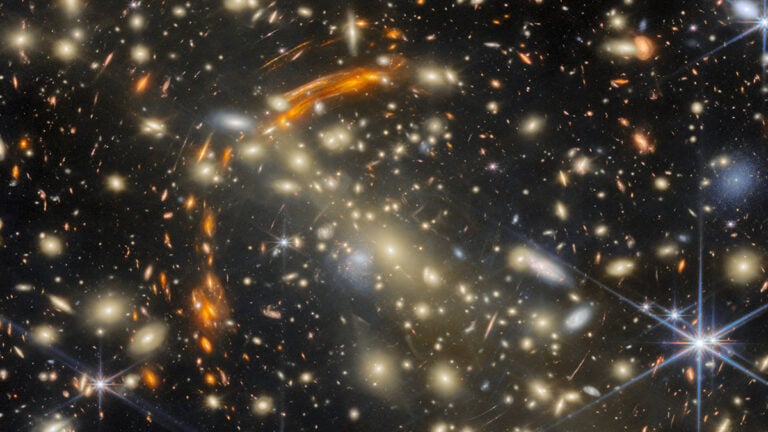
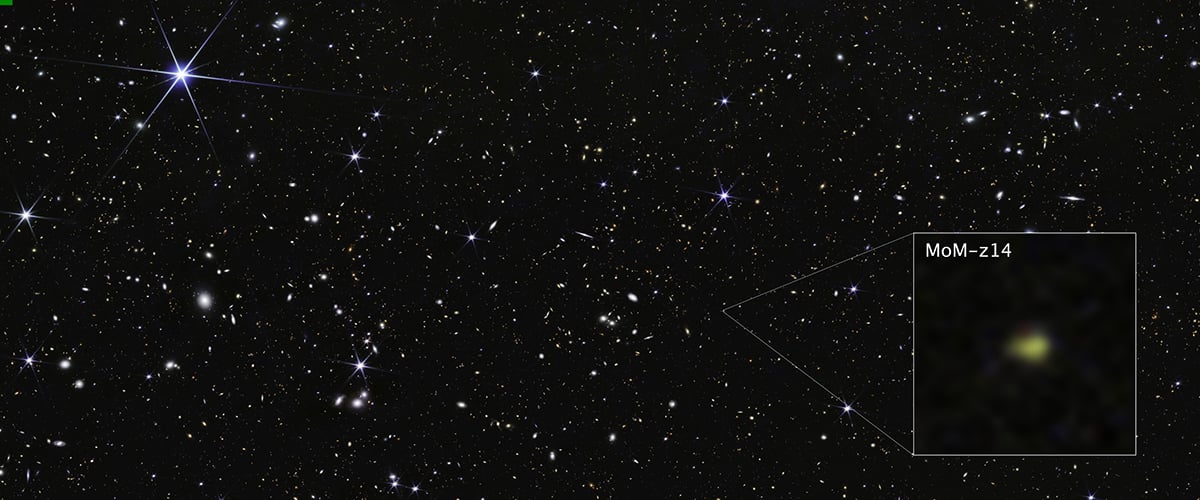
The James Webb Space Telescope continues to redefine the observational frontier of modern astronomy. Using its near-infrared instruments, JWST now probes epochs that lie only a few hundred million years after the Big Bang. On 28 January 2026, ESA, NASA, and CSA released a new deep-field image of the COSMOS region. Within this dense field of galaxies, astronomers confirmed an extraordinary object. The galaxy, named MoM-z14, appears at a spectroscopic redshift of z = 14.44. This places it just 280 million years after the Big Bang.
This confirmation pushes direct galaxy observations deeper into the cosmic dawn than ever before. Even more striking, MoM-z14 shows unexpected brightness and chemical maturity for such an early epoch. Together with the wider COSMOS field image, this discovery reshapes current models of early galaxy formation. What follows is a closer look at the image, the galaxy, and the science that makes this result so important.
A new JWST deep field in the COSMOS region
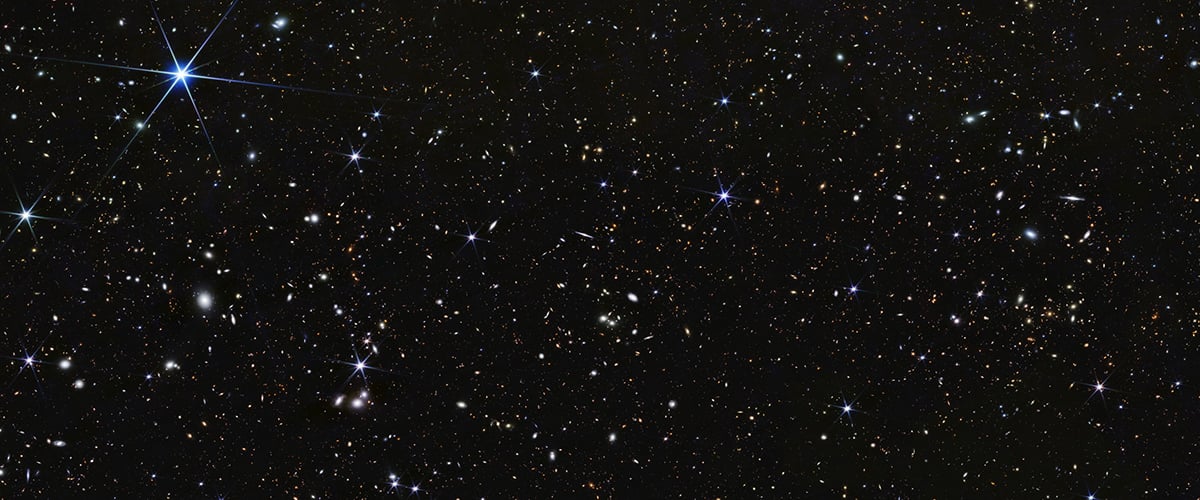
The newly released image targets the well-known COSMOS field, a region chosen for its extensive legacy data from previous space and ground observatories. Astronomers designed COSMOS as a laboratory for studying galaxy evolution across cosmic time. JWST adds unprecedented infrared depth to this dataset.
The field spans roughly 16.36 by 6.82 arcminutes. That is comparable to a large fraction of the Moon’s apparent width. Yet within this narrow slice of sky, JWST reveals hundreds of galaxies. Each faint point represents an entire system of stars, gas, and dust.
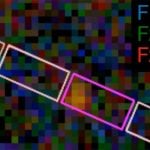
JWST captured this scene using its Near-Infrared Camera, or NIRCam. The telescope observed the field through multiple infrared filters. Scientists then combined these exposures into a colour composite. These colours do not represent natural vision. Instead, they encode wavelength information that traces stellar populations and dust. As a result, nearby galaxies appear structured and extended. Distant systems look compact and red. The reddest sources often indicate extreme distances. This colour signature guided astronomers toward MoM-z14. Importantly, this image serves as a discovery map. Researchers used it to identify candidate galaxies from the universe’s earliest phases. They then followed up with spectroscopy to confirm distances.
MoM-z14: A galaxy from only 280 million years after the Big Bang
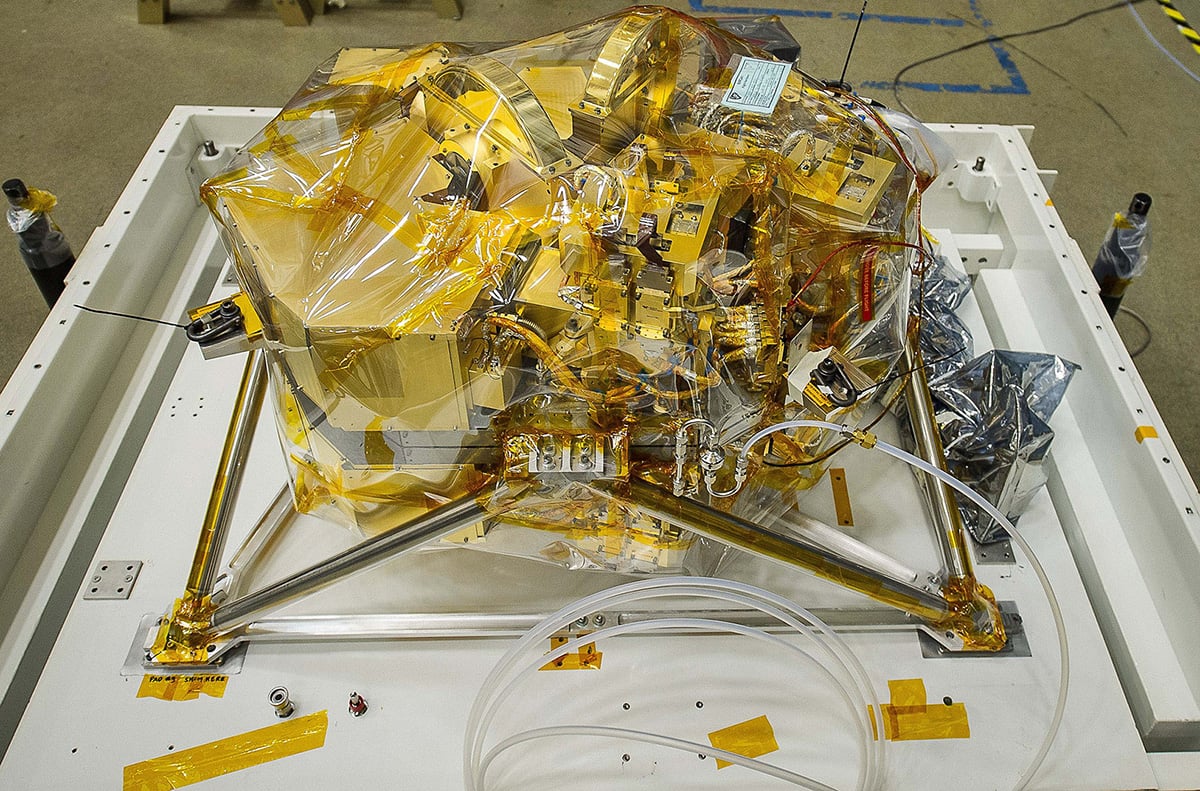
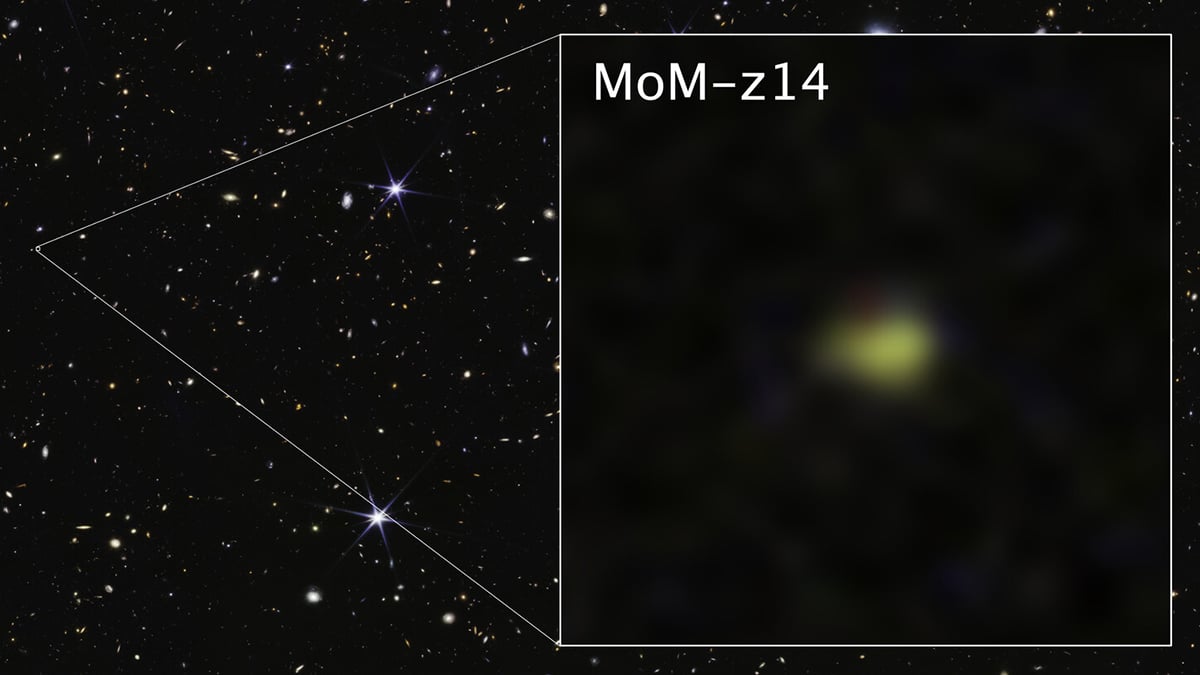
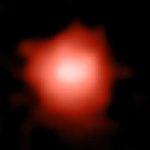
MoM-z14 stands as the most distant galaxy ever confirmed through spectroscopy. JWST measured its distance using the Near-Infrared Spectrograph, or NIRSpec. Spectroscopy breaks incoming light into its component wavelengths. This reveals distinct features that allow precise redshift measurements. For MoM-z14, NIRSpec detected a sharp spectral break consistent with hydrogen absorption in the early universe. From this signal, astronomers derived a redshift of 14.44.
At this redshift, we see the galaxy as it existed just 280 million years after the Big Bang. Its light has traveled for over 13 billion years before reaching JWST’s mirrors. Until now, most confirmed galaxies came from later times, typically beyond 300 or 400 million years. MoM-z14 pushes this boundary further back.
Even more surprisingly, the galaxy appears brighter and more compact than theoretical models predicted for such early epochs. Early galaxies were expected to be small, faint, and chemically rudimentary. MoM-z14 challenges that picture. Spectral data indicate signs of chemical enrichment. That means elements heavier than hydrogen and helium already existed in this system. Such elements form inside stars. Therefore, earlier stellar generations must have formed, evolved, and died rapidly. This implies accelerated galaxy growth during the universe’s infancy.
How JWST makes these discoveries possible
JWST was designed specifically to explore the early universe. Its strength lies in infrared sensitivity. As the universe expands, light from distant galaxies stretches to longer wavelengths. Radiation that began in ultraviolet or visible light arrives at Earth as infrared. Traditional optical telescopes miss much of this signal.
NIRCam detects faint infrared sources across wide fields. Astronomers use these images to locate candidate high-redshift galaxies based on colour behaviour. Objects that vanish in short wavelengths but appear in longer ones often indicate extreme distances. NIRSpec collects spectra from multiple objects at once. It measures redshifts with high precision. This step is critical. Imaging alone cannot confirm distance. Only spectroscopy provides definitive proof.
JWST also benefits from its large segmented mirror. With over six meters of collecting area, it gathers faint light efficiently. Its location at the Sun–Earth L2 point provides a stable thermal environment. This stability enables long exposures with minimal background noise. MoM-z14 represents a direct result of this capability.
Why MoM-z14 changes our view of early galaxy formation
The existence of MoM-z14 so early in cosmic history forces astronomers to revisit key assumptions. Current models predicted gradual galaxy assembly. Small structures should merge slowly. Star formation should ramp up over time. Heavy elements should appear later. MoM-z14 contradicts several of these expectations.
First, its brightness suggests intense star formation. Second, its compact structure implies efficient mass assembly. Third, its chemical enrichment indicates rapid stellar processing. This discovery also informs studies of cosmic reionization. During this period, radiation from early stars and galaxies ionized hydrogen across intergalactic space. This process transformed the universe from opaque to transparent.
Moreover, MoM-z14 provides a benchmark for simulations. Theoretical frameworks must now reproduce galaxies with similar properties at comparable times. This will refine our understanding of dark matter collapse, gas cooling, and star formation physics.
The universe today is about 13.8 billion years old. MoM-z14 appears less than 300 million years after its birth. At that stage, large-scale cosmic structures were only beginning to emerge. Filaments of dark matter guided gas into dense regions. Within these regions, the first galaxies ignited. MoM-z14 sits firmly within this formative era. Its properties suggest that multiple stellar generations already existed. Massive stars likely formed first. They lived short lives. They then exploded as supernovae. These explosions seeded the surrounding gas with heavier elements. Subsequent stars formed from this enriched material. This rapid cycle challenges earlier assumptions about slow chemical evolution.
The COSMOS field image places MoM-z14 among hundreds of other galaxies spanning a wide range of distances. Some appear relatively nearby. Others lie billions of light-years away. Together, they form a layered record of cosmic history. As JWST surveys more fields, this dataset will expand, patterns will emerge, and trends will sharpen. The early universe will become clearer.
Clear skies!
See more from DIYPhotography.net on Google
Add DIYPhotography.net as a trusted source. This makes
our stories more likely to appear in your Google Search results.
 Add as a preferred source on Google

Soumyadeep Mukherjee
Soumyadeep Mukherjee is an award-winning astrophotographer from India. He has a doctorate degree in Linguistics. His work extends to the sub-genres of nightscape, deep sky, solar, lunar and optical phenomenon photography. He is also a photography educator and has conducted numerous workshops. His works have appeared in over 40 books & magazines including Astronomy, BBC Sky at Night, Sky & Telescope among others, and in various websites including National Geographic, NASA, Forbes. He was the first Indian to win “Astronomy Photographer of the Year” award in a major category.
Join the Discussion
DIYP Comment Policy
Be nice, be on-topic, no personal information or flames.